




Abstract

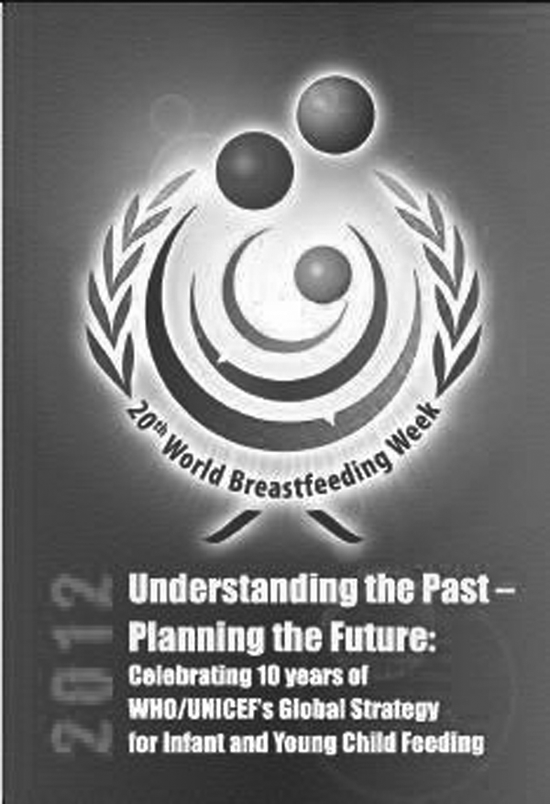
WBW 2012 image courtesy of WABA
The Innocenti Declaration also called upon international NGOs to draw up action strategies for protecting, promoting, and supporting breastfeeding, support national situation analyses and development of goals, and en courage and support national authorities in planning, implementing, monitoring, and evaluating their breastfeeding policies. Mr. James Grant, then Director of UNICEF, called upon the NGO community to organize in this regard, and the World Alliance for Breastfeeding Action (WABA) was born. 3 One of WABA's first ground-breaking acts was to establish an annual World Breastfeeding Week: a time for action, a time for advocacy, a time for advancing support for breastfeeding. Each year, a different theme is chosen.
This ongoing support, the increasing implementation of all four operational targets, the steady flow of evidence showing the vital importance of breastfeeding, and the fact that breastfeeding rates were shown to be responsive to programs of action, all contributed to a call for The Global Strategy for Infant and Young Child Feeding, which was endorsed by WHO and UNICEF in 2002 and published in 2003. 4 The Global Strategy added five more targets to those specifically included in the Innocenti Declaration: (5) develop, implement, monitor, and evaluate a comprehensive policy on infant and young child feeding, in the context of national policies and programs for nutrition, child and reproductive health, and poverty reduction; (6) ensure that the health and other relevant sectors protect, promote, and support exclusive breastfeeding for 6 months and continued breastfeeding up to 2 years of age or beyond, while providing women access to the support they require—in the family, community and workplace—to achieve this goal; (7) promote timely, adequate, safe, and appropriate complementary feeding with continued breastfeeding; (8) provide guidance on feeding infants and young children in exceptionally difficult circumstances and on the related support required by mothers, families, and other caregivers; and (9) consider what new legislation or other suitable measures may be required, as part of a comprehensive policy on infant and young child feeding, to give effect to the principles and aim of the International Code of Marketing of Breast-milk substitutes and to subsequent relevant Health Assembly resolutions. 5
This year, World Breastfeeding Week, or World Breastfeeding Month in several countries, is celebrated in August, as originally developed, or in October, a common alternative. As noted on the World Breastfeeding Week website: “20 years ago, the World Alliance for Breastfeeding Action (WABA) launched its first World Breastfeeding Week (WBW) campaign with the theme: Baby-Friendly Hospital Initiative (BFHI).” The BFHI was developed by UNICEF and WHO to support and recognize implementation of the Ten Steps called for in the Innocenti Declaration.
What will we celebrate this year? This year the theme is “Understanding the Past: Planning the Future—Celebrating 10 Years of WHO/UNICEF's Global Strategy for Infant and Young Child Feeding,” 1 and we take action to support all of its operational targets. The World Breastfeeding Week objectives ask us to recall what has happened in efforts to support infant and young child feeding over these past 20 years, celebrate successes and achievements, assess the status of implementation of the Global Strategy, call for action to bridge the remaining gaps in policy and programs, and draw public attention on the state of policy and programs.
This issue of Breastfeeding Medicine supports this year's theme and that of 20 years ago by including an article that celebrates the work of the WHO, UNICEF, and all those hard-working national BFHI teams and breastfeeding supporters out there. It discusses the progress and possible impact of BFHI over the 20 years since the first World Breastfeeding Week. Some of these data have not been published previously as they were collected for monitoring purposes, rather than as definitive research data. We hope that you will read the article with this in mind. This article also includes available data on rates of exclusive breastfeeding among infants in the first half of infancy.
The Academy of Breastfeeding Medicine (ABM) is a Core Member of WABA, serving as its physician action arm, and fully supports World Breastfeeding Week. As a founder, past president, and current board member of ABM and as a member of the board of WABA, I am indeed honored to contribute to this issue. In recognition of World Breastfeeding Week, we encourage all who read this journal to build on the understanding and the momentum of what has come before and to plan new and innovative ways to support every mother and family to decide to and fully succeed in optimally breastfeeding their children, for a brighter, healthier future.
Wishing you all a happy—and productive—World Breastfeeding Week!