




Abstract
Abstract
Background:
The deleterious effect of formula company–sponsored discharge bags on breastfeeding is well established. As of July 2012, all 49 maternity facilities in Massachusetts had banned these bags, making it the second “bag-free” state in the United States. Obstacles to changing this long-standing practice were numerous, including concerns regarding the cost of a substitute gift. This study was designed to describe what practices maternity facilities in Massachusetts have adopted in place of giving out a formula company–sponsored discharge bag.
Materials and Methods:
Maternity facilities in Massachusetts were surveyed regarding discharge gift practices. Information was collected regarding gifts given and cost.
Results:
The response rate was 100%. Fifty-nine percent of the facilities replaced the formula company–sponsored bag with their own gift bag carrying the hospital's logo. Bags were either given empty or contained educational materials and/or a gift such as a T-shirt, hat, or baby book. Fourteen percent of the facilities gave a gift that did not include a bag. Twenty-seven percent of facilities gave no gift. Cost of the gifts ranged from $1 to $35, with a mean cost of $10.67. The hospital budget was used to partially or fully fund 58% of gifts; 22% were covered in part by donations.
Conclusions:
Although most maternity facilities surveyed replaced the formula company–sponsored discharge bag with a different gift, one-quarter gave no replacement. These data indicate that discontinuing discharge gifts can be a readily accepted, cost-neutral step toward evidence-based breastfeeding best practice.
Introduction
O
Numerous studies have shown that the practice of distributing formula company–sponsored bags containing free formula samples correlates with decreased rates of exclusive breastfeeding and reduced overall duration of breastfeeding.2–11 Exclusive breastfeeding for 6 months is recommended by the American Academy of Pediatrics, 12 American College of Obstetricians and Gynecologists, 13 and American Academy of Family Physicians. 14
The strong evidence supporting the deleterious effects of formula company–sponsored discharge bags dovetails with the recommendations in the World Health Organization's International Code of Marketing of Breast-milk Substitutes. Article 6 addresses the problematic role of healthcare systems in promoting formula use and specifically prohibits healthcare facilities from distributing free formula or advertising formula products. 15 Adopted in 1981 by the World Health Assembly and fully or partially implemented by 84 countries worldwide, 16 the Code outlines best practices for marketing of formula and associated products.
Although the United States has not taken legislative action to implement the Code, in 2011 the U.S. Surgeon General issued a call to action to support breastfeeding that emphasized the intent of the Code, stating that “clinicians should not implicitly promote infant formula by providing venues for its advertisement.” 17
Given the ample data demonstrating a strong correlation between formula company–sponsored discharge bags and decreased rates of exclusive breastfeeding, changing the current distribution practice presents a ready target for improvement. Recent studies have documented progress, with an increasing number of maternity facilities choosing to halt distribution.18–21 In one recent survey of 1,239 hospitals in 20 states, the proportion that eliminated formula company–sponsored bags doubled from 14% in 2007 to 28% in 2010. 18
Despite the growing momentum for discontinuing the distribution of formula company–sponsored discharge bags as best practice in maternity care, implementing this change can be challenging. Hospital leadership must determine if families should receive a different gift and, if so, how to pay for it. Many maternity facilities expressed concern that patients would be dissatisfied if a discharge gift were not given; additional concerns have been raised regarding how to fund hospital-sponsored discharge bags in the absence of the free bags provided by formula companies. The objective of this study was to describe the specific practices that maternity facilities in Massachusetts have adopted in place of providing formula company–sponsored discharge bags.
Materials and Methods
Maternity facilities in Massachusetts were surveyed regarding discharge gift practices over a 9-month period from April 2012 to December 2012. Four questions were asked: (1) Is your facility giving out a gift at discharge? (2) If yes, what is it (in detail)? (3) How much does it cost? (4) Who pays for it? The majority of the data were obtained through in-person interviews at the statewide MotherBaby Summit in April 2012. Representatives were asked to bring their currently distributed discharge gift, if any. Interviews were conducted with the gift bag or item physically present in approximately 75% of cases, allowing respondents to explain in detail. When an in-person interview was not possible or clarification was needed, interviews were conducted by one research assistant via e-mail or telephone.
Results
The response rate was 100% (49/49). Maternity facility staff—most often nurse managers or lactation consultants—provided responses. As of 2012, 59% (29/49) of facilities had replaced the formula company–sponsored discharge bag with their own gift bag carrying the hospital's logo. Bags were either given empty or containing educational materials and/or a gift such as a T-shirt, hat, or baby book (Table 1). Fourteen percent (7/49) of facilities gave a gift that did not include a bag, whereas 27% (13/49) of facilities gave no gift (Fig. 1). The cost of the gifts ranged from $1 to $35, with a mean cost of $10.67. Funds from the hospital budget either partially or fully funded 58% of gifts; 22% were covered in part by donations.
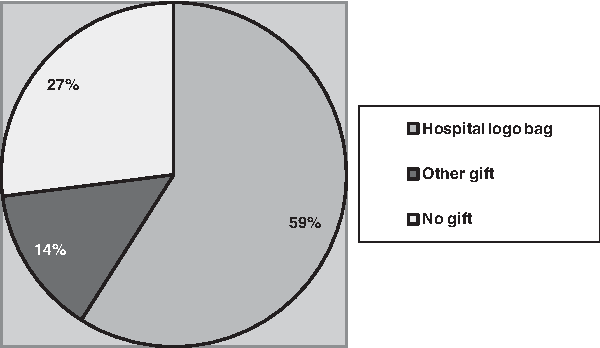
Massachusetts maternity facility discharge practices.
Discussion
Ending the distribution of formula company–sponsored discharge bags in Massachusetts represents a significant change from prior practice. Based on the data collected by Sadacharan et al. 18 in 2007, only 27% of Massachusetts maternity facilities (14/51) had banned the bags. (The number of maternity facilities in the state decreased from 51 to 49 between 2007 and 2012.) The same study documented a substantial increase to 64% (32/50) in 2010, just 2 years prior to adoption of this standard across the state. 18
This voluntary change took place on an institution-by-institution basis and was likely the result of a confluence of factors. The long-accepted practice of distributing formula company–sponsored free samples and other promotional items in the hospital creates an inherent conflict of interest for physicians. The Institute of Medicine brought new attention to this issue in its seminal 2009 report, Conflict of Interest in Medical Education, Research, and Practice. 22 This publication highlighted the deeply problematic nature of promoting industry-sponsored products in medical settings. The U.S. formula market, with spending estimated in 2008 of $4.97 billion annually, would be profoundly impacted. 23
In the context of its dual implications for public health and the public interest, a hospital's proactive decision not to distribute formula company–sponsored discharge bags has become increasingly associated with maternity best practice. The nonprofit organization Public Citizen reported that in 2013, two-thirds of the hospitals ranked in the top tier for gynecologic services by U.S. News and World Report do not distribute formula company–sponsored discharge bags or other promotional materials to postpartum mothers. 23
The Joint Commission in 2010 provided an additional impetus for addressing this issue. Recognizing that improvement in U.S. breastfeeding rates must begin with promotion of exclusive breastfeeding during the postpartum hospitalization, the Joint Commission issued new standards that established the rate of exclusive breastmilk feeding at hospital discharge as a Perinatal Care Core measure. Currently optional, this measure will be a required metric for all large maternity facilities (those with greater than 1,100 deliveries annually) as of January 1, 2014, establishing a new level of accountability for implementation of breastfeeding best practices. 24
At the same time, the process by which maternity facilities in Massachusetts adopted a uniform standard of practice for discharge gifts illustrates the power of advocacy. Ban the Bags, a not-for-profit organization, was founded in 2006 with the goal of ending the distribution of formula company–sponsored discharge bags nationally. Their Web site tracks maternity facilities that have opted to discontinue these bags, with facilities having the ability to self-report when this goal is achieved.
Accountability at the state level drove the rapid progress of Massachusetts maternity facilities toward the goal of ending distribution of formula company–sponsored discharge bags. In Massachusetts, an annual statewide meeting of maternity facility leadership, the MotherBaby Summit, began in 2009. Each Summit provides an opportunity to publicly highlight new successes in achieving maternity care best practices. Additionally, the MotherBaby Summit Web site tracked each maternity facility's status on one of two lists: “Have not banned the bags” and “Have banned the bags.” In the interviewing process for maternity facility staff regarding their discharge gift practices, many respondents reported that a strong motivation for eliminating formula company–sponsored bags was to “get off the list.” Hence, the peer pressure generated by reporting statewide progress accelerated changes in practice.
Finally, advocacy from public health leaders created additional momentum for change. Both the Massachusetts Breastfeeding Coalition and the Massachusetts Department of Public Health 25 played key roles in increasing visibility and awareness regarding the public health benefits of discontinuing distribution of formula company–sponsored discharge bags.
It should be noted that all 49 maternity facilities in Massachusetts eliminated formula company–sponsored discharge bags without mandates from regulations or legislation. Although a statewide ban on formula company–sponsored discharge bags was included in regulations proposed by the state's Public Health Council in 2006, the regulations were amended after intervention by then-governor Mitt Romney, 26 and no subsequent regulations or legislation have been introduced at the state level.
A critical combination of advocacy, public interest, maternity facility commitment, and medical evidence was necessary to potentiate the elimination of distributing formula company–sponsored discharge bags in Massachusetts. This is in part due to the long-standing assumption that receipt of a gift at discharge, traditionally a formula company–sponsored discharge bag, is expected by patients and families.
The results of our survey show that maternity facilities have successfully adopted a variety of creative approaches to meet family expectations in the absence of formula company–sponsored discharge bags. More than half of facilities reported using their own discharge gift as an opportunity to market and brand their facility, promote breastfeeding, and encourage safe infant care practices.
Our survey results also illustrate how facilities have addressed concerns regarding increased costs when free formula company–sponsored bags are not available. Substitute gifts can be inexpensive, as demonstrated by facilities reporting costs as low as $1, or cost-neutral, as in the case of facilities reporting gift donations. One facility reported cost savings by giving each mother all of the supplies needed during the hospitalization in a hospital-branded bag upon admission, thus saving staff time previously used to stock rooms or hand out formula company–sponsored discharge bags.
Over one-quarter of facilities in Massachusetts reported having eliminated the practice of gift giving all together. Maternity facilities that adopted this approach reported that patients and families were receptive to this practice and to the explanation that the change was to promote infants' health. One nurse manager reported that parents at her facility are told that “the baby is the gift.”
Conclusions
In Massachusetts, all maternity facilities have halted the practice of distributing formula company–sponsored discharge bags. The state achieved this public health success through the combined efforts of maternity facilities and advocacy groups to implement practices that promote exclusive breastfeeding. The majority surveyed replaced the formula company–sponsored discharge bags with different gift bags carrying the facility's logo, using it as a marketing opportunity. Of note is that one-quarter of facilities gave no replacement gift, indicating that discontinuing discharge gifts can be a readily accepted, cost-neutral step toward evidence-based best maternity practice.
Footnotes
Acknowledgments
We thank maternity leaders from the Commonwealth of Massachusetts for sharing their practices with us.
Disclosure Statement
No competing financial interests exist.