




Abstract
Abstract
Aim:
The duration of exclusive breastfeeding is affected by maternal confidence and perception of milk supply, but objective measurement of milk supply is rarely used. Mothers of preterm infants have found measuring milk supply by in-home test weighing to be helpful to ascertain their infants' breastfeeding intake. This study aimed to determine if this technique affects breastfeeding confidence of mothers of term infants.
Materials and Methods:
Participants filled in a survey of their breastfeeding confidence and perceptions of breastfeeding behavior prior to and after a 24-hour period of recording the times of feeds, amounts of each breastfeed or bottle feed (expressed breastmilk or formula), and amounts of breastmilk expressed.
Results:
The breastfeeding confidence of at least 66% of mothers who were initially confident was maintained, and the breastfeeding confidence of at least 11% of mothers who were initially not confident was improved after objective measurement of milk supply and breastfeeding behavior.
Conclusions:
Measurement of actual milk supply and breastfeeding behavior provides objective information that can guide clinicians in the management of lactation. It can also help to maintain or improve breastfeeding confidence.
Introduction
T
Ideally, clinical indications of adequate milk supply, including sufficient bowel movements and urine output 14 and satisfactory weight gains, 15 would be enough to provide reassurance. However, as 35% of women feeding term infants who wean early report PIM as the primary reason, 4 this is not the case. PIM could be addressed by assessing actual milk supply using the validated technique of 24-hour test weighing, but this is rarely used by clinicians. 4 It has been suggested that the effects of test weighing on maternal confidence and competence are unknown. 16 However, test weighing of premature infants either in the hospital or postdischarge was found either to have no effect on maternal confidence and competence 16 or to be helpful to mothers to ascertain their infants' breastfeeding intake so as to determine whether to offer supplementary feeds. 17
The aim of this study was to assess if the measurement of milk supply of breastfeeding mothers of term infants affects the mothers' confidence.
Materials and Methods
Participants
Mothers who were part of a convenience sample between 2 and 13 weeks after the birth of a singleton, term infant (≥37 weeks of gestational age at delivery, birth weight of ≥2,500 g) who were fully or partially breastfeeding 18 were invited to participate between September 2008 and March 2013. In order to study participants with a range of confidence levels, we recruited mothers under the care of general practitioners or lactation consultants for perceived breastfeeding problems, as well as volunteers for studies undertaken by our research group (e.g., Prime et al. 19 ) who were without perceived problems. The study was approved by the Human Research Ethics Committee at The University of Western Australia and the Ethics Committee of the Women and Newborn Health Service, and all participants provided informed consent.
Study design
Mothers' perceptions of their breastfeeding experience were surveyed before and after a 24-hour period of test weighing their infants.
Participants filled in a background demographic questionnaire and an initial survey that was designed to be quick and easy to complete. It comprised six statements concerning confidence, reason for participation, and how the participants felt about their breastfeeding (Fig. 1).
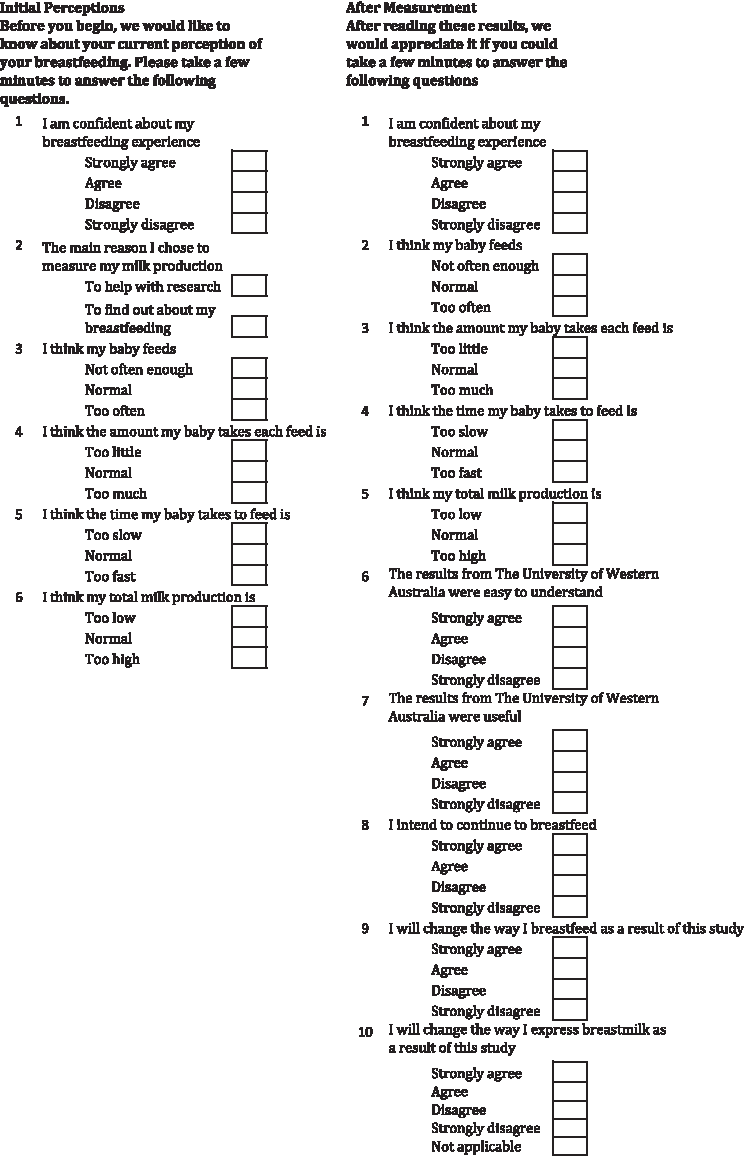
Surveys completed by participants on enrollment (Initial Perceptions) and after receiving their individual milk profile (After Measurement).
They were loaned accurate digital scales (BabyWeigh™; Medela Inc., McHenry, IL) (resolution, 2 g; accuracy, ±0.034%) to perform the 24-hour study. This involved the participants test weighing their infants in their own homes 20 before and after each breastfeed or supplementary feed and recording amounts of breastmilk expressed. Data were either recorded on paper or entered on a password-protected Web site accessed by invitation only. From these data, individual milk profiles were calculated and sent to each mother and, where applicable, to the appropriate clinician along with summarized population data for exclusively breastfeeding dyads (term infants) between 4 and 26 weeks of lactation (Table 1). 21
Data are from exclusively breastfeeding dyads (term infants) between 4 and 26 weeks of lactation. 20
Total breastmilk production=total breastfeeding transfer+total breastmilk expressed, where applicable.
Participants were then asked to fill in a second survey on their perceptions of their breastfeeding as well as the presentation and implications of their results (Fig. 1). Optional comments were invited. The time between the first and second surveys was less than 4 weeks.
Participants were deemed to be confident if, in response to the statement “I am confident about my breastfeeding experience,” they chose “Strongly agree” or “Agree” and were deemed to be not confident if they chose “Disagree” or “Strongly disagree.” Data were included only if the response to this statement was unequivocal.
The infants' growth centiles were calculated from the minimum weight during the study day (subtracting 100 g to allow for clothing) using an online program (www.childgrowthcalculator.com).
Statistical analyses
Sample size determination
Sample size was determined to allow for likely detection of a 5% rate of loss of confidence and a 10% rate of gain in confidence after measurement. With setting the binomial probability of zero occurrences to <0.05, 59 participants who were initially confident and 29 participants who were initially not confident were required to complete both the 24-hour study and the second survey. Assuming the 35% of women feeding term infants reporting PIM 4 would not be confident in their breastfeeding, we estimated that 88 participants would be required to complete both the 24-hour study and the second survey. Recruitment continued past this point as the measurement of milk profile was being used both by clinicians and as part of other research studies.
Statistical analysis
Analysis used R version 2.13.0 (Mac [Apple, Cupertino, CA] OS X version) with the base packages plus the libraries multcomp and nlme for general linear hypothesis tests and linear mixed effects models, respectively.22–24 Logistic regression was used to investigate whether completion of the 24-hour study and the second survey was associated with demographics or initial perceptions of breastfeeding behavior. Fisher's exact test was used to test for differences between confidence groups in exclusivity of breastfeeding, for confidence and the number of parameters perceived as normal, and for changes in patterns of perceptions. Linear regression and Tukey's Highly Significant Difference multiple comparisons of means were used to test for differences between confidence and perception groups in measured parameters. Student's t test was used to test for differences in measured parameters between two groups. Differences were considered to be significant where p<0.05.
Results are presented as mean±standard deviation or median (interquartile range) as appropriate.
Results
Participation, perception, and completion
Participants (n=203) with perceived breastfeeding problems were patients of general practitioners (n=21), clients of lactation consultants in private practice (n=39), or clients of the Breast Feeding Centre of Western Australia (n=99). There were 44 participants without any perceived problems. Clients of the Breast Feeding Centre included mothers of varied ethnic origins and socioeconomic status, whereas the remaining participants were predominantly white and of middle to high socioeconomic status. Initial confidence and participation rates in the three stages of the study are shown in Figure 2, and the reasons for participation and initial perceptions of their breastfeeding are shown in Table 2.
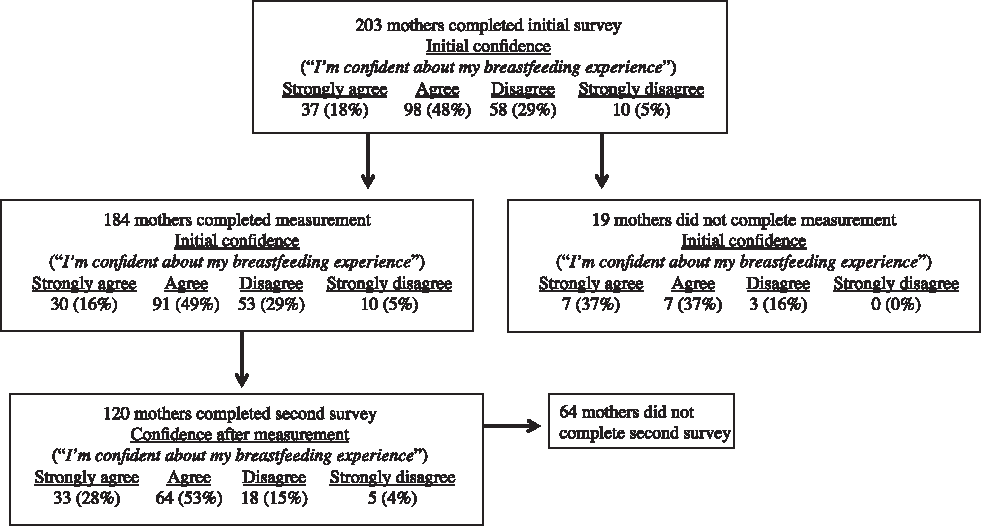
Enrollment and completion of the initial survey, completion of the measurement of milk profile, and completion of the second survey. Data are number of participants in each group (%).
NA, not answered.
Initially, 135 mothers were confident, and 68 were not confident. There was no significant relationship between initial confidence and infant's growth centile (p=0.55). There was a relationship between initial confidence and the number of parameters perceived as normal (p=0.012). Forty-five of 54 of mothers who perceived all parameters to be normal were confident. Thirty-eight of 89 mothers who perceived all parameters to be abnormal were not confident.
Milk profiles were measured by 184 of the 203 participants who were enrolled (Fig. 2). Their infants (84 female, 96 male, four with sex not recorded) had a gestational age at delivery of 39.5 (38.5, 40.4) weeks, birth weight of 3,504±456 g, and growth centile of 38.2 (15.9, 70.1) and were 5.4 (3.8, 8.7) weeks old when the 24-hour study was done. Of the mothers, fewer than half (n=82) were exclusively breastfeeding, 65 were expressing breastmilk, and their infants were exclusively breastmilk fed, 25 were supplementing with expressed breastmilk and infant formula, and 12 were supplementing with infant formula only. Mothers who were initially confident (n=121) had higher rates of exclusive breastfeeding (53%) and lower rates of use of supplementary infant formula (14%) than those who were not confident (30% and 30%, respectively) (p=0.007). Of the mothers who were initially confident and were using formula, two thought their total milk production was normal and used 20 mL and 40 mL of formula, respectively, whereas the remainder of the mothers thought their total milk production was too little and used 46–720 mL of formula. All the mothers who were initially not confident and were using formula thought their milk production was too little and used 90–602 mL of formula.
The second survey was filled in by 120 of the 184 participants who measured their milk profile (Fig. 2). Participants who completed the 24-hour study but did not fill in the second survey were not significantly different from those who did with respect to initial confidence (p=0.13), recorded perceptions of breastfeeding behavior (p=0.08), and measured demographics, infant growth centile, or weight gain (p>0.26). For mothers who were initially confident there was a difference (p<0.001) in total breastmilk production between those who did and did not fill in the second survey. For mothers who were initially not confident there was no significant difference (p=0.72) in total breastmilk production between those who did and did not fill in the second survey.
Milk profile and perception before measurement
The breastfeed amount and total breastmilk production were lower (p<0.001) for mothers whose initial perceptions were “Too little” compared with those who chose “Normal” (Table 3), but there were no significant differences between perception groups in the other measured parameters.
Data are median (interquartile range) or mean±standard deviation values as indicated. Not all participants responded to all statements.
p values are for comparison with those who reported a perception of “Normal” for this parameter.
NR, normal range.
Perception after measurement
Perceptions of breastfeeding behavior before and after measurement are presented in Table 2. From before to after measurement, there was a change in the pattern of perception of amount (p=0.009) and duration (p=0.012) of breastfeeds and of total milk production (p=0.008), with “Normal” being chosen more frequently after measurement, but no significant change for frequency of breastfeeds (p=0.14). The amount of breastfeeds was larger (p=0.011) for those who changed perception from “Too little” to “Normal” compared with those who still perceived the amount to be “Too little.” There was no significant difference in total breastmilk production (p=0.08) for those who changed perception from “Too little” to “Normal” compared with those who still perceived their total breastmilk production be “Too little.” The frequency of breastfeeds was lower (p=0.015) for those who changed their perception from “Too often” to “Normal.” The duration of breastfeeds was not different (p=0.12) among any of the perception groups.
There was a relationship (p<0.001) between confidence after measurement and the number of parameters perceived as normal, with 51 of 54 of mothers who perceived all parameters to be normal being confident and five of six mothers who perceived all parameters as abnormal being not confident.
Of the 121 mothers who were initially confident in their breastfeeding experience and completed the 24-hour study (83 with perceived problems, 38 with no perceived problems), 80 remained confident after measurement, four (with perceived problems) lost confidence, and 37 did not fill in the second survey. All of the mothers who lost confidence had a total milk production below the lower limit of the normal range of 478 mL. They were supplementing their infants (whose growth was between the 7th and 46th centiles) with expressed breastmilk and/or infant formula. The total milk production of 14 of the 37 who did not fill in the second survey was below the lower limit of the normal range. All of these were under the care of a general practitioner or lactation consultant.
Of the 63 mothers who were initially not confident in their breastfeeding experience and completed the 24-hour study (all with perceived problems), 18 gained confidence, 18 were still not confident, and 27 did not fill in the second survey. The total milk production of six of the 18 mothers who were initially not confident and did not change their opinion was below the lower limit of the normal range. They were supplementing their infants (whose growth was between the 1st and 99th centiles) with expressed breastmilk and/or infant formula. The remaining mothers in this category still had concerns about one or more of their breastfeeding parameters or were concerned about an unsettled infant or breastfeeding pain. The total milk production of nine of the 27 who did not fill in the second survey was within the normal range.
Assessment of the value of measurement
Questions on the value of the measurement were answered by 104 participants. Of these, 100 agreed that the results were easy to understand, and 97 agreed that they were useful. Of the 71 who were asked if they intended to continue to breastfeed, 69 agreed. Those who agreed that they would change the way they would breastfeed as a result of this study (n=49) had lower total breastfeeding transfer (618±190 mL) (p=0.005) than those who disagreed (736±216 mL). Thirty-six of 100 mothers agreed that they would change the way they express breastmilk as a result of this study, 44 disagreed, and the remaining 20 chose “Not applicable.”
The need for supplementary infant formula was expressed as a concern by six mothers who were using formula and two mothers who were not. The results confirmed that for six of these mothers continuation or commencement of the use of supplementary feeding was advisable, and for two mothers breastmilk production was adequate and the use of supplementary feeds was not likely to be required.
Discussion
After measuring their milk profile, mothers who were initially confident in their breastfeeding experience and filled in the second survey maintained their confidence, unless their total milk production was shown to be below the lower limit of normal or they had concerns other than their total milk production. Some mothers who were initially not confident and filled in the second survey gained confidence when their total milk production was demonstrated to be within the normal range, or they changed their perception of their breastfeeding behavior to “Normal.” Mothers who are confident in their ability to breastfeed have positive and prolonged breastfeeding experiences. 25 This maintenance of, or improvement in, confidence that we have demonstrated is therefore likely to have a positive effect on continuation of breastfeeding. Those who were shown to have a real insufficient milk supply, and not just a perceived insufficient milk supply, and lost confidence or who had their initial concerns validated were advised to discuss their results with their clinician and would be more likely to heed subsequent advice having received an objective measure of their milk profile.
The demonstrated relationship between breastfeeding confidence and the number of parameters of breastfeeding behavior being perceived as normal underlines the multifactorial basis for breastfeeding confidence. Moreover, three of 54 mothers were not confident in their breastfeeding relationship despite perceiving all the measured parameters to be normal, indicating that other factors noted by the mothers such as nipple pain and unsettled infant behavior are also important.
Participation and completion
The study population was representative of the local population with respect to method of feeding. Almost 50% of Western Australian mothers have ceased exclusive breastfeeding by 9 weeks. 5 Our participants completed the 24-hour study at 6.3±3.1 weeks after birth, and although 80% of the infants were fed exclusively on breastmilk, only 45% of our participants were exclusively feeding at the breast, and 20% were supplementing with infant formula. This underlines the fact that mothers who are not confident are more likely to be supplementing their infants with infant formula. The use of supplementary infant formula may have affected the mothers' milk supply before participation in this study. However, the authors have received comments from mothers who discovered that they were producing more milk than they had thought and were going to stop feeding supplementary infant formula.
The completion rate of 65% for the second survey compares favorably with the common return rate of 40–50%. 26 It is relevant that the majority of participants wanted “To find out about my breastfeeding” and, having received their results, had achieved their goal for participation, although not fulfilling the requirements of our goal of assessing the impact of the results on their confidence. Those mothers who were initially not confident and filled in the second survey had a similar total milk production to the dropouts and are therefore likely to be representative of the group.
Clinicians should be concerned that there was no significant relationship between initial confidence and infant's growth centile, which indicates that satisfactory growth alone is not sufficient to give mothers confidence in their breastfeeding experience. This study has shown that many mothers had doubts about the normality of their feeding duration, feeding amount, and total milk production, even if they expressed confidence in their breastfeeding.
Changes in perception after measurement
At least 80 of the 121 mothers who were initially confident in their breastfeeding and completed both the 24-hour study and the second survey remained confident. That is, measurement of total milk production did not undermine the confidence of these mothers whose milk production and breastfeeding parameters were within the normal range. This is similar to the finding that there was no difference in breastfeeding confidence between mothers of preterm infants who used test weighing in hospital and those who did not. 16 It is likely that when total milk production was below the normal range (14 of the 37 who did not fill in the second survey) there would be a loss of confidence, and indeed the four mothers who were initially confident and lost confidence had low total milk production. The consulting clinician was provided with the results to support subsequent advice. We certainly aim to do no harm, but feel that a mother who maintains confidence in her breastfeeding without measuring her milk production is less likely to heed advice from her consulting clinician and risk avoiding optimal care for her infant.
Initial lack of confidence was commonly associated with perceptions of feeding amount and total milk production being too little, as well as feeding duration being too slow. The 18 mothers who were still not confident after the measurement indicate that the care of a clinician is not necessarily, by itself, sufficient to increase confidence. Although 43% of the mothers who were initially not confident in their breastfeeding were lost to follow-up, the increase in confidence of 18 (29% of this group) indicates that measurement does not undermine the effect of clinical care and, indeed, can provide reassurance.
The significant increase in the frequency of perception of normality for breastfeeding behavior and total milk production after the 24-hour study indicates that measurement and information provided may have helped the mothers to understand that their breastfeeding may not be “average” but is within with the normal range. Parents and health professionals may not be aware that when an infant is growing normally (i.e., remaining within the 3rd to 97th centiles of the World Health Organization growth charts), there is a very wide range in breastfeeding patterns among dyads. 21
Perception of value of measurement
Nearly all of the mothers who responded to the second survey agreed that the results were easy to understand and useful and that they would continue to breastfeed. The positive comments concerning the usefulness of the measurement and planned changes to their breastfeeding or expressing demonstrate that the measurement of milk production either gave them reassurance or provided a basis for their clinician to manage their lactation.
Application of the technique
Test weighing has been shown to be accurate when performed by mothers, 27 and measures of breastfeeding parameters and milk transfer are reproducible (coefficient of variation, 9–18%). 28 This technique can be used to help to reassure mothers who, despite clinical indications of adequate milk production, are not confident in their breastfeeding. The physician may refer the mother to a lactation expert for measurement of the 24-hour milk profile, similar to a referral for pathology, and the lactation expert can ensure the mother is adequately instructed in test weighing.27,29 It is important that measurement of milk profile is undertaken over a full 24-hour period because there is a wide variation in infants' milk intake from one breastfeed to the next,20,30 but given the reproducibility of the measurements 28 one 24-hour period is sufficient.
If an infant is not thriving, this technique can be used to confirm if low milk production is the cause, in which case supplementary feeding is required while the mother's lactation or the infant's ability to breastfeed is investigated. The results will indicate if subsequent care may be provided by the lactation expert or referred back to the physician for medical investigation and treatment of maternal or infant abnormality.14,31
Avoiding an objective measure of breastfeeding parameters in case mothers' confidence is not supported is comparable to avoiding a pathology test in case the result is outside the reference range. An objective measure either provides reassurance or indicates that intervention is required, which may not occur if there is a false sense of confidence.
Limitations
Not all mothers who expressed an interest in measuring their milk production completed the 24-hour measurements, and not all mothers who completed the 24-hour measurements responded to the second questionnaire. Therefore we do not know the effect on all of the mothers of receiving the results. Weighing an infant before and after every feeding for 24 hours can be demanding, so while this technique is very useful, it is not appropriate for all lactating mothers. Measurement of the 24-hour milk profile forms only a part of the clinical care required by mothers who have breastfeeding difficulties. A mother who is shown to have a low milk production may lose confidence, but this should be balanced against her being confident in her breastfeeding and resisting advice from the clinician and compromising the optimal care of her infant.
Conclusions
Measurement of milk supply by 24-hour in-home test weighing of term infants is a technique that can provide objective information to guide the clinician in the management and support of the breastfeeding dyad. When breastfeeding parameters are shown to be normal, the confidence of breastfeeding mothers can be supported.
Footnotes
Acknowledgments
The authors thank the mothers for their participation and the clinicians who recruited the mothers and provided guidance on their lactation. Funding was provided by an unrestricted research grant from Medela AG, Baar, Switzerland.
Disclosure Statement
J.C.K., A.R.H., and P.E.H. are funded by an unrestricted research grant from Medela AG, Baar, Switzerland. D.B.L. declares no competing financial interests exist.