




Abstract
Abstract
Background:
Breast engorgement is a major cause of pain and weaning in the early postpartum period. While protocols reinforce the need for anticipatory engorgement advice and continued outpatient health professional breastfeeding support, there remains limited information on the efficacy of focused postdischarge engorgement education. This study sought to explore if outpatient postpartum engorgement education changed mothers' home management and if mothers found instruction on specific massage and hand expression techniques helpful.
Materials and Methods:
This was a prospective descriptive cohort study. Subjects received engorgement-specific postpartum support from a healthcare professional at the posthospital discharge (PD) newborn visit. Email surveys at 1, 2, and 12 weeks postpartum collected data on engorgement home management, clinical course, and postpartum education.
Results:
After the office visit, mothers changed their engorgement home management. Significantly more mothers utilized massage toward the axillae (25% versus 1%, p ≤ 0.001), reverse pressure softening (18% versus 3%, p = 0.001), and feeding more frequently (32% versus 16%, p = 0.04). Sixty-one percent would not have used massage and hand expression before education in the office. At 12 weeks, 96% of women reported massage and hand expression instruction as helpful. Mothers reported engorgement peaked at a median of 5 days postpartum, corresponding well to the office visit at a median of 4 days postpartum.
Conclusions:
Maternal engorgement symptoms are commonly present at the PD newborn visit. Education on engorgement, massage, and hand expression at this visit significantly changes home management strategies. Mothers find massage and hand expression instruction helpful.
Background
B
Postpartum breast engorgement is one of the most common early problems for breastfeeding mothers25–27 and can lead to premature weaning. 28 Typically symptoms, which peak between 3 and 5 days postpartum, 29 overlap with the American Academy of Pediatrics' (AAP) recommended time of the posthospital discharge (PD) newborn visit. 13
A number of studies have explored treatments that may be useful in relieving the symptoms of engorgement, and currently, the Academy of Breastfeeding Medicine (ABM) recommends that mothers receive prehospital discharge anticipatory guidance on engorgement management, including hand expression and reverse pressure softening.15,30 The protocol also recognizes the potential role of massage in engorgement management. A more recent study found that in-office therapeutic breast massage in lactation (TBML), which combines the principles of hand expression and gentle massage toward the axillae, helps relieve acute breast pain in mothers with engorgement. 31 However, no studies have examined the effect of providing routine postpartum TBML education to mothers for their home self-management of engorgement.
Given that literature demonstrates that mothers benefit from support that addresses their early breastfeeding difficulties31,32 and appreciate learning specific skills from professionals, 33 this study sought to examine whether routinely educating mothers on engorgement, hand expression, and TBML massage techniques during the PD-newborn visit would be helpful to mothers and change their home management of engorgement.
Materials and Methods
Study design
This was a prospective descriptive cohort study. Enrollment occurred at the PD newborn visit, which combined the primary care physician evaluation with a lactation consultant (LC) appointment. 10 The treating provider enrolled mothers at the visit from December 2013 through January 2014. All participants gave written informed consent at enrollment. Inclusion criteria included breastfeeding mothers 18 years or older. Exclusion criteria included a history of preterm delivery and infant neonatal intensive care unit admission. The research study was approved by the University Hospitals' Institutional Review Board.
At enrollment, participants completed a patient questionnaire on demographic information, delivery history, home management of engorgement before the visit, and current engorgement symptoms. The LC provided basic breastfeeding support, as well as specific hand expression, TBML massage, and engorgement education, during the visit. This instruction included verbal review of the TBML principles of gently massaging toward the axillae alternated with hand expression (Appendix A), a written engorgement handout (Fig. 1), and the URL for a video teaching hand expression and massage (http://bfmedneo.com/resources/videos).
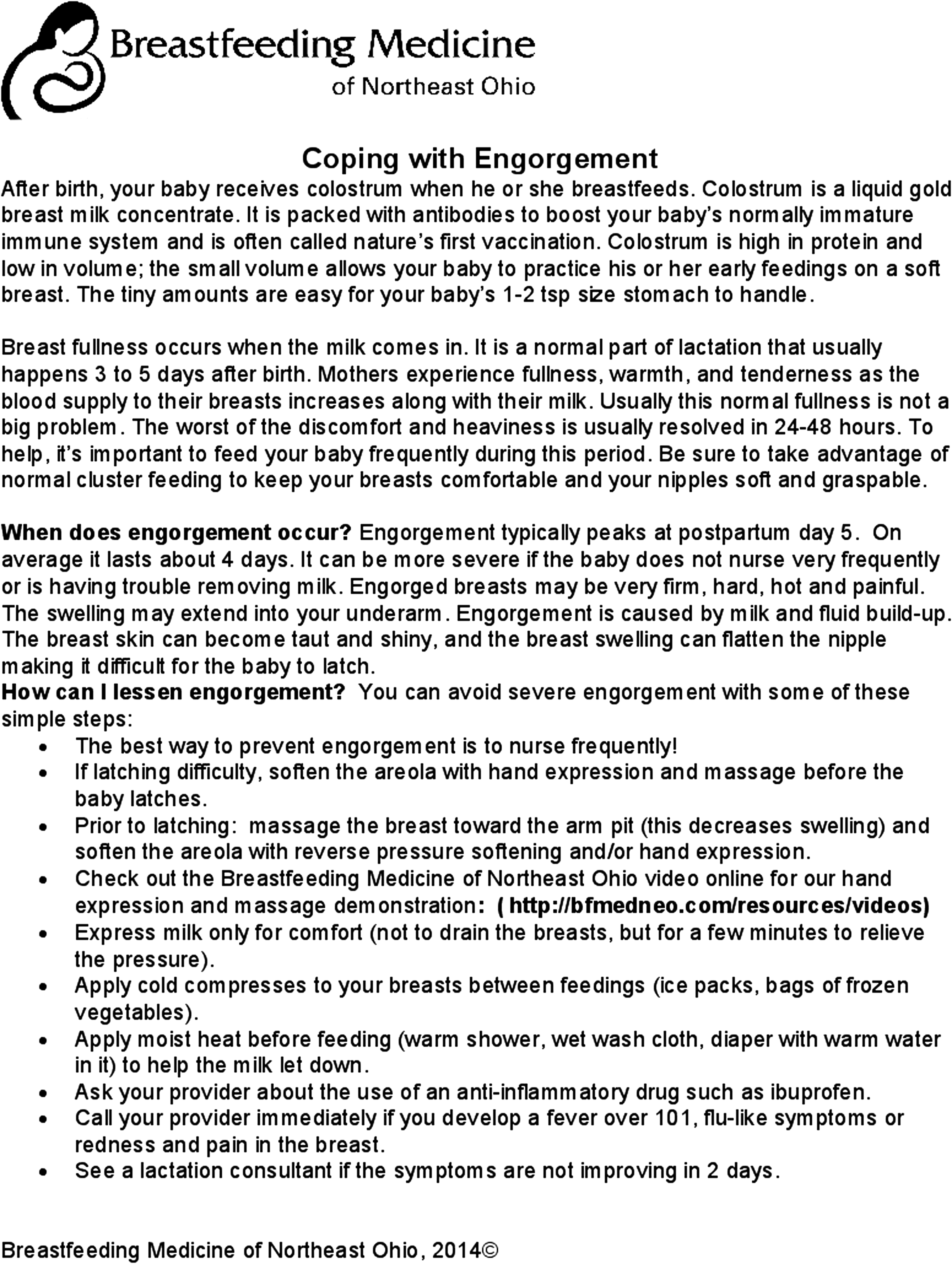
Coping with engorgement.
Follow-up email questionnaires were administered at 1, 2, and 12 weeks postpartum. The survey at 1 week postpartum assessed the change in home management of engorgement pre- and post- the in-office instruction on engorgement and TBML techniques, as well as mothers' impressions of the instruction. The survey at 2 weeks collected data on the clinical course of engorgement. The survey at 12 weeks assessed current breastfeeding practices and mothers' long-term impressions of the helpfulness of the TBML instruction. All data were collected and managed using the REDCap electronic data capture tools hosted at University Hospitals of Cleveland. 34
Study population
Enrollment occurred at a private suburban pediatric practice in Cleveland, Ohio that is perceived by the community as breastfeeding friendly. Patients typically deliver at one of two hospitals. One hospital is suburban and designated as Baby-Friendly, while the other is an inner-city teaching hospital that at the time of enrollment was working toward Baby-Friendly designation as part of the Best Fed Beginnings Project. 35
Measures
Descriptive variables on demographics, delivery and hospital practices, history of breastfeeding problems, current feeding practices, engorgement symptoms, weaning, and breastfeeding complications were recorded as previously described.36,31
Data on home management of engorgement were collected in response to the question: “If you have needed help relieving engorgement what have you tried?” Responses included: nothing, feeding the baby more frequently, reverse pressure softening, hand expressing, pumping, massage, cool and warm compresses, cabbage leaves, and ibuprofen.
To better understand the use of TBML massage principles, detailed descriptions of home massage techniques were collected in response to the question: “How do you massage?” Categorical answers included: toward the nipple/areola; toward the armpit/away from the nipple; multiple direction; used finger tips; used whole hands; used oil; it hurt; and it did not hurt.
The clinical course of engorgement was self-recorded by mothers at the 2-week survey. Mothers recorded the postpartum day that engorgement started, peaked, and stopped. Subjects rated engorgement severity at start, peak, and stop day according to the Humenick engorgement scale: (1) soft, no change; (2) slight change; (3) firm, nontender; (4) firm, beginning tenderness; (5) firm, tender; and (6) very firm and very tender. 29 Engorgement pain severity for start, peak, and stop day was rated by the patient on a numerical rating scale from 0 to 10, with 0 indicating no pain and 10 indicating the most severe pain.36,37
To evaluate helpfulness of the engorgement and TBML instruction, mothers were asked at the 12-week survey “Was getting instructed on massage and hand expression helpful?” Responses were recorded as no, somewhat helpful, helpful, and very helpful. Mothers were then given room to respond descriptively to “What was helpful about the visit and instruction?” and “What was different from what you heard previously about hand expression and massage?”
Data collection
During the study period, 95 mothers were screened for enrollment. Twelve were ineligible and 10 declined. Seventy-three mothers enrolled.
Analyses
Once collected, the data were exported from REDCap to SPSS software (SPSS, Inc., Chicago, IL) and analyzed under the supervision of the project investigator. Descriptive statistical analyses were performed to examine the distribution and normality of data.
Our primary analysis was to assess home management of engorgement and assess if postpartum education affected home management strategies. A secondary analysis on clinical course of engorgement was also conducted.
Categorical variables were described with frequency and percentages. Continuous variables were described as mean and standard deviation (SD), or median and range as appropriate. Paired t test was used to compare home management pre- and postoffice visit.
Results
Sample characteristics
Study population sample characteristics were recorded (Table 1). Inquiry of Baby-Friendly Hospital Initiative (BFHI) steps 1 found that 62% of mothers had been taught hand expression in the hospital and 83% received information about community breastfeeding resources from the hospital.
Engorgement home management preoffice visit
At the visit, 63% reported that they had already experienced engorgement since hospital discharge. Mothers reported already trying a wide variety of strategies to manage their engorgement symptoms. The most commonly tried home treatments were massage (38%), pumping (21%), warm compresses (18%), and feeding the baby more frequently (16%) (Table 2). Eleven percent of mothers reported not trying any home treatments. Although 62% of mothers reported being taught hand expression in the hospital, only 14% said that they tried using hand expression at home to relieve their engorgement symptoms.
Paired t test.
Engorgement home treatments postoffice visit
When assessing changes in home management following the office visit, we found significantly more mothers tried the following treatments after the office visit compared to before the visit: reverse pressure softening (18% versus 3%, p = 0.001), feeding the baby more frequently (32% versus 16%, p = 0.04), and cool compresses (21% versus 10%, p = 0.018) (Table 2).
The number of mothers using massage as a home treatment did not significantly change after the office visit (50% versus 38%, p = 0.145). However, the massage techniques that mothers used did change (Table 2). Significantly more mothers massaged toward the axilla (25% versus 1%, p < 0.001), in multiple directions (29% versus 15%, p = 0.007), and were able to massage without pain (29% versus 7%, p < 0.001). Sixty-one percent of mothers said they would not have used massage and hand expression to treat their engorgement before learning about it in the office.
Timing of office visit in relation to the clinical course of engorgement
The office visit occurred at a median of 4 days postpartum (range 3–9). At the office visit, 38% of mothers had periareolar swelling. On the Humenick engorgement scale, 29 mothers reported: firm, beginning tenderness (11%); firm, tender (18%); and very firm, very tender (10%).
Engorgement symptoms began a median of 3 days postpartum (range 2–16), peaked at 5 days (range 2–16), and resolved at 8 days (range 3–18). When engorgement peaked, mean pain level was 5.41 (SD 2.9). On the Humenick engorgement scale, mothers reported firm, beginning tenderness (12%); firm, tender (35%); and very firm, very tender (37%). Median length of engorgement symptoms was 4 days (range 1–13).
Mothers' impressions
When asked in the 12-week survey to look back at the office visit, 96% of mothers reported that the instruction on hand expression and massage was helpful. Twenty-nine reported the instruction to be somewhat helpful, 36% helpful, and 31% very helpful. Mothers also qualitatively reported what they found helpful about the office instruction (Table 3). Mothers appreciated learning specific massage techniques, seeing the techniques modeled, discovering how massage could provide pain relief, feeling supported by their providers, and becoming empowered to self-manage their symptoms.
When asked what was different about the teaching they received in the office visit compared to what they had learned previously about massage and hand expression, mothers often reflected that they had not learned anything in the past. Another notable theme was that the education clarified questions of technique, in particular, the benefit of massaging toward the axilla and with gentler pressure. Mothers appreciated when these techniques were demonstrated.
Twelve-week breastfeeding practices
At 12 weeks, 8% of mothers had weaned. Sixty-seven percent of mothers were still exclusively breastfeeding.
Discussion
This is the first known study to examine mothers' home management of engorgement, the effect of postpartum in-office education on home management strategies, and mothers' impressions of engorgement, massage, and hand expression education.
Our study shows that the majority of mothers utilize some form of home management to relieve their engorgement symptoms. There is wide variety in the types of home treatments mothers choose to try, including massage, pumping, feeding more frequently, hand expressing, warm and cool compresses, and ibuprofen. Massage is the most commonly used.
Our results suggest that education provided solely in the hospital on the home management of breastfeeding complications may not be remembered after discharge. Despite the fact that protocols recommend education on hand expression as a management strategy for engorgement 15 and that the majority of mothers learned about hand expression during their postpartum stay in the hospital, only 13% used it when they developed engorgement symptoms after discharge. Furthermore, our study suggests that mothers may find other strategies more helpful.
In our study, when mothers received engorgement education at the PD newborn visit, it increased their use of self-management strategies for engorgement symptoms, including feeding the baby more frequently, cool compresses, and reverse pressure softening. In addition, both mothers who had and had not previously tried massage as a home treatment found the specific TBML counseling on hand expression and massage toward the axillae helpful and changed their massage techniques accordingly. Their comments highlighted how much they valued learning specific massage techniques, seeing the techniques modeled, and being empowered with an additional tool they could use at home to manage their symptoms without requiring further office visits.
Our study affirms that the clinical course of engorgement remains similar to that described previously,29,26,38,39 peaking at postpartum day 5, despite changes in hospital birthing practices and BFHI measures. Given that engorgement peaks at median of postpartum day 5, this implies that engorged mothers will often be experiencing near peak symptoms during their newborns' PD visit.
Clearly, mothers change their home management strategies and gain increased confidence in their ability to mitigate engorgement symptoms when specific engorgement education, including TBML instruction, is provided at this visit. This is in alignment with the literature on the health belief model, which describes how individuals are most likely to learn skills when those skills are taught at the time they are needed. 40 Our study therefore supports the idea that lactation support with engorgement education at the PD newborn visit has an important role to play in facilitating breastfeeding success. This implies that engorgement education that includes hand expression and a TBML overview could be a beneficial addition to the routine outpatient support provided by family physicians, pediatricians, and other health professionals to early postpartum mothers.
We cannot comment on the long-term ramifications of providing support and postpartum TBML education at the PD newborn visit. While 92% of the mothers in this study were still breastfeeding at 12 weeks, our study was not designed to evaluate if the specific engorgement education contributed to this success. Future studies will also need to evaluate if mothers use these tools to troubleshoot future breastfeeding complications as suggested by Witt et al. 31 and whether this affects breastfeeding duration in the long term. In addition, we cannot extrapolate our results to other populations. However, since general professional support on lactation has been found to be helpful in varied populations, further study on the effect of engorgement and TBML-specific educational interventions would be worthwhile.
Conclusions
Breastfeeding mothers use a variety of home management strategies when they experience symptoms of engorgement. Maternal engorgement peaks at postpartum day 5, which corresponds with the AAP's recommended timing of the PD newborn visit. Mothers find it helpful when education on engorgement and the TBML techniques of hand expression and massage are provided at this visit. This education provides targeted breastfeeding support and specific skills that empower mothers to self-manage their engorgement symptoms.
Footnotes
Acknowledgments
Special thanks to Shelly Senders, MD, and the staff at Senders Pediatrics for their continued support in improving breastfeeding practices. The authors thank Kristen Auletta, Anne Vanic, and Mara Uguccini for their assistance with data collection.
Disclosure Statement
No competing financial interests exist.