




Abstract
Abstract
Background:
Severe breast engorgement can cause substantial discomfort for mothers and interfere with an infant's ability to feed at the breast. The aim of the study was to clarify the possibility that the percutaneous progesterone-containing gel (Progestogel) can eliminate severe postpartum breast engorgement in lactating women.
Subjects and Methods:
Twenty three patients were examined. The Progestogel for transdermal therapy in an amount of 2.5–3 g was applied to the breast. Before application and 20 min after application the density of the mammary glands was measured by a tonometer.
Results:
According to our observations, within 20 min application of 2.5–3 g of the Progestogel on the breast skin does not result in reducing breast swelling, engorgement and tenderness.
Conclusions:
After 20 minutes, transdermal application of Progestogel does not reduce the degree of engorgement of the mammary glands in the postpartum period.
Introduction
S
A recent study 3 reported that percutaneous progesterone-containing gel (Progestogel) can reduce pain and eliminate postpartum engorgement within 15–20 minutes. The aim of this study was to further clarify possibility that percutaneous progesterone-containing gel can eliminate severe postpartum breast engorgement.
Twenty-three patients were examined. Women had been lactating and breastfeeding normally between 5 and 6 days. The informed consent of the women was obtained according to the Declaration of Helsinki. The study was approved by the Ethical Committee D.O. Ott Institute of Obstetrics and Gynecology, RAN, Russia. Progestogel produced by “Besins Healthcare SA” (Belgium) was administered to the breast skin by an applicator in an amount of 2.5–3 g. To resolve breast engorgement, milk was extracted by a special hospital-grade electric breast pump with compression component. 4 The tonometer was designed specifically for the project to have an objective measure of breast hardness. This was a spring-loaded rounded probe of 8 mm diameter, protruding 1 cm from a flat plate. In the tube, there was a spring connected via the lever with the indicator. When pressing the probe on the breast, there was invagination of the surface area of the gland. The movement of the probe was proportional to the density of the gland. In the case of a hard dense structure of the breast, the probe was inside, feeling a certain resistance. The probe simultaneously squeezed the spring, causing the indicator to move. In the case of a less rigid structure of the breast, the probe was held inside the breast, experiencing less resistance; therefore, its effect on the spring and the indicator was less than in the first case. Pressing on the probe in all measurements were carried out before until the flat plate did not touch surface area of the breast. The numerical amount of how the indicator moved was a measure of the hardness of the mammary gland and was denoted by a conventional unit. The hardness of the mammary glands was measured between the upper inner and upper outer quadrants. Average data are given with standard deviation. Student's t-test was used for statistical analysis.
We measured breast hardness and identified the presence of painful sensations both in the left and right mammary glands. Furthermore, on the breast skin, we administered the Progestogel. After 20 minutes, we re-measured breast hardness and reexamined the mammary glands to identify the presence of painful sensations. Although the breast hardness in some women slightly decreased and equaled 97.8% ± 2.2% in relation to the initial state of the mammary glands (the differences insignificant, p = 0.08) (Fig. 1), palpation nevertheless was accompanied by painful sensations. Thereafter, milk was ejected from the breast by a breast pump and the hardness of the mammary gland by tonometry decreased to 40% ± 15% (the difference is significant, p < 0.0001).
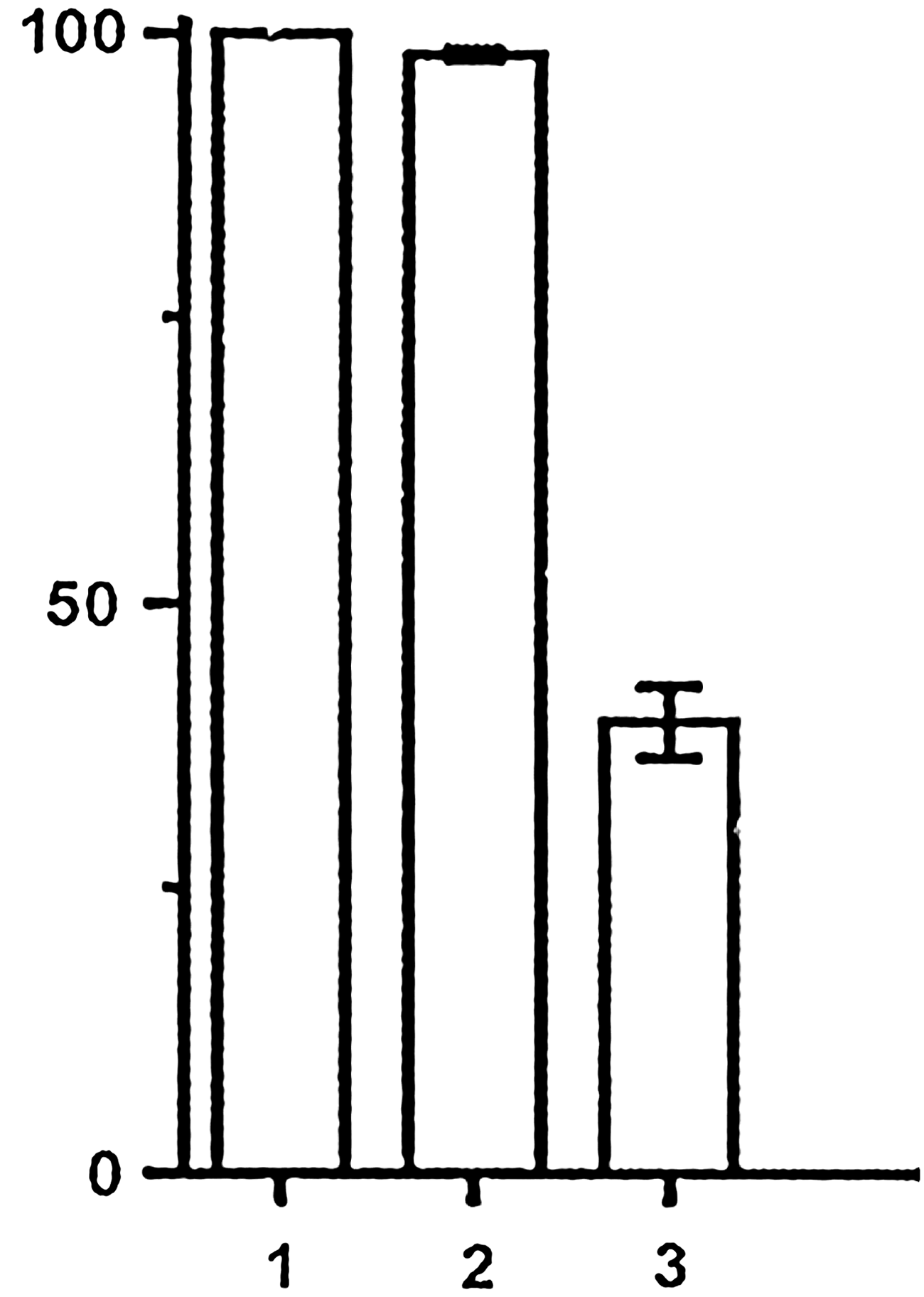
The density of mammary glands after Progestogel and milk ejection by a breast pump with the compression component. The vertical axis is density of mammary glands in percentage in relation to the initial state (100%). 1, initial state; 2, 20 minutes after the Progestogel was administered; 3, after pumping.
To conclude, after 20 minutes, transdermal application of Progestogel does not reduce engorgement of the mammary glands in the postpartum period.
Disclosure Statement
No competing financial interests exist.