




Abstract
Objective:
There are multiple health benefits associated with both breastfeeding and practicing physical activity (PA). Therefore, it is likely that many women might want to engage in both. We designed the current randomized clinical trial to examine the effect of moderate- to high-intensity PA on human milk (HM) volume and macronutrient contents.
Methods and Study Design:
In this prospective, randomized, crossover clinical trial, we recruited 31 healthy mothers who had been exclusively breastfeeding their infants. Mothers expressed HM twice each day on 2 consecutive days—a day with PA (1-hour before and 1-hour after PA) and a control day without PA (at the exact same hours of the day). The order of days (with/without PA) was determined randomly. Macronutrients and energy contents of HM were analyzed using the Human Milk Analyzer (Miris AB, Uppsala, Sweden). PA was graded according to the Borg Rating of Perceived Exertion scale (RPE scale).
Results:
A total 124 HM samples from 31 mothers were analyzed. Moderate- to high-intensity PA affected neither macronutrients (fat, carbohydrates, protein) nor energy content. Milk volume remained unaffected by PA as well.
Conclusions:
Maternal PA does not affect HM volume or its macronutrient contents. Lactating mothers can be reassured regarding their breast milk volume and composition while practicing PA of moderate to high intensity.
Introduction
The benefits of breastfeeding for both infants and their mothers are well established.1–5 The American Academy of Pediatrics recommends exclusive breastfeeding for about 6 months, followed by continued breastfeeding for 1 year or longer as complementary foods are introduced. 6
Physical activity (PA) is highly recommended at all stages of the life cycle. 7 Thus, women with uncomplicated pregnancies should be encouraged to engage in aerobic and strength-conditioning exercises before, during, and after pregnancy. 8 Resuming or initiating exercise activities after delivery is important in supporting lifelong healthy habits. Decrease in women's level of participation in exercise after delivery has been reported and might lead to overweight and obesity.9–12 Moreover, for healthy pregnant and postpartum women, the guidelines recommend at least 150 minutes per week of moderate-intensity aerobic activity, adjusted as medically indicated. 13
Since there are multiple health benefits associated with both breastfeeding and participation in PA, it is likely that many women might want to engage in both. However, little is known about the effect of PA on human milk (HM) composition and volume. We thus designed the current study to test the hypothesis that moderate- to high-intensity PA does not affect macronutrient contents and volume of breast milk.
Methods
Population
Thirty-one healthy mothers who exclusively breastfed a healthy full-term newborn 2–6 months postpartum were recruited through an ad posted on the Tel Aviv Medical Center Facebook page and in several baby-related forums on the internet and distributed at family health centers. All mothers performed moderate- to high-intensity PA before or during pregnancy and resumed PA 6 weeks after delivery. The sample size of the population was calculated based on the data published by Dewey et al. 14 on the impact of exercise on breast milk volume and composition. A cohort of 33 sedentary and exclusively breastfeeding mothers were randomly assigned to an exercise group or a control group. They reported no difference in the volume or composition of the breast milk with a confidence level of 95%.
The study was approved by our local Institutional Review Board, and written informed consent was obtained from all mothers.
Data collection and laboratory methods
The study lasted 2 consecutive days for each participant (Fig. 1) and included 1 day of moderate- to high-intensity aerobic PA and 1 day of rest with no PA, which was a control day. Thus, in essence, each mother served as her own control. The participants were randomly assigned by computer-generated random numbers either to start with a day of PA followed by a day of rest or vice versa. The intensity of the activity was classified according to the Borg rating of perceived exertion (RPE) scale, which uses a quantitative measure of perceived exertion based on the physical sensations a person experiences during PA. 15 Scores range from 6 (no exertion) to 20 (maximum exertion), and scores from 12 to 16 are considered moderate- to high-intensity level of exertion. 15 Moreover, when the reported score is multiplied by 10, it is an estimate of the heart rate during the exercise. 15
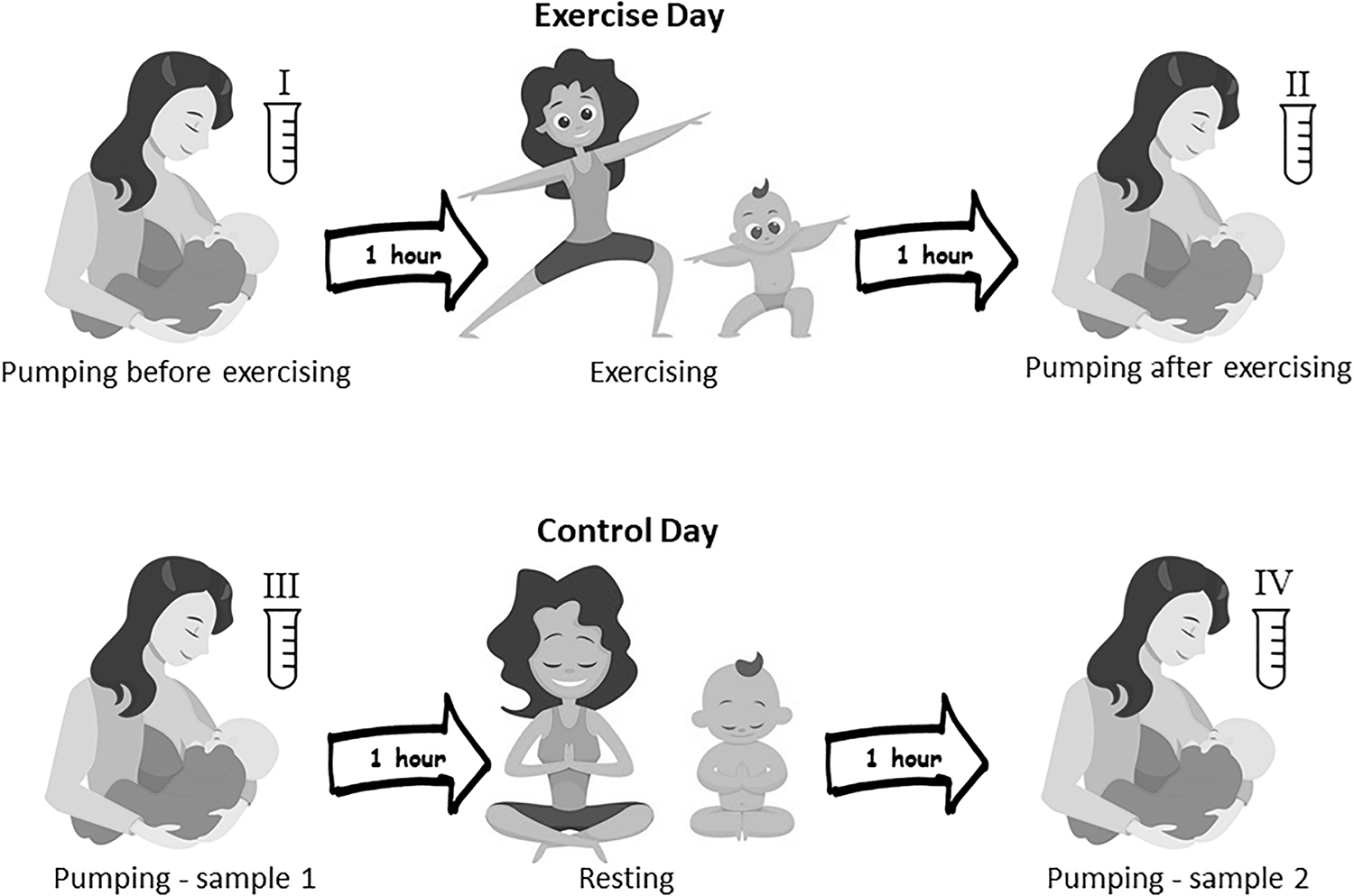
Study design.
Breast milk was collected twice a day, by using an electric pump (n = 23) or by manual expression (n = 8). Total breast milk expressed at each milk sampling session was recorded and a sample of 2 mL was used for macronutrients' analysis. Breast milk was expressed on the day with PA, at 1 hour before the PA and at 1 hour after ending the activity, and on the control day at the same time intervals though no PA was performed. Thus, each participant gave four milk samples and recorded the total volume of these four milk expression sessions.
The participants were guided to keep a similar daily routine on both days, similar diet and amount of fluids intake. Thirty mothers filled out the 24-hour dietary recall form on each day of milk sampling. The 24-hour questionnaires were reviewed by a clinical nutritionist to rule out possible major diet changes during the study period. We systematically recorded demographic and clinical data from the mothers and their infants, including maternal age, body mass index (BMI), years of education and nutritional supplements, mode of delivery and number of lactations per day, infant gender, age, birth weight, and current weight.
Immediately following expression, HM samples were stored in a refrigerator at <5°C for a maximum period of 48 hours before being stored at −20°C until thawed and analyzed. Just before analysis, each frozen sample was initially heated at 40°C in a thermostatic bath, and then homogenized using an ultrasonic technique (MIRIS milk sonicator; Miris, Uppsala, Sweden), as recommended by the manufacturer. Macronutrients (fat, protein, and carbohydrate) and energy contents were measured using the Human Milk Analyzer from Miris, an instrument based on mid-infrared transmission spectroscopy. The analyses were performed following the manufacturer's protocol by a single investigator (M.B.).
Statistical analyses
The Minitab Statistical Package, version 16 (Minitab, State College, PA) was used for analyses. Paired Student's t test was used to evaluate the differences in macronutrient and energy contents between the first and the second expression of the same day and between the 2 study days using the delta in macronutrient contents on the day with PA (before/after PA) and on the control day without PA (sample 1-sample 2). A p-value of <0.05 was considered significant.
Results
A total of 124 HM samples from 31 mothers were analyzed, yielding the concentration of protein, fat, carbohydrates (g/100 mL), and energy (kcal/100 mL). Of them, two protein measurements were excluded because of technical analysis problem. One mother did not fill out a questionnaire. Maternal and perinatal characteristics are presented in Table 1.
Demographic and Perinatal Characteristics
Data are presented as (%, N) or mean ± SD (range).
BMI, body mass index; SD, standard deviation.
In brief, maternal mean age was 33.5 ± 3.3 and their BMI was 22.8 ± 3.2. Mothers were healthy, except for one with thalassemia minor, two with inactive asthma, and three with treated and well-balanced hypothyroidism. Minor diet changes between the 2 days of milk sampling were found only in five mothers, such as minor disproportion of meal contents and their size. Aerobic PA included running or walking (13, 43%), functional training (5, 16%), aerobic lesson (5, 16%), and swimming (2, 6%). The mean intensity score of PA was 14.2 ± 1.6 according to the Borg RPE scale. All infants were reported to be healthy and normally developed.
Macronutrient contents are described in Table 2 and Figure 2. We found no statistically significant differences in any of the macronutrients between HM samples expressed before and after moderate- to high-intensity PA as well as between the two samples of control day. Furthermore, the deltas in macronutrient contents on the day with PA (before and after PA) and on the control day without PA (sample 1 and sample 2) were not different. We observed statistically significant differences in the milk volumes expressed between the two expressions of the day with PA (before and after PA) and between the two expressions of the control day (p = 0.026 and 0.03, respectively), when milk volume was higher in the first expression in both of the days. However, the delta of HM volume between the two expressions of the day were not statistically different between the 2 study days.

Macronutrients and milk volume data for both study days. B, Before; A, After; 1, Sample 1; 2, Sample 2.
Macronutrients and Milk Volume Data
Data are presented as mean ± SD, range.
NS, not significant; PA, physical activity.
Discussion
We have found that moderate- to high-intensity maternal PA did not affect HM macronutrients and energy contents.
In the past, it has been a common practice to advise mothers to restrict the amount of exercise they do while breastfeeding, as it would affect the taste of their breast milk and their overall breast milk production. 16 It was demonstrated that lactic acid concentration in breast milk increases following exercise hence affecting infant acceptance of HM.17–19
In contrast, there are few publications in the field that demonstrated that maternal PA has no adverse effect on infant growth,14,20,21 acceptance of breast milk, 22 and HM macronutrient composition and volume.14,23–25 Lovelady et al. conducted a study that showed no difference between exercising (n = 8) and sedentary mothers in milk lipid, protein, or lactose content, but demonstrated a higher milk volume and energy output in milk of exercising mothers. 21 Similarly, McCrory et al. compared milk content between two groups of lactating mothers—a diet group (n = 22) and a diet plus exercise group (n = 22), and showed that change in milk content, including fat, protein, and energy did not differ significantly among groups. 25 Other studies analyzed minerals, such as calcium, phosphorus, magnesium, sodium, or potassium; 26 and immunological properties such as secretory IgA, lactoferrin, and lysozyme. 27
A meta-analysis of randomized controlled trials by Daley et al. provided initial evidence that participating in exercise while breastfeeding does not adversely affect infant weight gain. 28 Su et al. conducted a cohort study featuring 587 mothers that showed no difference in the mean of infant weight and length changes, indicating that exercise appeared to have no significant influence on infant growth up to 52 weeks after birth. 29 Dewey et al. showed no significant difference in breast milk volume and composition between exercising (45 minutes of aerobic PA five times a week for 12 weeks) and sedentary groups of postpartum lactating mothers. 14
Fly et al. conducted a study on 14 lactating mothers who participated in a maximal graded exercise test and a 30-minute rest period to determine the influence of exercise on the concentration of selected milk minerals and electrolytes. They demonstrated that maximal exercise did not alter concentrations of phosphorus, calcium, magnesium, potassium, or sodium in milk. 26 Carey et al. showed a significant elevation in milk lactic acid concentration after maximal exercise on a treadmill through 90 minutes after exercise, and no significant differences in milk pH, lipid, ammonium, or urea measurements after exercise sessions. 17 Bopp et al. showed no significant difference in long-chain polyunsaturated fatty acid levels in plasma and breast milk between moderate exercising and sedentary women at 12 weeks postpartum. 30
Regarding HM volume, we have found statistically significant differences in milk volumes on both days of research—HM volume before and after PA and HM volume between sample 1 and sample 2. However, differences in the delta of milk volume between the day with PA and the control day were not statistically significant. We can only speculate that the observed differences might derive from intrinsic variation of milk volume throughout the day, with a larger volume of HM expressed during the first milk expression in the morning.31,32 We therefore concluded that PA did not affect the volume of breast milk expressed, similar to the study by Dewey et al. 14
No dramatic diet changes took place between the 2 study days. While diet changes between the 2 study days were found in five mothers, those changes were considered minor, based on our nutritionist's assessment, and should not influence HM macronutrient contents. Several studies showed that the immediate impact of maternal diet on breast milk content—including fat, carbohydrate, and protein—is minimal or absent.33–36
The singularity of our study's design is that each mother served as her own control. This ensures that the results were not influenced by confounding variables, such as maternal age, BMI, etc. Our study demonstrated that performing aerobic PA as part of maintaining a healthy lifestyle during the lactating period has no adverse effect on macronutrient contents of HM.
There are few limitations to our study. First, our findings should be interpreted in the context of relatively small sample size of 31 participants. In addition, we did not use an objective measure of exercise intensity (such as heart rate, blood lactate etc.) and used the subjective Borg scale.
We conclude that HM volume and macronutrient contents are not affected by maternal PA. Thus, lactating mothers can be reassured to practice sport of moderate to high intensity during their breastfeeding period.
Footnotes
Disclosure Statement
The authors declare no conflicts of interest.
Funding Information
No financial assistance was received in support of the study.