




Abstract
Objective:
This study was a randomized controlled experiment to determine the effects of listening to music on breast milk production in Turkish mothers with premature newborns.
Methods:
The study consisted of two groups of randomly selected mothers (n = 20 each) of newborns in the neonatal intensive care unit (NICU) of two university hospitals in Istanbul between November 2017 and November 2018. On the first day, all mothers were provided with training for milking with pumps. On the second through fourth days, mothers in the music group (MG) underwent two sessions of milking with music and a pump for 15 minutes at 11:00 and 16:00; the mothers in the control group underwent two sessions of milking without music. To evaluate stress levels, Spielberger's State-Trait Anxiety Inventory was administered and salivary cortisol tests were taken on the first and final days of the study.
Results:
The mean age of participants was 28.5 ± 5.3 years, the mean gestational week was 32.21 ± 2.26, and the mean birth weight of the newborns was 1748 ± 533.4 g. The state and total anxiety scores of the MG were statistically low (p < 0.05). There was no difference between the MG and control group in the amount of breast milk produced; however, the final test cortisol levels of the MG group were significantly lower compared with the pretest measurements (p < 0.05).
Conclusion:
Listening to music in the NICU while breastfeeding can help reduce stress levels in mothers to premature newborns and support breast milk production.
Introduction
In parallel with the developing technology in the world, the chances of survival of premature newborns are increasing due to advancements in the fields of perinatology and neonatology. This increased survival rate necessitates extra support to foster the long-term growth and neurodevelopmental outcomes of premature infants.1,2 The most important factor affecting growth and development in premature infants is nourishment. However, starting and maintaining breastfeeding in premature infants within the first days after birth is more challenging compared with those born full term. The inability of mothers with infants in neonatal intensive care unit (NICU) to establish sufficient contact with their newborns to breastfeed can result in insomnia, stress, and anxiety; in addition, hormonal changes can negatively affect breastfeeding and the amount of breast milk produced.3–6 Providing premature newborns with breast milk reduces neonatal morbidity and positively impacts neuromotor development. 7 As such, breast milk production should be increased regularly to support healthy development and weight gain. 8
It has been reported that listening to music can stimulate alpha waves in the brain that cause relaxation by enhancing endothelial function, which expands blood vessels and increasing the release of nitrite oxide and endorphins.5–9 Music can provide effective results from the first session, and music therapy (MT) in premature newborns can reduce hospital stay time and increase weight gain, oxygen saturation, heart rate, and breastfeeding.7–10 Heart rate is balanced in mothers undergoing MT, leading to reduced depression, anxiety, and stress scores, and increased attachment to the newborn.12–15
Music has been used to strengthen spirituality and aid in disease treatment across many cultures throughout history. 11 It has been told that the ancient Greek god Heros ascended to the deity of Aesculapius medicine and established a dormitory for health protection in Bergama in fourth century BC. Here, he applied various treatment methods, including suggestion, physiotherapy, and MT, which are still used today. 12
MT is a noninvasive intervention that fosters optimal and continuous quality of care, which consists of culturally based, parent-selected, and personalized musical tunes; in fact, the use of MT in Turkey dates back to at least 6,000 years ago.13–15 The first formal MT practices in Turkey were implemented by the Seljuks and the Ottomans, with the first institutions established for MT in Anatolia in nursing homes.15–17 The music used in these institutions has been divided into modes over time, and the modes have been divided according to disease or state affected. 18
Although studies have shown that MT increases breast milk production, there is no study examining the effect of music on breast milk production in Turkish women.3,16 The aim of this study was to investigate the effect of music on breast milk production in mothers with premature newborns in the NICU.
Materials and Methods
Study design
This was designed as a randomized controlled study to determine the effect of listening to music on breast milk production. The study was carried out in two university hospitals, Istanbul University Medical Faculty Hospital and Bezmialem Vakıf University Medical Faculty Hospital. The population of the study included 44 mothers (22 in the music group (MG) and 22 in the control group) of premature newborns in the NICU randomly selected between November 2017 and November 2018.
Sample size calculation
The sample group was determined before the study by taking into consideration the mean and standard deviation values (MG: 7.12 ± 1.57 mL; control: 6.68 ± 1.37 mL) of breast milk variables in an effect size calculation using a power analysis. 3 According to the results of this analysis, the power of 17 participants in each group was 81%. Forty-four participants were, therefore, enrolled in the study.
The inclusion criteria for the study included mothers of newborns in the NICU born between 28 and 34 weeks, newborns not breastfed but who could be breastfed, and newborns without advanced congenital anomalies; in addition, mothers must have been able to speak and understand Turkish, had their first birth, and agreed to participate in the study.
The mothers included in the study were determined using a simple randomization method on those who met the research criteria (Fig. 1). The subject and aim of the study were briefly explained to participants.

Selections of participants diagram.
Data were collected using the following surveys:
Introductory Information Form: It consists of 30 questions about the sociodemographic, economic, and obstetric characteristics of the participants regarding the newborn.
Daily Follow-up Form: It records the amount of breast milk produced in the morning and evening during milking time. Salivary cortisol levels were also recorded for each day.
Spielberger's State-Trait Anxiety Inventory (STAI) Form: A Likert-type scale that separately measures state and trait anxiety levels with 20 questions. The survey was developed by Spielberger et al. in 1970 and was adapted for use in Turkey by Oner and Le Compte in 1985.
Music
The music used in this study was purchased online from the Turkish Music Research and Promotion Group (TUMATA). A pilot study evaluated samples of music in five mothers with premature newborns in the NICU. All of the mothers reported that the Büzürk mode comforted and calmed them; thus, this mode was used in the study. 13
Interventions
On the first day of the study, mothers were trained in milking with a pump and were asked to milk at least eight times a day. On the first day, the mothers underwent two sessions of milking at 11:00–16:00 without music, and breast milk production measurements were recorded. Salivary cortisol samples were also taken and the STAI was administered to both groups. The obtained salivary cortisol test kit was centrifuged on the same day and placed in a −20°C refrigerator.
The MG listened to music for 15 minutes across two sessions of milking with a pump at 11:00–16:00 on the second, third, and fourth days, and the amount of breast milk produced was recorded on the follow-up form. During the other milking sessions across the day, mothers carried out normal milking without listening to music.
In the control group, milking was carried out in two sessions at 11.00–16.00 without music for days, and the amount of breast milk produced with a pump was measured and recorded on the follow-up form. After the last session, the final salivary cortisol test and STAI were administered applied to both groups (Fig. 2).
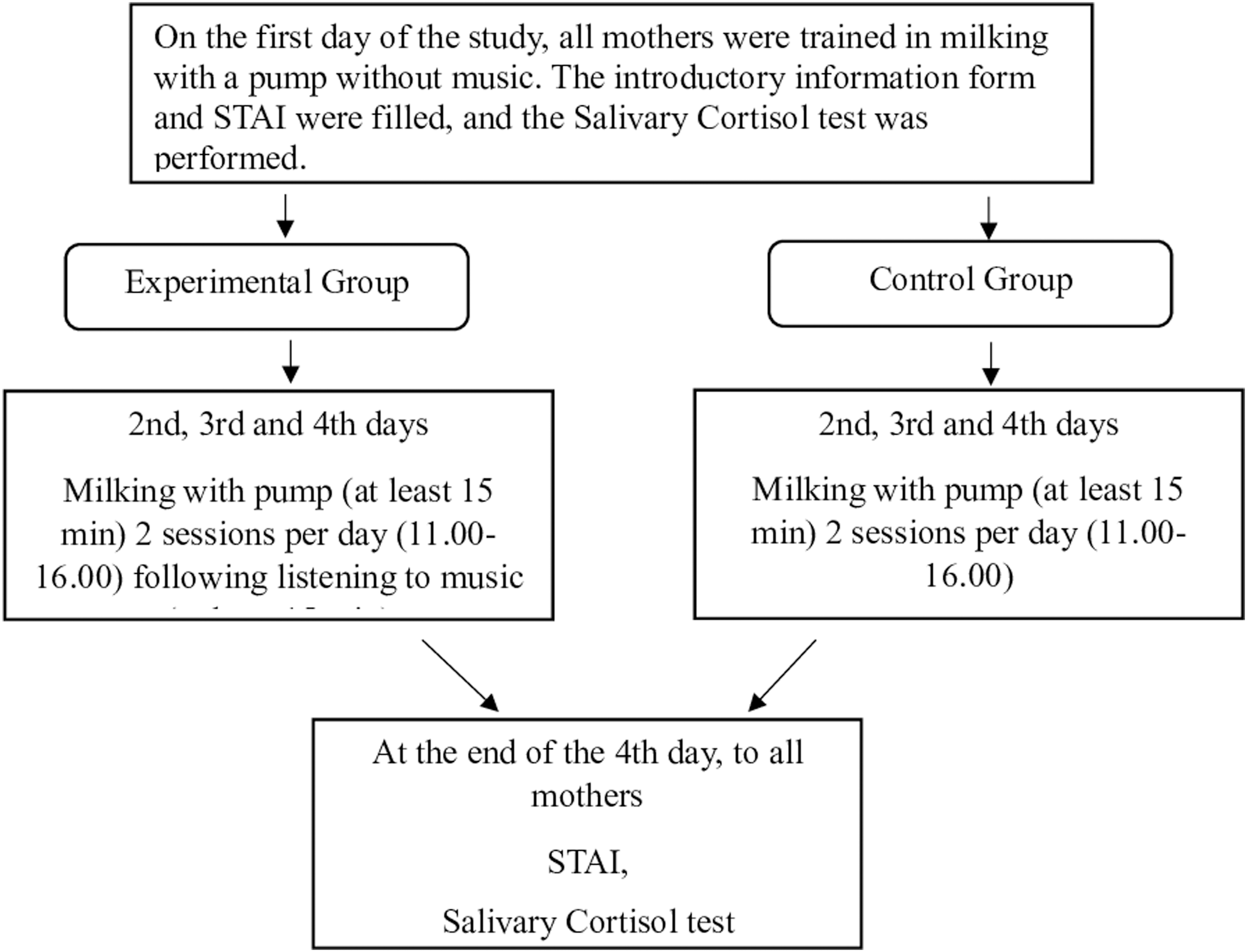
Research flowchart.
Statistical analysis
The Statistical Package for the Social Sciences (SPSS) 22.0 package program was used to evaluate data obtained from this study. The Mann–Whitney U test and Wilcoxon signed-rank test were used in comparisons, the chi-squared analysis was used to determine the homogeneity of the participants in terms of their descriptive characteristics, and the Spearman correlation analysis was performed to test the relationship between dependent variables.
Results
The mean age of the mothers in the study was 27.7 ± 5.2 years in the MG and 29.2 ± 5.3 years in the control group; there was no difference between the groups (p > 0.05). Most participants were high school graduates and housewives, had a higher income than their expenses, and had a nuclear family structure; overall, the characteristics of both groups were similar in terms of education, profession, income status, and family structure (p > 0.05).
There was no difference in mean gestational week, with 31.79 ± 2.32 weeks in the MG and 32.63 ± 2.16 weeks in the control group (p > 0.05). The birth weights of the newborns in the MG were nonsignificantly lower in the MG compared with the control group (MG: 1,625.4 ± 557.2 g; control: 1,885.3 ± 484.9 g; p > 0.05).
No statistical difference was found between groups in breast milk production across days and sessions (p > 0.05). The mean breast milk production across groups was 2.2 ± 3.58 mL on the first day and 51.8 ± 29.17 mL on the fourth day. Breast milk production was significantly higher in the MG compared with the control group on the third and fourth days (p < 0.001) (Table 1).
The Amount of Breast Milk Increase for Participants
The pretest mean score across participants on the STAI-A was 46.7 ± 6.7 and was 44.4 ± 3.1 for the STAI-B score; there was no difference between these scores across groups. The final STAI-A mean score of the MG was significantly higher than the control group (MG: 46.2 ± 3.5; control: 40.1 ± 6.1) (p < 0.005), indicating a reduction in anxiety scores of the mothers who listened to music. The final STAI-B score of the mothers in the MG was 42.1 ± 3.9 and the final test STAI-B score of the participants in the control was 42.6 ± 3.5; no statistical difference was detected between the two groups (p > 0.05) (Fig. 3). Therefore, there was no change in trait anxiety scores. However, a comparison of pretest STAI total scores with final test STAI total scores revealed significantly lower total scores in the MG compared with the control group (p = 0.010).
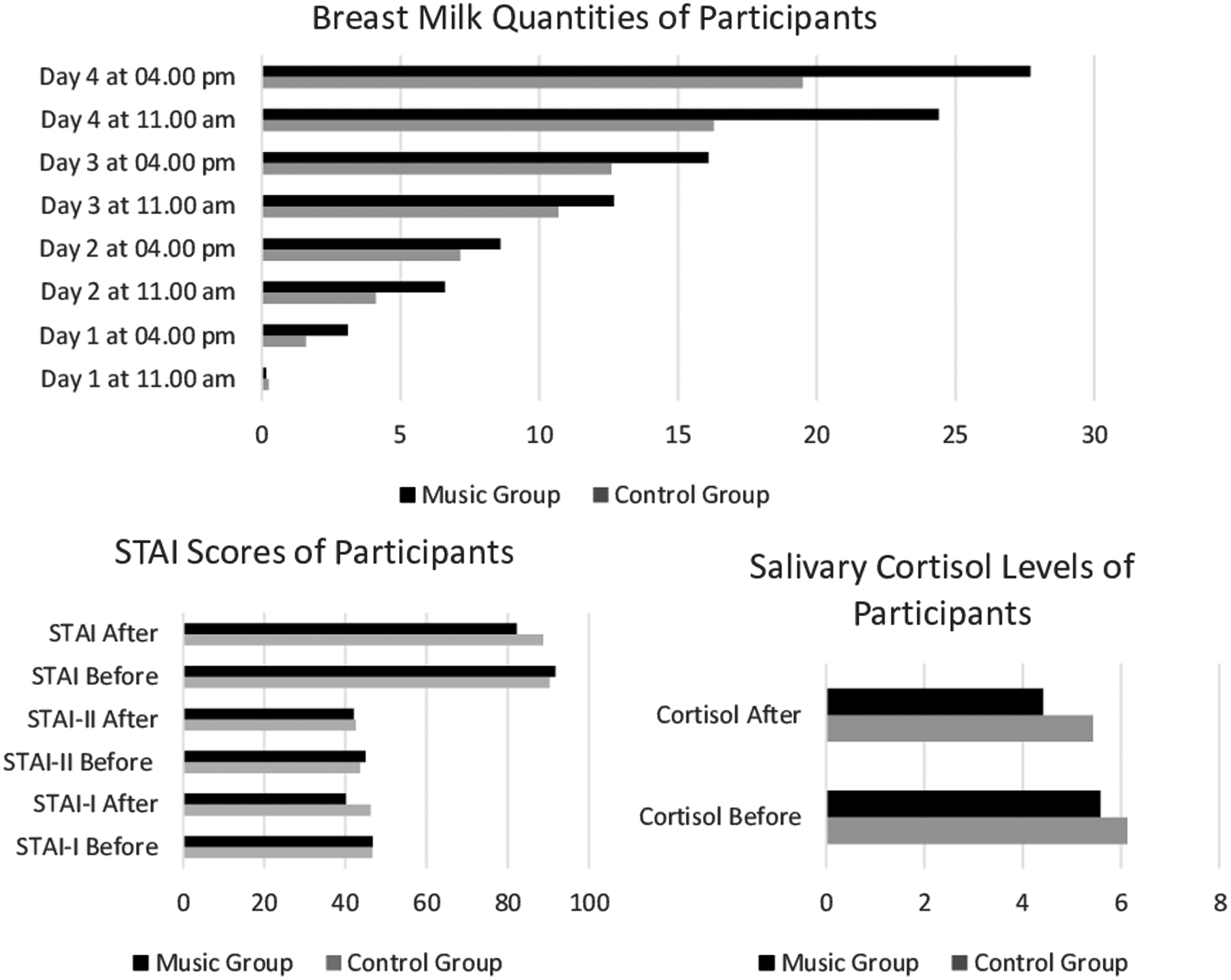
Pre–post changes among three sessions.
The mean pretest salivary cortisol levels in the MG were 5.58 ± 2.78 nM and the final test levels were 4.42 ± 1.69 nM; differences between measurements were statistically significant (p < 0.05). The final test saliva cortisol level in the control group (5.43 ± 2.81) was lower than the pretest (6.13 ± 3.22) levels, but there was no statistically significant difference between measurements (p > 0.05) (Table 2).
The Saliva Cortisol Level of the Participants
Participants in the MG frequently listened to music in their daily lives (40%) and most mothers (65%) listened to music to relax; 60% of the MG reported listening to music often at home and 35% said they still listened to music sometimes after being discharged.
Discussion
In this study, breast milk production was similar overall across groups. However, there was a significant increase in breast milk production of mothers in the MG compared with mothers in the control group on the third and fourth days. On these days, mothers reported feeling relaxed with low anxiety levels; in addition, saliva cortisol levels were lower in the MG compared with the control group at these time points as well. Although there was no significant difference between the MG and control in pretest state, trait, and total anxiety scores, mothers in the MG had significantly reduced final test state and total anxiety scores of the STAI-A and B compared with mothers in the control group; however, there was no difference in trait anxiety levels. The mean salivary cortisol level of the MG was 5.58 ± 2.78 nM in the pretest and 4.42 ± 1.69 nM in the final test; the difference between the measurements was statistically significant (p < 0.05). The final test saliva cortisol levels of the control group (5.43 ± 2.81 nM) were lower than pretest (6.13 ± 3.22 nM) levels, but there was no statistically significant difference between measurements (p > 0.05).
A previous study reported that the amount and volume of breast milk of mothers with premature infants in the NICU who listened to music significantly increased for 1 week. 19 Similarly, in a study where MT was applied to mothers with premature infants in the NICU, salivary cortisol levels were found to be lower and the amount of breast milk was found to be higher during music sessions. 3 In addition, breast milk production significantly increased after the music session on the last day. These results support the findings of a significant increase in the amount of breast milk production in the MG after the third day in this study.
In a study to determine the effect of listening to music on breast milk production in mothers with infants in the NICU, stress levels and depression scores were found to be lower in the MG and control groups. The authors attributed these findings to the low sample size (n = 3), as some mothers left the study. 20 These results demonstrate the difficulty of conducting long-term follow-up studies of newborns in the NICU and coincide with the limitations of this study, where the short-term stay of infants in the NICU and the fact that the mothers did not attend the follow-ups after discharge reduced the number of planned samples. The number of samples and follow-ups should be increased to more broadly determine the effect of music on breast milk production.
One study showed a significant increase in relaxation scores in the MG compared with the control group but no significant impact on breast milk production. This finding was also attributed to the low number of samples and external factors, as it was unknown how many times mothers provided milk with pumps during follow-up. 21 Similarly, we could not determine how many times the MG and control group provided milk with pumps outside of the follow-up sessions. Although all mothers were trained on pumps on the first day of the study, mothers were not supervised, which can be an important determinant in increasing breast milk production. It is recommended to provide milk by pump at least six to eight times a day to increase the amount of breast milk. 22 Therefore, in future studies, it would be more appropriate to measure breast milk production and record the number of times a day milking is performed and note them on daily follow-up forms.
The effect of listening to music with visual content on breast milk production and the fat and calorie content of the breast milk of mothers with premature infants in the NICU was evaluated. All mothers were supplied with a double-sided electric pump. Researchers found that breast milk production was significantly increased in the MG compared with the control group. 10 In addition, it has been shown that double-sided electric pumps are superior to other pumps in increasing breast milk production.23,24 In this study, the use of one-sided manual electric pumps and the short follow-up period may have negatively affected breast milk production and measurements.
In another study to determine the effect of MT, breast milk production of mothers with premature infants in the NICU was measured twice a day with music and twice a day without music. Although there was no difference in production according to the music sessions on the first and second days of the study, there was an increase in the production during sessions with music on the third and fourth days. 25 These results support the findings in our study, suggesting that MT may take a few days to show benefits on breast milk production.
In studies on mothers with premature infants in the NICU, breathing exercises along with music were reported to reduce anxiety and stress levels, and listening to music was reported to have positive effects on maternal anxiety and depression scores.26–29 These findings support the results of lower state and total anxiety scores in this study. Music provides relaxation to mothers and decreases their levels of stress and anxiety such that the amount of breast milk and its fat content increases. In studies conducted in this direction, it was reported that music provided relaxation to mothers and decreased their levels of stress and anxiety, maternal attachment increased such that the amount of breast milk and its fat content increased.7,10,21,30–33
Limitations of the Study
The follow-up period of the study was limited to 4 days due to discharge times from the hospital. Other limitations include having the mothers listen to music in patient rooms from the second day onward and the presence of other patients in patient rooms. In addition, the number of times the mothers provided milk with pumps and how much they provided were not measured; the mothers only stated orally that they took this into consideration.
Conclusion
This study suggests that music can be used to increase breast milk production in mothers with premature newborns. Music sessions are low in cost, provide rapid effects, and have a positive effect on stress and anxiety levels and depression risk by helping mothers relax. Women's health clinics should evaluate the psychosocial status of the parents and consider incorporating music sessions into nursing interventions.
Ethics Committee Approval
Approval was obtained from the Clinical Research Ethics Committee of the Rectorate of Bezmialem Vakıf University for the evaluation of the ethical suitability of the research. An institutional permit was obtained from both hospitals and an informed consent form was obtained from each participant.
Footnotes
Disclosure Statement
No competing financial interests exist.
Funding Information
No funding was received for this article.