




Abstract
Objective:
Excessive gestational weight gain (GWG) and postpartum weight retention are risk factors for female obesity. The aim of the study was to assess postpartum weight change patterns among 64 Turkish, exclusively breastfed to 6 months and continued to 1 year and beyond, mothers during 1-year follow-up.
Materials and Methods:
Postpartum women's sociodemographic characteristics and breastfeeding patterns were obtained and anthropometric measurements were determined at five time points (1st, 3rd, 6th, 9th, and 12th months).
Results:
Mean GWG was 12.2 ± 5.8 kg and mean postpartum weight retention was 4.2 ± 4.9, 4.6 ± 4.8, 3.7 ± 5.4, 2.8 ± 5.0, and 3.3 ± 5.5 kg at 1st, 3rd, 6th, 9th, and 12th months, respectively. According to the results of repeated measure analysis of variance (ANOVA), there was significant time effect in body weight (F = 6.509; p = 0.001), body mass index (BMI) (F = 6.743; p = 0.001), and weight retention (F = 6.509; p = 0.001) measured over 1 year. Bonferroni multiple post hoc tests results showed similar significant changes between 1st–9th months (p < 0.05), 3rd–6th months (p < 0.05), 3rd–9th months (p < 0.05), 3rd–9th months (p < 0.001), and 3rd–12th months (p < 0.05) for body weight, BMI, and weight retention. Two-way repeated measures ANOVA of body weight, BMI, and weight retention by time showed significant interactions for employment status (p < 0.05) and prepregnancy BMI (p < 0.05).
Conclusion:
These findings highlight the importance of weight management starting from pregnancy to postpartum 1 year.
Introduction
Excessive gestational weight gain (GWG) and postpartum weight retention are risk factors for female obesity, 1 and it is suggested that up to 50% of women gain weight above the Institute of Medicine (IOM) guidelines during pregnancy. 2 Women who return to their prepregnancy weight by about 6 months have a lower risk of being overweight 10 years later. 3 The main reasons why breastfeeding mothers cannot return to their prepregnancy weight 4 are factors such as the mother's age,5–9 socioeconomic status, 10 working status, and educational level, 11 and they are also associated with postpartum weight retention risk.
Increased prepregnancy body mass index (BMI) and inappropriate GWG have been identified as risk factors for postpartum weight retention, perinatal complications, and subsequent maternal and child health. 12 Recommended optimal weight gain for normal weight and obese women during pregnancy varies between 11.5–16.0 and 5.0–9.0 kg, respectively. 13
Most of the studies on postpartum weight changes have been conducted in the USA, Brazil, and India.1,14–20 However, similar longitudinal research in Turkey is lacking.
The main aim of the present study was to assess maternal weight change patterns during the first year postpartum among mothers who breastfed to 6 months and continued breastfeeding. The secondary aim was to identify factors known to be associated with postpartum maternal weight retention such as sociodemographic characteristics, prepregnancy BMI, and GWG, which will provide important data to develop strategies for better health outcomes for both the mother and the infant.
Materials and Methods
Participants and study design
The current descriptive study was carried out between February 2013 and May 2014, enrolling a convenience sample of mothers who brought their babies to the University of Marmara well-child outpatient clinic during the 3 months study recruitment period. The visits were scheduled at 1, 3, 6, 9, and 12 months. Inclusion criteria included healthy, older than 18 years of age, and nonsmoking mothers who intend to exclusively breastfeed, with primiparous, singleton births, and full-term infants. Exclusion criteria included refusal of consent, women <18 years, pregnancy duration <37 or >42 weeks, who reported complications, including high blood pressure and preeclampsia, and diabetes during pregnancy. Women who discontinued exclusive breastfeeding during the first 6 months and breastfeeding during the first 12 months were excluded from the follow-up assessments. The available pool of mother-infant dyads was 535 per year.
The sample size of this study was calculated with the MedCalc software, which was designed as a general independent power analysis program. Siega-Riz et al., 10 using the mean scores of the postpartum weight retention, in their study, calculated the effect size as 0.95, with 80% power, and type I and type 2 error rates were 0.05 and 0.20, respectively; it was calculated that the number of mothers to be sampled should be 58 according to repeated measure ANOVA test. Assuming exclusive breastfeeding for 6 months and breastfeeding for more than 12 months, the sample size estimate was 160 above the participant size (n = 58), given the 20% dropout rates and the power analysis result. One hundred forty participants were reached in 3 months period. The dropout rate was 5.0%, 24.8%, 9.0%, and 21.0% at 3rd, 6th, 9th, and 12th months, respectively. After the losses, 64 participants have completed the study. Reasons for dropouts and loss of follow-up were recorded (Fig. 1).
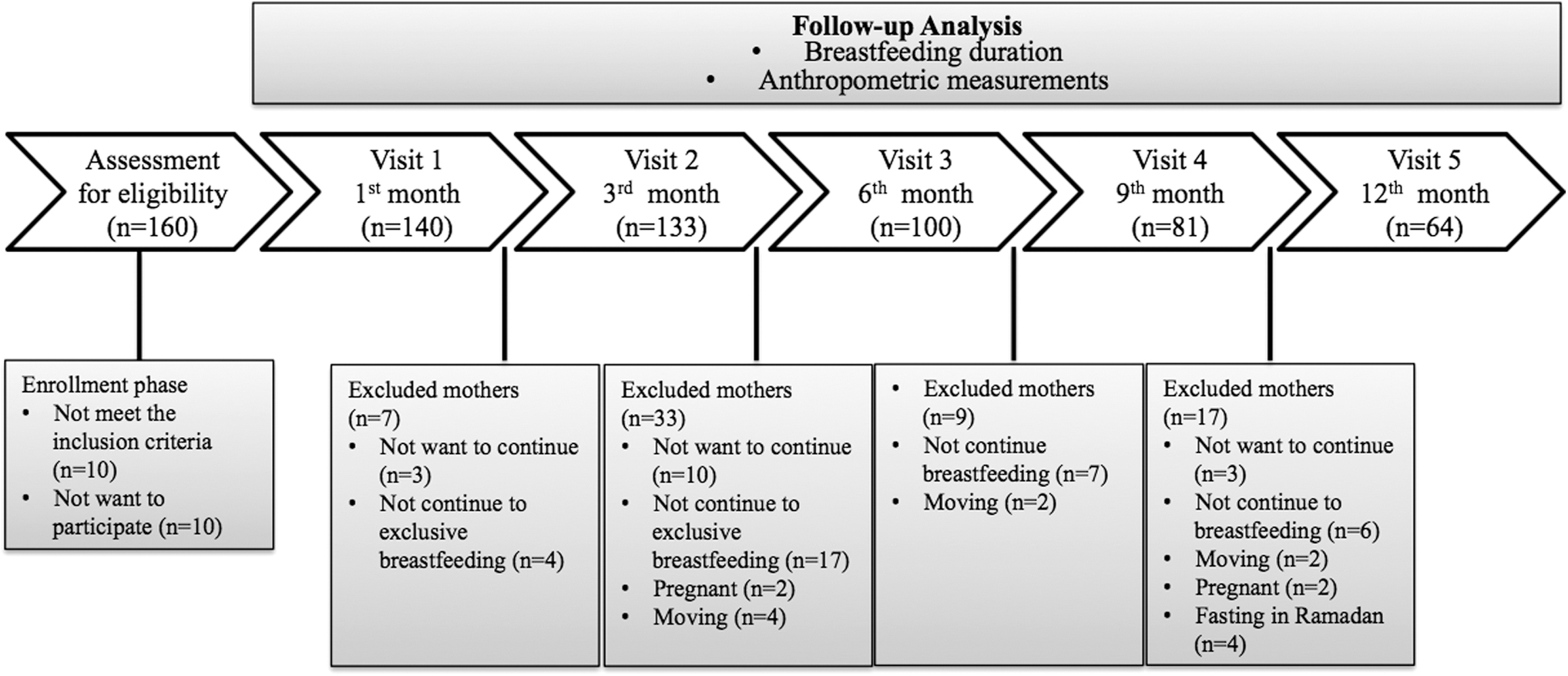
Flowchart of participants and samples.
Outcome measures
Baseline
Anthropometric measurements took place at the first-month baseline visit on recruitment. The height and body weight of each participant were measured to the nearest 0.5 cm and 0.1 kg, respectively, while barefooted and in light clothing, using an Omron digital bathroom scale and a SECA stadiometer. BMI was calculated using the formula: BMI = weight (kg)/height (m2). Each measurement was repeated two times, and the mean value was calculated. Prepregnancy weight and weight at delivery recalled at the first baseline visit were recorded. Prepregnancy BMI was categorized according to the World Health Organization (WHO) classification as underweight (BMI <18.5 kg/m2), normal weight (BMI = 18.5–24.9 kg/m2), overweight (BMI = 25.0–29.9 kg/m2), and obese (BMI ≥30.0 kg/m2). 21 Documented GWG was calculated by subtracting the prepregnancy weight from weight at delivery. GWG percentage (ratio of observed GWG to expected GWG multiplied by 100) was divided into three categories according to the IOM criteria as inadequate, adequate, or excessive. 2 Postpartum weight retention was calculated by subtracting the prepregnancy weight from the current weights at each time point during the 1-year follow-up.
Face-to-face interviews were conducted at baseline to collect detailed information about maternal age, education level, employment status, income status, and breastfeeding status.
Follow-up
Follow-up weight measurements and infant feeding data (breastfeeding, weaning) were collected at 1st, 3rd, 6th, 9th, and 12th postpartum visits. During the follow-up visits, the body weight of the women was measured, and postpartum weight retention was calculated by subtracting the prepregnancy weight from the current weights at each time point during the 1-year follow-up. Breastfeeding status was assessed by asking if they were still exclusively breastfeeding their infants. Women who were no longer breastfeeding exclusively were excluded during the 6 months follow-up visits. Women who exclusively breastfeed at 6 months and breastfeed beyond with the introduction of complementary foods were included in the final analyses.
Statistical analyses
All statistical analyses of study data were performed using SPSS 16.0 (SPSS, Inc., Chicago, IL) program. Continuous variables were presented as means and standard deviation. The variables' distributions were assessed for normality with the Kolmogorov-Smirnov test. Follow-up measures were analyzed with repeated measures analysis of variance (ANOVA) followed by a post hoc Bonferroni test. Two-way ANOVA in repeated measures was used to interpret the impact of prepregnancy BMI, maternal age, educational level, and income level on body weight, BMI and weight retention, time and parameters time interactions. Mauchly's test was used to test the assumption of sphericity. Greenhouse-Geisser corrections were used where sphericity could not be assumed, and the results were interpreted by using the F value and p-value in the “Sphericity Assumed” line. The significance level was accepted as p < 0.05.
The study was approved by the Clinical Studies Ethics Committee of the Marmara University of Medical School (01.2013.0023). Written informed consent was obtained from all participants before the study.
Results
This study was conducted with 140 mothers at 1st month, 133 mothers at 3rd month, 100 mothers at 6th month, 81 mothers at 9th month, and 64 mothers at 12th month. Nearly half of the mothers (48.4%) were primary school graduates. Fifty-eight mothers (90.6%) were housewives, and mean age was 29.8 ± 5.6 years (18.0–42.0 years). Sixty-six percent of the infants were born by cesarean section and the duration between the two pregnancies was 68.8 ± 44.1 months (median 60.0 months). Of the total 64 subjects, 48.5% were overweight or obese, at the beginning of their pregnancies, prepregnancy BMI was 25.4 ± 4.6 kg/m2, and mean GWG was 12.2 ± 5.8 kg. While 34.4% of women gained excessive weight during pregnancy, the other remarkable result was that 20.3% gained insufficient weight (Table 1).
Maternal Characteristics
BMI, body mass index; GWG, gestational weight gain; min.–max., minimum–maximum.
Weight changes stratified by BMI, GWG, and employment status during 1-year follow-up were illustrated in Figure 2a–c, respectively. It was observed that underweight and normal weight mothers' weight decreased between the 1st and 12th months, while overweight mothers' weight increased by 1.04 kg, and obese mothers' increased by 6.86 kg. According to the GWG classification, it was found that the weight decreased (1.97 kg) in mothers with excessive GWG. While the weight of nonworking mothers did not change in any of the time points, working mothers' weight decreased by 5.1 kg until the 9th month and then increased by 0.3 kg between the 9th and 12th months.

While weight retention decreased in underweight and normal weight mothers during the 1-year follow-up, it showed a slight increase in overweight mothers (1.6 kg), and a higher increase in obese mothers (4.6 kg) (Fig. 3a). Weight retention was not observed in inadequate GWG group (−0.17 kg), while 2.33 kg weight retention was observed in adequate GWG group, and 6.5 kg in the excessive GWG group (Fig. 3b). While weight retention at the first time point in working mothers was two times higher compared to nonworking mothers, it was lower than 9th and 12th compared to nonworking mothers (Fig. 3c).
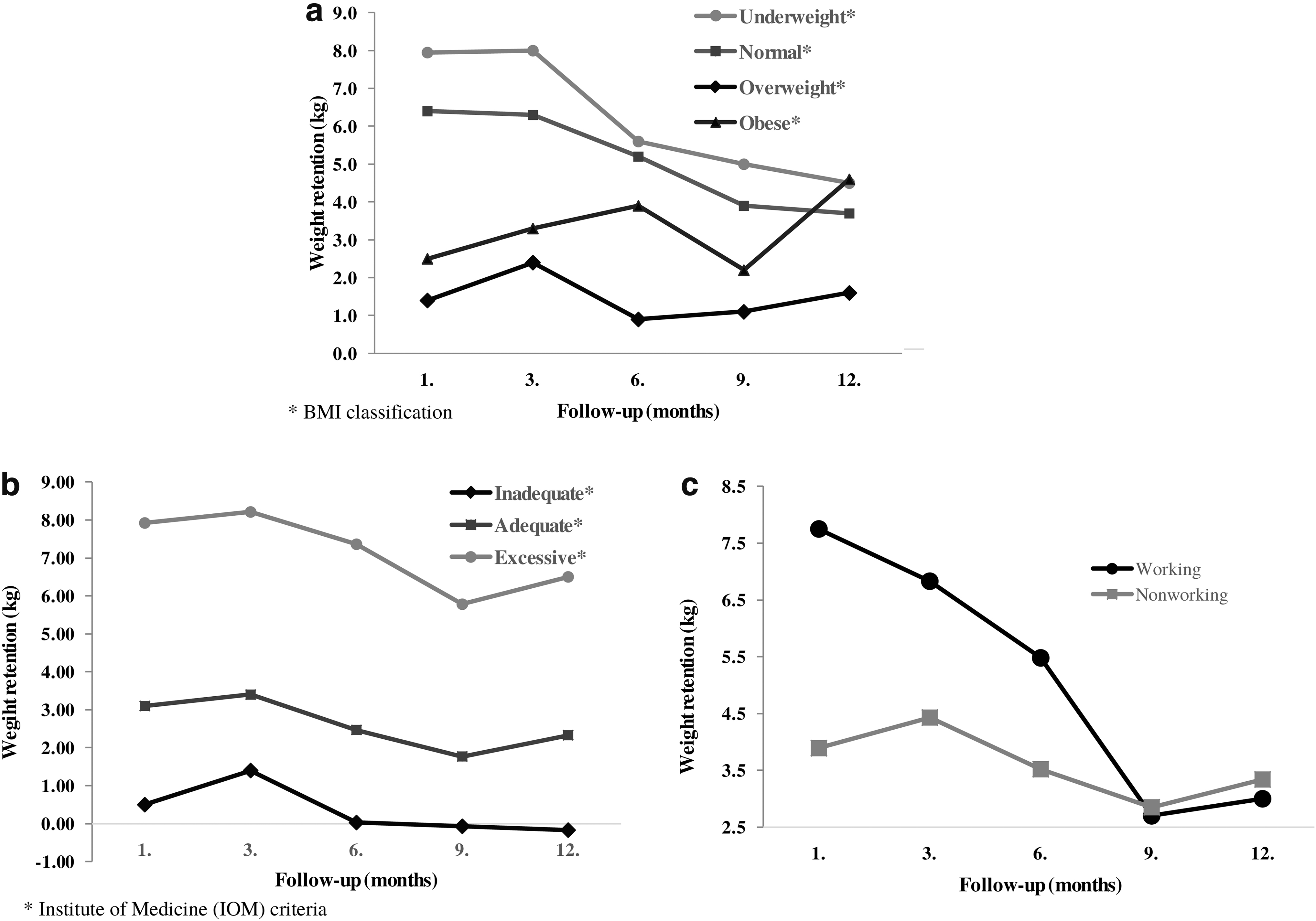
Longitudinal change in mothers' weight, BMI, and weight retention showed a similar pattern; increased at 3 months, decreased between the 3 and 9 months, and increased at 12 months (p = 0.001). The two-way repeated measures ANOVA of mothers' weight, BMI, and weight retention indicated a statistically significant main interaction for time × employment status (p = 0.05, F = 3.215; p = 0.05, F = 3.189; p = 0.05, F = 3.215, respectively). Likewise according to the two-way repeated measures ANOVA of mothers' weight, BMI, and weight retention indicated a statistically significant main interaction for time × prepregnancy BMI (p = 0.05, F = 2.510; p = 0.05, F = 2.388; p = 0.05, F = 2.510, respectively). Maternal age, educational status, number of children, duration between pregnancies, and GWG did not show an interaction according to the two-way repeated measures ANOVA analysis (p > 0.05).
Discussion
In this sample of Turkish mothers who exclusively breastfed to 6 months and continued breastfeeding to 1 year, we observed that 3.3 kg of GWG was retained at 12 months postpartum. This study described in detail the weight trajectory of postpartum women during the first postpartum year, along with factors known to be associated with the weight trajectory. While a fluctuating trajectory was observed in weight retention, it was determined that prepregnancy BMI and maternal employment status significantly affected this trajectory. Excessive weight gain during pregnancy was shown in 34.4%, but it was insufficient in 20.3%. Postpartum weight retention was ≥5 kg in 34.4% of the mothers at 1 year.
It is suggested that high GWG is in itself a risk factor for long-term weight gain. In the literature, weight gain during pregnancy varies between 13 and 15.9 kg, depending on prepregnancy BMI.1,16,22 In addition it was shown that 14% to 43% women gained excessive weight during pregnancy.18,20 In our study the GWG was 12.2 kg in women with an average prepregnancy BMI of 25.4 kg/m2. In line with the previous studies, excessive weight gain was shown in 34.4% of the women. However, literature also shows that GWG is insufficient in 33% to 41.4% of the women.18,20 In our study, GWG was insufficient in 20.3%.
Previous studies showed a strong and positive association of GWG with postpartum weight retention.5,16,18,23–25 On the contrary, although GWG did not affect weight retention significantly at any of the five time points, weight retention was highest with 6.5 kg in the excessive GWG group in this study.
Study results are controversial around the issue of prepregnancy weight impact on postpartum weight retention. Some studies found that prepregnancy weight predicted a high postpartum weight trend, 6 others showed that high BMI before pregnancy is not associated with greater risk of postpartum weight retention.5,7,20 In this study, prepregnancy BMI was high, with 48.5% of women either overweight or obese. Furthermore, prepregnancy weight had a significant effect in postpartum weight retention reduction between 3rd and 12th months. Weight retention was highest in obese mothers according to the prepregnancy BMI.
The study conducted by Jiang et al. found that 84.24% of mothers returned to their normal BMI in 12 months postpartum, 12 whereas in this study, almost half (40.6%) of the mothers returned to their normal BMI in 12 months postpartum.
According to the study of Nagpal et al., 91.3% of mothers retained weight in 1 year postpartum period. 26 In another study, about 75% of women were heavier than prepregnancy weight 1 year after birth. 27 Similar to other studies, only 28.1% of the mothers returned to prepregnancy body weight in the postpartum first year. In the study of Olson et al., it was observed that mothers had a weight retention of 1.51 ± 5.95 kg in the postpartum first year. 28 In our study, weight retention was 3.3 kg almost twice the amount observed in Olson et al. study. Compared to previous studies, weight retention was higher than expected.26–28
A systematic review demonstrated that 20% to 25% of women retain greater than 5 kg postpartum. 26 In our study, 34.4% of women retained more than 5 kg at 1 year postpartum, which was higher than reported in the literature.
Studies conducted in different countries have shown that the weight retention varies according to the socioeconomic status.23–25 Weight retention was significantly higher in women with low to moderate socioeconomic status (3.2 kg) than women with high socioeconomic status (1.8 kg). 23 At 12 months being underweight, excessive GWG and low maternal education level were associated moderately with weight retention, whereas GWG, maternal age,19–23 and not working were associated strongly with weight retention. 24 In the cohort study conducted in Brazil, it was found that women with higher educational level and who are married tend to have lower weight retention during the postpartum period. 25 In this study, we found an effect of employment status and prepregnancy BMI on postpartum weight retention. While weight retention was higher in working mothers at the first time point, it was similar compared to nonworking mothers at the end of the year. In addition, weight retention decreased in underweight and normal weight mothers according to prepregnancy BMI, while it increased in overweight (1.6 kg) and obese mothers (4.6 kg). The study did not find any effect of maternal age, education, income status, GWG, and duration between pregnancies on postpartum weight retention at five time points.
The strength of the present study includes using a prospective longitudinal design. The longitudinal design of the study allowed us to look at changes over time. Limitations of the study include self-reported weight of prepregnancy, which might under or overestimate the actual measure. Although the study has sufficient statistical power, the findings apply to a select group of women who are able to sustain optimal breastfeeding practices. It should be noted that post hoc analyses could not be conducted on women who were excluded from the study due to missing data, limiting the generalizability of the findings.
Conclusions
Approximately half of the women returned to normal BMI in the 12 months postpartum. The postpartum period presents as an important life stage to influence long-term obesity risk. Ultimately, intervention researches and health policies toward supporting maternal weight management could avert obesity among postpartum women. Well-child visits during the postpartum period should be considered as an opportunity for weight management interventions for women to promote maternal and child health outcomes.
Footnotes
Authors' Contributions
S.A. and P.B. designed the study. S.A. and P.B. collected the data. P.B. analyzed the data. S.A. and P.B. contributed materials and analyzed. S.A. and P.B. prepared and finalized the draft of the article. Both authors read and approved the final article.
Acknowledgments
The authors thank all the mothers who participated in this study. We are very grateful to the health extension workers.
Disclosure Statement
No competing financial interests exist.
Funding Information
No funding was received for this article.