




Abstract
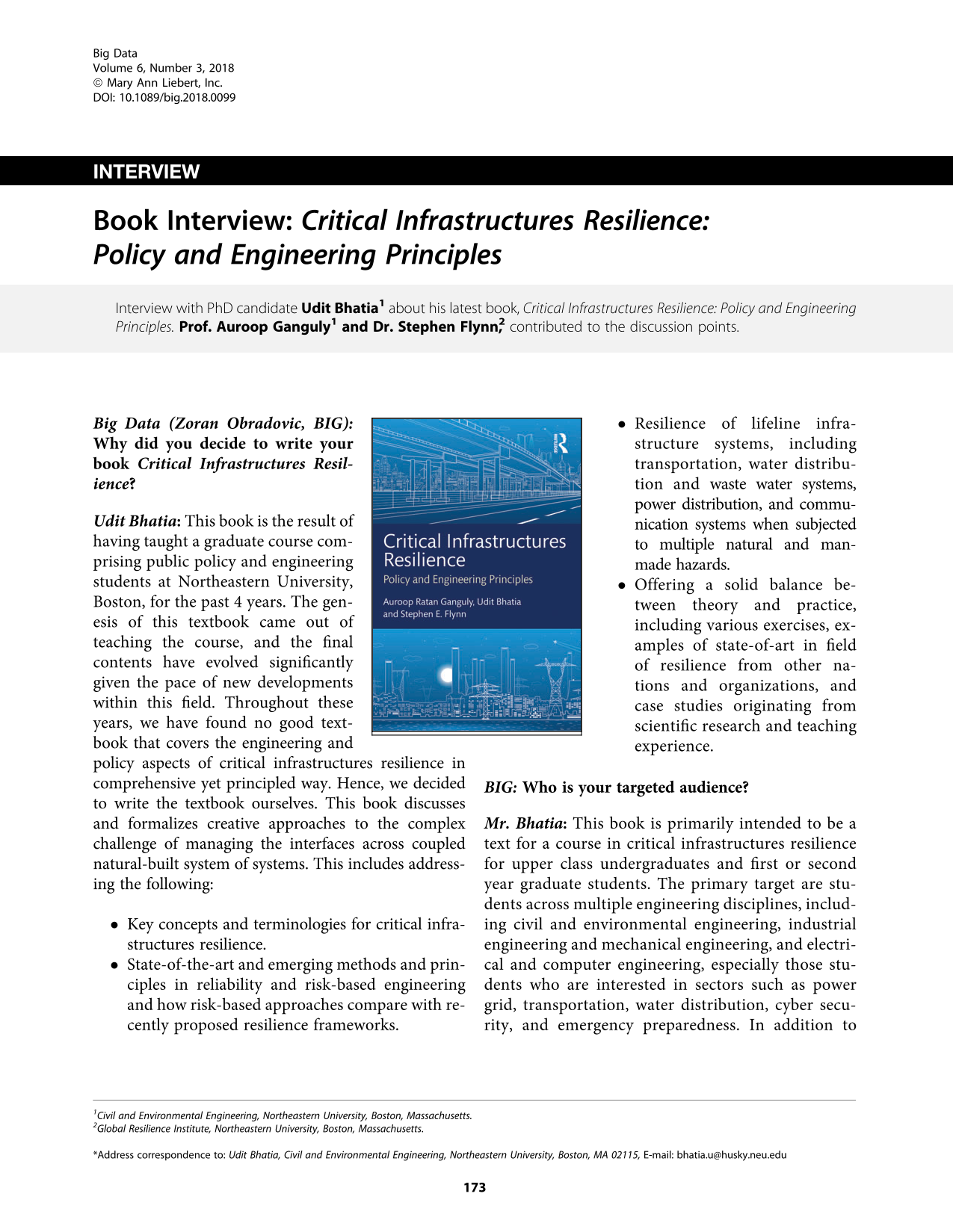

Key concepts and terminologies for critical infrastructures resilience. State-of-the-art and emerging methods and principles in reliability and risk-based engineering and how risk-based approaches compare with recently proposed resilience frameworks. Resilience of lifeline infrastructure systems, including transportation, water distribution and waste water systems, power distribution, and communication systems when subjected to multiple natural and man-made hazards. Offering a solid balance between theory and practice, including various exercises, examples of state-of-art in field of resilience from other nations and organizations, and case studies originating from scientific research and teaching experience.
The materials covered, including the case studies, are drawn from a flipped classroom course taught at Northeastern University in the area of critical infrastructures resilience where the students were drawn from both engineering and policy, participated in role playing negotiations, or war games across infrastructure sectors in the context of a major infrastructure owner and operator, with tailored assignments. Undergraduate students in policy or engineering who are interested in understanding the engineering or policy aspects, respectively, of resilient recovery and design, which are not taught in either curricula currently, may treat this book as a reference. In addition, with the Presidential Policy Directive on Critical infrastructure Security and Resilience, the efforts to strengthen and maintain secure, functioning, and resilient critical infrastructure are growing and are expected to increase in near future. Hence, this book would serve as a reference for practitioners and working professionals for their usual disciplinary training.
Chapter 3 discusses the concept of hazard modeling, different categories of hazards, their nature of evolution, and approaches to understand these hazards. This chapter also introduces the concept of nonstationarity in risks, with specific focus on climate-related hazards. The extent to which a hazard turns into disaster depends on exposure, and vulnerability is also discussed in this chapter.
Chapter 4 further elaborates on the concepts of resilience paradigm, which includes elements of risk assessment but goes further. Although risk management approaches focus on identifying, assessing, and taking steps to reduce risk to an acceptable level, resilience paradigm aspires to design effective and efficient recovery strategies in advance, which entails reducing downtimes, and even learning from hazards to reduce fragility. This chapter discusses opportunities and challenges, including emerging methods and tools, with specific resilience examples on individual and interconnected lifeline infrastructure networks at both the regional and urban scales.
Chapter 5 discusses various impediments and opportunities for critical infrastructure resilience policies. Whole developed nations have already started to take steps toward building resilience, developing and emerging economies are also beginning to catch up. However, devastating consequences of recent disasters across the globe have demonstrated that communities and nations (even developed nations) are still far from resilient. Hence, chapter 5 covers the policy measures for resilience that are necessary to both drive and work in tandem, with engineering and scientific approaches. One appendix is included that contains standard probability distribution tables required to solve exercises and examples throughout the book. We have often used transportation systems as an illustrative example in many examples and exercises. This choice is primarily guided by the availability of data sets that we have gathered over the course of years.
The field of critical infrastructures resilience is multidisciplinary and still evolving. In the first edition, we have tried to introduce novel concepts around related to the topic that has high societal urgency. To avoid repetitions and verbosity, we have alluded to research articles, case studies, and books that already pre-exist. Moreover, certain topics, such as life cycle analysis, agent-based modeling, artificial intelligence, cybersecurity, and cyber-resilience, are not covered extensively in this edition. We are planning proactively for second edition and we look forward to the feedback and suggestion of readers for second edition.