




Abstract

Elsevier, Amsterdam, The Netherlands, 2021.
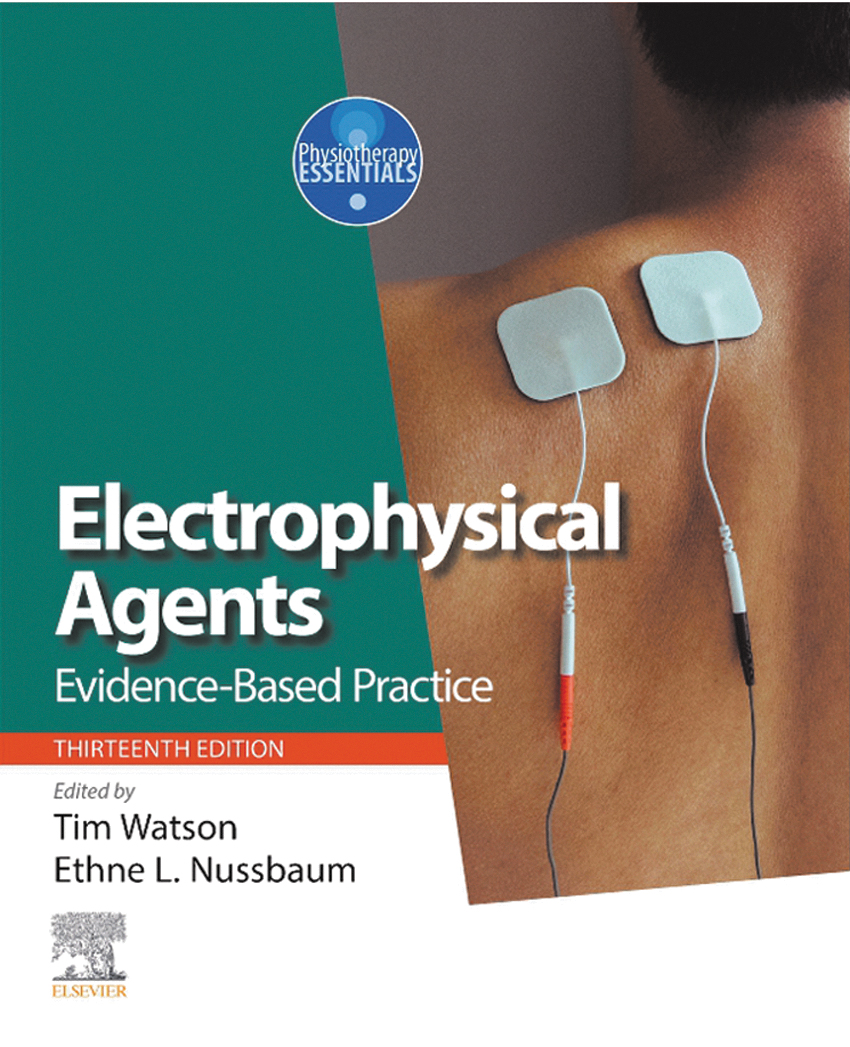
Anew title, and the addition of a new editor, continues the iterative approach to updating this popular text originally published in 1948 as Clayton's Electrotherapy and Actinotherapy. I recall the latter in its seventh edition as a student of physiotherapy, and in skimming through the 1975 edition as I write this, I marvel at how much we have learned in the field of “electrophysical agents” (EPAs) and how far the evidence has evolved. The editors of the 13th edition are experts and stalwarts in the field, and they have brought together a team of first-class contributors.
The editors have made the important observation that EPAs can be effective elements of treatment, and this writer agrees that EPAs form only one component of a well-structured plan of physiotherapy management. When applied with a full understanding of the underpinning science, evidence, and application methods and parameters, EPA can be a successful adjunct to treatment. This volume is an excellent up-to-date primer toward developing the necessary understanding for knowledgeable and successful clinical application.
The structure of the 13th edition is now a hybrid of efforts within the field to categorize different therapies under the broad umbrella of “EPAs.” There are seven sections, and the overall page number is not significantly different to the previous edition. There has been some restructuring of the earlier content. The remainder focuses on and integrates evidence of EPAs with the scientific concepts including physical principles and biophysiological effects of each EPA. As such, each chapter could stand alone but would be poorer without the preliminary content found at the start and end of the book. With the loss of physics as a stand-alone course of study in many physiotherapy programs across the globe, the biophysical constructs have been retained and these remain an important component of the text.
This reviewer found the historical context provided at the start of many chapters useful for providing the uninitiated reader with some understanding of the deep foundations upon which EPAs have developed, as well as being a perspective of how far the field has developed. An example is that of wearable devices producing energies that could once only be delivered by bulky machinery in hospital clinics. This development puts EPAs within the reach of people who need continued applications over extended periods potentially saving the costs associated with repeated clinic visits. Cost-effectiveness of EPAs is not dealt within the text but such research is only beginning to be published.
Given the advances in the clinical and biological sciences, the chapter on the neurobiology of pain and the overview of tissue healing and repair is underpinned by an extensive and updated list of references. The seminal references are still included and highlight the history and foundations of this fourth pillar of physiotherapy. It is important that chemical messengers have received some focus in Chapter 3, as many EPAs have been found to stimulate or inhibit these mediators and are likely to influence the effect mechanisms of many EPAs.
The images throughout are clear and pleasingly reproduced in shades of green. The captions are well referenced and provide necessary information to aid comprehension. The use of in-text boxed information to illustrate concepts or to highlight commonly sought information (such as the primary effects of an EPA) is a useful strategy that should assist the busy clinician. Photographic images are reproduced in black and white and are used judiciously to illustrate applications. In one instance, an appendix has been included to provide the authors with the scope to explicate concepts in greater detail than might otherwise have been acceptable within the body of the chapter.
Throughout the text, the matter of “dose” application for successful clinical outcomes is carefully considered. Authors appear to have been encouraged to highlight where sufficient evidence is available to inform successful dosing and applications in various clinical presentations, as well as pointing out where further research is required. This strategy contributes to the reader's knowledge about the process of clinical reasoning and choice of EPA.
The content coverage of the broad field of EPAs extends from the more traditional domains to the newest. Electrical stimulation retains its pre-eminent place with a chapter on the foundations of electrical stimulation and a further five chapters in a later section. EPAs such as paraffin wax and shortwave diathermy that have fallen out of favor in some parts of the world have been retained. This should be considered as a positive feature, as interest in EPAs is being rekindled and new evidence from pragmatically and rigorously designed comparative clinical studies is coming to light. The loss of such information would be a setback to the profession.
Newer EPAs such as radiofrequency and shockwave (and arguably vibration) therapies are included in this new edition and may yet see EPA use revitalized in parts of the profession where they have almost disappeared. This volume keeps alive the history and the evidence for when that day arrives. It is good to see that laser is treated as a stand-alone and not lumped into the broader field of photobiomodulation (PBM) where other forms of light therapy have found a home.
However, the chapter on laser misses two opportunities. The first is the omission of information inclusion of laser PBM in international guidelines such as the National Institute for Health and Care Excellence (https://www.nice.org.uk/guidance/ipg615). The second is the exponential development of transcranial PBM as a potential method for treating signs and symptoms of neurodegenerative conditions where there is no effective medical treatment.
Another form of light therapy also has its own chapter. Content on ultraviolet therapy has been retained in this edition. This is considered wise as, in the hands of the skilled practitioner, the evidence indicates that it continues to be an effective method of wound management. Along with blue light therapy with its bactericidal effects, and the advent of easier methods of application, ultraviolet therapy may see a resurgence in places such as sub-Saharan Africa where tropical wounds are prevalent.
A highlight of this volume is the consistency of evidence that, on balance, continues to support EPAs in clinical practice. It is gratifying to see that the highest levels of evidence have been used as source data where possible. Yet, as is the case for many other treatments and approaches, more research is necessary to explicate dosing factors and target conditions for best effect. Indeed, this matter is acknowledged by a number of the contributing authors (e.g., treatment time and depth of field for shortwave diathermy).
Given the supportive evidence in the physiological effects of EPAs presented (e.g., in the electrical stimulation chapters), it is somewhat surprising that the clinical evidence in some cases can be weak. The authors take aim at the adequacy of the published clinical evidence and challenge clinical researchers to correct past mistakes. One author highlights that incorrect application of EPAs can result in ineffective clinical outcomes, therefore, individualization of treatment is a practical necessity where dosing guidelines do not exist.
The critique of the literature in each chapter provides a source for reflection. Where some EPAs have lost favor due to a purported lack of evidence (even though there is significant level of evidence), other methods such as cold-water immersion have little evidence, yet are used extensively in sports physiotherapy. It is useful to reflect on ultrasound as one of the most widely used EPAs in modern physiotherapy. The ultrasound chapter has been used to great effect to rebut the increasingly widely held perception that ultrasound has no evidence to support its use. The author capably draws out a critique of the scientific literature and summarizes where evidence exists and where research is still required. This approach makes this text a useful tool for identifying clinical research topics and for the refinement of clinical decision making.
The diagnostics section of the 13th edition (including electrodiagnosis and ultrasound imaging) has ensured that the field of EPAs continues to reflect what is new and contemporary, especially as the physiotherapy profession continues to evolve and become increasingly subspecialized.
Clinical safety is an important factor in the application of EPAs. In this text, reported cases of adverse events are identified where possible, but there is a dearth of such information generally in this field. Thus, the text is not only a great “jumping-off” point for the uninitiated, but also a “go-to” for teachers and students. Indeed, the final section on safe application of EPAs should be mandatory content for all students, physiotherapists seeking professional registration/licensing or re-entry to practice, and those who seek a well-rounded discourse on EPA theory and application.
Overall, the volume retains its relevance in the increasing diversity of the physiotherapy profession. The benefit of a textbook such as this, compared with published scientific articles, is the ability of the authors and editors to collate and summarize the field, providing information and perspectives that can be used to effectively critique scientific articles. Without a comprehensive foundational understanding of EPA biophysics, the physiological effects, and recommendations for safe application, researchers risk perpetuating mistakes in their research that will restrain advances in the field. More importantly, we risk ineffective use of EPAs for the benefit of patients.
Footnotes
Author Disclosure Statement
The author knows the editors of the book, through membership at various times between 2007 and 2019 of the World Confederation for Physical Therapy (World Physiotherapy) International Society for Electrophysical Agents in Physical Therapy.