




Abstract
Abstract
Introduction and Objectives:
The traditional approach to target a particular receptor is to design compounds that bind to the same site as the endogenous ligand, the so-called “orthosteric site.” However, recently the search has shifted to ligands that can interact with a different region of the receptor protein, the “allosteric site,” since this approach offers potential pharmacological and therapeutic advantages. The aim of our work was to explore the benzimidazole heterocycle as a novel scaffold for cannabinoid allosterism.
Materials and Methods:
We synthesized a series of novel benzimidazole-2-carboxamides, analogues of ORG27569, and performed their pharmacological characterization as CB1R allosteric modulators using competitive [3H]-CP55940 and [35S]-GTPγS binding assays.
Results:
The benzimidazoles
Conclusions:
Replacing the indole ring with a benzimidazole ring within the structure of ORG27569 abolished the binding of the resultant ligands to CB1R, but the modulation on the agonist-induced GTPγS binding was maintained.
Introduction
The traditional approach to target a particular receptor involves designing compounds, agonists or antagonists, that bind to the same site as the endogenous ligand, the so-called “orthosteric site.” However, recently, the search has shifted to ligands that can interact with a different region of the receptor protein, the “allosteric site,” since this approach offers potential pharmacological and therapeutic advantages. 1
One possibility to overcome the limitations of the “traditional” cannabinoids, interacting with the orthosteric sites on cannabinoid receptors, is to look for compounds that can bind to a different (allosteric) site.2,3 However, only a very limited number of chemical structures have been investigated as potential allosteric cannabinoid ligands (including endogenous and synthetical allosteric modulators). 4 Among them, worth mentioning are the indole carboxamides such as ORG27569 (Fig. 1), ORG27759, and ORG29647, 5 and some derivatives of these compounds,6–9 the urea compound PSNCBAM-1 10 and its recently published 11 and patented 12 analogs, or the cocaine-related structure RTI-371. 13
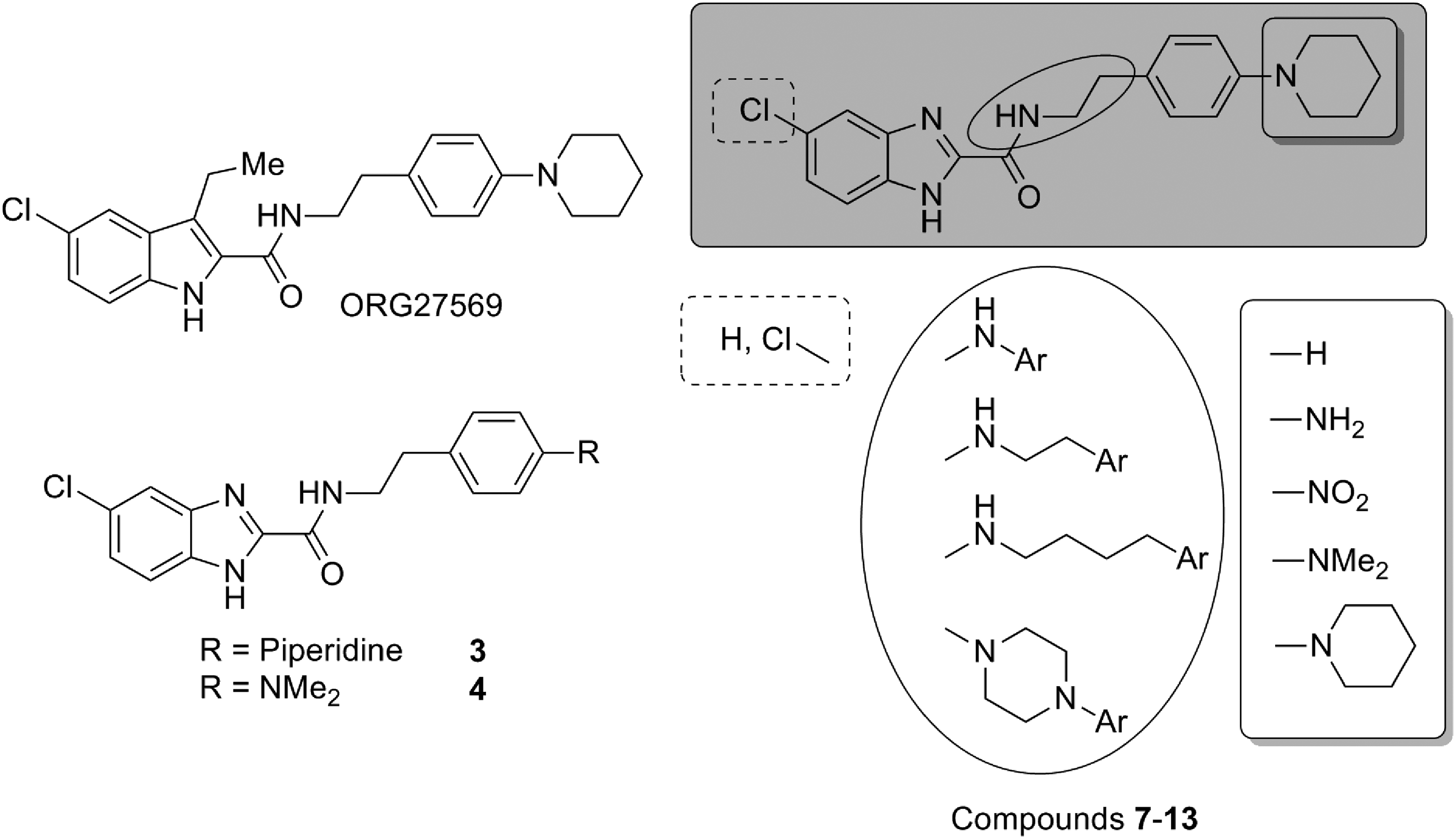
Structure of ORG27569 and of the synthesized benzimidazoles.
Several analogs of ORG compounds have been extensively studied by Kendall, Lu, and coworkers,7,14,15 but to date, the indole ring has not been replaced, with the exception of four benzofuran compounds, which had shown interesting properties.
14
Within this context, we decided to study the possibility of modifying the nature of the heterocycle in the ORG compounds, incorporating a benzimidazole ring. To explore this scaffold, structural and substituent changes have been undertaken on the benzimidazole, on the piperidine group, and on the length of the amide linker (Fig. 1). Once synthesized, the affinity of the new compounds for CB1R and CB2R has been measured in competitive [3H]-CP55940 binding experiments, and their efficacy as allosteric modulators has been evaluated in [35S]-GTPγS binding assays. Only compounds
Materials and Methods
Chemistry
The synthesis of compounds
5-Chloro-2-(trichloromethyl)-1H-benzimidazole (1 )
Methyl trichloroacetimidate (1.90 mL, 15.4 mmol, 1.1 equivalent [eq]) was added dropwise to a cooled solution of 4-chloro-o-phenylenediamine (2.00 g; 14.0 mmol, 1 eq.) in glacial acetic acid (25 mL). At the end of the addition, the dark reaction mixture was kept at room temperature for 1 h. Afterward, water (20 mL) was added to facilitate the product precipitation. The resulting residue was filtered off, washed with water, and dried under vacuum. It was purified by medium-pressure chromatography (Isolera, eluent: hexane →3:7 n-hexane/EtOAc) to give 3.05 g of
5-Chloro-1H-benzimidazole-2-carboxylic acid (2 )
5-Chloro-N-[4-(piperidin-1-yl)phenethyl]-1H-benzimidazole-2-carboxamide (3 )
A mixture of
5-Chloro-N-[4-(dimethylamino)phenethyl]-1H-benzimidazole-2-carboxamide (4 )
A mixture of
Pharmacology
Equilibrium binding assay
The equilibrium binding assays were performed as previously described. 16
[35S]-GTPγS binding assay
CP55940 was purchased from Tocris (Bristol, United Kingdom), [35S]GTPγS (1250 Ci/mmol) from PerkinElmer (Seer Green, Buckinghamshire, United Kingdom), GTPγS from Roche Diagnostics (Burgess Hill, West Sussex, United Kingdom), and GDP from Sigma-Aldrich (Poole, Dorset, United Kingdom).
All [35S]-GTPγS binding assays were carried out with mouse whole-brain membranes, prepared as described elsewhere. 17 These membranes (5 μg of protein per well) were preincubated for 30 min at 30°C with adenosine deaminase (0.5 U/mL). The membranes were then incubated with the agonist with a vehicle or modulator for 60 min at 30°C in assay buffer (50 mM Tris-HCl, 50 mM Tris-base, 5 mM MgCl2, 1 mM EDTA, 100 mM NaCl, 1 mM dithiothreitol, and 0.1% BSA) in the presence of 0.1 nM [35S]-GTPγS and 30 μM GDP, in a final volume of 500 μL. Binding was initiated by the addition of [35S]-GTPγS. Nonspecific binding was measured in the presence of 30 μM GTPγS. The reaction was terminated by rapid vacuum filtration (50 mM Tris-HCl, 50 mM Tris-base, and 0.1% BSA) using a 24-well sampling manifold (Brandel cell harvester) and GF/B filters that had been soaked in buffer (50 mM Tris-HCl, 50 mM Tris-base, and 0.1% BSA) for at least 24 h. Each reaction tube was washed six times with a 1.2-mL aliquot of ice-cold wash buffer. The filters were oven-dried for at least 60 min and then placed in 3 mL of scintillation fluid (Ultima Gold XR). Radioactivity was quantified by liquid scintillation spectrometry.
Results and Discussion
The synthesis of compounds

Synthesis of benzimidazoles
The ability of benzimidazoles
In [35S]-GTPγS binding assays performed with compound

Stimulation of binding of [35S]-GTPγS to mouse whole-brain membranes by CP55940 in the presence of vehicle (DMSO, n=10) or
According to the results from molecular modeling studies of the allosteric CB1R binding site of ORG27569 that have been published to date, the main interaction between this ligand and the receptor, in the presence of CP55940, occurs between the piperidine nitrogen and the K3.28(192) amino acid.
19
However, there are not many reported data regarding the importance of the 3-ethyl substituent or the free NH of the indole. Regarding the substitution on position 3 of the indole, a recent paper indicates that a small chain (H or Me) improved CB1R allosteric modulation.
8
It is noteworthy that in our hands, replacement of the 3-ethyl group of ORG27569 with a nitrogen (in
Conclusions
In summary, the benzimidazole ring has been explored as a potential scaffold for developing cannabinoid allosteric ligands. Thus, a series of benzimidazole-2-carboxamides has been prepared. Regarding binding assays, compounds
Footnotes
Acknowledgments
The authors gratefully acknowledge research support from Spanish Grant SAF2012-400075-C02-02 and CAM S2010/BMD-2308. P.M. is recipient of a fellowship JAE-Pre-2010-01119 from “Junta para la Ampliación de Estudios” that is co-financed by FSE.
Author Disclosure Statement
No competing financial interests exist.
Abbreviations Used
References
Supplementary Material
Please find the following supplemental material available below.
For Open Access articles published under a Creative Commons License, all supplemental material carries the same license as the article it is associated with.
For non-Open Access articles published, all supplemental material carries a non-exclusive license, and permission requests for re-use of supplemental material or any part of supplemental material shall be sent directly to the copyright owner as specified in the copyright notice associated with the article.
