




Abstract
Abstract
Synthetic cannabinoids are one of the most rapidly expanding classes of novel psychoactive substances found in illegal markets. These substances have evolved to the point that many examples no longer fit with the traditional cannabinoid classification system, where assignment of these compounds is difficult and ambiguous, leading to inconsistencies in regard to their chemical structures. This and other drawbacks can result in misunderstandings between forensic scientists and legal disciplines, complicating efforts toward improving the inadequacies of current antidrug laws. After a critical review, we offer an updated yet simplified cannabinoid classification system with the intention to facilitate interdisciplinary communication.
Traditional “cannabinoids” or “phytocannabinoids” include at least 66 biologically active terpene phenolic compounds, derivatives of two-substituted 5-amylresorcine, that are found in Cannabis sativa herb1,2 or are the products thereof such as herbal cannabis (“marihuana”), cannabis resin (“hashish”), and liquid cannabis (“cannabis oil”). 3 Their synthetic analogues capable of binding to cannabinoid receptors4,5 are also generally referred to as “cannabinoids.” The understanding of “cannabinoids” and their complex biological activities is tightly connected with the search for new pharmacological medicines, driven by their structure–activity relationship with the cannabinoid receptors. From this point of view, the meaning of the term “cannabinoid” relates to the effect on or the affinity to the cannabinoid receptors. Such compounds could be divided into cannabimimetics possessing cannabinoid activity (agonists) and antagonists capable of binding to cannabinoid receptors without causing cannabinoid effects but blocking the receptors for other compounds.4–6
From the chemical point of view, “cannabinoids” embrace a variety of diverse structures that served a basis for a classification system that has become the current standard in the beginning of the 21st century. According to this classification system, cannabinoids are divided into the following classes.5–7
1. Classical cannabinoids: derivatives of dibenzopyran (Fig. 1), namely Δ9-tetrahydrocannabinol (THC), its isomers, and its structurally related synthetic analogues, for example, HU-210, prepared in 1988. 8
2. Nonclassical cannabinoids: synthetic derivatives of cyclohexylphenol (or 3-arylcyclohexanole), for example, CP 47,497 and CP 55,940 (Fig. 1), synthesized by US Pfizer company.9–11
3. Hybrid cannabinoids: to this class, some compounds that were modeled to combine structural features of both classical and nonclassical cannabinoids could be conventionally referred. A series of such compounds was prepared by the authors of the articles.12–14 An example could be found as AM-403015 in Figure 1.
4. Aminoalkylindoles: large class of compounds that take origin from a series prepared in 1991,
16
which gave the name to the whole class, including pharmacologically interesting WIN55,212-2 (Fig. 2). Further development of this class of synthetic cannabinoids was conducted by J.W. Huffman and A. Makriyannis laboratories, which prepared and studied pharmacological activity of a large number of 3-naphthoylindoles,17–22
3-phenylacetylindoles,
23
3-benzoylindoles,24,25 and naphthylmethylindoles.
26
The aminoalkylindole chemical class was subdivided into the following groups: naphthoylindoles (
5. Eicosanoids: endocannabinoids and their synthetic analogues. The primary endocannabinoids are the arachidonic acid derivatives N-arachidonoylethanolamine (anandamide; AEA) or 2-arachidonoylglycerol (2-AG) (Fig. 3), discovered in 1992–1995.33–35
6. Other cannabinoids: heterocyclic compounds that are not attributed to a specific class based on small number of compounds prepared or insufficient understanding of activity. This class could be exemplified by known groups such as diarylpyrazoles (e.g., SR141716A and SR144528)36,37 and 3-naphthoylpyrroles38,39 (Fig. 4).

Chemical structures of some classical, nonclassical, and hybrid cannabinoids.
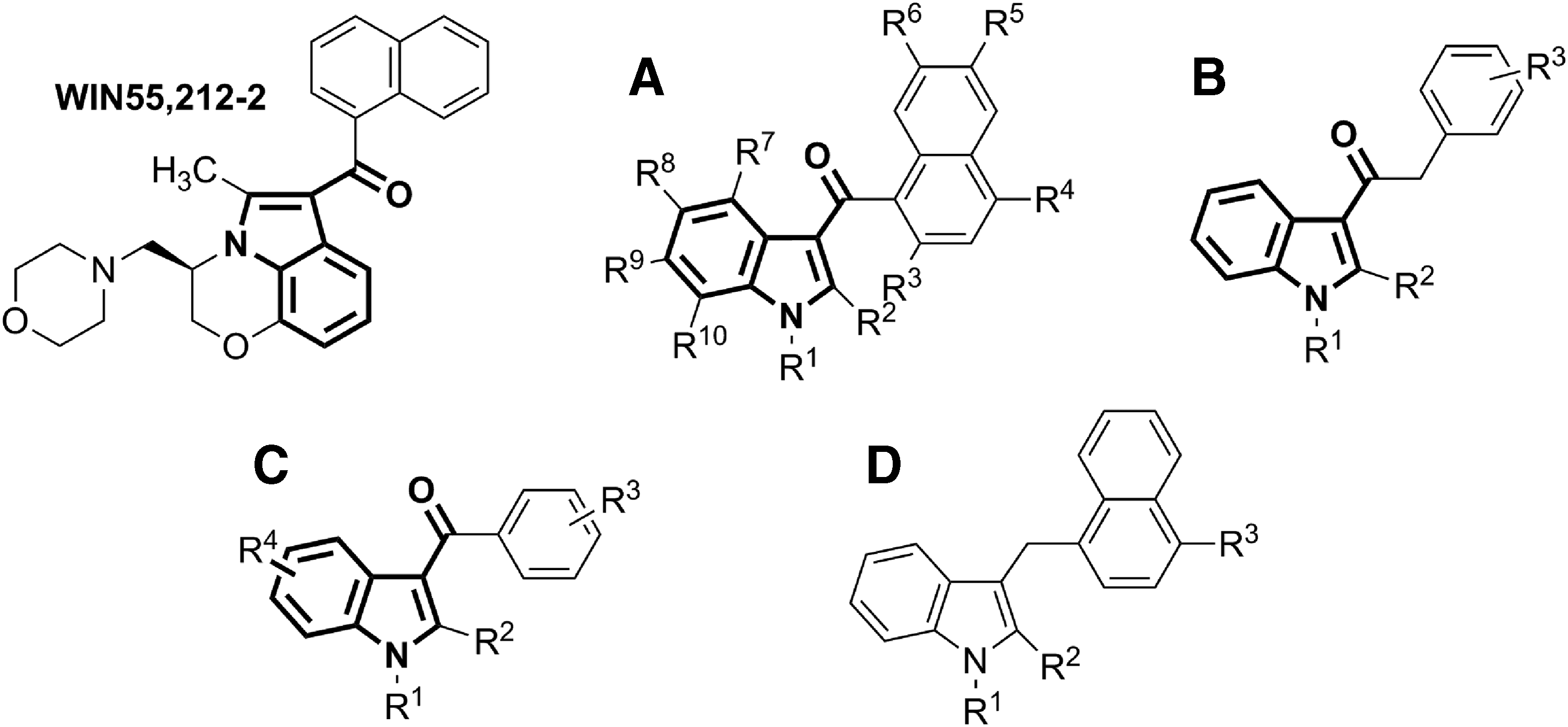
Chemical structure of aminoalkylindoles: naphthoylindoles

N-Arachidonoylethanolamine (anandamide) (
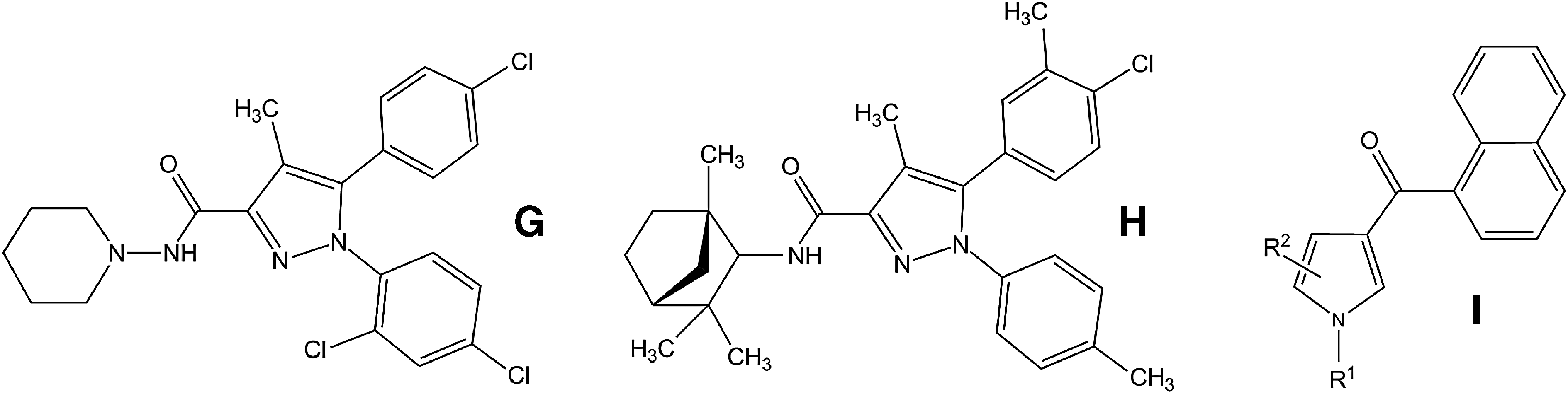
Structures of SR141716A (
This classification system was later expanded to include adamantoylindoles, cyclopropoylindoles, and indolecarboxamides within the category of aminoalkylindoles. 40 However, indazolecarboxamides, another emerging group of synthetic cannabinoids in illegal markets, were added to the category of “others” since they technically do not fit within the general aminoalkylindole category despite differing from their indole counterpart by only a single nitrogen atom.
One of the first representatives of the “adamantylindole” group with the general formula

Structures of adamantanecarbonylindoles
Derivatives of 3-(2,2,3,3-tetramethylcyclopropanecarbonyl)indole with general formula
Syntheses and pharmacological properties of cannabinoids from indolecarboxamides (or indole-3-carboxamides) group (structure
Modification of aminoalkylindoles consisting of insertion of additional nitrogen atom in the indole ring and replacing the ketone with a carboxamide functional group leads to a new group of synthetic cannabinoids, indazolecarboxamides (to be exact, indazole-3-carboxamides, structure
With the onset of the “spice” cannabinoids in the illegal market of NPSs observed since 2011 and rapid expansion of the chemical adulterants in such products, the traditional classification system has become insufficient as a means to categorize the structural diversity driven by the illegal market of NPSs.44,75 These substances are often referred to as designer drugs based on nefarious attempts to circumvent regulations where an NPS is “designed” around existing legislation. The “aminoalkylindole” structural class continues to evolve in response to specific regulatory listings and the listing of specific examples has proven to be insufficient due to a rapid NPS life-cycle that is a far more efficient process than adapting new legislation. Hundreds of cannabinoid NPSs have been detected over the past decade and the currently used classification system limits the vast majority of these substances to the category of “aminoalkylindole” or “other.” Furthermore, the subject of synthetic cannabinoids is no longer unique to scientific discussion but is now a topic of concern from a legal and public health perspective. For this reason, it is of particular importance that a clear distinction is made between phytocannabinoids and synthetic cannabinoids based on relative health risks resulting from abuse and from their disparate regulations. In contrast to the current classification system with seven categories based on structure alone, we propose three general categories based on natural occurrence with subcategories based on structure. According to this newly proposed classification system, cannabinoids are divided into the following classes.
Phytocannabinoids: Naturally occurring chemical compounds that are derived from Cannabis sativa, and related species of this plant are categorized as phytocannabinoids.
Endocannabinoids: Naturally occurring chemical compounds produced by living organisms that are associated with the cannabinoid receptors (CB1 and CB2) or more generally considered part of the endocannabinoid system.
Synthetic cannabinoids: Non-naturally occurring chemical compounds that either affect the endocannabinoid system or that are structural analogues of an endocannabinoid, phytocannabinoid, or other synthetic cannabinoids.
1.1.
1.2.
1.3.
2.
2.1.
2.2.
2.3.
3.
3.1.
3.1.1.
3.1.2.
3.1.3.
3.2.
3.2.1.
3.2.2.
3.3.
3.3.1.
3.3.1.1. 3-Carbonylindoles
3.3.1.1.1. Naphthoylindoles
3.3.1.1.2. Phenylacetylindoles
3.3.1.1.3. Benzoylindoles
3.3.1.1.4. Cycloalkanecarbonylindoles
3.3.1.1.4.1. Adamantanecarbonylindoles
3.3.1.1.4.2. Cyclopropanecarbonylindoles
3.3.1.1.5. Indole-3-carboxamides
3.3.1.1.6. Indole-3-carboxylates
3.3.1.1.7. Others 3-carbonylindoles
3.3.2.
3.3.2.1. 3-Carbonylindazoles
3.3.2.1.1. Naphthoylindazoles
3.3.2.1.2. Indazole-3-carboxamides
3.3.2.1.3. Indazole-3-carboxylates
3.3.3.
3.3.4.1. 2-Carbonylbenzimidazoles
3.3.4.1.1. 2-Naphthoylbenzimidazoles
3.3.4.
3.4.
3.4.1.
3.5.
3.5.1.
3.5.1.1. 3-Naphthoylpyrroles
3.5.2.
3.5.2.1. Diarylpyrazoles
3.6.
3.7.
The former “classical” cannabinoid designation includes both the natural Δ9-THC and synthetically derived HU-210 based on their characteristic ABC-tricyclic terpenoid ring structure. Whereas in the new system, HU-210, an early example of a spice adulterant is categorized as a synthetic cannabinoid. Likewise, the AC-bicyclic compounds cannabidiol and synthetically derived CP-55,940 would be categorized as “nonclassical” in the former system, whereas in the new system based on occurrence, plant-based Δ9-THC and cannabidiol are classified as phytocannabinoids and subcategorized based on structure. Isotopically labeled forms, although synthetically derived, are also categorized as phytocannabinoids. Primary examples of the ABC-tricyclic, AC-bicyclic, and “other” terpenoid subcategories of the phytocannabinoid class include Δ9-THC, cannabidiol, and cannabigerol (Fig. 6).

Chemical structures of exemplary phytocannabinoids.
Within the endocannabinoid category, the new classification system also designates inclusion based on natural occurrence such as the primary natural ligands, arachidonyl ethanolamide (anandamide, AEA) and 2-arachidonyl glycerol (2-AG). Biosynthetic precursors and other eicosanoids such as 5,8,11-eicosatrienoyl (mead) ethanolamide, 76 N-dihomo-γ-linolenoyl ethanolamine, 77 and N-docosatetraenoyl ethanolamine 77 that bind to the cannabinoid receptors also fall within this category (Fig. 7). However, endocannabinoid modulators such as URB-597, an inhibitor of the fatty acid amide hydrolase enzyme that is responsible for the degradation of AEA, are categorized as synthetic cannabinoids.
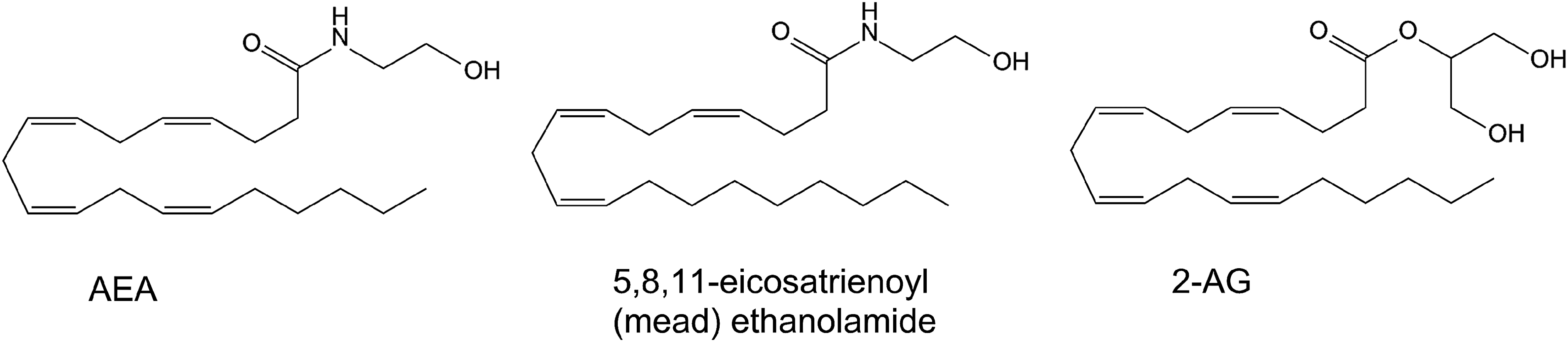
Chemical structures of exemplary endocannabinoids.
Synthetic cannabinoids that are structurally related to a phytocannabinoid-similar counterpart are designated to Section 3.1.1–3.1.3 corresponding to their terpenoid structure using the same ABC ring system designations (Fig. 8). For example, the synthetic cannabinoids HU-21078 and CP-47,497, 79 both detected as adulterants in herbal smoking mixtures, in this system, are categorized using the same structural criteria as the phytocannabinoids but segregated from their natural counterparts.
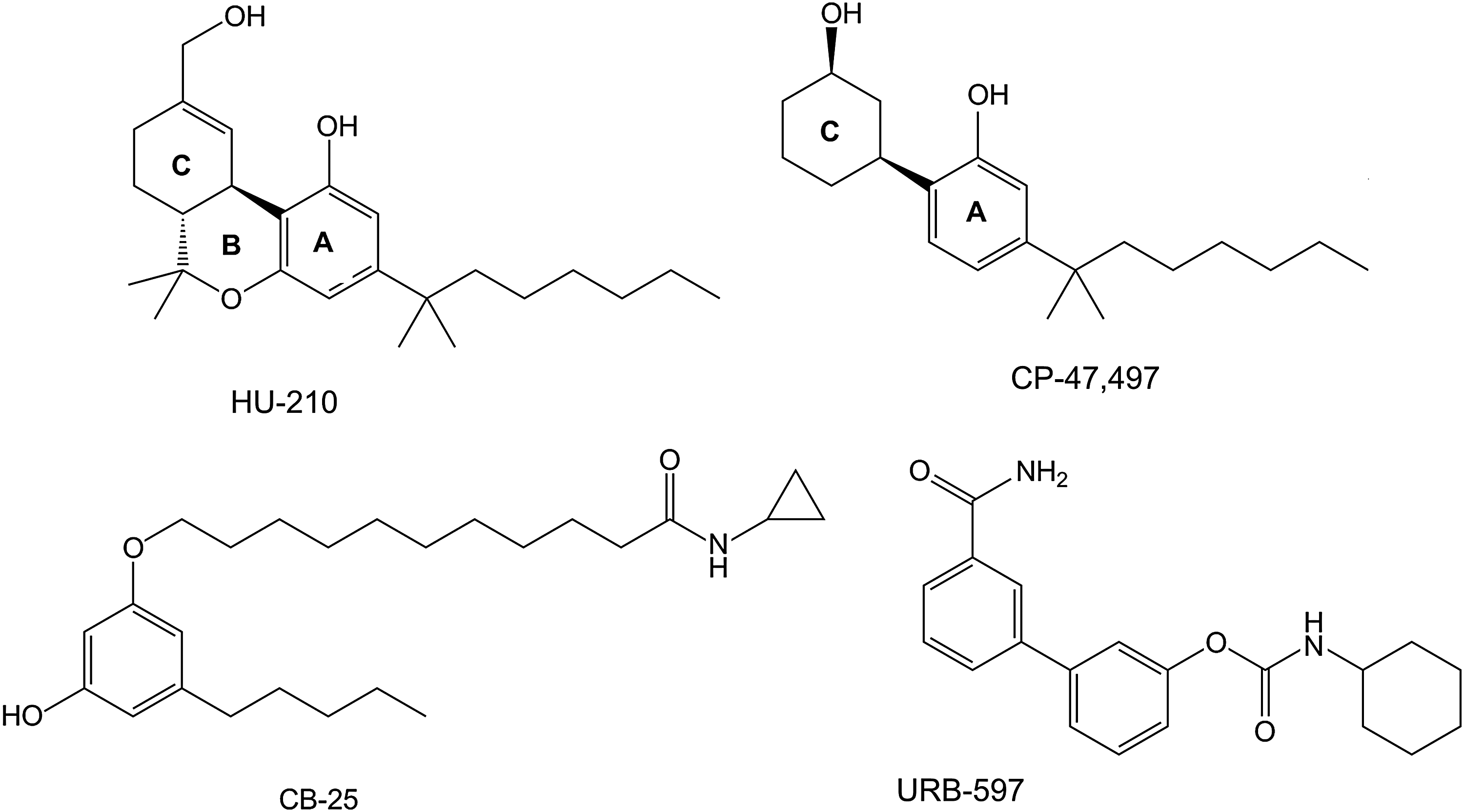
Chemical structures of exemplary phytocannabinoid-similar and endocannabinoid-related synthetic cannabinoids.
A simplified approach to the general “aminoalkylindole” category of synthetic cannabinoids is to replace this terminology with language that is based on the central pharmacophore with multiple, specific subtypes. Pharmacophore models of synthetic cannabinoids have been described80,81 and this concept and terminology have been utilized for the purpose of assessment of structural similarity. 81 It is the opinion of the authors that a “core” subunit of a three-component pharmacophore model will most effectively provide logical subcategories for the synthetic cannabinoids. With this approach, the “indole-similar” core may be further divided into pharmacophore-based groups that are similar aromatic systems differing only by the presence of an additional nitrogen heteroatom including indazoles, benzimidazoles, 82 and other azaindoles (Fig. 9). It should be noted that the examples provided in Figure 9 would be categorized in the category of “other,” based on the former classification system that is dependent on an overly specific “core” + “head group” pharmacophore requirement (i.e., naphthoylindoles) described in Figure 10. The latter classification requirement is dependent only on the core structure that cast a wider net on the diverse functionality observed with synthetic cannabinoid designer drugs. The “core” pharmacophore is the logical choice to provide such a basis as more chemical diversity is observed within the “head” and “tail” pharmacophores. Although no exemplary compounds for Sections 3.4–3.6 covering indenes, pyrroles, pyrrazoles, and carbazoles are provided in this discussion, the same logic and rationale for a pharmacophore-based categorization system may be applied.
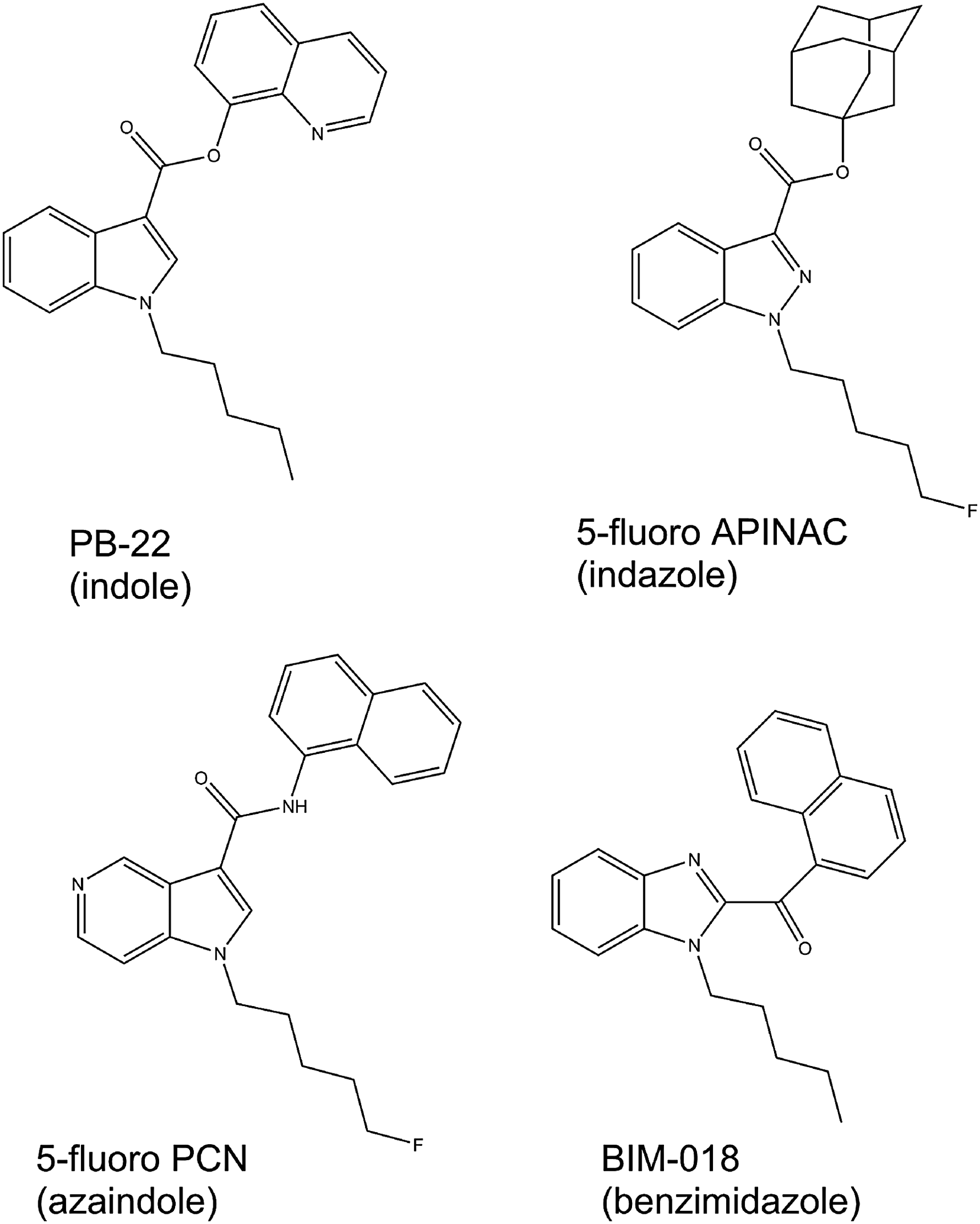
Chemical structures of exemplary indole-similar synthetic cannabinoid subcategories.
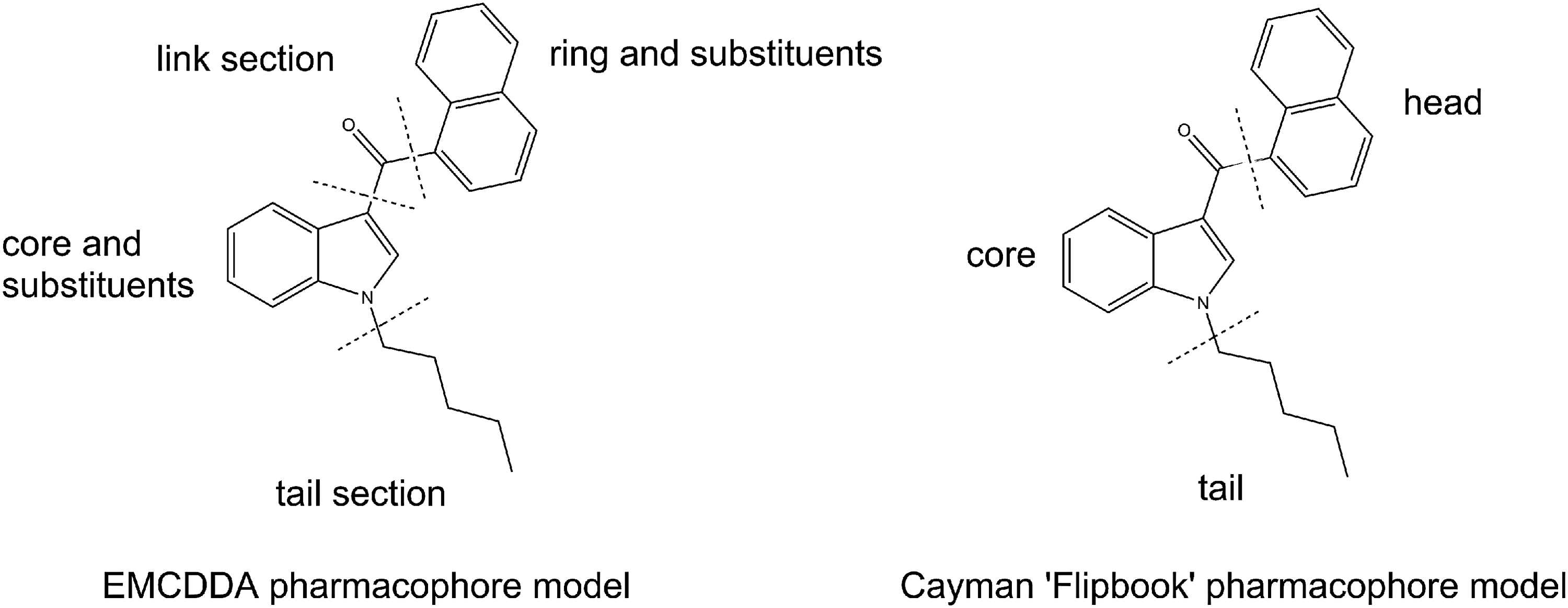
Pharmacophore-based models of synthetic cannabinoids.
It is quite understandable that in the view of constant development of the chemistry of new synthetic cannabinoids that any new suggested classification system will inevitably require updating, including the determination of new and separate groups and classes. Nevertheless we believe that our suggested classification adequately captures the structural diversity of synthetic cannabinoids, thus improving their systematization. As a result, this updated classification system could serve practical basis for improvement of national and international legislations to put analogues of known synthetic cannabinoids under control with the aim to prevent their propagation as designer drugs.
Footnotes
Author Disclosure Statement
No competing financial interests exist.