




Abstract

The cannabinoid delta-9-tetrahydrocannabinolic acid A (THCA-A, Fig. 1) is both the enzymatic product of THCA synthase as well as the immediate precursor to THC by means of a non-enzymatic decarboxylation. Interestingly, in 1969, Mechoulam isolated and fully characterized (complete spectroscopy) a structural isomer of THCA-A, giving it the name THCA-B (Fig. 1) to distinguish it from THCA-A. 1 Among cannabinoids, THCA-B displayed some very unique physical and spectroscopic properties. For instance, the infrared (CHCl3 solution) position of the THCA-B carboxyl carbonyl peak (1710 cm−1) was very different from that of the THCA-A carboxyl carbonyl peak (1615 cm−1). Finally, in 1975, the structure of THCA-B was fully corroborated by an unequivocal Norwegian X-ray study using a carefully selected prismatic crystal of it. 2 According to the SciFinder® chemistry database, this X-ray article has been cited in only four later publications, suggesting that its important conclusions may not be as well known to the larger Cannabis research community.
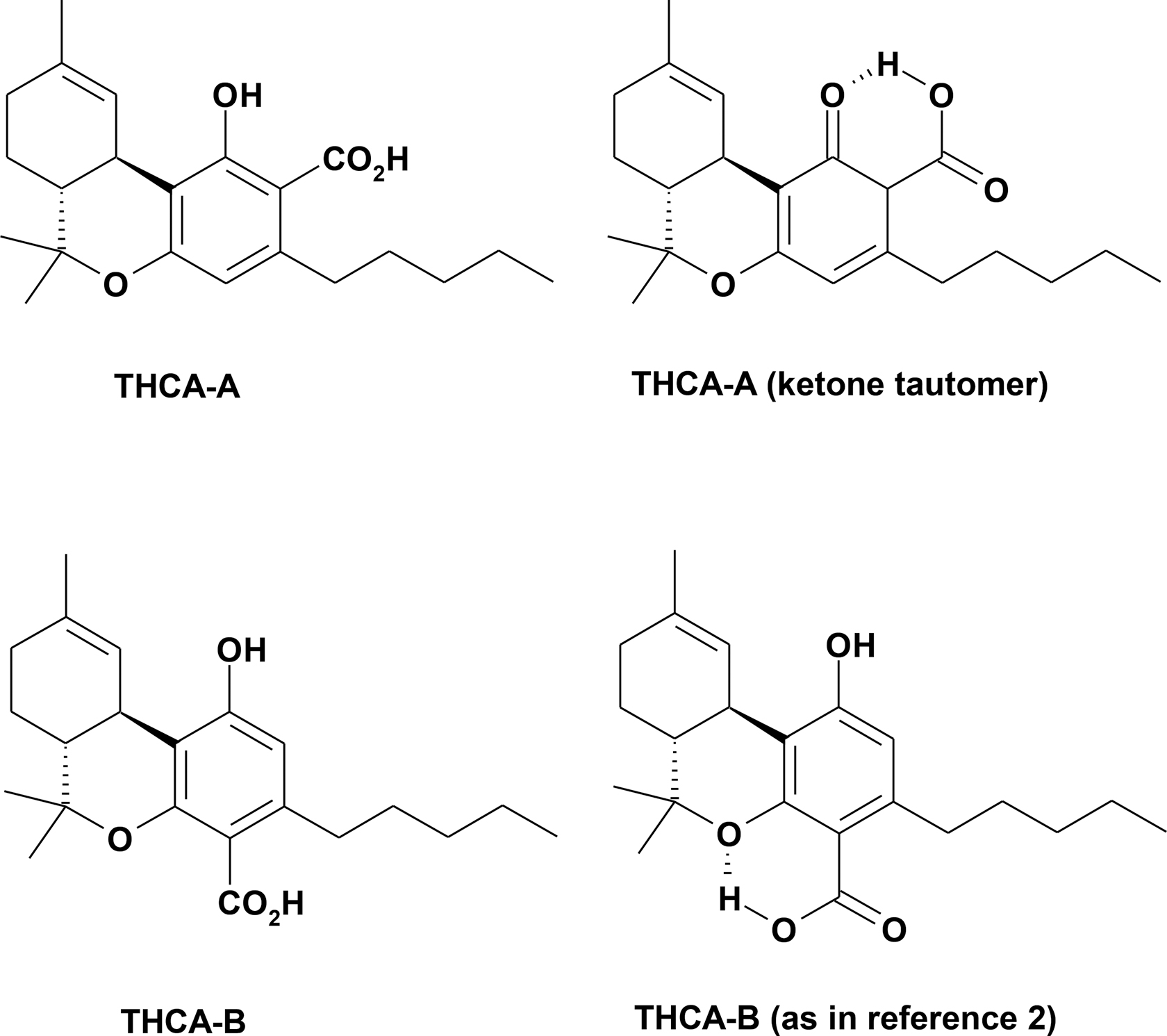
Structures of THCA-A, THCA-B, and related forms. THCA, delta-9-tetrahydrocannabinolic acid.
Unlike other widely published cannabinoids, THCA-B has been the subject of relatively few articles. One of the most intriguing chemistry attributes of THCA-B described by several authors has been its remarkable thermal stability and reluctance to decarboxylate as compared with THCA-A. For instance, Hanus in his extensive cannabinoid treatise 3 stated (p. 1371) that “THCA-A is decarboxylated at 90°C, while THCA-B is stable at this temperature” although the exact physical state of the THCA-A and THCA-B (botanical extract residue or crystalline solid) involved in this comparison was not described. However, to the best of my knowledge, no reason has been provided in the Cannabis literature for this unusual stability disparity of the two isomers. Therefore, an explanation for this decarboxylation discrepancy between THCA-A and THCA-B is now the subject of this note.
A credible explanation for the observed difference in the THCA-A and THCA-B required decarboxylation temperature should ideally apply to all physical states and heating methods of the two isomers, assuming they are both treated equally. Two extremes can be imagined. Consider first the case where THCA-A and THCA-B are pure (but not crystalline) cannabinoids, perhaps residues with some occluded solvent resulting from a Cannabis extraction process. The comparatively facile decarboxylation of THCA-A has been rationalized by invoking the role of the aromatic hydroxyl group ortho to its carboxylic acid function. Although the exact mechanistic details differed among several authors, consensus between them was that a transient THCA-A ketone tautomer (of its aromatic ortho hydroxyl group) intermediate could easily promote decarboxylation (Fig. 1). Initiated by the intermediate ketone acting on the nearby carboxyl group hydrogen, the resulting decarboxylation activation energy for THCA-A would clearly be lowered. 4 Although the THCA-B carboxyl group does have some degree of hydrogen bonding to its central pyran oxygen (Fig. 1), 2 it has no adjacent aromatic ortho hydroxyl group to form a comparable decarboxylation-facilitating ketone tautomer and, therefore, lacks the lower energy decarboxylation pathway available to THCA-A. This intramolecular mechanistic explanation for the higher decarboxylation temperature of THCA-B (>140°C 1 ) would pertain to any heating method applied to either isomer as a residue or in solution.
Now consider a second unique decarboxylation situation where both THCA-A and THCA-B are heated as extremely perfect solids. Pure THCA-A has been described as a crystalline substance melting at 70°C. 5 However, THCA-B can be purified to an even higher melting (184–185°C) crystalline solid. 1 This striking melting point difference between the two isomers can be explained by the X-ray study of THCA-B. 2 These authors discovered that besides van der Waals forces, the THCA-B crystal integrity was also maintained by an “intermolecular hydrogen bond network, going from the phenolic group in one molecule to the carboxylic group in the neighbor molecule.” The hydrogen bond distance between two adjacent THCA-B molecules in the crystal lattice was measured to be 2.688 angstroms, indicating a relatively short and strong hydrogen bond. Consequently, if THCA-B is heated as a crystalline solid, the decarboxylation temperature would first need to exceed its higher melting point temperature to disrupt the strong intermolecular hydrogen bond network involving its carboxyl group. In this second pure solid comparison case, the decarboxylation temperature difference between THCA-A and THCA-B would likely be even greater.
For the aforementioned reasons, whether these two isomers are each heated as an extract residue or a pristine solid, THCA-B would require a higher decarboxylation threshold temperature than THCA-A. Finally, a reviewer has correctly commented that other different environmental conditions for THCA-A and THCA-B could also facilitate preferential decarboxylation of the former. Related information regarding such conditions can be found in the already cited work of Perrotin-Brunel. 4
Footnotes
Author Disclosure Statement
No competing financial interests exist.
Funding Information
No funding was received.