




Abstract
Introduction:
There is widespread acceptance of cannabis for medical or recreational use across the society, including pregnant women. Concerningly, numerous studies find that the developing central nervous system (CNS) is vulnerable to the detrimental effects of Δ9-tetrahydrocannabinol (THC). In contrast, almost nothing on the consequences of perinatal cannabidiol (CBD) exposure. In this study, we used mice to investigate the adult impact of perinatal cannabinoid exposure (PCE) with THC, CBD, or a 1:1 ratio of THC and CBD on behaviors. Furthermore, the lasting impact of PCE on fluoxetine sensitivity in the forced swim test (FST) was evaluated to probe neurochemical pathways interacting with the endocannabinoid system (ECS).
Methods:
Pregnant CD1 dams were injected subcutaneously daily with vehicle, 3 mg/kg THC, 3 mg/kg CBD, or 3 mg/kg THC +3 mg/kg CBD from gestational day 5 to postnatal day 10. Mass spectroscopic (MS) analyses were conducted to measure the THC and CBD brain levels in dams and their embryonic progenies. PCE adults were subjected to a battery of behavioral tests: open field arena, sucrose preference test, marble burying test, nestlet shredding test, and FST.
Results:
MS analysis found substantial levels of THC and CBD in embryonic brains. Our behavioral testing found that PCE females receiving THC or CBD buried significantly more marbles than control mice. Interestingly, PCE males receiving CBD or THC+CBD had significantly increased sucrose preference. While PCE with THC or CBD did not affect FST immobility, PCE with THC or CBD prevented fluoxetine from decreasing immobility in both males and females. Excitingly, fatty acid amide hydrolase (FAAH) inhibition with a dose of URB597 that was behaviorally inactive in the FST rescued fluoxetine efficacy in PCE mice of both sexes.
Conclusions:
Our data suggest that PCE with either THC, CBD, or THC+CBD alters repetitive and hedonic behaviors in a phytocannabinoid and sex-dependent manner. In addition, PCE with THC or CBD prevents fluoxetine from enhancing coping behavior. The restoration of fluoxetine responsiveness in THC or CBD PCE adults by inhibition of FAAH suggests that PCE causes a lasting reduction of the ECS and that enhancement of anandamide signaling represents a potential treatment for behavioral deficits following PCE.
Introduction
The increased availability of cannabis products, public interest in self-medicating with cannabinoid preparations and widely held perceptions that cannabis components are “safe” have increased cannabis use during pregnancy.1–5 This use is associated with an increased risk for impaired executive function, psychosis, and a predisposition to the development of major depression and anxiety symptoms.4,6–15 Preclinical studies modeling human perinatal cannabis exposure with Δ 9 -tetrahydrocannabinol (THC) or potent synthetic cannabinoids find analogous, long-lasting behavioral deficits in the offspring.16–23 One limitation of existing preclinical studies is that only a few used THC, whereas many have used highly efficacious synthetic cannabinoids.24–29 This is a significant shortcoming as THC's pharmacology (low-intrinsic efficacy agonist) is distinct from that of synthetic cannabinoids. A second limitation is that many preclinical studies stop cannabinoid administration at birth, which in rodent brain development roughly corresponds to early in the third trimester in human brain development. 30
THC and cannabidiol (CBD) are the two most studied cannabinoids found in cannabis31,32 and both interact with the endocannabinoid system (ECS),33–35 although in different ways. The ECS consists of endocannabinoids (eCBs), cannabinoid receptors, and the enzymes that synthesize and degrade eCBs. The ECS has well-established roles in neurodevelopment.36,37 The recent widespread promotion and public acceptance of CBD as a “safe” and “natural” medication, including use during pregnancy 38 has encouraged pregnant or nursing mothers to use CBD as a treatment for a variety of symptoms, exposing the fetus to CBD. Importantly, few studies have addressed the significant and timely question of how CBD impacts the developing fetal brain.39,40 Furthermore, it is also unclear whether perinatal exposure to an equal mixture of THC and CBD, as might occur during therapeutic use of cannabinoid preparations (e.g., Bediol or Sativex41,42), modifies the neurodevelopmental effects of either THC or CBD. Finally, it is important to develop therapies that will reverse the detrimental behavioral consequences of PCE.
This study examined the lasting impacts of perinatal THC, CBD, or THC+CBD on behaviors of adult progenies. Specifically, we first examined using mice of both sexes if PCE through the dam affects repetitive, anxiety, or coping behaviors. Because of the close relationship between serotonin and eCBs, including the necessity of intact endocannabinoid signaling for serotonin uptake inhibitor efficacy,43–45 we then determined if PCE affected the efficacy of fluoxetine to decrease immobility in the forced swim test (FST) and if inhibition of anandamide (AEA) breakdown modified the effect of fluoxetine on PCE mice.
Materials and Methods
Animals
Male and female CD1 mice were housed in 4–5 animals per cage on a 12-h dark/12-h light cycle. We used the outbred CD1 mouse strain as its genome heterogeneity is similar to wild-caught mice, 46 and it harbors fewer mutations than commonly used inbred strains. CD1 dams are superior breeders and exhibit robust mothering behaviors. Food and water were available ad libitum. Timed pregnancies were set up as trios (1 male with 2 females) and the date on which female mice showed a vaginal plug was defined as gestational day 0.5. Three independent cohorts of breeding were set up to generate the progenies used for the behavior experiments. Mice were treated in compliance with the guidelines of the U.S. Department of Health and Human Services and all procedures were approved by the Indiana University Bloomington Institutional Animal Care and Use Committee.
Drugs
The following drugs were used: 3 mg/kg THC (Provided by the Drug Supply Service, National Institute on Drug Abuse [NIDA]), 3 mg/kg CBD (NIDA), 20 mg/kg fluoxetine hydrochloride (Cayman), and 0.1–1.0 mg/kg URB597 (Cayman). The stock solution of 100 mg/mL THC, 30 mg/mL CBD, or 10 mg/mL URB597 were dissolved in a vehicle consisting of Cremophor® EL (Sigma-Aldrich), ethanol, and saline at 1:1:18 ratios. 27 Fluoxetine was dissolved in a solution containing 2% Tween 80. 47
PCE paradigm
CD1 dams were randomly assigned to the following treatment groups: 7 naive; 13 vehicle; 11 THC; 14 CBD, and 9 THC+CBD. Excluding the naive group, dams received daily subcutaneous (s.c.) injections of freshly prepared drug solution in a volume of 10 mL/kg between 3 and 5 PM from gestational day 5 (GD5) to postnatal day 10 (P10). Litters were weaned at ∼21 days, separated by sex and housed 3–5/cage until behavioral testing.
Mass spec
Dams were treated daily s.c. with either 3 mg/kg THC or CBD from GD 5 to 18.5. Two hours after the last injection, mice were sacrificed through rapid decapitation. Embryonic brains were immediately removed, cortex dissected, placed in liquid nitrogen, and stored at −80°C until extractions were performed. Cortical tissue was extracted and analyzed exactly as described. 48 In brief, methanolic extracts were partially purified on C18 solid-phase extraction columns and eluants are analyzed using C18 Zorbax analytical column-coupled high pressure liquid chromatography/mass spectroscopic (MS)/MS (API300). THC and CBD standard curves were generated using the dam injection solutions to standardize for injection levels of THC and CBD.
Behavioral testing procedures
For behavioral testing experiments, male and female adult progenies from naive, vehicle, THC, CBD, THC+CBD-exposed dams were tested at P80–P120. To avoid potential sex pheromone influences during the behavioral experiments, male and female mice were tested on different days. Mice were subjected to a battery of behavioral tests in the following sequence for each cohort: 1st cohort: open field arena (OFA), sucrose preference test (SPT), marble burying test (MB), nestlet shredding test (NS), and FST; 2nd cohort: OFA and FST; and 3rd cohort: OFA and FST. Mice were habituated in the testing room for 30 min before testing. All behavioral assays, except the SPT were conducted under 100 lux illumination during the light phase. NS, SPT and FST were manually scored by observers blinded to treatment.
Open field arena
The mice were introduced into the center of the arena (Plexiglas chamber, 50×50 cm2) and allowed to explore for 10 min. The locomotion was analyzed with Noldus EthoVision XT 10.0 (Noldus Information Technology, Leesburg, VA).
Sucrose preference test
SPT was conducted as described. 49 Group-housed mice were habituated with two bottles, one containing 1% sucrose solution and one with water, in their home cages for 4 days. On the 5th day, mice were separated into individual cages with two bottles, one with 1% sucrose solution and one bottle with water, to assess their sucrose consumption. The consumption of 1% sucrose solution was measured for two consecutive days. The percentage of sucrose preference was quantified as % of sucrose solution consumed=(volume of 1% sucrose solution consumed/V of total liquid consumed×100).
Marble burying
The MB task was carried out as previously described. 27
Nestlet shredding
The NS task was carried out as previously described. 27
Forced swim test
To assess acute coping behavior, a single mouse was placed into a glass cylinder (height 25 cm, diameter 17 cm) containing 10 cm of clear water (23±1°C) for 6 min of forced swimming. Immobility time was measured during the last 4 min of the test and was defined as the duration of time where the mouse had stopped struggling and was floating while making minimal movements to keep its head above the water.50,51 The fluoxetine and URB597 effects on FST were evaluated by injecting the mice with fluoxetine 30 min or with URB597 60 min before the FST. The rescue effect of 0.1 mg/kg URB597 was evaluated by administering URB597 or vehicle 30 min before fluoxetine (20 mg/kg) and 1 h before FST.
Statistical analysis
Behavioral results are expressed as mean±standard error of the mean. Data normality was tested by the Shapiro–Wilk, Kolmogorov–Smirnov, Cramer–von Mises, Anderson–Darling tests using SAS (SAS, Cary, NC). Then, data were analyzed by analysis of variance or Mann–Whitney test, as appropriate, with Prism 9 (GraphPad, San Diego, CA). No significant differences were found between the naive (5 males and 7 females) and vehicle (9 males and 11 females) groups (1st cohort) and thus their data were pooled and designated as the control group. The naive group was omitted in the 2nd and 3rd cohorts.
Results
MS analysis
To determine whether phytocannabinoids reach embryonic brain following maternal exposure, CD1 dams were s.c. injected daily with 3 mg/kg THC or 3 mg/kg CBD from GD5 to GD18. Two hours after the last injection, embryonic cortices were harvested for MS analysis. We found significant levels of THC or CBD in E18.5 brains (Fig. 1). These data indicate that both THC and CBD readily cross from dams into the developing central nervous system (CNS) of their progenies. THC levels in males (0.048±0.0032 nmoles/g) were higher (p<0.001) than the females (0.031±0.0037 nmoles/g), CBD levels in males (0.0096±0.0014 nmoles/g) were significantly lower (p<0.0001) than CBD levels in females (0.039±0.0013 nmoles/g). Altogether, these data suggest compound and sex-dependent transport and/or metabolism differences between THC and CBD in the embryos.

Embryonic brain levels of THC and CBD following maternal treatment. Embryonic brain levels of THC or CBD were determined after treatment of dams from GD5 to GD18.5 with either 3 mg/kg of THC or 3 mg/kg CBD. Males had higher (p<0.001) THC levels than females, while females had higher (p<0.001) CBD levels than males. Statistical significance was determined by one-way ANOVA followed by Sidek's multiple comparisons test. ANOVA, analysis of variance; CBD, cannabidiol; GD5, gestational day 5; PCE, perinatal cannabinoid exposure; THC, Δ 9 -tetrahydrocannabinol. Color images are available online.
General behavioral evaluation of PCE adult progenies
We modeled PCE in mice by daily s.c. administration of 3 mg/kg THC, 3 mg/kg CBD, or 3 mg/kg THC +3 mg/kg CBD to dams from GD5 to P10. Progenies from vehicle, THC, CBD, or THC+CBD-treated dams reached similar body weights by P21 (Table 1). At P60–P70, body weights of PCE progenies were similar to controls.
Summary of Mean±Standard Error of the Mean and Statistics for Listed Measurements
Ctrl group includes adult progenies from both naive and vehicle-treated dams. n, animal number. Statistical analyses were conducted with one-way ANOVA followed by the Bonferroni post hoc test.
Significant difference from ctrl.
ANOVA, analysis of variance; CBD, cannabidiol; OFA, open field arena; P21, postnatal day 21; SPT, sucrose preference test; THC, Δ 9 -tetrahydrocannabinol.
To assess the lasting impacts of PCE, adult PCE and control progenies were evaluated with OFA, SPT, MB, and NS assays to determine their locomotion, hedonic, repetitive, and innate behaviors, respectively (Table 1). PCE adult progenies exhibited normal spontaneous locomotion in the OFA and NS behavior. Regarding repetitive behaviors, female THC or CBD PCE progenies, but not THC+CBD PCE mice buried significantly more marbles (p < 0.05). Male PCE progenies exhibited normal MB behavior. Male progenies of CBD or THC+CBD PCE mice exhibited significantly greater sucrose preference (p < 0.05), whereas female PCE progenies and controls had similar sucrose preferences.
PCE with THC or CBD results in resistance to acute fluoxetine efficacy in the FST
While controversial as a measure of depressive-like behaviors,51,52 the FST examines a subject's response (immobility time) to an inescapable stress. Antidepressants such as serotonin-selective reuptake inhibitors (SSRIs), including fluoxetine, decrease immobility time. 53 Differences in immobility time in response to an SSRI offer an opportunity to probe neurochemical pathways. We found that PCE and control adult progenies exhibited indistinguishable immobility times in the FST (Table 2). As expected, administering 20 mg/kg fluoxetine intraperitoneal injection (i.p.) 30 min before the FST significantly reduced the immobility time in the control group (p < 0.01 for both sexes; Fig. 2). Surprisingly, acute fluoxetine treatment did not decrease immobility time in THC or CBD PCE progenies. The effect of fluoxetine on immobility time in THC+CBD PCE progenies was ambiguous. While the effect of fluoxetine on immobility time approached statistical significance if sexes were combined (p=0.05), when the sexes were separated the difference was far from significant (male, p=0.24; female, p=0.26; no sex-dependent difference was found for THC+CBD PCE). These results suggest that PCE with either THC or CBD alters the circuits required for fluoxetine to reduce immobility time in FST. Determining the consequence of PCE with the combination of THC and CBD on fluoxetine efficacy in the FST requires additional study.
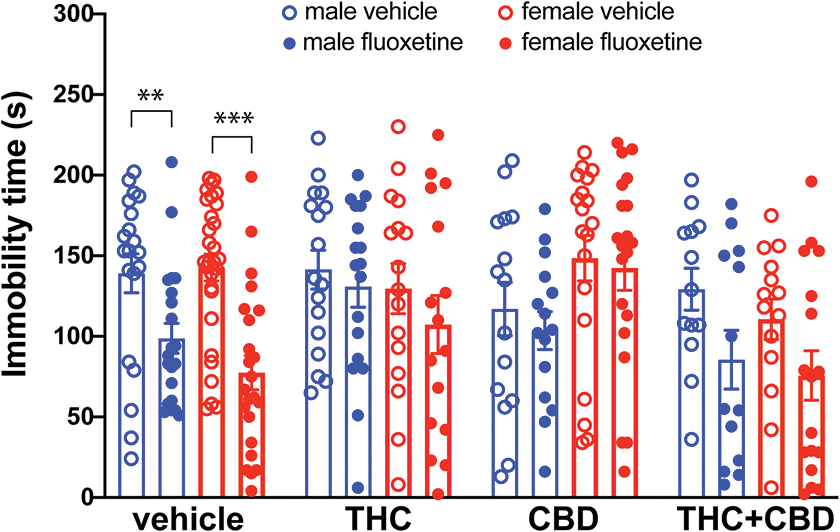
PCE has variable consequences on fluoxetine efficacy in the FST. PCE with 3 mg/kg THC, CBD, or their combination had no effect on immobility time in the FST. In offspring from dams receiving vehicle, 20 mg/kg fluoxetine robustly decreased FST immobility time in both sexes. However, fluoxetine failed to decrease immobility time in mice of either sex subjected to PCE with either THC or CBD. In mice receiving PCE with the combination of THC and CBD, fluoxetine trended to (males or females individually) or significantly (males and females combined) decreased FST immobility. Distributions and bar graphs are shown for immobility time from male and female mice. Bar graphs are presented as mean±SEM. Multiple Mann–Whitney tests, followed by Sidak's correction for multiple comparisons, were conducted for statistical comparisons. **p<0.01, ***p<0.001. FST, forced swim test; SEM, standard error of the mean. Color images are available online.
Summary of Forced Swim Test Immobility Time (Seconds) with Vehicle (Veh) or Fluoxetine (Fluo) for Control and Perinatal Cannabinoid Exposure Adult Progenies (THC, CBD, THC+CBD)
The distribution of data residuals was non-normal. Multiple Mann–Whitney tests corrected by the Holm–Sidak method for multiple comparisons were employed for statistical comparisons. There was no sex-dependent difference for mice treated with vehicle or fluoxetine and thus data from both sexes were merged for statistical comparisons.
Cotreatment with a subeffective dose of URB597 rescues the acute fluoxetine effect in FST.
While the pathways involved in responses to an inescapable stress are complex, strong evidence suggests eCB signaling is necessary for fluoxetine to decrease immobility time.45,54 Increasing AEA signaling in medial prefrontal cortex (mPFC) during stress increases the firing of dorsal raphe serotonergic neurons and increases active coping behaviors in the FST in a CB1 cannabinoid receptor (CB1R)-dependent fashion. 54 AEA can be increased by inhibiting the enzymatic activity of fatty acid amide hydrolase (FAAH), which degrades AEA. 55 FAAH inhibition by URB597 reverses social deficits following PCE in rats. 56 To evaluate whether increasing AEA restores the responsiveness of PCE progenies to fluoxetine, we tested whether URB597 pretreatment at a dose that is behaviorally inactive in the FST alters fluoxetine efficacy in the FST in PCE offspring.
We first evaluated the acute effect of different URB597 doses on the FST in naive adult CD1 mice. We found that pretreatment with 0.3 but not 0.1 or 1.0 mg/kg URB597 (i.p.) 1 h before the FST significantly decreased immobility time compared with controls (naive; p < 0.05; Fig. 3A). Thus, to determine if increasing AEA levels restored fluoxetine responsivity in the PCE mice, we administered 0.1 mg/kg URB597, a dose that did not affect basal FST immobility, 1 h before FST. As expected, PCE and control groups treated with 0.1 mg/kg URB597 exhibited similar immobility times (Fig. 3B; Table 3). However, 0.1 mg/kg UBR597 pretreatment enabled THC and CBD PCE progenies to respond to fluoxetine with reduced immobility time, which did not significantly differ from control groups (both sex: p < 0.05).

FAAH inhibition restores fluoxetine sensitivity in the FST following THC or CBD-PCE.
Summary for Forced Swim Test Immobility Time (Seconds) with URB597 Pretreatment
Control or PCE adult progenies were treated with vehicle or fluoxetine 30 min before FST. The data residuals were normally distributed and thus ANOVA was used for statistical analysis. Three-way ANOVA analysis found PCE and treatment but not gender as significant variables. Thus, two-way ANOVA analysis with two factors: PCE and treatment (vehicle, fluoxetine) was used. There was no interaction between these two factors. The F factor refers to the fluoxetine treatment. Post hoc Bonferroni's multiple comparisons test was conducted to compare the vehicle and fluoxetine-treated groups.
p<0.05, **p=0.01, ***p<0.001, ****p<0.0001.
FST, forced swim test; PCE, perinatal cannabinoid exposure.
In summary, we found that PCE with either THC or CBD prevented the fluoxetine-induced decrease in immobility time in FST. Enhancing AEA levels with a low-dose URB597 normalizes fluoxetine responsiveness in THC and CBD PCE adult progenies.
Discussion
Our preclinical study modeling chronic and moderate human consumption of cannabis during pregnancy shows that PCE with THC, CBD, or their combination results in drug-specific, lasting changes in specific adult behaviors. For this study, we chose doses of 3 mg/kg THC and CBD as these doses give maternal plasma levels consistent with those observed in moderate human users.57–59 While there are no rigorous data on human fetal levels of CBD following maternal exposure, this dose of THC gives levels comparable to those seen in aborted fetal remains 60 and in embryonic brain from pregnant rhesus monkeys treated with human-intoxicating doses of THC. 61
A major finding of our study is that PCE exerted sex-dependent impacts on repetitive and hedonic behaviors, with female repetitive and male hedonic behaviors affected, respectively. Interestingly, our data showed for the first time that PCE with THC or CBD, while having no effect on immobility time in the FST, prevented fluoxetine from reducing immobility time. Excitingly, we found that a dose of URB597 ineffective on immobility time on its own, restored responsiveness of the PCE progenies to fluoxetine in the FST. It has been shown that stress decreases mPFC AEA 54 and mPFC CB1R is required for fluoxetine to reduce immobility in the FST. 45 Altogether, these findings suggest that PCE results in a hypoactive mPFC ECS, blunting the efficacy of fluoxetine in the FST and that fluoxetine efficacy can be recovered by enhancing AEA tone.
A concern is that administration of cannabinoids to the nursing dam may alter maternal behavior and this could affect pup development and later behaviors. We feel this is unlikely for several reasons. The first is that administration of similar doses of THC to lactating rat dams did not affect several maternal behaviors. 62 The second is that 3 mg/kg of THC produces few behavioral effects in mice. 63 The third is that by parturition, dams had received THC for ∼14 days, which is sufficient for tolerance to develop for THC's behavioral effects, especially as females develop tolerance more quickly.64–66 Nonetheless, it is impossible to exclude that the effects we see here are mediated through the dam's behaviors. Future experiments cross fostering of CB1 knockout (KO) dams with CB1 wildtype (WT) pups could examine the role of maternal CB1 receptors.
The recent widespread promotion of CBD as a “safe” medication has encouraged pregnant or nursing mothers to use CBD. There is little information on whether CBD impacts or even reaches the developing CNS.39,40 We did not predict the dramatic sex differences in embryonic CNS levels of CBs found in this study. However, there are decades of data that have demonstrated marked sex differences in rodent brains due, in part, to their differences in neurosteroid production that drives changes in neural circuitry. 67 Given that P450 enzymes play a key role in neurosteroid production 68 and that both phytocannabinoids and eCBs are metabolized by P450 enzymes, 69 we can hypothesize that the sex-dependent differences in brain phytocannabinoids may be a result of the enzymatic differences that help to drive sexual differentiation. In this study, we found that significant amounts of CBD reach the embryonic brain following maternal exposure and PCE with CBD, with lasting impacts on adult behaviors. In addition to reduced fluoxetine responsiveness, PCE-CBD adult female mice exhibited significantly more repetitive behaviors (MB). Furthermore, PCE-CBD and PCE-CBD+THC adult male mice exhibited significantly greater sucrose preference (Table 1), perhaps related to mesolimbic dopaminergic system activity. 70 This suggests that PCE with CBD results in lasting changes in the mesolimbic reward system that increases preference for palatable food/drink.
It has been proposed that anxiolytic and antidepressant effects of SSRIs and increased brain eCBs share overlapping cellular mechanisms of activity.43,45,71,72 Pharmacological or genetic inhibition of FAAH elicited an antidepressant-like effect in the FST in rodents,45,71,73 correlating with an increase of serotonin activity in the cortex. 71 In the present study, we also demonstrated an acute dose/effect of a FAAH inhibitor (URB597) on decreasing immobility in the FST. Interestingly, pretreatment with a dose of URB597 that was ineffective in the FST restored the acute effect of fluoxetine treatment on FST immobility in PCE-THC, PCE-CBD, and PCE-THC+CBD mice. Our data are consistent with a previous publication, which found that coadministration of subeffective doses of fluoxetine and a FAAH inhibitor potentiated the antidepressant-like effect. 45 Thus, PCE with THC or CBD may induce an elevation of expression/activity of FAAH in adults, decreasing the pharmacological efficacy of fluoxetine. Further experiments are needed to confirm the fluoxetine resistance in other models of stress, with chronic dosing and the expression/activity of FAAH in PCE progenies.
In conclusion, the present study contributes new insights into the long-term consequences of PCE on repetitive and anhedonic behaviors in sex-dependent manner. In addition, we found that THC and CBD PCE prevented the effect of acute fluoxetine in the FST, which was restored by pretreatment with a subeffective dose of the FAAH inhibitor URB597. These results collectively suggest long-term, selective impacts to mice subjected to PCE. Further studies in a chronic treatment model will be important to further investigate the lasting impacts of PCE on SSRI effectiveness.
Footnotes
Author Disclosure Statement
No competing financial interests exist.
Funding Information
This study was funded by the National Institute on Drug abuse of the National Institutes of Health (R01DA043982), the IU Grand Challenge, startup funds from the College of Arts and Sciences, and Gill endowment fund. The content is solely the responsibility of the authors and does not necessarily represent the official views of the National Institutes of Health.