




Abstract
Introduction:
Excessive alcohol consumption can result in alcoholic liver disease (ALD). There is no FDA-approved drug to specifically treat ALD and current management approaches have limited efficacy. Past studies indicate that monoacylglycerol lipase (MAGL) inhibition can have a positive impact on nonalcoholic fatty liver disease. However, the effect of MAGL inhibition in ALD has not been reported.
Materials and Methods:
We tested the highly selective and clinically evaluated MAGL inhibitor ABX-1431 in the Lieber-DeCarli liquid alcohol diet-induced model of ALD in C57BL/6 mice.
Results:
ABX-1431 failed to reduce ALD-associated steatosis and elevated levels of liver enzymes associated with hepatic injury. Furthermore, survival rate declined with increasing doses of ABX-1431 when compared with mice administered vehicle only.
Conclusion:
These data suggest that MAGL inhibition does not improve ALD and is unlikely to be a good strategy for this condition.
Introduction
Excessive alcohol consumption is a global problem with enormous social, economic, and health consequences. Alcoholic liver disease (ALD) affects ∼15 million Americans. 1 The mortality rate from liver cirrhosis rose from 3.3 per 100,000 in 1999 to 10.6 per 100,000 in 2019. 2 While alcohol negatively impacts several major organs, including the brain and heart, the liver sustains the earliest and greatest damage because it is the primary site of ethanol metabolism. 3
ALD comprises a spectrum of conditions ranging from fatty liver (steatosis) to cirrhosis (see Refs.4–6 ). Steatosis is the earliest and most common lesion in people who drink excessive alcohol. The liver is the main organ for fatty acid (FA) metabolism through a variety of complex pathways. Under normal conditions, hepatocytes store limited amounts of triglycerides (TG) in cytosolic lipid droplets, the neutral storage form of FAs, because most TGs are oxidized and secreted into the bloodstream. Alcohol stimulates de novo lipogenesis and decreases lipid droplet autophagy and secretion, leading to accumulation of TGs.7–9 The transition to hepatitis is characterized by ballooning degeneration of hepatocytes and concomitant inflammation. 10 Continued alcohol consumption can progress to hepatic fibrosis. 6 With increased cellular insult, hepatitis can transition to cirrhosis and liver failure. 11 Hepatocellular carcinoma can develop at any stage of cirrhosis.
TG in hepatocyte lipid droplets are hydrolyzed by three important lipases in a stepwise manner: adipose TG lipase (TG to diacylglycerol [DG]), hormone-sensitive lipase (DG to monoacylglycerol [MAG]) and MAG lipase (MAGL) (MAG to glycerol and a FA). 12 While these reactions release FAs, they control the concentration of TG, DG, MAG, and glycerol in the hepatocyte and have central signaling roles in multiple metabolic processes. 12
MAGL additionally plays a critical step in diminishing cannabinoid receptor 1/2 (CB1/2) signaling by catalyzing 2-arachidonoyl glycerol (2-AG) hydrolysis. 13 The endocannabinoid 2-AG is one of the most abundant cannabinoid receptor agonists and hydrolysis of 2-AG generates arachidonic acid, a precursor of proinflammatory eicosanoids.14,15 Past studies in mice with global and myeloid-specific MAGL gene knockout showed reduced liver fibrosis and inflammation after liver-specific insults16–18 induced by various conditions but not alcohol. Whether MAGL inhibition can reduce ALD has not been previously investigated.
In the present study, we investigated whether MAGL inhibition could improve ALD. We tested ABX-1431, a selective inhibitor of MAGL, 19 on female mice maintained on the Lieber-DeCarli (LDC) alcohol-containing liquid diet. This compound represents a pharmacologically relevant approach for inhibition of MAGL as it has been used in clinical trials and has excellent ADMET properties and selectivity toward the target enzyme.
Materials and Methods
Forty-four 10-week-old female C57BL/6J mice (Jackson Laboratory) were used because female rodents, like women, are more susceptible to alcohol-induced liver injury.20–22 All experimental procedures were approved by and performed in accordance with the Institutional Animal Care and Use Committee.
Control mice (n=8) were fed standard mouse chow ad libitum (PicoLab Certified Rodent LabDiet® 5053). Experimental mice (n=36) were fed the LDC liquid diet (Bioserv, 1258SP). Carbohydrates from standard chow come largely from starches and provide a better baseline snapshot of healthy livers. Ethanol (200 Proof; Acros) concentrations gradually increased from 0% to 5.07% w/v (0% to 6.4% vol/vol) in the LDC diet over a 19-day acclimation period. Mice were maintained on the highest ethanol concentration thereafter. Starting on day 19, mice received either vehicle (2% NMP/canola oil) or ABX-1431 at 0.3, 1 and 3 mg/kg once daily by oral gavage at a 10 mL/kg dosing volume. Food was weighed and fresh rations were provided daily. Animals weighed twice weekly and were pair fed to the 3 mg/kg group.
On day 50 (31 days after initiation of dosing) mice were sacrificed and blood was collected through cardiac puncture. Plasma was sent to IDEXX BioAnalytics (North Grafton, MA) for analysis of the liver enzymes aspartate aminotransferase (AST), alanine aminotransferase (ALT), alkaline phosphatase (ALP), cholesterol, high-density lipoprotein (HDL), and low-density lipoprotein (LDL).
After flushing with saline, the liver was weighed and half of the median lobe was flash frozen in optimal cutting temperature and stored at −80°C. The left tibia was measured for standardization. The median lobe was cryosectioned (10 μm) at three unique locations and stained with H&E and Oil Red O. Three fields per section were imaged (Olympus IX51) and assessed for steatosis using ImageJ.
A sample of the median lobe of each liver was used to carry out a Pierce BCA Protein Assay (Thermo Fisher Scientific, Waltham, MA) and TG Colorimetric Assay Kit (Cayman Chemical, Ann Arbor, MI) was used according to the manufacturer's instructions. TG levels in each sample were normalized to protein concentration.
One-way ANOVA with Fisher's LSD post hoc comparisons and Logrank test for trends were performed using GraphPad Prism 9 software (GraphPad Software, San Diego, CA). Results are expressed as mean±SEM. Group means were considered significantly different when p<0.05.
Results
The control diet and LDC+vehicle mice presented with no health issues or mortality. In contrast, the probability of survival declined (p=0.0095) with increasing doses of ABX-1431 (Fig. 1A). The 0.3, 1, and 3 mg/kg groups experienced 11%, 22%, and 44% mortality, respectively. At harvest, whole livers were significantly larger in all LDC-fed mice, except for the group receiving 3 mg/kg ABX-1431 (Fig. 1B). Liver weights of deceased mice were not recorded.
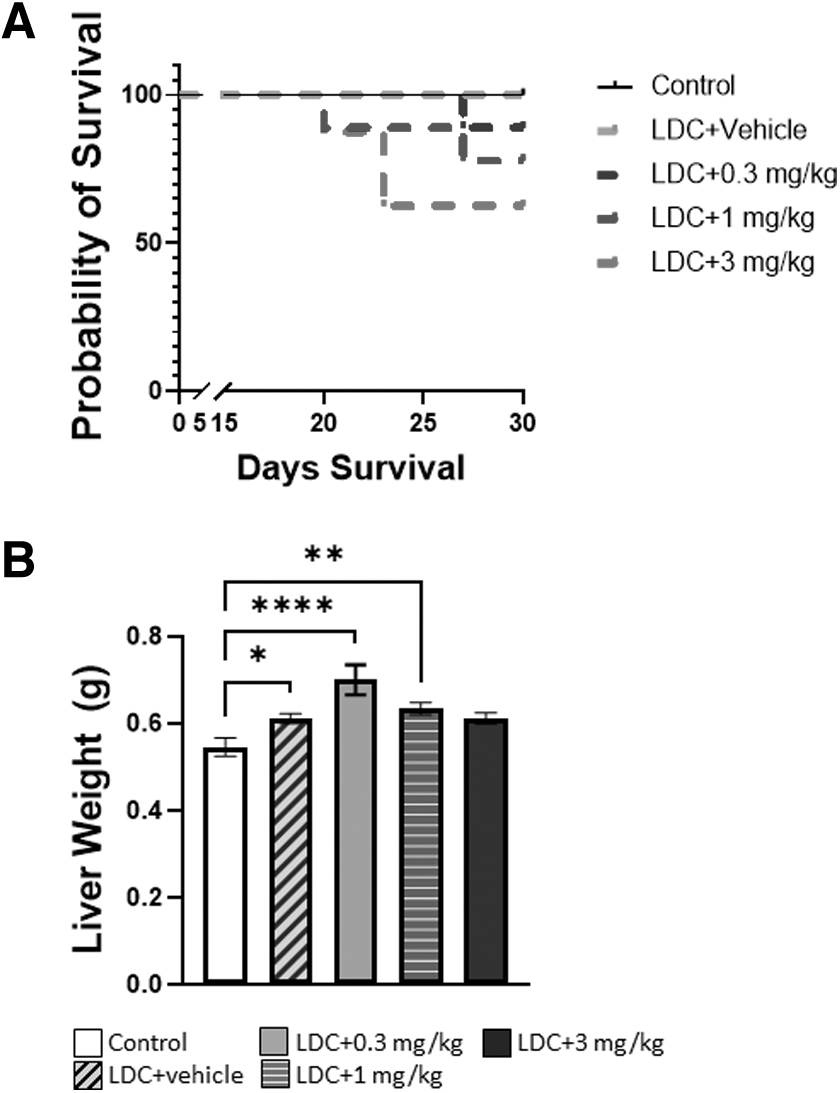
While there was no mortality in the control and LDC diet+vehicle, mortality increased in the LDC diet+ABX-1431 groups in a dose-dependent manner.
Consistent with alcohol intake, TG and cholesterol were elevated in LDC diet groups yet levels were unaffected by ABX-1431 (Table 1). Also consistent with alcohol intake, select enzymes associated with liver injury were elevated in the groups receiving the LDC diet (Table 1). However, AST, ALT, and lactate dehydrogenase tended to increase with increasing doses of ABX-1431, and the LDC +3 mg/kg ABX-1431 group had significantly higher levels than the LDC+vehicle group.
Liver Enzymes and Lipids
Circulating levels of ALP, AST, ALT, HDL, LDL, and cholesterol. TG were measured in liver. Data are presented as mean±SEM.
p<0.05, **p<0.01, ***p<0.001 compared with control.
p<0.05, †††p<0.001 compared with LDC+vehicle as determined by Fisher's LSD post hoc comparison.
ALP, alkaline phosphatase; ALT, alanine aminotransferase; AST, aspartate aminotransferase; HDL, high-density lipoprotein; LDC, Lieber-DeCarli; LDL, low-density lipoprotein; LSD, least significant difference; TG, triglycerides.
Significant steatosis was observed in all groups ingesting alcohol compared with controls as indicated by Oil Red O staining (Fig. 2A, B) and H&E staining (not shown) quantification (Fig. 2A–D). MAGL inhibition did not affect steatosis as indicated by Fisher LSD post hoc comparisons.
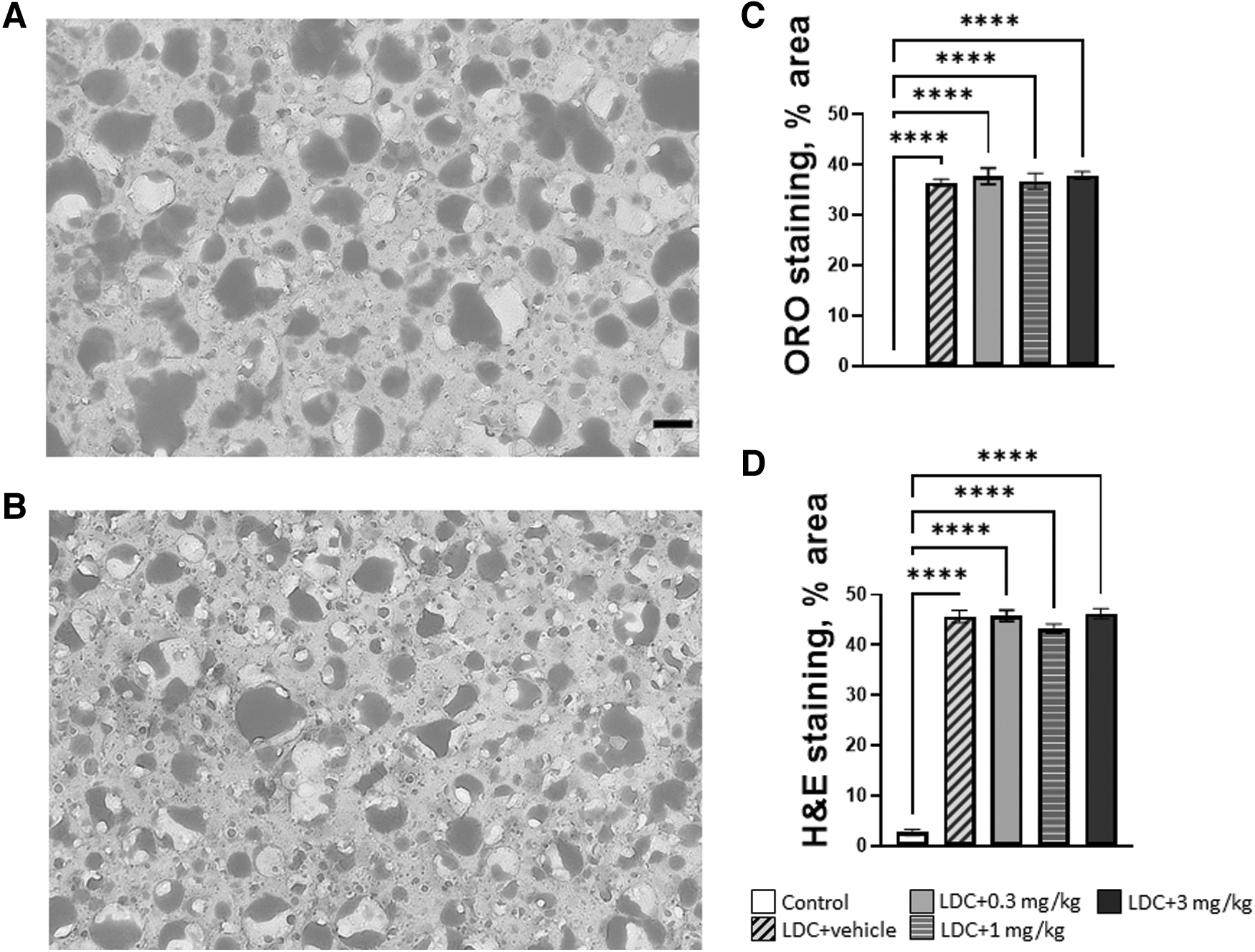
Oil Red O staining was similar in the LDC+vehicle
Discussion
MAGL inhibitors or genetic deficiency have been reported to be protective against hepatic injury. In a model of non-ALD, MAGL−/− mice were protected from weight gain, hepatomegaly, steatosis, and hepatic inflammation. 23 Genetic and pharmacological inhibition of MAGL reduced inflammation and liver lesions in an ischemia/reperfusion liver injury model. 17 Habib et al. 16 reported that MAGL−/− mice exposed to the carbon tetrachloride or bile duct ligation injury were more resistant to inflammation and fibrosis than their wild-type counterparts. Therapeutic treatment with the MAGL inhibitor MJN110 after bile duct ligation reduced liver macrophage number, reduced inflammatory gene expression, and promoted fibrosis reduction or regression. Furthermore, therapeutic treatment with inhibitors MJN110 or JZL184 after cessation of CCl4 treatment accelerated fibrotic regression. 16 These encouraging results led us to explore the role of MAGL inhibition in ALD, which, to the best of our knowledge, was not reported previously.
First reported in 2018, ABX-1431 is an irreversible MAGL inhibitor and is a first-in-class experimental drug for MAGL. 19 It has completed six clinical trials and is considered safe for use in humans. Therefore, this compound was chosen for our studies. Surprisingly, we did not observe hepatoprotection from ABX-1431 in the LDC model of ALD. In contrast, the highest dose elevated select enzymes associated with hepatic injury compared with the LDC+vehicle group.
Dose-dependent mortality was also increased in our study. The doses administered for this study were based upon past reports. Doses as high as 32 mg/kg have been previously administered to rats without reported adverse effects. 19 Past studies also indicate that seizure-prone mice ingested food formulated with 350 mg/kg ABX-1431 (created a steady-state plasma concentration equivalent to 3–10 mg/kg IP dose) from postnatal day (P)18-P30. 24 At P30, the ABX-1431 group had a higher survival rate than the control group, attributed to the fact that ABX-1431 caused more frequent but less severe seizures in these mice.
Hence, the doses selected for our studies were in range of what has been previously reported in literature in rodents as being nontoxic. Our data suggest a potential negative interaction between chronic alcohol and ABX-1431. Further research is required to investigate these relationships.
This study is not without limitations. We investigated a single pharmacological agent, although a well-characterized one that is suitable for in vivo experimental work. Furthermore, the LDC model is reflective of alcoholic steatosis alone and lacks the inflammatory component that may be positively impacted through MAGL inhibition via the CB2 receptor. Tissue was only harvested from surviving mice in the ABX-1431 groups and may have skewed group means toward the survivors. Lastly, although in vivo MAGL activity and 2-AG accumulation, as well as other pharmacokinetic data, were reported in the original article, 19 we did not replicate these assays in this study. Such studies will form the basis of future investigations. In summary, the present data show that inhibition of MAGL using ABX-1431 does not reduce steatosis caused by ALD and is unlikely to represent a viable therapeutic option.
Footnotes
Authors' Contributions
J.L.L.: Formal Analysis, Investigation, Writing—Original Draft, and Writing—Review and Editing. L.T.L.: Investigation, Writing—Review and Editing. G.A.: Resources and Investigation. R.M.: Conceptualization, Funding acquisition, and Writing—Review and Editing.
Author Disclosure Statement
No competing financial interests exist.
Funding Information
This work was funded by an internal grant from RTI to R.M. Furthermore, R.M. is also supported by R01DA040460 and R01DK124615.