




Abstract
Introduction:
Cannabis is a widely used drug like tobacco and alcohol. In the meantime, it is also prescribed for medical treatment in some countries. Tobacco smoke contains chemical carcinogens and particulate matter (PM) that are both harmful to health.
Method:
In this study, we investigated PM levels in second-hand smoke (SHS) of hand-tamped cannabis cigarettes compared to cigarettes with tubing tobacco and the 3R4F reference cigarette.
Results:
It could be demonstrated that the largest proportion of the particle mass is attributable to particles with a diameter of less than 1μm and that every tested cigarette emitted more PM than the 3R4F reference cigarette. In addition, our data clearly revealed that cannabis smoke contains higher PM levels in SHS than tobacco cigarettes. Compared to the reference cigarette, the PM1 emissions of cannabis were 105% higher. Also, the cannabis mixed cigarettes had higher PM levels than the 3R4F cigarettes. For instance, the PM10 emissions were 93% higher. Also, the Gauloises Mélange tubing tobacco also reached higher PM concentrations than the 3R4F cigarette.
Discussion:
Regardless of negative health effects, cannabis is seen as a harmless drug in the public eye. We found strong indications for potential health risks by PM from cannabis products and, therefore, the public should be educated about a potential harm.
Introduction
Cannabis is currently one of the most widely used illegal drugs globally. 1 In some countries, it has received a legal status.2,3 In comparison with other recreational drugs, it may have a less harmful side-effect profile—however, because it is commonly inhaled together with tobacco, its inhalative consumption may lead to lung cancer. 4 Compared with illegal drugs such as cocaine or heroin, it is less expensive and more easily available in most parts of the world. 5 These factors make cannabis, together with tobacco and alcohol, one of the most widely used recreational drugs, especially among young adults.5,6 Within the young German population between 18 and 25 years, 35.8% have consumed cannabis at least once in their lifetime. 7
Next to its use as a recreational drug, cannabis flowers are used with therapeutic intention. In this respect, it was prescribed for medical treatment since March 2017 in Germany. 8 At present, 14 different cannabis flowers from the female hemp plant are prescribed, some of which vary widely in their content of tetrahydrocannabinol (THC), which has an analgesic, nausea-relieving, appetite-stimulating, and psychotropic effect. Another active component prevalent in cannabis is cannabidiol (CBD). CBD has antiphlogistic, anticonvulsant, anxiolytic, and antipsychotic effects.9,10 The cannabis flowers are generally ingested orally or inhaled by smoking or vaporization (vaporizer). 9
The therapeutic effect is mainly owing to the activation of the cannabinoid receptor type 1 (CB1). CB1 receptor activation by THC inhibits calcium release and adenylyl cyclase and, therefore, inhibits neurotransmitter release. 11 Cannabis is used as an appetite stimulant, for pain relief, as well as an antiemetic or for symptomatic therapy of spasms in the context of multiple sclerosis.10,12
Cannabis smoke is produced when the dried flowers, leaves, stems, seeds, or resin from the genus of cannabis plants are burned. 13 The smoke contains various carcinogenic chemicals also commonly found in tobacco smoke.4,14 Although the main components of tobacco and cannabis smoke, namely nicotine and phytocannabinoids, are substantially different, the smoke condensates encompass similar chemicals differing mainly in their quantitative composition.3,15 Concerning tobacco, both actively smoking a cigarette and passive smoking are harmful to health. 16 In 2016, a fifth of men and even one-third of women globally were exposed to second-hand smoke (SHS), also referred to as environmental tobacco smoke. Despite the threat of SHS, only 20% of the world's population are protected by comprehensive national smoke-free laws. 17 SHS constitutes a mixture of two forms of smoke that arise from burning a tobacco cigarette: mainstream smoke, directly exhaled by the smoker and, even more importantly, side-stream smoke from the smoldering tobacco product. 18
Particulate matter (PM) is a mixture of solid and liquid particles from various sources and compositions suspended in the atmosphere. 19 PM can be classified by the different diameters of the particles. The U.S. Environmental Protection Agency and the European Union distinguish between inhalable particles with regard to their diameter. Three categories of PM are distinguished, consisting of particles with diameters ≤10 μm (PM10), particles with diameters ≤2.5 μm (PM2.5), and particles with diameters ≤1 μm (PM1) to measure potential harm to the public. 20
The smaller a particle, the more likely it will penetrate deeper into the respiratory tract, generating increased potential for adverse health effects.20–22 The smallest particles of size <1 μm can penetrate down to the alveoli and can potentially be transferred into the bloodstream, thus translocating into the cell tissue.23,24 PM exposure over a longer period can lead to various negative health effects. For instance, cardiovascular disease–related events, including myocardial ischemia, heart failure, arrhythmias, and strokes can increase substantially. 25 Furthermore, it can lead to inflammatory responses of the lung and chronic obstructive pulmonary diseases. 26
Some studies found that total particulate matter concentration in marijuana smoke is similar to or higher than that in tobacco smoke. How similar the chemicals are in terms of qualitative factors, they differ in quantity.15,27 For example, nitrogen oxide, hydrogen cyanide, and aromatic amines concentrations were found to be three to five times higher in marijuana smoke than in tobacco smoke. 15 On average, 29% of particles in marijuana smoke are larger in mobility diameter than particles from tobacco smoke. 27
Although a number of studies have analyzed PM levels when smoking tobacco cigarettes, little research has been conducted on the question of PM levels arising from cannabis cigarettes. Therefore, this study has been conducted to compare the levels of different PM categories from standardized cannabis smoke with tobacco smoke and a mixture of both.
Materials and Methods
Products
In our experimental setup, the particle size fractions PM10, PM2.5, and PM1 in SHS of four types of cigarettes, namely pure cannabis (Bedrocan®; Bedrocan International BV, Veendam, the Netherlands 28 ), mixed cannabis (50% Bedrocan and 50% Gauloises Mélange tubing tobacco 29 ), pure Gauloises Mélange tubing tobacco, and the 3R4F reference cigarette. 30 The used cannabis flower variety Bedrocan contained ∼22% THC and <1% CBD. The respective release certificate of the Dutch Ministry of Health, Welfare and Sport is given as Supplementary Data S1. The 3R4F reference cigarette is a cigarette from the University of Kentucky and is used as a reference cigarette in many studies. 27 The advantage of the reference cigarette is that the quantity of all burning ingredients is known beforehand. 30
Cigarettes with pure cannabis, mixed cannabis, and pure Gauloises Mélange tubing tobacco were hand-tamped with a filling machine into cigarette tubes from the brand West with cellulose acetate filter. Before that, the cannabis flowers were ground to a size similar to the tobacco. The flower variety Bedrocan was introduced to the market in 2003 and has been used in various research projects worldwide. 28 For a better comparison, 775 mg of tubing tobacco, cannabis, or a mix (each 387.5 mg tobacco and cannabis) corresponding to the same amount of tobacco as the 3R4F reference cigarette 30 were tamped in standard cigarette tubes. A cigarette tamping machine was used to standardize the stuffing procedure of the cigarettes and limit manually induced variance.
In Table 1, the four different types of cigarettes are listed. Forty-eight 3R4F reference cigarettes, 50 Gauloises Mélange, 45 pure cannabis, and 44 mixed cannabis cigarettes were tested. The reason for the different number of cigarettes is that some incorrect measurements had to be removed.
The Four Different Products Investigated, 3R4F Reference Cigarette, Gauloises Mélange Tobacco, Cannabis Pure, Cannabis Mixed with the Stated Manufacturer, and the Number of Cigarettes Tested
Automatic environmental tobacco smoke emitter and smoking protocol
Owing to ethical considerations around the safety of researchers or potential test subjects from the danger of the smoke, four different cigarettes were smoked by an automatic environmental tobacco smoke emitter. A smoke pump (Schimpf Ing, Norway) simulated the smoking process. It consists of a 200 mL glass syringe connected to the mouthpiece of the smoking product via a nylon tube. The smoke pump generates a puff of 40 mL volume by moving back and forth. Puff volume and puff frequency were adjusted by a microcontroller. The program was set at eight puffs per cigarette and two puffs per minute. An initial double puff was needed to ensure the lighting of the cigarette. This protocol is based on the tobacco smoke particles and indoor air quality (ToPIQ) smoking protocol of Mueller et al., where smokers were observed, and the WHO smoking protocol.31,32 The entire setup was placed in an insulated 2.88 m3 measuring chamber. A diagram of the set-up is given in the publication of Gerlach et al. 33
The measurements were carried out according to a standardized ToPIQ-II protocol 34 consisting of recurring phases. These four phases involved a pre-ignition phase, followed by a combustion phase, a subsequent postcombustion phase, and finally, after 10 min, a suction phase (at least 5 min). The combustion phase started with a double puff. After the combustion phase, the cigarettes were manually extinguished. After the postcombustion phase, the glass chamber was ventilated with an industrial fan. Although the smoking behavior of a cannabis consumer is potentially different compared with a regular smoker the same smoking protocol was applied to cannabis cigarettes. It is assumed that cannabis smokers have a higher puff volume, inhale the smoke for longer, and hold their breath for longer than tobacco smokers.35–37
Measurement equipment
The Grimm Laser Aerosol Spectrometer 1.109 measured the particle mass concentration for the particle size fractions PM10, PM2.5, and PM1 in real time. 38 Only the generated SHS was measured. Before the analysis, a dilution of the smoke with compressed air in a ratio of 1:10 by a dilution system VKL mini (Grimm Model 7.951) was necessary to avoid wear and tear on the spectrometer. This dilution was accounted for in the data processing.
Data processing
Data from the combustion and postcombustion phases (10 min) were analyzed. First, the dilution ratio (1:10) was back converted. Then, the mean concentration (Cmean) of each PM fraction for the respective smoke product (cannabis pure, cannabis mixed, Gauloises, 3R4F reference cigarette) was calculated and analyzed with Bias 11.10 (epsilon-Verlag GbR Hochheim, Darmstadt). Cmean was tested with the Kolmogorov–Smirnov–Lilliefors test for Gaussian normality. In addition, to see any potentially significant difference between the PM levels of the four different tobacco products, the Kruskal–Wallis test with subsequent Conover–Iman comparison was performed. The level of significance was set at p=0.05.
Results
Cmean of the four different cigarette types are listed in Table 2.
Mean Concentrations of PM10, PM2.5, and PM1 of the Four Cigarette Types Investigated with Stated Standard Deviation
All mean values were significant to each other (p<0.05) except the two PM1 mean concentrations of cannabis pure and cannabis mixed.
PM, particulate matter.
The PM concentrations between the tested cigarette types varied substantially. The highest PM concentrations were measured for the cannabis pure cigarettes. Compared with the reference cigarette, the Cmean for the PM10 fraction of the pure cannabis cigarette was 131% higher, in case of PM2.5 123% higher, and for PM1 105% higher. The measured PM concentrations of cannabis mixed were also higher compared with the 3R4F cigarettes and the Gauloises Mélange cigarettes. For instance, the Cmean for the PM10 fraction of the cannabis mixed cigarette was 93% higher than the 3R4F cigarette and 53% higher than the Gauloises Mélange cigarette. The hand-tamped Gauloises Mélange cigarette also reached higher PM10 concentrations (+26%) than the 3R4F reference cigarette.
As described previously, the Kruskal–Wallis test with subsequent Conover–Iman comparison was performed to test the similarity among the different samples. The PM concentrations between the four tobacco brands were all significantly different from each other. Only cannabis pure and cannabis mixed showed no significant differences in PM1 concentrations (p>0.05).
Figure 1 provides the particle mass distribution of the different PM fractions PM10-2.5, PM2.5-1, and PM1. As demonstrated, the main particle mass belongs to the PM1 fraction. Compared with the total amount of PM concentrations, the 3R4F reference cigarette emits 98% PM1 particles, cannabis pure 87%, cannabis mixed 96%, and Gauloises Mélange 96%. Although the mass concentration of PM1 is relatively lower in cannabis, it is higher in absolute terms in comparison with the different tobacco products.
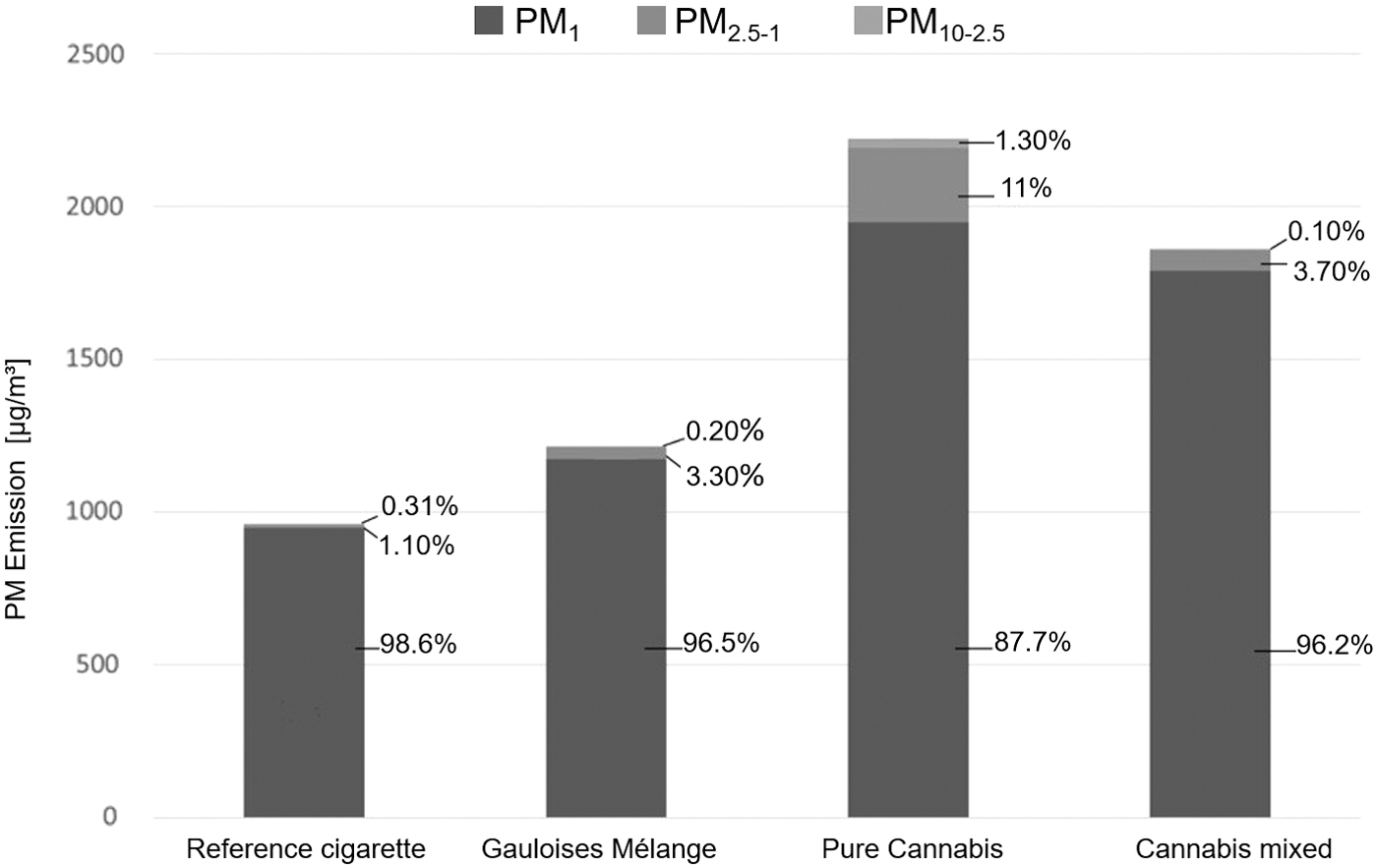
Distribution pattern of the mean concentrations of all cigarette types tested with percentage data of the particle fractions PM10-2.5, PM2.5-1, and PM1. PM, particulate matter.
Figure 2 provides box plots of the four different cigarette types with varying sizes of PM particles. As seen and expected, the lowest standard deviation is associated with the 3R4F cigarette. The standard deviation of the hand-tamped cigarettes (cannabis pure, cannabis mixed, and Gauloises Mélange) is substantially higher, which was expected, as these cigarettes were tamped manually.
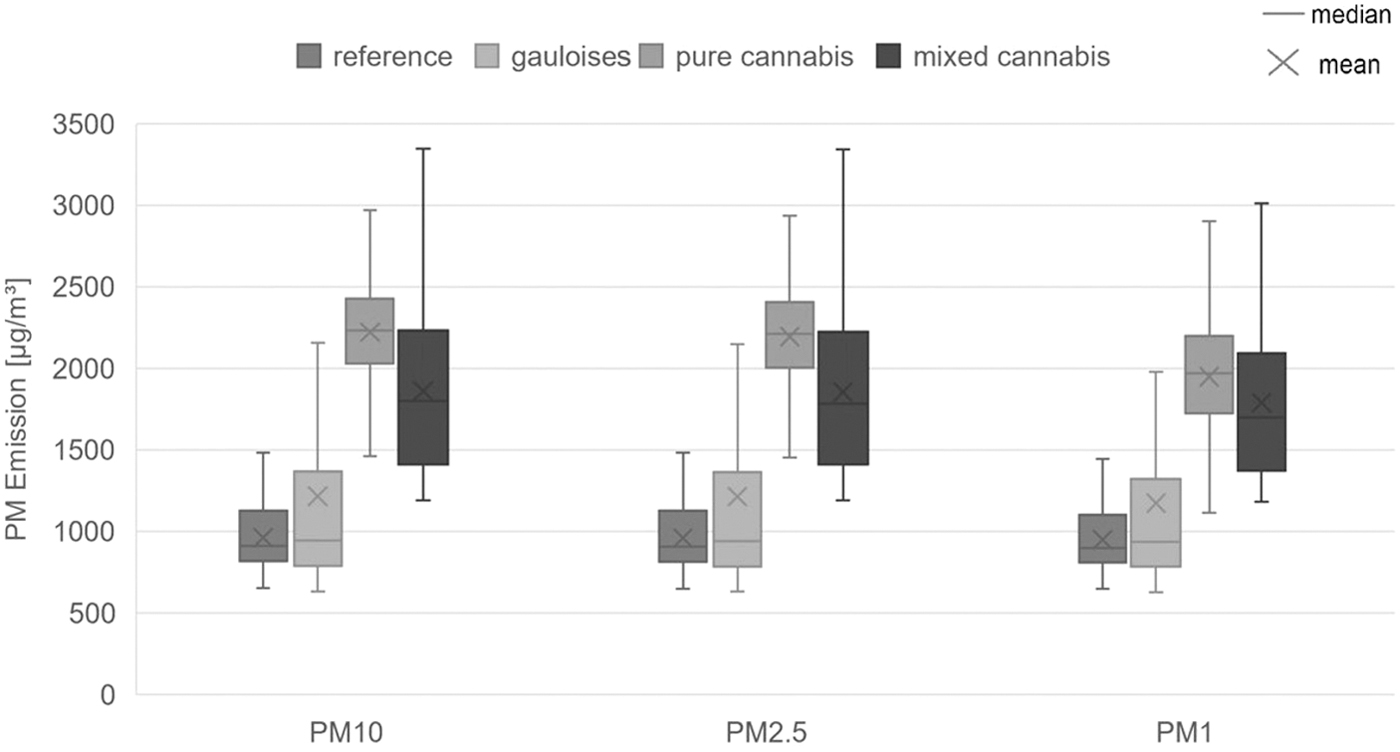
Box plots with minimum to maximum whiskers of the four cigarette types tested of PM10, PM2.5, and PM1 with indication of median (—) and mean (X).
Discussion
Previous ToPIQ studies determined the PM fractions of different tobacco products and types of cigarettes to assess the burden of PM arising from passive smoking of common tobacco products.39–41 These studies were conducted under the assumption that the composition of tobacco products, for example, the content of tar, nicotine, and carbon monoxide, as well as the occurrence of different additives like aromatics, might influence the amount of PM emissions.42,43 The ToPIQ studies primarily measured the relative difference in PM levels between the tobacco products and the reference cigarette. 44 This study builds on the existing literature by comparing the reference cigarette and cannabis in how far they may vary in their corresponding PM emissions. As given in Table 2, the highest amount of PM emission is associated with cannabis cigarettes. These findings help to paint a clearer picture of the possible negative health effects of cannabis consumption.
As explained in the “Introduction” section, the smaller a particle, the more likely it is to penetrate the alveoli and be absorbed into the blood stream leading to adverse health consequences.20,45 As given in Figure 1, the most prevalent particles among the four different cigarette types were PM1 particles. Particles with the chief negative impact on health were thus the most abundant.
Despite some acknowledged adverse effects, cannabis is widely seen as a harmless drug in the public eye.46,47 One reason may be that people believe unsupported information about the health benefits of cannabis on social media or the internet. 46 In this context, 25% of the young U.S. population think that second-hand cannabis smoke is somewhat safer than tobacco smoke. 48 However, in contrast to this public opinion, our results clearly show that PM emissions from pure cannabis cigarettes are substantially higher than from ordinary cigarettes. In addition to that, several other studies have shown significantly higher PM2.5 exposures by pure cannabis in comparison with tobacco cigarettes. They measured the mean daily concentration [μg/m3] of cannabis smoking (bong smoking and marijuana cigarettes) homes to be approximately four times higher than those of cigarette smoking homes.49,50 Furthermore, each cannabis strain has a different PM emission, and thus, further research with different cannabis strains is needed in the future. 51
In terms of tobacco, Gauloises Mélange with a light blue packing suggests that it is a “light” tobacco associated with lower health risks. But compared with the 3R4F reference cigarette, the PM values were ∼25% higher. Thus, a consumer protection regulation should be considered to protect consumers and their environment from higher PM concentrations.
Compared with machine-made reference cigarettes, the cannabis pure cigarettes, the mixed cannabis, and the Gauloises Mélange cigarettes were hand-tamped, which may contribute to the higher standard deviation. As one can see, the standard deviation is considerably higher among the Gauloises Mélange cigarettes (53%) than the reference cigarette (26%). In addition, cannabis pure and cannabis mixed cigarettes have a much higher standard deviation than the reference cigarette, especially mixed cannabis. That suggests the filling density in the tamped cigarettes varied despite the standardized procedure.
Since September 2021, the WHO has tightened the guideline values for PM. The 24-h mean is 15 μg/m3 for PM2.5 and 45 μg/m3 for PM10. 52 The measured PM2.5 and PM10 concentrations in our study were substantially higher. Considering that many people think SHS can be eliminated by opening a window and other measures, the PM2.5 concentration is reduced only by half after 1 h in smoker homes. 53 So, the exposure to high levels of SHS is likely to exceed the guideline values from the WHO for several hours in a typical situation.53,54
Studies suggested that vaporizing cannabis likely induces lower PM concentrations than smoking because the components are not combusted.55,56 But one can assume that a danger of a high PM concentration is still prevalent. A recent study reported in cannabis dispensaries related PM2.5 concentration levels similar to indoor spaces where smoking is permitted. 57
In recent years, the prescriptions for medical cannabis have increased quite a lot in Germany. According to the German statutory health insurance, the number of prescriptions increased in 2019 by 44%. 58 Although cannabis smoke can have a lot of health risks, there are still not enough studies that support the efficacy of cannabis treatments. There is insufficient knowledge about the therapeutic effects of cannabis, the differences between various cannabinoid combinations, or the consequences of cannabis consumption. 59
One limiting factor to this study is that the grain sizes of the grounded cannabis were not measured. Consequentially, no assumptions can be made about the PM concentration effects on the tamping power. This should be taken into consideration in further studies. In addition to that, it is difficult to compare the different standard deviations as the number of tested cigarettes varies in our sample. Our study is also limited to one specific strain of cannabis (Bedrocan). Therefore, the presented data are only representative for this specific strain in conjunction with our method and not for cannabis generally.
Conclusion
This study presents PM concentrations in SHS from cigarettes tamped with pure medical cannabis, tobacco, and both. Of interest, cannabis pure cigarettes emitted the most PM. The experimental setup was only a stylized model, which does not allow measuring the exact effects on the body. Nevertheless, we found strong indications for potential health risks by PM from cannabis products. Therefore, the public should be informed about the potential harm of cannabis smoking concerning PM. There is still a lot of research necessary regarding the risks and potential benefits of cannabis consumption, drawing a clear-cut conclusion about its overall effect on general health outcomes.
Data Availability Statement
Datasets of this study are available from the corresponding author upon request.
Footnotes
Authors' Contributions
This article is part of the thesis of F.J. F.J., M.B., J.D., D.B., and D.A.G. that contributed significantly to the conception and design of the study. Moreover, they prepared the experiments, which were performed by F.J. Also, F.J. analyzed the data and interpreted the results with the help of M.B., J.D., D.B., and D.A.G. The article was written by F.J. and critically reviewed by all authors. All authors have participated sufficiently in the work to take public responsibility for appropriate portions of the content. All authors agreed to be accountable for all aspects of the work in ensuring that questions related to the accuracy or integrity of any part of the work are appropriately investigated and resolved. All authors have read and approved the final version of the article.
Author Disclosure Statement
The authors declare no conflict of interest.
Funding Information
This research received no specific grant from any funding agency from public, commercial, or not-for-profit sectors.

Abbreviations Used
References
Supplementary Material
Please find the following supplemental material available below.
For Open Access articles published under a Creative Commons License, all supplemental material carries the same license as the article it is associated with.
For non-Open Access articles published, all supplemental material carries a non-exclusive license, and permission requests for re-use of supplemental material or any part of supplemental material shall be sent directly to the copyright owner as specified in the copyright notice associated with the article.
