From Basic Biology to Engineering and Clinical Translation of Stem Cells: Meeting Report on the 8th International Meeting of the Stem Cell Network North Rhine Westphalia
Available accessMeeting reportFirst published online December, 2015
From Basic Biology to Engineering and Clinical Translation of Stem Cells: Meeting Report on the 8th International Meeting of the Stem Cell Network North Rhine Westphalia
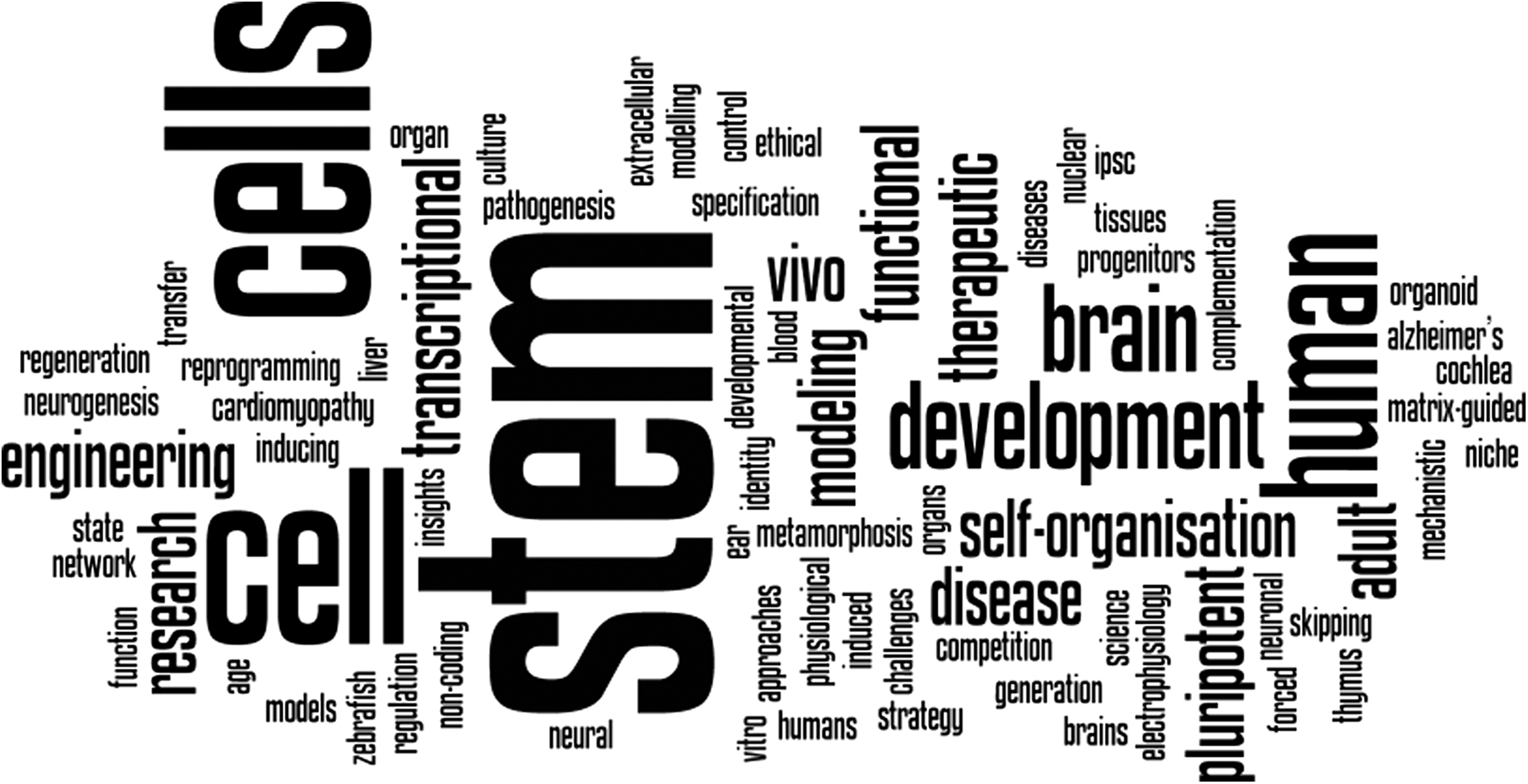
In April of 2015, the 8th International Meeting of the Stem Cell Network North Rhine Westphalia (see www.congress.stemcells.nrw.de), organized by Oliver Brüstle, took place in the beautiful city of Bonn, Germany. This year's scientific program comprised highly interesting presentations and discussions. Numerous researchers and speakers from various scientific fields presented their data about both somatic and pluripotent stem cells and covered the fields of stem cell development, engineering, aging, specification, and self-organization. Compared to previous meetings, an increasing number of presentations dealt with therapeutic approaches and disease modelling, represented by a word cloud that we generated form all of the talk titles (Fig. 1). Thus, the congress provided a broad and compelling impression about new developments in basic research, regenerative medicine, disease modeling, and drug discovery. More than 550 participants, presenting 131 posters, were attracted by the scientific program that provided an excellent and interdisciplinary platform for discussion and collaborations. This meeting report summarizes the most interesting presentations on various issues of stem cell research.
Word cloud visualizing key words from all talk titles presented at the meeting. Words mentioned more often are visualized in bigger font sizes. Word cloud was generated using Wordle (www.wordle.net).
Fred Gage (Salk Institute for Biological Studies, LaJolla, CA, USA) gave an opening lecture, covering fundamental questions like “How did we become humans?” He stated that it would be essential to determine cellular and molecular differences between human and nonhuman primates (NHP) to understand the evolution of humans. To identify relevant phenotypical differences between humans and NHPs, his lab generated and characterized induced pluripotent stem cells (iPSCs) and derived neurons from chimpanzees and bonobos as new tools to unravel great ape evolution. Interestingly, comparative gene expression analyses of human and NHP iPSCs led to the identification of increased levels and mobility of the retrotransposon L1 in NHPs compared to humans (Erwin et al., 2014; Marchetto et al., 2013). He concluded that differences in L1 transposon abundance and mobility may have differentially shaped the genomes of humans and NHPs during evolution. One explanation for the observed differences would be that a subgroup of humans capable of more efficiently suppressing viruses or mobile elements showed improved survival when early humans migrated out of Africa. This would have led to less genomic diversity among existing humans, and thus might still have continuing adaptive significance for the human population. Further use of primate iPSCs as model to study differences between human and NHP surely will uncover further details about human evolution.
Another application involving iPSCs was presented by Jürgen Knoblich (Institute of Molecular Biotechnology, Vienna, Austria). After presenting a recently published method to generate three-dimensional brain tissue in vitro, so-called cerebral organoids, from human pluripotent stem cells (Lancaster and Knoblich, 2014), he focused on how this technology could be used in the future. He and his team generated iPSCs from a patient suffering from microcephaly due to a transheterozygous nonsense mutation in CDK5Rap2. Cerebral organoids derived from these patient-specific iPSCs underwent premature neural differentiation, showed spindle orientation defects, and were smaller compared to healthy controls. Repair of the CDK5Rap2 mutation in patient iPSCs via transcription activator-like effector nuclease (TALEN) technology then led to a complete rescue of the disease-associated phenotype in cerebral organoid cultures. He concluded that patient-specific iPSCs allow the recapitulation of brain developmental disorders in three-dimensional cultures and that genome engineering and organoid technologies allow for unambiguous assignment of human genetic disorders to specific genes.
Matthias Lutolf (Institute of Bioengineering, Lausanne, Switzerland) also talked about the importance of three-dimensional culture to generate organoids and their advantages compared to classical in vitro approaches. He stated that important aspects of the three-dimensional in vivo organization have been recreated in these organoid systems, but that such studies mostly have been performed in Matrigel, a poorly defined proteinaceous mixture whose properties cannot be readily modulated. As such, the uncharacterized interactions between cells and this extracellular matrix (ECM) have proven to be a major challenge to understanding the underlying regulatory mechanisms governing morphogenesis. Thus, his lab employed highly tunable synthetic ECM hydrogels to disentangle the contributions of biochemical and physical components of the microenvironment in the specification of pluripotent stem cell fate and morphogenesis. They developed a high-throughput approach to generate combinatorial interactions systematically between various components of the cellular microenvironment in three dimensions and deployed it to elucidate the mechanisms controlling early neuroepithelial development from single mouse embryonic stem cells. Lutolf then focused on the synergistic roles of matrix elasticity, degradability, and ECM protein composition in specifying neural fate and initiating apico-basal polarity and how his lab explores the relationship of matrix characteristics dynamic symmetry-breaking events in such multicellular constructs. Taken together, Lutolf demonstrated that such morphogenetic processes are tightly coupled to the physical characteristics of the matrix and that a patterned neural tube-like organoid can be generated within an optimized, fully synthetic matrix (Gjorevski et al., 2014). This systematic approach should be applicable to other organoid systems.
A new technical approach for iPSC-based disease modeling was presented by Adam Cohen (Department of Chemistry and Chemical Biology, Harvard University, Cambridge, MA, USA). Recent advances in stem cell technology have opened the possibility to study genetically defined human cells in models of development, aging, and disease. An unresolved key challenge has been the functional characterization of these cells. This challenge is particularly acute for neurons and cardiac cells, where the function comprises changes in membrane voltage that are not directly visible. Cohen pointed out that manual patch clamp electrophysiology lacks sufficient throughput to characterize large numbers of cells under a wide range of conditions. Thus, he and his colleagues developed genetic tools, instrumentation, and software for high-throughput all-optical electrophysiology, i.e., optical perturbation and measurement of membrane voltage. To perturb the voltage, they use a light-gated ion channel, CheRiff, derived from a freshwater alga found in England. A fluorescent voltage-indicating protein, QuasAr2, derived from a halophilic archaeal microorganism found in the Dead Sea, was used to record the voltage. The instrumentation allows optical stimulation of the sample in any user-specified pattern of space and time and simultaneous optical recording from the sample at up to 1000 frames/sec. The software extracts biologically meaningful electrophysiological parameters from highly complex datasets. Cohen's group is applying this all-optical electrophysiology platform to study genetic and drug-induced arrhythmias in human iPSC-derived cardiomyocytes and to study hiPSC-based models of neuronal diseases, including amyotrophic lateral sclerosis (ALS), epilepsy, and pain (Hochbaum et al., 2014).
A visionary research project to explore the idea of growing human organs in other animals was presented by Hiro Nakauchi (Institute of Stem Cell Biology and Regenerative Medicine, Stanford University, Stanford, CA, USA). Using a technique called blastocyst complementation and rat iPSCs, his group reported generation of a rat pancreas in a pdx1−/− apancreatic mouse. Interestingly, the size of pancreas was mouse sized (Kobayashi et al., 2010). Recently, he did the reverse experiment in which mouse pancreas was generated in a pdx1−/− apancreatic rat. The size of the mouse pancreas generated in rat was rat sized. When transplanted, the mouse islets generated in rats engrafted long-term without immunosuppression and normalized the blood glucose levels. Nakauchi concluded that the generation of organs in vivo using xenogeneic iPSC-complemented blastocysts provides a new strategy for understanding organogenesis and a novel approach for organ supply.
Thomas Zwaka (Mount Sinai School of Medicine, New York, NY, USA) talked about cell competition. He pointed out that the concept represents a radical departure from the established view that embryonic development is simply a matter of following a preprogrammed set of rules. Instead, cellular competition is a highly conserved process that promotes the elimination of less fit and potentially dangerous cells during developmental progression. Zwaka presented data on forward genetic screens in pluripotent stem cells to uncover a network of genes, including P53 and topoisomerase 1 (TOP1), that control cell competition in pluripotent cells and the epiblast. A subsequent meta-analysis of the data uncovered a primary molecular effector mechanism, the activation of a canonical immune-related stress response, and subsequent phagocytosis of loser cells by winners. He proposed that cell competition permits selection of the best-fit cells via activation of an ancient stress-related pathway, while, at the same time, maximally preserving resources at this juncture of development.
Shoukhrat Mitalipov (Center for Embryonic Cell and Gene Therapy, Oregon Health and Science University, Portland, OR, USA), already presented data at a previous meeting of this series in 2011 (Radtke and Horn 2011), where he summarized his initial approaches to reprogram somatic cells to pluripotency by somatic cell nuclear transfer (SCNT). At this meeting, he talked about the advances in nuclear transfer and reprogramming in recent years. Cytoplasmic factors present in mature, metaphase II- (MII) arrested oocytes have a unique ability to reset the identity of transplanted somatic cell nuclei to the oocyte state. Mitalipov and his colleagues recently demonstrated the successful reprogramming of human skin fibroblasts into embryonic stem cells (ESCs) following somatic cell nuclear transfer (SCNT-ESCs). A battery of genetic, epigenetic, and transcriptional analyses performed on human SCNT-ESCs confirmed their close similarities to genuine in vitro fertilization– (IVF) derived ESCs than traditional iPSCs. Mitochondrial dysfunction is implicated in disease and in age-related infertility. Mitochondrial replacement therapies (MRT) in MII oocytes could prevent transmission of mitochondria DNA (mtDNA) defects from parents to their children. Last, he pointed out that SCNT offers MRT for patients with inherited or acquired mtDNA disease while generating metabolically rescued pluripotent cells.
Benedikt Berninger (Institute of Physiological Chemistry, University Medical Center Mainz, Germany) highlighted the importance of understanding the logic by which new neurons succeed in integrating into an adult neural circuitry. He discussed work studying the impact of experience on the incorporation of adult-generated dentate granule neurons in the mouse hippocampus using rabies virus-mediated tracing of synaptic connectivity. He provided evidence for a critical period in the life of newborn granule neurons during which their local and long-range connectivity becomes markedly remodeled following exposure of adult mice to an enriched environment (EE) or voluntary exercise (VE) (Bergami et al., 2015). Intriguingly, whereas local connections onto newborn neurons were labile upon return of the mice to a standard housing, long-range connections, such as those from the entorhinal cortex, remained stably increased. Then he discussed experimental efforts to induce neurogenesis in bona fide nonneurogenic areas of the brain, such as the neocortex, by lineage reprogramming of glial cells. Indeed, forced expression of Sox2 can convert NG2 glia into immature neurons that receive synaptic input (Heinrich et al., 2014). Thus, induced neurons can also be become functionally incorporated into the adult circuitry, raising the question of whether their connections are formed de novo following lineage conversion or are “inherited” from their glial ancestors.
An approach combining single-cell functional and gene expression analysis was presented by Bertie Göttgens (Department of Haematology, Cambridge Stem Cell Institute, Cambridge University, Cambridge, UK). Heterogeneities within self-renewal and differentiation capacities of hematopoietic stem cells (HSCs), similar to other stem cell fields, challenge our understanding of the molecular framework underlying HSC function, e.g., gene expression studies are conducted mostly with nonpure stem cell fractions but with multiple HSC subtypes and contaminating non-HSCs in bulk populations. Aiming to resolve such heterogeneity within HSC populations and to understand gene expression programs in murine HSCs, Göttgens and his colleagues combined single-cell functional assays with flow cytometric index sorting and single-cell gene expression assays, thereby linking 11 flow-cytometric parameters with single cell transplantation outcome. Bioinformatic analyses of this data complemented with single-cell RNA-seq data finally allowed the identification of key molecules associated with long-term self-renewal. Finally, Göttgens reported that this approach also was successfully used to identify highly purified populations of mammary progenitor cells, demonstrating that this approach probably also will resolve heterogeneities in other stem cell systems (Schulte et al., 2015; Wilson et al., 2015).
In summary, the 8th International Meeting of the Stem Cell Network North Rhine Westphalia in Bonn offered a great variety of state-of-the-art topics in stem cell research, similar to previous meetings of this series (Fleischmann and Horn 2009; Radtke and Horn 2011, 2013; Wurm and Horn 2008). Of note, presentations and discussions frequently included therapeutic concepts and translational aspects of stem cell research, showing the increasing complementarity between basic and translational stem cell research. The meeting was very well organized and offered a comprehensive update on the newest developments in stem cell research from outstanding international speakers. The sessions were held at the former German Parliament (Bundestag) Plenary Chamber (now the World Conference Center), providing an impressive and inspiring but still comfortable and relaxing atmosphere for students as well as junior and senior researchers to find new collaborations or have conversations with other researchers and the industry.
Footnotes
Author Disclosure Statement
The authors declare that no conflicting financial interests exist.
References
1.
BergamiM., MasserdottiG., TempranaS.G., MotoriE., ErikssonT.M., GobelJ., YangS.M., ConzelmannK.K., SchinderA.F., GotzM., and BerningerD. (2015). A critical period for experience-dependent remodeling of adult-born neuron connectivity. Neuron, 85, 710–717.
2.
ErwinJ.A., MarchettoM.C., and GageF.H. (2014). Mobile DNA elements in the generation of diversity and complexity in the brain. Nat. Rev. Neurosci., 15, 497–506.
3.
FleischmannG., and HornP.A. (2009). Pluripotency and reprogramming: Meeting report on the Fifth International Meeting of the Stem Cell Network North Rhine Westphalia. Cloning Stem Cells, 11, 473–475.
4.
GjorevskiN., RangaA., and LutolfM.P. (2014). Bioengineering approaches to guide stem cell-based organogenesis. Development, 141, 1794–1804.
5.
HeinrichC., BergamiM., GasconS., LepierA., ViganoF., DimouL., SutorB., BerningerB., and GotzM. (2014). Sox2-mediated conversion of NG2 glia into induced neurons in the injured adult cerebral cortex. Stem Cell Rep. 3, 1000–1014.
KobayashiT., YamaguchiT., HamanakaS., Kato-ItohM., YamazakiY., IbataM., SatoH., LeeY.S., UsuiJ., KniselyA.S., HirabayashiM., and NakauchiH. (2010). Generation of rat pancreas in mouse by interspecific blastocyst injection of pluripotent stem cells. Cell, 142, 787–799.
8.
LancasterM.A., and KnoblichJ.A. (2014). Generation of cerebral organoids from human pluripotent stem cells. Nat. Protoc., 9, 2329–2340.
9.
MarchettoM.C., NarvaizaI., DenliA.M., BennerC., LazzariniT.A., NathansonJ.L., PaquolaA.C., DesaiK.N., HeraiR.H., WeitzmanM.D., YeoG.W., MuotriA.R., and GageF.H. (2013). Differential L1 regulation in pluripotent stem cells of humans and apes. Nature, 503, 525–529.
10.
RadtkeS., and HornP.A. (2011). Cells, niche, fate: Meeting report on the 6th International Meeting of the Stem Cell Network North Rhine Westphalia. Cell. Reprogram., 13, 381–384.
11.
RadtkeS., and HornP.A. (2013). Pluripotent and somatic stem cells: From basic science to utilization in disease modeling and therapeutic application. Meeting report on the 7th International Meeting of the Stem Cell Network North Rhine Westphalia. Cell. Reprogram., 15, 394–396.
WurmM., and HornP.A. (2008). Reprogramming, regeneration, and the stem cell niche: meeting report on the 4th International Meeting of the Stem Cell Network North Rhine Westphalia. Cloning Stem Cells, 10, 183–188.