




Abstract
Abstract
The online-ahead-of print e-pub version of the article entitled, Bone Mesenchymal Stem Cell-Conditioned Medium Regulates the Differentiation of Neural Stem Cells Via Notch Pathway Activation, by Li H-M, Tong Y, Xia X, Huang J, Song P-W, Zhang R-J, Shen C-L, utilizing the DOI number 10.1089/cell.2018.0042 is being officially retracted from Cellular Reprogramming.
The original version of the paper was submitted to the journal for peer review on July 29, 2018, with the revised version after peer review submitted on October 21, 2018. The paper was accepted for publication on November 20, 2018 and was subsequently published online ahead of print on December 27, 2018. After the e-publication of the article, the editor received an email from the corresponding author on January 14, 2019 requesting “to withdraw the above-mentioned manuscript for further consideration, due to a technical reason (we have done a further experiment and found this article need add more results).”
Though it is unclear why the authors were not able to determine these faults with the paper within the six months the manuscript was in review, revision, and production, the editorial leadership of the Journal has determined that the paper requires a full retraction from the literature as Cellular Reprogramming is committed to upholding the strictest standards and best practices of scientific publishing.
Introduction
Spinal cord injury (SCI) is disastrous and costly, and there are no effective treatments for it (Grégoire et al., 2015). After injury, the adult mammalian central nervous system (CNS) exhibits little spontaneous regeneration and self-repair. Cell transplantation may be a treatment to SCI, and neural stem cells (NSCs) have the capacity of self-renewal and differentiating into three main phenotypes (neurons, astrocytes, and oligodendrocytes) of CNS cells (Reynolds and Weiss, 1992). However, when NSCs are transplanted into the injured spinal cord, the cells are inclined to differentiate into astrocytes (Cao et al., 2001).
And according to recent in vitro studies (Fang et al., 2016, 2018), they have found that bone mesenchymal stem cell-conditioned medium (BMSC-CM) could regulate the process of NSCs differentiation with a result of decreasing the generation of astrocytes and the expression of glial fibrillary acidic protein (GFAP), but conversely increasing the generation of neurons and the expression of microtube-associated protein-2 (MAP-2). The BMSC-CM consisted of soluble factors secreted by bone mesenchymal stem cells (BMSCs) and a previous study has shown that similar to BMSCs, BMSC-CM in the context of SCI is beneficial and not deleterious and could improve motor recovery. However, the actual molecular mechanism responsible for the influence of BMSC-CM on NSCs differentiation is yet to be studied in detail.
A number of pathways are associated with regulating the differentiation of NSCs. The Notch signaling pathway plays an important role in the development of CNS, and Notch1 is accepted as an essential signaling molecule in the regulation of adult neurogenesis (Louvi and Artavanis-Tsakonas, 2006; Xiao et al., 2009). And the downstream gene hairy enhancer of the split (Hes) family such as Hes6, which can increase the differentiation of neurons, will upregulate when the Notch1 signaling pathway is activated (Katakura et al., 2013). After being exposed to γ-secretase inhibitor II, which inhibits Notch1 activation, the effect of Hes of regulating the cell differentiation is inhibited (Shen et al., 2004).
Besides, regulation of the cell cycle plays an important role in cell proliferation, differentiation, and apoptosis of NSCs. The Notch-Hes1 pathway may contribute to the adequate proliferation of sensory precursor cells via transcriptional downregulation of p27kip1 expression by Hes1 (Katakura et al., 2013). Therefore, we suggest that Notch1 activation could be a potential molecular mechanism in the impact of BMSC-CM on NSCs differentiation.
To certify our hypothesis, this in vitro study was designed to culture NSCs alone or to culture NSCs with BMSC-CM. The Notch signal-blocking agent, γ-secretase inhibitor, N-[N-(3,5-difluorophenacetyl)-
Materials and Methods
Animals
Animals used in this study were according to previous studies (Fang et al., 2018). The 24–48-hour-old rats and adult male rats (weight 80–100 g) of Sprague Dawley (SD) were obtained from the Institute of Experimental Animal Science of Anhui Medical University.
Culture and identification of NSCs
NSCs were cultured as previously described (Fang et al., 2016). Briefly, NSCs were isolated from the cerebral cortex of 24–48-hour-old SD rats. NSCs were maintained in a proliferation medium (DMEM/F12, Gibco BRL; 2% B27; Invitrogen; 20 ng/mL epidermal growth factor; PeproTech; 20 ng/mL basic fibroblast growth factor; PeproTech) supplemented with 50 U/mL penicillin and 50 μg/mL streptomycin. Then, the cells were incubated in a 5% CO2, 37°C humidified incubator and the medium was changed every 3–4 days. The cells were maintained for 7 days and were passaged when the neurospheres reached a diameter of ∼100 μm. Passage 2 cells were utilized to detect the expression of neuroepithelial stem cell protein (Nestin; Abcam and Sox2; Abcam) by using immunofluorescence.
Culture of BMSCs and preparation of BMSC-CM
BMSCs were cultured as previously described (Fang et al., 2016). Briefly, BMSCs were isolated from femurs and tibias of adult male SD rats. BMSCs were maintained in medium (DMEM; Gibco BRL; 20% fetal bovine serum; HyClone) under 5% CO2 in a 37°C humidified incubator. The medium was hereby replaced after 48 hours and changed every 3–4 days. When the cells reached at least 80%–90% confluence, BMSCs were passaged at a ratio of 1:2. And passage 3 BMSCs (Fig. 1) were utilized to obtain BMSC-CM. When the BMSCs grew to at least 90% confluence, the medium was replaced by DMEM/F12 and the cells were cultured for 12–24 hours. At last, the conditioned medium was collected via a 0.22-μm filter.
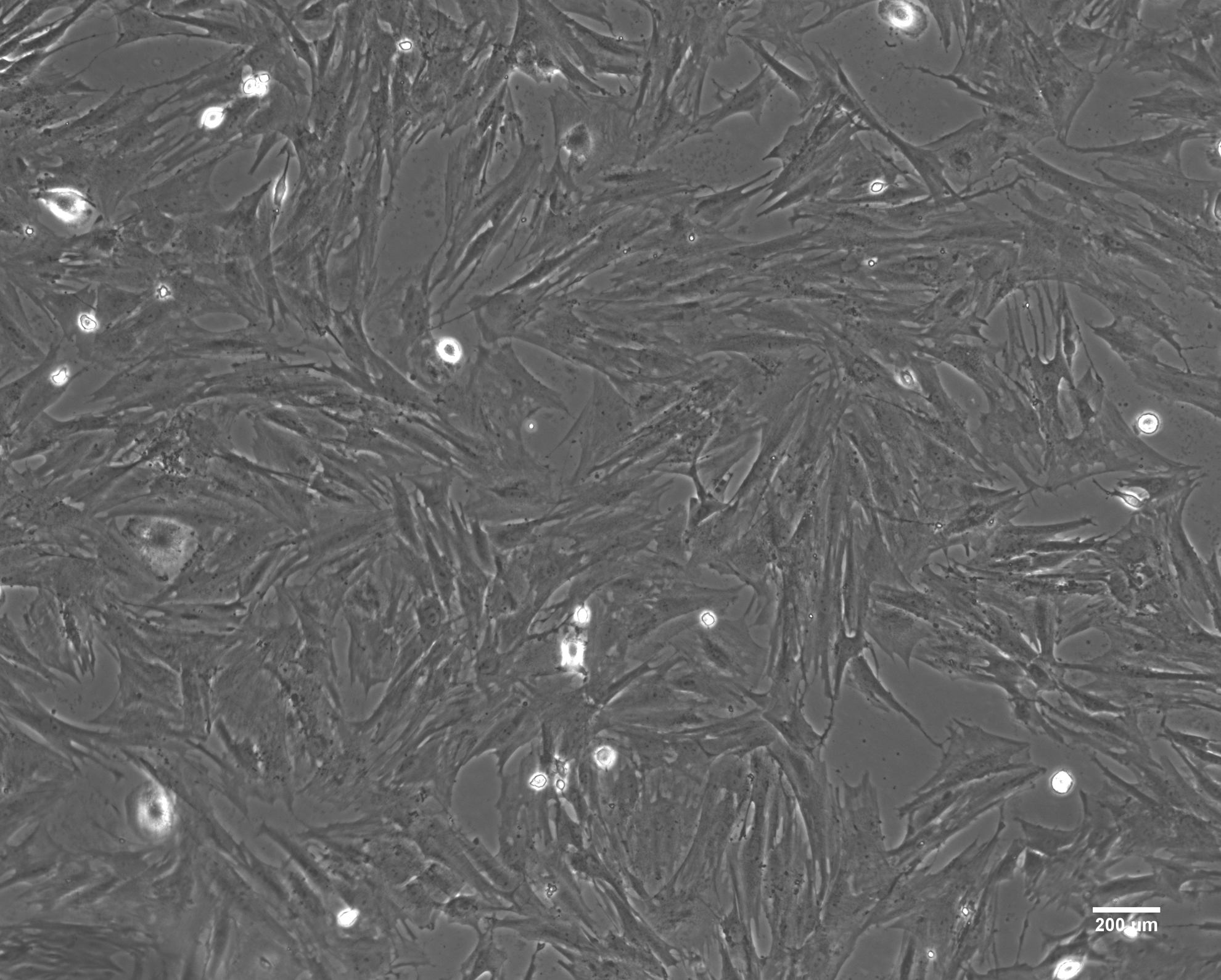
A pattern of fibroblasts of passage three bone mesenchymal stem cells was observed in an inverted microscope. Scale bar = 200 μm.
Differentiation of NSCs in vitro
Passage 2 NSCs were plated onto poly-
Immunofluorescence assay
Immunofluorescence assay for cell samples was performed according to a previous study (Wang et al., 2009). The samples were incubated with rabbit anti-MAP-2 (1:500; Abcam), mouse anti-GFAP (1:1000; Abcam), mouse anti-Nestin (1:50; Sigma), rabbit anti-Sox2 (1:1000; Abcam), and mouse anti-Tuj1 (1:1000; Abcam) overnight at 4°C. After washing with PBS, the samples were incubated with CY3-conjugated anti-rabbit (1:200), Alexa Flour-488 anti-mouse (1:200) antibodies. DAPI (Beyotime, China) was used to label the nuclei. A fluorescence microscope was used for visualization.
Western blot analysis
Western blot analysis was performed according to a previous study (Liu et al., 2014); it was used to detect Notch1 ligand (DLL1) protein, Notch1 intra-cellular domain (NICD) protein, GFAP protein, and MAP-2 protein. The β-actin was used as an internal control. The sample lysates were loaded onto 5%–20% sodium dodecyl sulfate poly-acrylamide gel electrophoresis, and the proteins were detected by using indicated antibodies.
The primary antibody (1:1000; Cell Signaling Technology) was incubated with the polyvinylidene fluoride membranes overnight at 4°C. After rinsing with tris-buffered saline containing Tween-20, the membranes were incubated with the HRP- (horseradish peroxidase)-conjugated secondary antibody (Cell Signaling Technology) at room temperature for 1 hour. The Super Signal West Femto Maximum Sensitivity Substrate detection system (Pierce) was used to examine the sample.
Real-time polymerase chain reaction
According to the manufacturer's protocol, total RNA was isolated by using TRIzol reagent (Invitrogen Corp) and reverse transcribed into complementary DNA by using Transcriptor First-Strand cDNA Synthesis Kit (Roche Corp.) after the cells had differentiated for 7 days. Real-time polymerase chain reaction (PCR) was performed by the SYBR Green Master Mix (Applied Biosystems) and a Realplex Mastercycler (predenaturation at 95°C for 10 seconds, denaturation at 95°C for 15 seconds, and extension at 60°C for 60 seconds for 40 cycles). The sequences of the primers used in this experiment are depicted in Table 1. Fold change was determined by using formula 2−ΔΔCT, and β-actin gene was used in every sample as an internal control to standardize the results. Each sample was analyzed in triplicate.
Real-Time Polymerase Chain Reaction Primers Used to Detect Gene Expression
Statistical analysis
The statistical analysis was performed by using SPSS 23.0 software. Data for the comparison of two groups were determined by an independent-sample T-test and/or one-way ANOVA (analysis of variance). If the data did not pass the Shapiro–Wilk normality test, we used the Mann–Whitney U-test for analysis. All data are presented as mean ± standard deviation. p < 0.05 was considered statistically significant for all analyses.
Results
Identification of NSCs
As shown by immunofluorescence assay, up to 98% of the cells in the neurospheres were positive for Nestin/Sox2 (Fig. 2), which is consistent with the identification of NSCs (Lou et al., 2003).
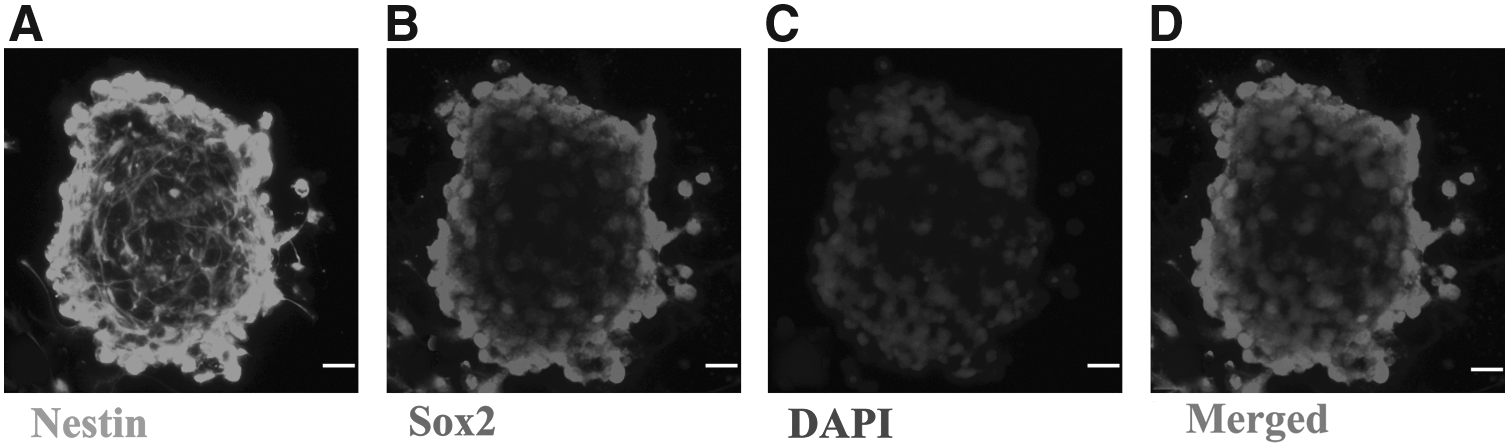
Immunofluorescence identification of NSCs.
Differentiation of NSCs induced by BMSC-CM
After culturing for 7 days, the immunofluorescence assay has shown distinct differentiation of neurons (MAP-2-positive), neurons (Tuj1-positive), and astrocytes (GFAP-positive) of NSCs in three groups (Figs. 3 and 4). As for the NSCs differentiation, there were more MAP-2-positive cells, more Tuj1-positive cells, and less GFAP-positive cells in the BMSC-CM group compared with the control group and the BMSC-CM + DAPT group.
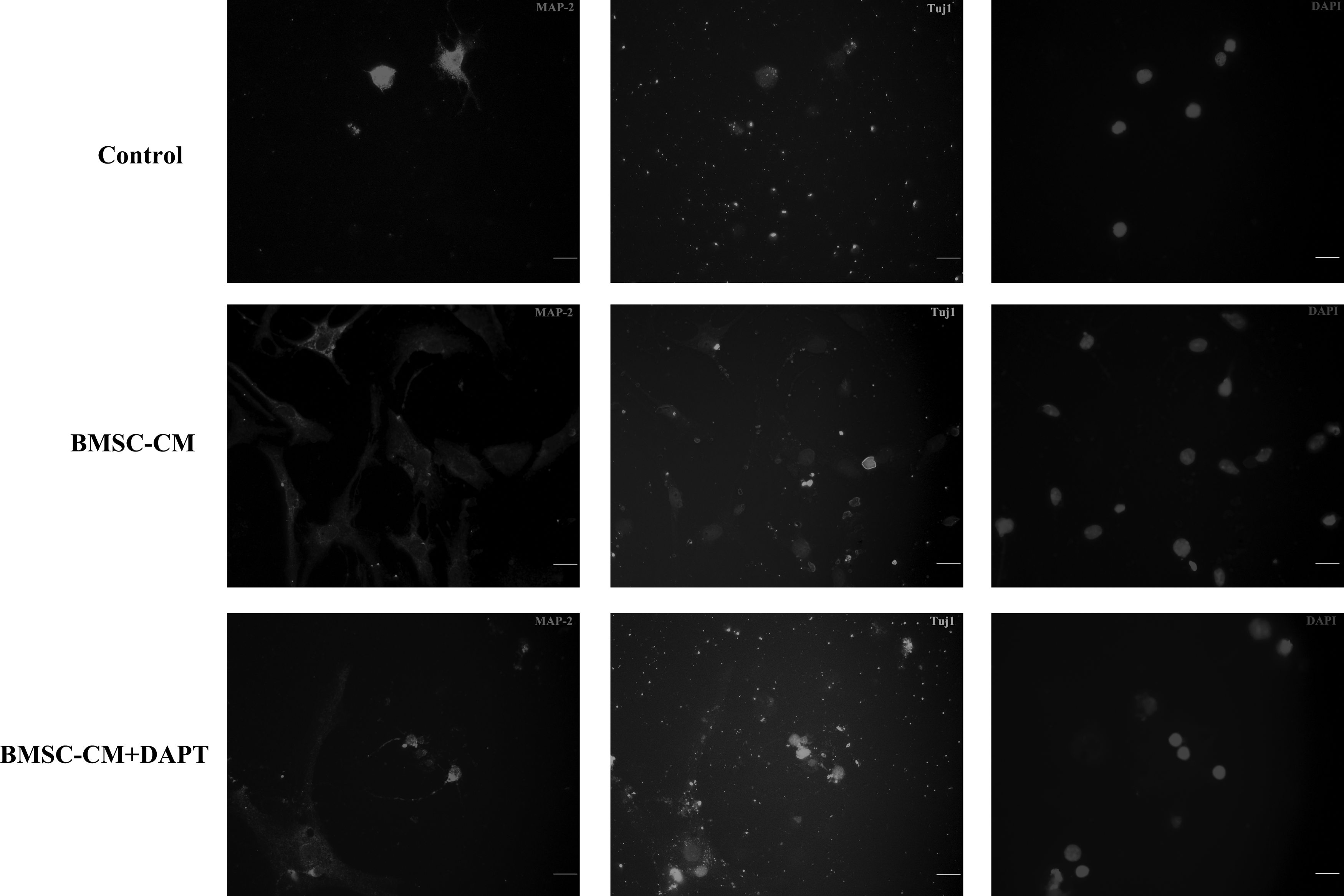
Immunofluorescence assay showed MAP-2-positive/Tuj1-positive cells in different culture conditions. There was a dramatic increase in the number of MAP-2-positive/Tuj1-positive cells in the BMSC-CM group compared with the control group. In the presence of DAPT, the number of MAP-2-positive/Tuj1-positive cells decreased dramatically compared with the BMSC-CM group. The nuclei were labeled by DAPI (blue). The neurons were labeled by MAP-2 (red)/Tuj1 (green). Scale bar = 100 μm. BMSC-CM, bone mesenchymal stem cell-conditioned medium; DAPT, N-[N-(3,5-difluorophenacetyl)-

MAP-2-positive/GFAP-positive cells in different culture groups. There was a dramatic decrease in the number of GFAP-positive cells and a dramatic increase in the number of MAP-2-positive cells in the BMSC-CM group compared with the control group. In the presence of DAPT, the number of GFAP-positive cells increased and that of MAP-2-positive cells decreased dramatically compared with the BMSC-CM group. The neurons were labeled by MAP-2 (red). The astrocytes were labeled by GFAP (green). Scale bar = 100 μm. GFAP, glial fibrillary acidic protein.
Western blot analysis also showed that the levels of neuronal marker MAP-2 protein were higher and those of glial marker GFAP protein were lower in the BMSC-CM group compared with the control group (Fig. 5).

Western blot analysis of the expression of MAP-2 and GFAP protein in each group.
Notch1 pathway activation in the differentiation of NSCs co-cultured with the BMSC-CM
To confirm a role of the Notch1 pathway in the regulation of differentiation of NSCs by the effect of BMSC-CM, western blot analysis was used to detect relevant proteins of the Notch1 pathway. The results showed that the expression of DLL1 and NICD was higher in the BMSC-CM group than the control group, indicating the activation of the Notch1 pathway (Fig. 6A).
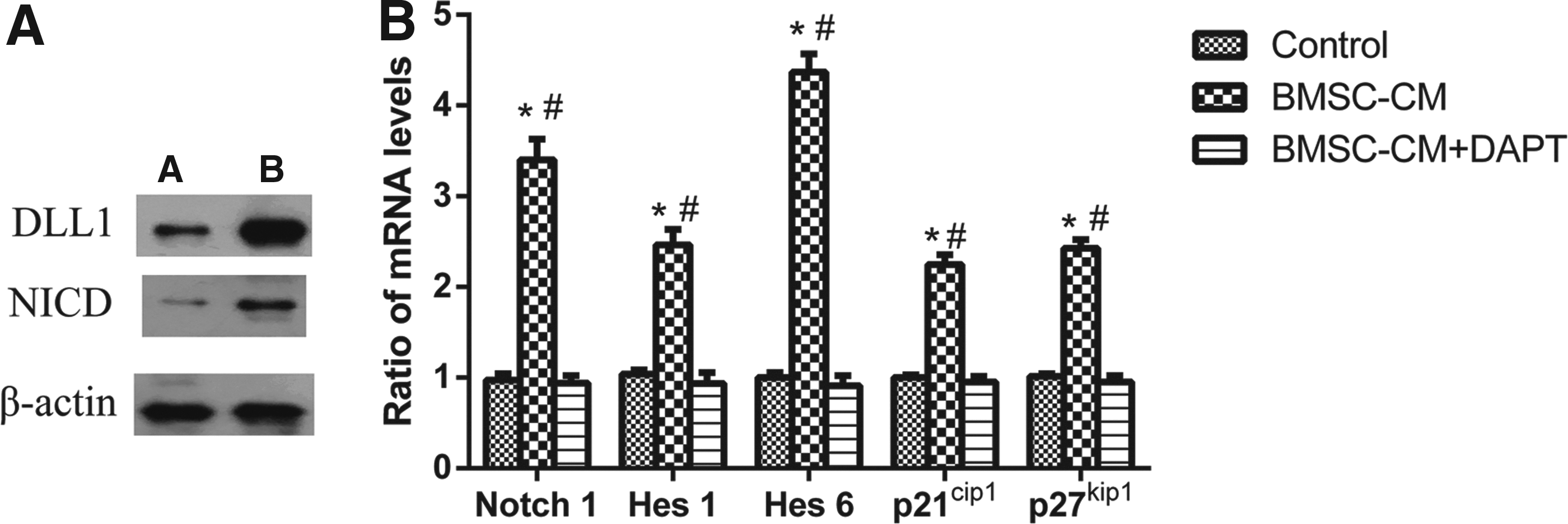
Notch1 pathway activation in the co-cultured group.
Also, we further assessed the expression of relevant mRNA of the Notch1 pathway when the NSCs were cultured with BMSC-CM in the presence and absence of DAPT. Real-time PCR results showed that the expression of Notch1, Hes1, p21cip1, p27kip1, and Hes6 was higher in the BMSC-CM group than the control group. However, in the BMSC-CM + DAPT group, the expression of Notch1, Hes1, p21cip1, p27kip1, and Hes6 dropped, again indicating the significant activation of the Notch1 signaling pathway (Fig. 6B).
Discussion
The aim of this study was to investigate how BMSC-CM affects the fate of the differentiation of NSCs. Here, after culturing NSCs with BMSC-CM for 7 days, the percentage of MAP-2-positive cells increased whereas that of GFAP-positive cells decreased compared with the control group. These results were supported by immunofluorescence assay and western blot analysis. It was reported that BMSCs could influence the differentiation of NSCs. For example, Lou et al. found that the percentage of neurons significantly increased in 7 days in in vitro co-cultures of NSCs and BMSCs (Lou et al., 2003). Besides, they have found that BMSCs decreased the generation of astrocytes.
Other researchers also found a reduction in the percentage of GFAP-expressing cells and promoted differentiation of NSCs into oligodendrocytes, which indicated that the fate of generation of astrocytes and oligodendrocytes was due neither to selective proliferation of a particular cell type nor to selective cell death (Rivera et al., 2006, 2008). Wang et al. (2009), using an in vitro transwell system to co-culture NSCs with BMSCs or NIH3T3 cells, found that the levels of the neuronal marker were higher in NSCs in the BMSCs co-culture group, and those of GFAP were lower, compared with the NIH3T3 cells co-culture group. In addition, previous studies found that BMSC-CM had the same effect as BMSCs on the differentiation of neurons in vitro (Cantinieaux et al., 2013). Thus, we used BMSC-CM as our experimental group and were able to demonstrate the potential mechanism of BMSC-CM regulating the fate of NSCs.
Numerous signaling pathways control the differentiation of NSCs, and the Notch signaling pathway was reported as a prominent pathway in inducing the differentiation of NSCs (Conti et al., 2001; Grandbarbe et al., 2003; Kageyama and Nakanishi, 1997; La et al., 1997). In this study, we focused on the Notch1 (Chojnacki et al., 2003; Wanga et al., 2009). The Notch1 signaling pathway is activated by the ligand (DLL1), leading to the NICD being cleaved by γ-secretase (Androutsellistheotokis et al., 2006; Xiao et al., 2009), which could be inhibited by DAPT.
The cleaved NICD translocates into the nucleus, where it regulates the expression of the HLH family (e.g., Hes1/6). It was reported that inhibition of Hes1 expression promotes NSCs neuronal differentiation whereas expression of Hes6 promotes NSCs neuronal differentiation through inhibiting Hes1 function and promoting proteolytic degradation of Hes1 (Bae et al., 2000; Baron, 2003; Gratton et al., 2003; Koyanonakagawa et al., 2000). Other researchers have found that Hes6 might not affect the expression level of Hes1 but decrease the level of the Hes1 target genes. The Notch-Hes1 pathway may contribute to the adequate proliferation of sensory precursor cells via transcriptional downregulation of p27kip1 expression by Hes1, which directly binds to the p27kip1 promoter region. Hes1 activation may also repress p21cip1 transcription (Katakura et al., 2013; Murata et al., 2005, 2009).
With this canonical theory, we speculated that BMSC-CM may regulate the differentiation of the NSCs through the Notch1 pathway activation. In this study, the expression of Notch1, DLL1, and NICD in the BMSC-CM group was upregulated, followed by the upregulation of the Hes1/6 mRNA expression. These results indicate the activation of the Notch1 pathway in the BMCS-CM group, which regulates the fate of NSCs differentiation. Further, after inhibition of Notch signaling with DAPT, the expression of Notch1, Hes1/6 was downregulated and the NSC neuronal differentiation was also decreased, conversely increasing the NSC astrocytes differentiation.
And our experiments also showed that p27kip1 and p21cip1 mRNA levels in the BMSC-CM group were higher than in controls. Collectively, these results demonstrate that the interaction between NSCs and BMSC-CM was mediated partly through the Notch1 pathway activation, specifying the differentiation of NSCs.
Further, we have also found that in the BMSC-CM + DAPT group, the percentage of MAP-2-positive cells was still higher but that of GFAP-positive cells was lower than that in the NSCs group. These results indicate that the Notch1 signaling pathway may be not the only way to regulate the differentiation of NSCs.
A previous study has demonstrated that BMSC-CM could neutralize the effect of bone morphogenetic protein-4 (BMP-4) on the differentiation of NSCs by upregulating the expression of Smad6 and decrease the expression of GFAP by inhibiting the BMP-4-SMAD1/5/8 signaling pathway, conversely increasing the generation of neurons (Fang et al., 2016, 2018). And our control group was the same as this study group, where the BMP-4 could be detected in an expression. These results suggest that an interaction might exist between the Notch1 signaling pathway and the BMP-4-SMAD1/5/8 signaling pathway. We will seek to verify this hypothesis in future studies.
In conclusion, this study showed that BMSC-CM increased the generation of MAP-2-positive cells and decreased that of GFAP-positive cells of NSCs differentiation, partly through Notch1 signaling pathway activation. BMSC-CM increased Hes6 expression levels, which led to decreased Hes1 activity. Decreased Hes1 activity increased p21cip1 and p27kip1expression levels. These mechanisms promoted neuronal differentiation in NSCs. However, whether this constitutes an interaction between the Notch1 signaling pathway and the BMP-4-SMAD1/5/8 signaling pathway remains unclear. At last, the specific factors of the BMSC-CM that affect the expression of Hes1/6 in the process of NSCs differentiation remain unknown. Future experiments to investigate these remaining issues are, therefore, necessary.
Footnotes
Acknowledgments
The authors thank the staff of the School of Life Science at Anhui Medical University for their technical assistance. This work is supported by the National Natural Science Foundation of China (No. 81472088).
Ethics Approval
Animal protocols for these studies were approved by the Animal Care and Use Committee of Anhui Medical University, Hefei, China.
Author Contributions
C.-L.S.: conceived the study and designed experiments; P.-W.S. and R.-J.Z.: supervised the study; H.-M.L., Y.T., X.X., and J.H.: performed experiments; and H.-M.L.: analyzed data and wrote the article.
Author Disclosure Statement
The authors declare that no conflicting financial interests exist.