




Abstract

The study by Drouin-Ouellet et al (2022) describes a novel direct reprogramming methodology that retains aging characteristics and generates a mature neuronal population. A barrier when modeling neurodegenerative diseases including Parkinson's disease (PD) is the ability to model idiopathic disease in a way that maintains aging features. Age is a major risk factor for developing PD; many age-related changes are not maintained by induced pluripotent stem cell (iPSC) reprogramming. Others have previously reported aging features retained using direct reprogramming methods (Gatto et al, 2021; Tang et al, 2017).
The authors describe direct reprogramming of fibroblasts into iNeurons (Fig. 1), which include a subpopulation of iDopaminergic neurons (iDANs), expressing both TAU and tyrosine hydroxylase. iNeurons are generated from 10 control participants and 18 patients with idiopathic PD. No differences are reported in efficiency of reprogramming, morphology, or electrophysiological function of the resulting neurons. The iNeurons were generated using shREST and the neuronal factors Ascl1, Lmx1a, Lmx1b, Foxa2, Otx2, and Nr4a2. This combination was identified as the most efficient from different combinations of 10 reprogramming factors trialed.
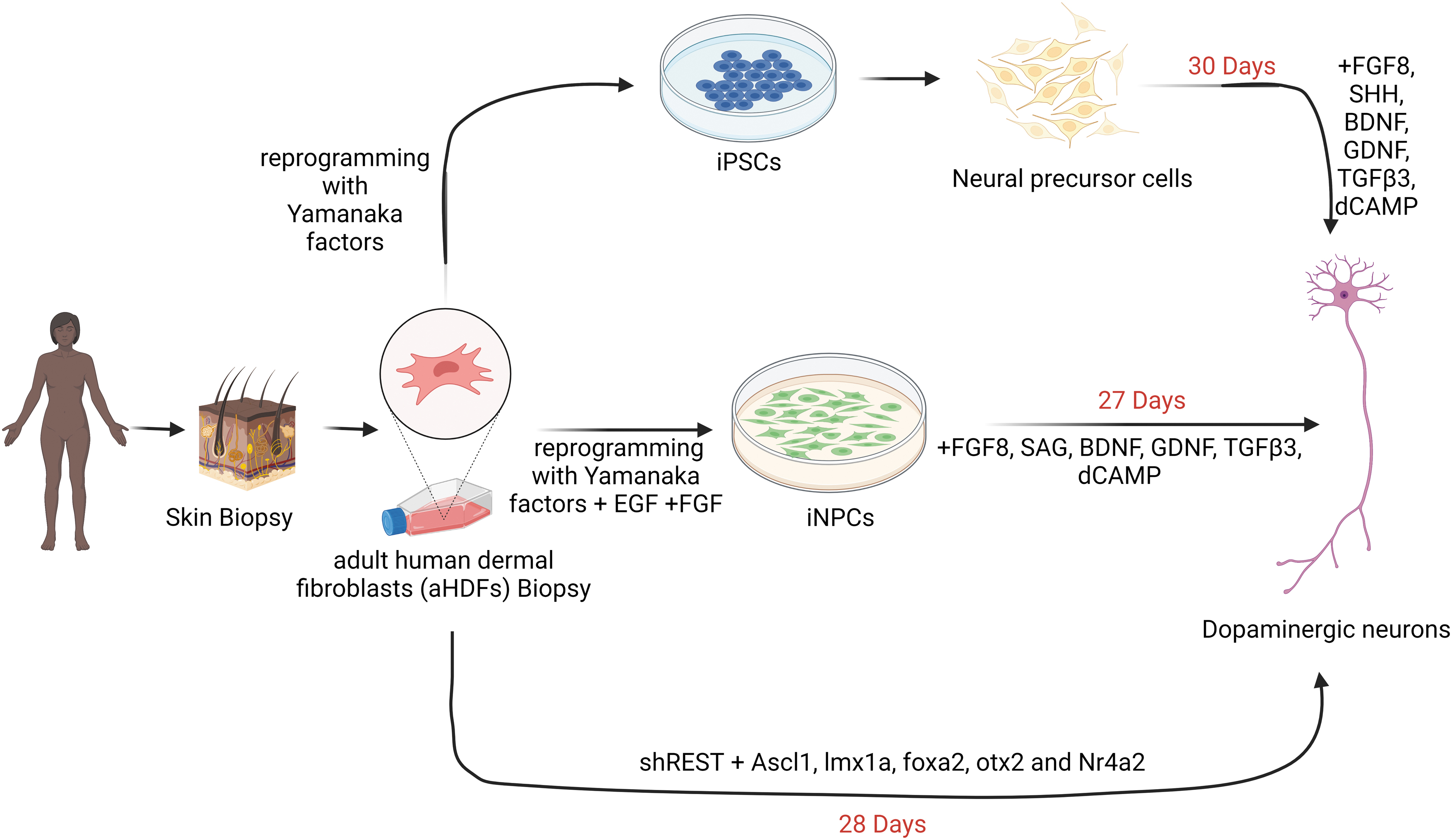
Diagrammatic representation of three most commonly used reprogramming methods from fibroblasts to neurons. Created with Biorender.
Next, the authors investigate a major pathway known to be dysregulated in PD, autophagy. Several disease phenotypes are identified in PD iNeurons. PD iDANs have reduced LAMP2a positive puncta that are not further reduced upon starvation, a condition that in the control iDANs induces decreased LAMP2a puncta. Furthermore, basal levels of colocalization of the HSC70 chaperone and alpha synuclein are reduced in PD iDANs. When investigating macroautophagy, PD phenotypes are found in all iNeurons. LAMP2-positive puncta show no differences between control and PD iNeuron's at the cell body, however, larger LAMP2 puncta are found in neurites of PD iNeurons. Transcriptomics analysis confirmed changes in specific lysosomal genes in PD iNeurons. PD iDANs also have a buildup of p62 puncta in response to starvation. Finally, phosphorylated αSYN levels after stress are increased specifically in iNeurons from PD patients.
Importantly, these PD-related phenotypes are not found in neurons generated from the same lines through iPSC reprogramming or the parental fibroblasts. Clearly, retention of aging markers is key to the development of PD phenotypes in these iNeurons; however, only certain phenotypes are specific to iDANs. It is unclear whether this is of disease relevance. Interestingly, patient stratification is possible dependent on three phenotypes, p62, LAMP2, and phosphorylated αSYN.
This study makes an important contribution to the field. A potential issue with direct reprogramming methods can be variability and efficiency. This study has achieved this on a larger scale and produced enough neurons to investigate disease-specific phenotypes with the possibility of compound testing. Direct reprogramming, however, cannot generate other cell types associated with disease, such as astrocytes. It will be important to compare this direct reprogramming method with others published that also maintain aging features and are able to generate astrocytes as well as neurons from neuronal progenitor cells. As our knowledge and expertise of reprogramming methods increase, so does our capability to model complex human diseases of aging.
Footnotes
Authors' Contributions
E.S. and H.M. both contributed to the conceptualization of the article, the original writing, and editing and reviewing.
Author Disclosure Statement
The authors declare they have no conflicting financial interests.