




Abstract
Abstract
Background:
Adult literature documents that healthcare providers rely on patient characteristics, such as age, race, and weight, when making clinical decisions. However, little research has examined these biases among pediatric populations. This study aimed to examine the impact of child and maternal weight and race on clinical decision-making of healthcare trainees in the context of a pediatric pain assessment using standardized virtual pediatric patients and mothers.
Methods:
Ninety-two healthcare trainees read a standardized clinical vignette describing a child with chronic pain, which was accompanied by eight virtual human (VH) scenes—each with a child and mother. Scenes varied by the dyad's race, child's weight status, and mother's weight status. For each scene, participants were asked to make six healthcare assessment ratings.
Results:
Participants rated children (M = 42.44 vs. 48.69; p < 0.001) and mothers (M = 51.06 vs. 65.31; p < 0.001) with obesity as being less likely to adhere to physician recommendations compared with healthy weight children and mothers. Child patients with obesity (M = 38.88 vs. 30.08; p < 0.001) and mothers with obesity (M = 49.71 vs. 43.71; p < 0.001) were also rated as bearing more responsibility for the child's health status compared with healthy weight peers.
Conclusions:
This study provides evidence that child and mother weight can impact clinical decision-making, as well as for the utility of VH technology in studying decision-making among healthcare trainees and providers.
Introduction
Youth with overweight or obesity (OV/OB) are subjected to weight bias and stigmatization 1 and are at risk for negative consequences, including increased depressive symptoms, anxiety, disordered eating, and decreased self-esteem.2,3 Weight stigmatization and bias toward youth with OV/OB are committed by many groups, including peers, teachers, and parents.1,4,5 Furthermore, parents of children with OV/OB are also often stigmatized or blamed for their children's weight.6,7
The adult literature consistently documents that healthcare providers contribute to disparities in care by responding to patient characteristics (e.g., race/ethnicity, gender, and age).8–12 It is suggested that this results through a dual processing model of stereotyping, which occurs rapidly outside of conscious awareness, particularly in situations involving clinical uncertainty, high workload, fatigue, and high stress.8,13,14 One of the most widely studied characteristics to contribute to healthcare biases is patient race and ethnicity. Multiple studies have documented higher pain intensity ratings among racial minority children,15,16 although providers are less likely to prescribe opioid and narcotic pain medications compared with Caucasian children.17,18
These unconscious heuristics also lead healthcare providers to endorse negative stereotypes about adult patients with OV/OB, including rating them as lazy,19,20 nonadherent to medical recommendations,21,22 and more responsible for their conditions. 22 However, to our knowledge, only one study has explored these associations in pediatric populations. Boyle et al. 16 found that healthcare trainees were more likely to rate the pain of virtual human (VH) pediatric patients with obesity as being influenced by psychological or behavioral issues, as well as a desire to avoid nonpreferred activities (e.g., school) compared with the pain of healthy weight VH patients. Weight bias is troubling given the frequency with which healthcare providers will come in contact with patients with OV/OB. 23
Examining weight bias among adult populations only assesses the impact of patient weight on provider bias. However, pediatric patient encounters typically rely on both child patient and parent interactions with the healthcare team. Parents of children with obesity reported themes of being dismissed or perceiving negative attitudes from physicians, which caused parents to avoid their physician for fear of being blamed for their children's condition. 6 Taveras et al. 24 also examined maternal perceptions of obesity counseling and found that mothers with obesity who had children with obesity reported receiving too little advice about nutrition and physical activity compared with mothers who were healthy weight. Given this and the known biases toward adults with obesity, it seems likely that maternal weight status may impact healthcare provider perceptions and behaviors toward child patients.
One possible way to investigate these factors is with VH technology, which allows researchers to manipulate individual characteristics (e.g., age, sex, race, and weight status) and assess bias within the context of hypothetical medical encounters. 25 An additional advantage of VH technology is that it reduces methodological limitations associated with other assessment modalities (e.g., social desirability biases11,26) and increases the chance that healthcare providers and trainees will report their attitudes truthfully. 27 Research using VH technology has demonstrated that providers and trainees use patient characteristics when assessing and making treatment decisions for VH patients.12,25,28
The purpose of this study was to utilize VH technology to examine the influence of child and mother weight status on healthcare trainee decision-making. Given the pervasiveness of obesity in our society, weight-related biases are likely formed well before entering the clinical workforce. 19 For example, Miller et al. 29 found that undergraduate students were more likely to discount the pain of healthy weight women, women with overweight, and men with obesity and judge it as less in need of treatment. From an intervention perspective, it may be more feasible to target these biases in an academic environment as part of the standard educational curriculum. Thus, examining potential biases among future healthcare professionals provides an important assessment as they begin their early preparations for patient care.
We chose to examine these perceptions within the context of a child presenting with pain, given the subjective nature of pain assessment and its high rates of comorbidity with obesity. 30 Youth with obesity are also significantly more likely to experience back and lower extremity pain than youth with a BMI below the 85th percentile. 31 Tsiros et al. 32 further documented that children with obesity self-reported higher pain intensity levels than their healthy weight peers. Furthermore, children with obesity and pain experience more functional disability due to pain and longer duration of pain episodes relative to healthy weight peers with pain. 33 This is likely observable to peers and may contribute to perceptions in the general population of children and young adults that children with OV/OB are likely to be impacted by pain more than their healthy weight peers. Therefore, it is hypothesized that (1) trainees will rate VH digital images of children with obesity as experiencing a greater intensity of pain than healthy weight children; (2) trainees will rate VH children and mothers with obesity as less likely to adhere to treatment recommendations compared with healthy weight VH children and mothers; (3) trainees will rate VH children and VH mothers with obesity as bearing more responsibility for the child's current health status than healthy weight VH children and mothers. No a priori hypotheses were made about trainee level of motivation to help VH child patients. We also conducted exploratory analyses with no a priori hypotheses to examine for interaction effects between child and mother VH weight on outcome variables.
Methods
Participants
Participants were 92 students at a university in the southeastern United States who were pursuing a bachelor of science degree in a healthcare-related field (e.g., nursing, pre-med, and psychology). Ninety-two percent of the sample was female, and a majority self-identified as Caucasian (75%). The average age was ∼22 years (SD = 4.39), and 64% were in their fourth year or higher of study. Detailed participant characteristics are provided in Table 1.
Demographic and Background Characteristics of Participants
Procedure
Participants were recruited through listserv e-mails and posted flyers. The study used a computer-based delivery model, similar to previous studies,16,25 and was IRB approved. Students who expressed interest in participating and met eligibility criteria were e-mailed a unique username/password and link that directed them to the study. Participants provided electronic consent.
Participants viewed 16 VH digital image scenes separately (8 scenes, each shown twice to increase reliability) that included a vignette, standardized vital statistics, and 2 full-body static VH images (i.e., pediatric patient and mother of the patient). Presentation of the 16 digital image scenes was counterbalanced based on a computer algorithm to prevent order effects. For each scenario, participants were asked the following six assessment questions:
Level of pain you believe this patient is currently experiencing (no pain sensation to most intense pain sensation). I am motivated to help this patient feel better (not at all to very much so). Likelihood that this child will follow the recommendations made by the physician (not at all likely to completely likely). Likelihood that this child's mother will follow the recommendations made by the physician (not at all likely to completely likely). Degree that this patient is responsible for their current health status (not at all likely to completely likely). Degree that this patient's mother is responsible for their child's health status (not at all likely to completely likely).
Ratings were made using a 100-point visual analog scale (VAS), anchored by the previously mentioned endpoint descriptors. With a computer mouse or keypad, participants used a “slider” to indicate the point on the VAS that best represented their rating. After completing the 6 items for each of the 16 VH scenes, participants completed a demographic questionnaire.
VH Digital Image Profiles
Eight unique scenes were created, each with a female, VH child, and mother together in the scene. Scenes were created using The Sims 4, a life simulation video game published by Electronic Arts, Inc. Child weight status (obese or healthy weight), mother weight status (obese or healthy weight), and dyad race (Caucasian or African American) were systematically manipulated, creating eight unique scenes that included all combinations of cues (See Figs. 1 and 2 for examples).

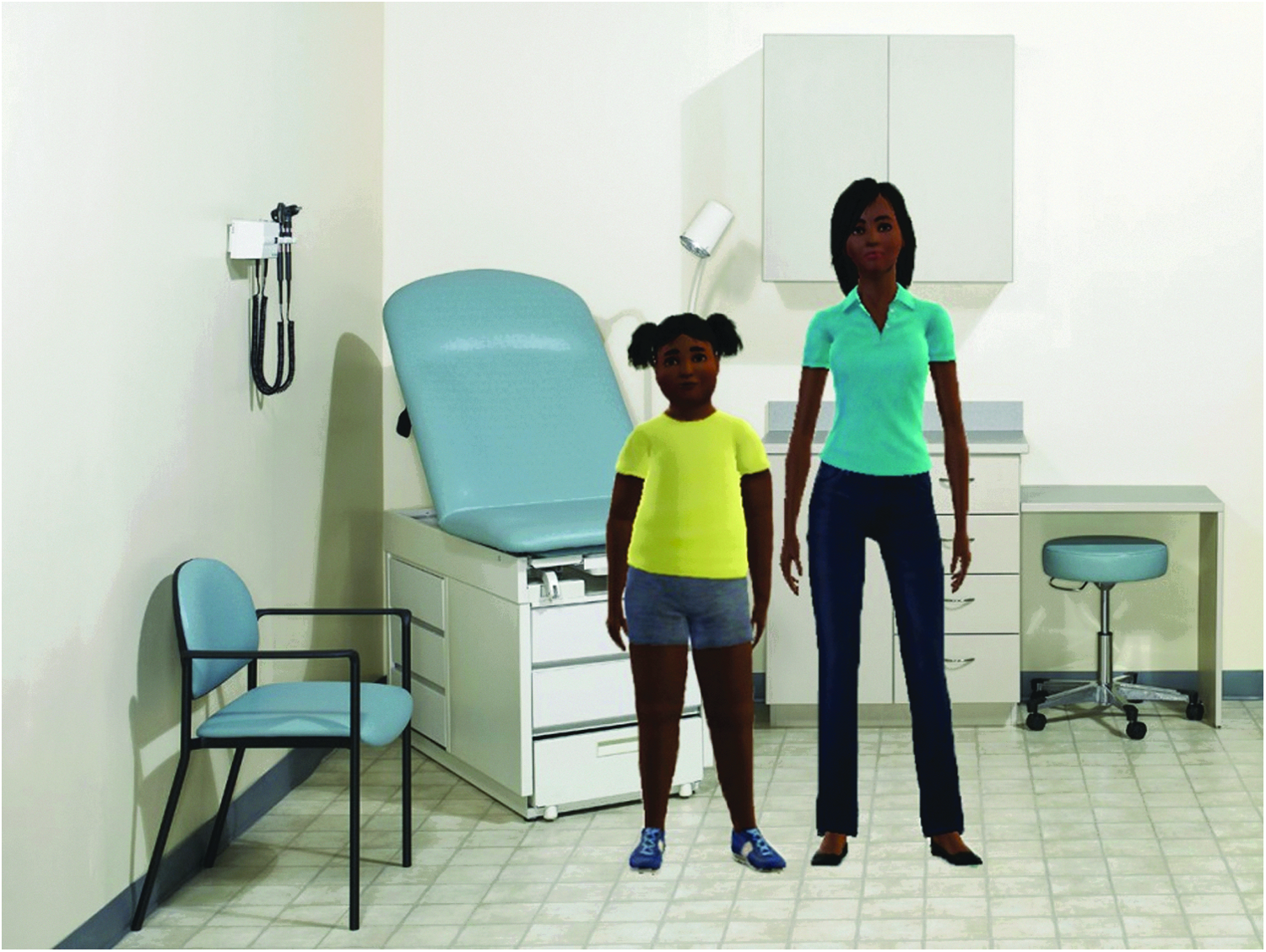
The same vignette was used for each profile and was presented as follows:
Patient is a 12-year-old female presenting with lower back pain. She is accompanied to the appointment by her mother. This is her first visit scheduled with her pediatrician to specifically address her back pain, although she has been experiencing pain for over 3 months. She has missed school several times in the past month due to her pain. She is not taking any medication for her pain at this time.
Physiological information (e.g., temperature, blood pressure, pulse rate, respiration rate, and mental status) was also presented on the same page as the VH patient and mother. These values were standardized across patients and were noted to be within normal limits. The digital images were static and not intended to show any pain features.
Statistical Analyses
All analyses were conducted using the SPSS, version 21. Duplicate responses for each of the six assessment items were averaged for each participant. Average participant assessment and treatment ratings were calculated across virtual patients at each cue level (e.g., race, child weight status, and mother weight status). Repeated-measures analysis of variance was used to examine assessment decisions as a function of VH personal characteristics. Within-subjects variables included child weight status (healthy weight or obese), mother weight status (healthy weight or obese), and dyad race (Caucasian or African American). We also conducted exploratory analyses with no a priori hypotheses to examine for interaction effects between child and mother VH weight on outcome variables, using a conservative p-value of 0.01.
Results
Average participant ratings were calculated across virtual patients at each level of cue. These averages are presented in Table 2.
Means Ratings across Items within Cues
Rating scale is 0–100.
p < 0.05; **p < 0.01; ***p < 0.001.
Level of Pain
Consistent with our hypothesis, results indicated a main effect of virtual patient weight status [F(1,91) = 15.87, p < 0.001, partial η2 = 0.148] on ratings of pain level. Participants rated child patients with obesity to be experiencing greater pain than healthy weight child patients. Results revealed no main effects for VH race or mother weight status on pain level.
Patient Adherence
Analyses assessing perceptions of patient adherence to treatment recommendations revealed a main effect of virtual child patient weight status [F(1,91) = 28.05, p < 0.001, partial η2 = 0.236] and mother weight status [F(1,91) = 6.20, p = 0.015, partial η2 = 0.064]. VH child patients with obesity were rated as less likely to adhere to recommendations than healthy weight child patients. In addition, participants rated child patients of mothers with obesity as less likely to adhere to recommendations than peers with healthy weight mothers. There was no main effect of VH race.
Mother Adherence
Analyses assessing perceptions of mother adherence to treatment recommendations demonstrated a main effect of virtual mother weight status [F(1,91) = 68.07, p < 0.001, partial η2 = 0.428]. Mothers with obesity were rated as less likely to adhere to recommendations than healthy weight mothers. There were no main effects of VH race or child patient weight status.
Patient Responsibility
Consistent with our hypothesis, there was a main effect of virtual patient weight status on perceptions of responsibility [F(1,91) = 42.43, p < 0.001, partial η2 = 0.318]. Participants rated child patients with obesity as bearing more responsibility for their health status than healthy weight patients. There were no main effects of VH race or mother weight status.
Mother Responsibility
Results revealed a main effect of virtual patient weight status [F(1,91) = 22.35, p < 0.001, partial η2 = 0.197] and mother weight status [F(1,91) = 39.20, p < 0.001, partial η2 = 0.301] on perceptions of mothers' responsibility. Participants rated mothers with obesity as bearing more responsibility for their child's health status than healthy weight mothers. In addition, mothers were rated as bearing more responsibility for their child's health if the virtual child patient had obesity compared to those virtual child patients with healthy weight. There was no main effect of VH race.
Motivation
There were no significant effects of race, patient weight status, or mother weight status on participants' motivation to help VH patients.
Two-Way Interaction Effects
There was a significant interaction (VH race by virtual patient weight status) observed for the item, “Likelihood that this child's mother will follow the recommendations made by the physician” [F(1,91) = 7.03, p = 0.009, partial η2 = 0.072]. For Caucasian VHs, participants rated VH mothers to be more adherent to recommendations if their VH child was healthy weight (M = 59.80, SD = 18.24) than obese (M = 56.86, SD = 18.41). There were no significant differences observed among African American VHs. There was also a significant interaction of VH child weight status by VH mother weight status [F(1,91) = 7.94, p = 0.006, partial η2 = 0.080]. Participants rated VH mothers with obesity as significantly less adherent to recommendations if they had a VH child with obesity (M = 49.46, SD = 18.48) compared with a healthy weight child (M = 65.70, SD = 20.21). No other interactions met criteria for statistical significance.
Discussion
This study used VH technology to examine the effects of child patient and mother weight status and race on healthcare trainee perceptions of VH patients. Although there is substantial evidence in the adult literature that healthcare providers and trainees use biased attitudes when assessing and treating adult pain patients,12,27,29,34 few studies to date have investigated these relationships in a pediatric population, 35 and only one has used VH technology.16,35 Furthermore, there has been no VH research investigating the role of parental characteristics on potential clinical decision-making. This study has unique impact as the first to demonstrate that both child and maternal weight status influence healthcare trainees' ratings of VH pain intensity, treatment adherence, and responsibility for health.
VH child weight status was an important factor in decision-making, as four out of six mean assessment ratings differed across child weight status. In addition, VH mother weight status was associated with three out of six ratings. Patients with obesity were rated to have significantly more intense pain than healthy weight patients. This finding is supported by literature showing that youth with OV/OB experience higher rates and increased intensity of chronic pain than youth without OV/OB,30,32,36 as well as experience more functional disability due to pain and longer duration of pain episodes relative to healthy weight peers with pain. 33 These factors are likely observable by peers, peers who eventually become young adults. Although we can only speculate, these early observations may be important contributors to the higher pain rating for children with OV/OB in this study. Consistent with the adult literature,21,22 participants also rated child patients with obesity as less adherent to physician recommendations compared with healthy weight patients, supporting our hypothesis. Furthermore, child patients were rated significantly less adherent to recommendations when their mother had obesity rather than healthy weight. Notably, an interaction effect was also found in that VH mothers with obesity were rated as less adherent to recommendations if they had a VH child with obesity compared with having a healthy weight child. Together, these findings are particularly concerning. If biased beliefs regarding adherence are directly or indirectly communicated, patient self-efficacy may be negatively affected. Bandura 37 purports that self-efficacy is undermined when individuals are labeled negatively (i.e., “nonadherent”); subsequently, individuals perform below expectations. Similarly, a review by Drotar 38 suggested that youth's perception of healthcare provider support was significantly related to adherence for a variety of pediatric chronic illnesses.
Participants rated VH child patients with obesity as bearing more responsibility for their current health status than healthy weight patients. VH mothers were also rated as bearing more responsibility for their child's health when the patient or the mother had obesity than healthy weight. Although obesity has long been viewed as a controllable disease, 39 it is concerning that participants blamed children and their mothers for children's current health status, as additional stigmatization from healthcare trainees or providers may further increase the risk of psychosocial difficulties for these youth. Furthermore, healthcare trainees and providers can capitalize on parents' ability to promote healthy behaviors among children40,41 without using judgmental or accusatory language.
Notably, there were no significant main effects of dyad race on the assessment items, although there was an interaction effect such that participants rated VH Caucasian mothers to be more adherent to recommendations if their VH child was healthy weight. The lack of a main effect is contrary to other studies identifying race as a prominent variable in healthcare assessment and treatment.12,28 One possible explanation for the current findings is that, relative to racial bias, weight bias is more socially acceptable, potentially due to the controllability view of obesity. 42 A study by Wear et al. reported that medical students held negative views about individuals with obesity because they perceived them to be at fault for the status of their health. 43 Such views may make individuals more apt to report biases toward obesity relative to race. An alternative explanation is that the weight of the VHs served as a more salient characteristic than race. One study demonstrated that perceived weight discrimination ranked higher in prevalence than racial discrimination. 44
Many of the current findings are concerning given possible contributions to child weight stigmatization and health disparities. However, one encouraging finding was that participants were not significantly less motivated to help VH patients with obesity compared with healthy weight patients. This finding is consistent with a study by Boyle et al. 16 with healthcare trainees, in which weight status was not related to motivation to help. Another encouraging finding was that VH race minimally influenced participants' ratings despite previous VH research demonstrating higher pain intensity ratings in both pediatric and adult populations.12,16,28 The current findings may suggest that other VH variables are more salient for decision-making. In fact, Hirsh et al. 25 found that race was a prominent cue in decision-making for only 3 out of 54 undergraduate participants when idiographic analyses were examined.
Although this study highlights the importance of considering both child and maternal factors that may influence clinical decision-making, study limitations should be considered. The sample largely comprised Caucasian females and was limited to undergraduate students pursuing a degree in a healthcare-related field. It is possible that some of these students will not pursue clinical careers in the future; thus, one must be careful when generalizing results to professionals. However, although undergraduates understandably have less clinical experience than practitioners, it is important to study trainees at the beginning of their careers. This may be a critical point at which intervention efforts could prevent further bias from developing, as previous research suggests that proactive education on genetic causes of obesity can reduce stigma among trainees. 20 Future intervention research should include new trainees, advanced trainees, and clinicians to best understand how stereotyped decision-making evolves over time. This information could assist in identifying essential time periods and targets for intervention to increase efficacy of educational efforts.
Although VH technology increases the ecological validity of vignette-based research, participants were still unable to interact with VHs. In addition, participants did not experience real-world stressors (e.g., time limitations and fatigue) that produce higher cognitive demand when stereotyping may be more likely to occur.8,14 Generalizability may be enhanced by using more complex protocols to accurately replicate unique patient–provider interactions. For instance, immersive virtual environments allow participants to communicate with VHs, further increasing ecological validity. 45 Generalizability may also be limited by only including female VHs, as research has demonstrated that adult women's pain is more likely to be discounted or misattributed, especially among those with overweight. 29 However, manipulating the gender of VH patients and/or their parent would require doubling the number of scenes presented to account for all combinations, which would significantly increase participant burden. Future research should vary VH gender to better understand whether similar relationships exist among pediatric populations as in the adult literature.
It should also be noted that the exact same vignette was used for each scenario. It is possible that this could have reduced the realism of the stimuli, which could have impacted task engagement and reliability and validity of participants' ratings. Furthermore, some of the terms for the outcome variables were overly general. It is possible that participants may have had different reference points when responding to items, which could have impacted the results. Although the wording of this item was intentionally vague, the ambiguity does not allow us to understand whether participants truly interpreted “health status” to mean the child's pain or weight status. Future research will benefit from more explicit prompts in the participant queries. Finally, there was a high level of transparency associated with the study design, as only three VH characteristics were varied from scene to scene, and participants provided multiple ratings on each scene. It is possible that participants were aware of the weight-related nature of the study, and this transparency may have led participants to provide more socially desirable responses to pain assessment and treatment ratings. Therefore, the current findings may actually be conservative estimates of individuals' stereotyped and biased judgments.
In summary, this study demonstrated that virtual child patient and mother weight status significantly contributed to healthcare trainees' assessment and perception of pediatric VH patients. This study adds to the literature by providing evidence for the utility of VH technology in studying pain-related decision-making among pediatric healthcare trainees and providers. However, given the lack of pediatric research to date, future research is warranted to further understand the relationships between patient, parent, and trainee–provider demographic characteristics. Ultimately, results may help inform clinical practice by increasing individuals' awareness of the biases that exist in the assessment and treatment of pediatric chronic illnesses.
Footnotes
Author Disclosure Statement
No competing financial interests exist.