




Abstract
Background:
Little is known about the simultaneous use of screen time (ST) parenting practices in children. Hence, study objectives were to determine patterns of ST parenting practices and associations with demographic, anthropometric, and sedentary behavior measures in parents and their adolescent children (12–17 years).
Methods:
Dyadic survey data from Family Life, Activity, Sun, Health, and Eating, a cross-sectional, internet-based study, conducted in 2014 were analyzed using latent class analysis on six ST parenting practices—permissive, rules/limits, monitoring, modeling, accessibility, and negotiated rules. Self-report model covariates included adolescent age and parent and adolescent sex, body weight category, and sedentary behavior.
Results:
Based on 1200 parent–adolescent dyads, five latent classes were identified representing a continuum of practice use (high to low)—Complete Influencers (16%, reference class), Disagreeing Influencers (18%), Positive Influencers (24%), Negative Influencers (23%), and Indifferent Influencers (20%). Disagreeing, Indifferent, and Negative Influencers were 50%–81% and 45%–49% less likely to contain younger adolescent dyads and male adolescent dyads, respectively. Dyads with adolescent overweight/obesity had twice the odds of belonging to one of the other four classes. Odds of belonging to one of the other four classes were 3%–9% lower for every 1 minute/day increase in adolescent sedentary behavior.
Conclusions:
Parents utilize distinct patterns of ST practices, which are differentially associated with adolescent age, sex, weight, and sedentary behavior. Advocating for parental use of combinations of practices, like rules/limits and monitoring, to decrease their adolescents' ST may prove more beneficial than no practice use.
Introduction
Sedentary behavior, primarily sitting behaviors associated with low energy expenditure, is linked to adverse child health outcomes, including overweight/obesity, stimulant use, aggressive/antisocial behavior, depression, and stress.1,2 Recreational screen-based media use is a common form of sedentary behavior and adolescents (13–18 years of age) spend over 6 hours/day engaged in such activities. 3 Additionally, adolescents who report higher amounts of screen time (ST) are less likely to engage in physical activity on any given day as compared with adolescents who report lower amounts. 3 Given that pediatric experts recommend limiting child ST to less than 1 to 2 hours/day, 4 these results are concerning.
To influence their children's behavior, parents use content- and context-specific childrearing methods called parenting practices.5,6 Systematic reviews have identified parenting practices, such as limits, monitoring, and modeling that are associated with child ST; however, findings across studies are inconsistent, possibly due to lack of uniform terminology for labeling practices.6,7 To facilitate alignment of similar parenting constructs across physical activity and ST domains, Vaughn et al. proposed an integrated conceptual model. 5 The model includes three overarching ST parenting practice domains—permissiveness/neglect, structure, and autonomy support/responsiveness. 5 Permissiveness/neglect practices, such as allowing screen media in the child's bedroom, are considered negative because they promote excessive ST. 8 Structure practices, including rules/limits, monitoring, and modeling, are generally designed to promote the behavior of interest and thus considered positive practices. 9 However, because ST is not a health-promoting behavior, some structure practices (e.g., availability and accessibility) are considered negative practices. Autonomy support/responsiveness, such as providing choices and negotiated rules, are considered positive practices (i.e., promote less ST). 10
Studying individual relationships between parenting practices and children's ST also may result in inconsistent research findings because practices often are not used singularly with the use of some prompting the need for others. 11 Additionally, while research suggests that maternal and paternal use of ST practices may differ based on child sex,9,12,13 studies exploring relationships between practice use and other characteristics, such as body weight and child age, are lacking. To promote effective parenting practices that reduce child ST, public health professionals need to know which ST parenting practices are used in combination and which patterns are associated with reduced ST.
Most research has focused on specific ST parenting practices with less attention given to children's willingness to comply with those practices. The choice to obey or not obey their parents' behavioral rules is partially dictated by whether children believe their parents have the right to set such rules—a concept known as legitimacy of parental authority (LPA). 14 As children age, they tend to desire more autonomy and less parental control which may affect their behaviors. To date, LPA regarding ST parenting practices (ST-LPA) has not been studied in children and parents simultaneously.
In this article, latent class analysis (LCA) was applied to publicly available data from the Family Life, Activity, Sun, Health, and Eating (FLASHE) Study to identify groups of parent–adolescent dyads that exhibited similar patterns of ST parenting practices. Because it was hypothesized that relationships among practices differed among individuals, a person-oriented approach (LCA) was used rather than a variable-oriented approach that assumes relationships between variables are the same for all individuals. FLASHE was designed to examine psychosocial, generational (parent-child), and environmental correlates of cancer-preventive behaviors from individual and dyadic perspectives. 15 Three domains of ST parenting practices were measured—permissiveness/neglect, structure, and autonomy support/responsiveness—and fathers, underrepresented in the parenting practice literature, 12 were purposively included. 15 The objectives of this article addressed three gaps in the literature: (1) determining patterns of ST parenting practices using a dyadic approach (interdependence between parent and child); (2) person-oriented approach; and (3) investigating associations among patterns and parent and adolescent demographic, anthropometric, and particularly sedentary behavior measures.
Methods
Sample
FLASHE, conducted from April to October 2014, was a cross-sectional, Internet-based study sponsored by the National Cancer Institute (NCI). 15 Recruitment of eligible parent–adolescent dyads was accomplished using an online consumer opinion panel with surveys administered through the web. Eligibility criteria included at least 18 years of age and at least one adolescent child 12–17 years of age living at least 50% of the time in the household. One eligible adolescent was randomly selected from eligible households. Balanced sampling was used to create a household sample similar to the general US population for sex, income, age, household size, and region. 16 In total, 1945 dyads (parent–caregiver–adolescent) were enrolled, and participation involved the completion of three web surveys each by parents and adolescents. FLASHE was approved by the US Government's Office of Management and Budget, the NCI Special Studies Institutional Review Board, and Westat's Institutional Review Board. All participants provided informed consent (parent informed consent for self and adolescent) and informed assent (adolescent). Complete information on study methods is published elsewhere. 16
Measures
Six ST parenting practices were measured for both parents and adolescents with one item each and represented the three domains of permissiveness/neglect—permissive (allow ST when had bad day); structure—rules/limits (parent decides how much ST), monitoring (make sure not too much ST), modeling (limit own ST when adolescent present), accessibility (take places for ST); and autonomy support—negotiated rules (decide together ST amount). While accessibility is usually considered a positive or healthful practice (e.g., fruit and vegetable intake, physical activity), here it is considered a negative or adverse practice because it is expected to increase ST. The construct ST-LPA was measured with one item (okay to make rules about ST). The items were taken or modified from valid, reliable instruments using cognitive testing 16 ; source information and full survey wording can be found on the FLASHE website. 15 Item responses ranged from strongly disagree (1) to strongly agree (5). Responses were dichotomized as strongly disagree to neither disagree nor agree (1–3) and agree to strongly agree (4–5).
Parent sedentary behavior—minutes/weekday of sitting time—was measured using the International Physical Activity Questionnaire (IPAQ)-Short Form. 17 Adolescent sedentary behavior was measured using the self-reported, 15-item Youth Activity Profile (YAP) that measures activity at and out of school and sedentary habits. 18 Raw YAP scores were converted to estimated minutes/day of sedentary behavior out of school using a calibration model developed from a subset of FLASHE adolescents who participated in accelerometry data collection. 19
Adolescent age was dichotomized as early adolescence (12–14 years) and middle adolescence (15–17 years). 20 Parent and adolescent race/ethnicity were categorized as Hispanic, non-Hispanic black or African American only, non-Hispanic white only, and non-Hispanic other (included American Indian or Alaska Native, Asian, and Native Hawaiian, or other Pacific Islander). Parent education level included less than high school degree, high school degree, or General Education Development certification, some college, and 4-year college degree or higher. Parent marital status included married, divorced/widowed/separated, never married, and member of an unmarried couple. Although household income included nine options ranging from $0–$9999 to ≥$200,000, it was dichotomized to $0–$99,999 and ≥$100,000 in the public use dataset. Body mass index [BMI = weight (kg) divided by height (m2)] was based on parent and adolescent self-reported height and weight. Parent BMI was classified as underweight (<18.5), healthy weight (≥18.5 and <25), overweight (≥25 and <30), and obesity (≥30). Adolescent BMI was classified based on Centers for Disease Control and Prevention's sex-specific 2000 BMI-for-age growth charts as underweight (<5th percentile), healthy weight (≥5th percentile and <85th percentile), overweight (≥85th percentile and <95th percentile), and obesity (≥95th percentile). Categories were collapsed to underweight/healthy weight and overweight/obesity for analysis.
Statistical Analyses
Statistical analyses were performed using SAS®, version 9.4 (SAS Institute, Inc., Cary, NC) with statistical significance set at p ≤ 0.05. Dyads were included in the analyses if both parent and adolescent reported sedentary behaviors because it was the primary outcome of interest. The present analyses included 1200 (62%) of the 1945 enrolled parent–adolescent dyads. Participant characteristics, sedentary behavior measures, parenting practices, and ST-LPA were summarized with descriptive statistics. Physical activity survey weights were not used because variance estimation for weighted quota samples remains challenging for survey research. 21 Demographic and anthropometric characteristics between analytic and excluded dyads were compared using chi-square tests. Strength of associations among ST parenting practices were assessed using Spearman rank correlation coefficients (rs) as weak <0.30, moderate = 0.30–0.49, and strong ≥0.50. 22
Based on 12 indicators (6 parent- and 6 adolescent-reported ST parenting practices) and recommendations by Bray et al., 23 analyses were conducted using PROC LCA. 24 The appropriate model was selected from one through six class solutions and based on information criteria, entropy (model selection certainty), and interpretability—how clearly classes are distinguished from one another using item-response probabilities (probability of reported agreement with a specific practice given membership in a specific class). Full-information maximum likelihood estimation was used to account for missing data on practice indicators. The selected latent class model was refit with adolescent age group and parent and adolescent sex, BMI category, sedentary behavior (minutes/day), and ST-LPA included as covariates to produce posterior probabilities. The inclusion of covariates resulted in a set of regression coefficients that represent the increase in odds of belonging to a class relative to a reference class and corresponding to each covariate attribute. Only significant covariates were retained in the final model. Descriptive (not inferential) class comparisons were performed by assigning dyads to the class for which they had the highest posterior probability of membership.
Results
Demographic and anthropometric comparisons between analytic and excluded dyads revealed that significantly more parents and adolescents in the analytic sample were non-Hispanic white (72% vs. 64% and 65% vs. 59%, respectively), and more parents were married (74% vs. 67%), had at least a 4-year college degree (50% vs. 40%), higher household income (15% vs. 5%), and healthy weight (39% vs. 30%). More parents and adolescents in the excluded sample were non-Hispanic black/African American (22% vs. 16% and 21% vs. 15%, respectively), and more parents were divorced/widowed/separated or never married (15% vs. 12% and 12% vs. 9%), and had some college education (40% vs. 33%) and overweight or obesity (34% vs. 30% for both). Characteristics of the parent–adolescent dyads in the analytic sample are presented in Table 1. The majority of parents were female (74%), non-Hispanic white (72%), married (74%), and had overweight/obesity (59%). The majority of adolescents were female (51%), non-Hispanic white (66%), and had healthy weight (70%). Mean parent sedentary behavior was 379 minutes/day and mean adolescent sedentary behavior out of school was 278 minutes/day.
Parent and Adolescent Characteristics and Measures (N = 1200 Dyads)
Included American Indian or Alaska Native, Asian, and Native Hawaiian or other Pacific Islander.
Based on self-reported height and weight.
Parent-reported adolescent use.
Adolescent-reported self-use.
Scale range is 1 (strongly disagree) to 5 (strongly agree).
ASR, autonomy support/responsiveness; BMI, body mass index; ED, electronic device including desktop/laptop computer/iPad/other tablet, cell phone/smart phone, television, gaming console, handheld gaming device, and electronic reader; GED, general education development; LPA, legitimacy of parental authority; NH, non-Hispanic; NR, negotiated rules; PN, permissiveness/neglect; S, structure; SB, sedentary behavior; SD, standard deviation; ST, screen time.
Correlations among ST parenting practices are presented in Table 2. Parent-reported practice correlations ranged from nonexistent (rs = 0.03 between permissive and rules/limits) to strong (rs = 0.71 between rules/limits and monitoring). Adolescent-reported practice correlations ranged from weak (rs = 0.13 between permissive and rules/limits) to strong (rs = 0.69 between rules/limits and monitoring). Correlations between parent- and adolescent-reported practices ranged from moderate (rs = 0.48 for monitoring) to strong (rs = 0.59 for rules/limits).
Correlations among Screen Time Parenting Practices
Spearman's rank correlation coefficients; all correlations significant at p ≤ 0.05 except one between parent-reported permissive and rules/limits.
AC, accessibility; MD, modeling; MN, monitoring; PE, permissive; RL, rules/limits.
Model fit statistics supported a five-class model (Supplementary Table S1). Classes were interpreted and labeled based on item response probabilities (Figs. 1 and 2). Complete Influencers, 16% of the dyads, were characterized by high probabilities for all parent- and adolescent-reported (agreement with) parenting practices. Disagreeing Influencers, 18% of the dyads, were characterized by high probabilities for parent-reported rules/limits, monitoring, modeling, and negotiated rules; and low probabilities for all adolescent-reported parenting practices. Indifferent Influencers, 20% of the dyads, were characterized by low probabilities for all parent- and adolescent-reported parenting practices. Negative Influencers, 23% of the dyads, were characterized by high probabilities for parent- and adolescent-reported (agreement with) permissive and accessibility; and low probabilities for parent- and adolescent-reported rules/limits, monitoring, modeling, and negotiated rules. Positive Influencers, 24% of the dyads, were characterized by high probabilities for parent- and adolescent-reported rules/limits, monitoring, modeling, and negotiated rules; and low probabilities for parent- and adolescent-reported permissive and accessibility.

Latent class item-response probabilities for parent-reported ST parenting practices. Spokes represent item-response probabilities converted to percentages. Item-response probabilities represent the probability of agreement with a specific parenting practice given membership in a specific latent class. Complete Influencers (16% of dyads) = high probabilities for all ST parenting practices. Disagreeing Influencers (18% of the dyads) = high probabilities for rules/limits, monitoring, modeling, and negotiated rules. Indifferent Influencers (20% of the dyads) = low probabilities for all ST parenting practices. Negative Influencers (23% of the dyads) = high probabilities for permissive and accessibility practices. Positive Influencers (24% of the dyads) = high probabilities for rules/limits, monitoring, modeling, and negotiated rules; and low probabilities for permissive and accessibility practices. ST, screen time.
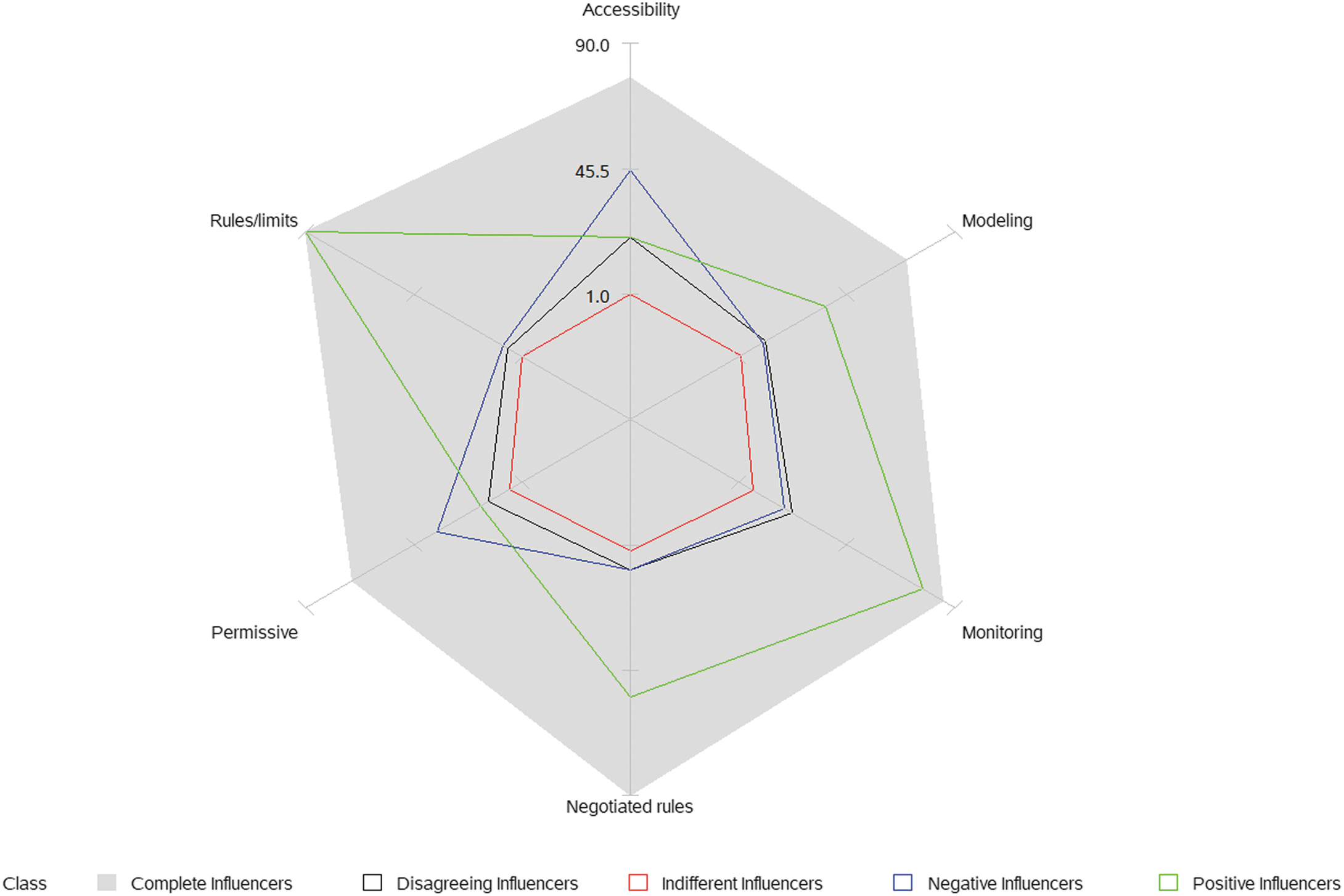
Latent class item-response probabilities for adolescent-reported ST parenting practices. Spokes represent item-response probabilities converted to percentages. Item-response probabilities represent the probability of agreement with a specific parenting practice given membership in a specific latent class. Complete Influencers (16% of dyads) = high probabilities for all ST parenting practices. Disagreeing Influencers (18% of dyads) = low probabilities for all ST parenting practices. Indifferent Influencers (20% of dyads) = low probabilities for all ST parenting practices. Negative Influencers (23% of dyads) = high probabilities for permissive and accessibility practices; and low probabilities for rules/limits, monitoring, modeling, and negotiated rules. Positive Influencers (24% of dyads) = high probabilities for rules/limits, monitoring, modeling, and negotiated rules; and low probabilities for permissive and accessibility practices.
Odds ratios and corresponding 95% confidence intervals for covariate effects are presented in Table 3. Significant effects were found for adolescent age, sex, BMI category, and sedentary behavior, and parent and adolescent ST-LPA. For all comparisons, the reference class was Complete Influencers (i.e., odds of belonging to specific class as compared with odds of belonging to Complete Influencers). Compared with dyads with older adolescents, dyads with younger adolescents had 50%, 81%, and 67% lower odds of belonging to Disagreeing, Indifferent, and Negative Influencers, respectively. Compared with female adolescent dyads, male adolescent dyads had 45%, 46%, and 49% lower odds of belonging to Disagreeing, Indifferent, and Negative Influencers, respectively. Compared with dyads with adolescent underweight/healthy weight, dyads with adolescent overweight/obesity had approximately twice the odds of belonging to one of the other four classes. The odds of belonging to one of the other four classes were 3% to 9% lower for every 1 minute/day increase in adolescent sedentary behavior out of school. Compared with dyads with high parental agreement with ST-LPA, dyads with low agreement had 13.6, 9.4, and 3.1 times the odds of belonging to Indifferent, Negative, and Positive Influencers, respectively. Compared with dyads with high adolescent agreement with ST-LPA, dyads with low agreement had 10.1, 13.7, 6.1, and 3.9 times the odds of belonging to Disagreeing, Indifferent, Negative, and Positive Influencers, respectively.
Odds Ratios and 95% Confidence Intervals for Parent and Adolescent Characteristics by Latent Class Membership
Reflects associations between latent class membership and dyad characteristic; complete influencers are reference class; second characteristic in pair is reference characteristic (e.g., younger adolescents compared with older adolescents). Bolded values indicate significant ORs; parent sex, BMI, and SB, and parent- and adolescent-reported count of electronic devices used by adolescents were not significant effects.
OwOb defined as BMI ≥85th percentile; UwHw defined as BMI <85th percentile.
CI, confidence interval; O, older (15–17 years); OR, odds ratio; OwOb, overweight/obesity; UwHw, underweight/healthy weight; Y, younger (12–14 years).
Parent and adolescent characteristics of the five latent classes using maximum-probability assignment are presented in Table 4. Proportionally, more early adolescence and female adolescent dyads were in the Complete and Positive Influencers than the other three classes. Complete Influencers had the lowest proportion of dyads with adolescent overweight/obesity while Disagreeing Influencers had the highest proportion. Complete Influencers had the lowest proportions of dyads with both low parent and low adolescent agreement with ST-LPA and the highest mean amount of adolescent sedentary behavior out of school. Positive Influencers had the lowest mean amount of adolescent sedentary behavior out of school.
Parent and Adolescent Characteristics of Latent Classes Using Maximum-Probability Assignment
Percentages represent proportion of dichotomized characteristic present in the class (e.g., Complete Influencers composed of 59.8% young adolescents and 40.2% middle adolescents).
Although 1200 dyads were used to select the initial latent class solution, some dyads were excluded from the final model due to missing covariate data.
OwOb defined as BMI ≥85th percentile; UwHw defined as BMI <85th percentile.
Discussion
The purpose of this study was to determine patterns of parent- and adolescent-reported ST parenting practices and to investigate their associations with demographic, anthropometric, and sedentary behavior measures. A continuum of five patterns emerged representing parents and adolescents who reported use of all six ST parenting practices (Complete Influencers), use of some of the practices (Negative and Positive Influencers), low use of the practices (Indifferent Influencers), and discordance between parents and adolescents on practice use (Disagreeing Influencers). Significant associations among the five patterns and adolescent age, sex, BMI category, and sedentary behavior, and parent and adolescent agreement with ST-LPA were observed.
Similar to the current study, opposing classes were observed in another study using LCA on physical activity and ST parenting practices in preschool-aged children. Activity Supportive parents, similar to Positive Influencers, had high scores for limiting or monitoring ST and low scores for practices that may promote ST. 25 In contract, ST Permissive parents, similar to Negative Influencers, had high scores for practices that may promote ST and low scores for limiting or monitoring ST, although associations with child sedentary behavior were not found. 25 However, individual associations between monitoring and limiting ST practices and reduced child ST have been reported in other studies conducted with preschool-aged children, 9 elementary school children, 26 and early adolescents. 27 In a systematic review of ST parenting practices, the strongest evidence for reducing ST in children was found for setting limits on television, video, and computer use. 6 Parental modeling of reduced ST, another practice defining Positive Influencers who reported 7–10 minutes/day less adolescent sedentary behavior out of school than the other four classes, also has been associated with reduced ST in preschool and school-aged children.7,13 Taken together, results suggest that the use of combinations of structure and autonomy support practices, such as rules/limits, monitoring, and modeling, in the absence of permissive and accessibility practices, may result in less adolescent ST.
The higher percentages of male adolescents belonging to Complete and Positive Influencers suggest that parents are more likely to use multiple ST parenting practices, particularly structure and autonomy support/responsiveness practices, with their sons than their daughters. While no sex difference for adolescent sedentary behavior was found in the current study, others have reported that boys spend more time playing video games than girls12,26,28 and girls are more involved in social media than boys. 29 Playing video games often involves the use of headphones, which likely excludes players from family life and interactions more so than social media use. 30 Hence, parents may feel the necessity to control or monitor their son's ST more so than their daughter's ST. Parenting practice research may benefit from identifying ST behaviors that are associated with individual or combinations of practices.
Younger adolescents and parents and adolescents who agreed with ST-LPA were more likely to belong to Complete and Positive Influencers, classes with the highest number of parent- and adolescent-reported practices. In contrast, older adolescents and parents and adolescents who did not agree with ST-LPA were more likely to belong to Indifferent Influencers, the class with the lowest number of parent- and adolescent-reported practices. These results are supported by the child development literature that states as adolescents move from childhood to adulthood, they demand, and parents grant them, increasing autonomy. 31 The discordance observed in Disagreeing Influencers, high parent-reported practice use and ST-LPA agreement coupled with low adolescent-reported practice use and ST-LPA agreement, may reflect conflict between parents and adolescents. Problematic developmental pathways may result from premature rejection of parental legitimacy over areas normatively defined as legitimately within parental control14,32 as suggested by the higher percentage of adolescents with overweight/obesity in the Disagreeing Influencers class. Clearly, more research is needed in this area as few studies addressing child sedentary behavior or other obesity-promoting behaviors have included constructs like LPA.
The inclusion of fathers and multiple health behaviors and use of dyadic data and LCA are study strengths. While measuring constructs with single items may not have provided a comprehensive assessment, brief measures are needed in broad-scope surveys to reduce participant burden. Bias due to the self-reported nature of the data may exist; however, studies suggest that self-reported height and weight result in low misclassification rates for BMI status in adults and adolescents.33,34 Examining scales of agreement among classes was not possible because parenting practices and ST-LPA measures were dichotomized for ease of class interpretation. Although the distribution of parent-reported ST-LPA was right skewed, analyses were not adversely affected because LCA does not depend on normality assumptions. Finally, although balanced sampling was used for similarity to the general US population, demographic and anthropometric differences between analytic and excluded dyads may limit generalizability.
Conclusions
The study findings suggest that parents utilize distinct patterns of ST practices ranging from use of many practices, use of some practices, to no practice use with more positive adolescent health outcomes (less sedentary behavior and overweight/obesity) observed in multiple practice use classes. Hence, advocating for parental use of combinations of ST practices, particularly rules/limits, monitoring, and modeling, may prove more beneficial to adolescent health behaviors than use of permissive and facilitating practices or no practice use.
Footnotes
Authors' Contributions
J.L.T. designed the study, conducted the data analysis, interpreted the results, and wrote the article. A.S.L. and T.I.W. contributed to the study design, results interpretation, intellectual content of the article, and edited the article. All authors read and approved the final article.
Funding Information
The work was supported by the US Department of Agriculture (USDA), Agricultural Research Service (Project 6001-51000-004-00D). The findings and conclusions in this publication are those of the authors and should not be construed to represent any official USDA or US Government determination or policy. USDA is an equal opportunity provider and employer.
Author Disclosure Statement
No competing financial interests exist.

References
Supplementary Material
Please find the following supplemental material available below.
For Open Access articles published under a Creative Commons License, all supplemental material carries the same license as the article it is associated with.
For non-Open Access articles published, all supplemental material carries a non-exclusive license, and permission requests for re-use of supplemental material or any part of supplemental material shall be sent directly to the copyright owner as specified in the copyright notice associated with the article.
