




Abstract
Background:
Few evidence-based obesity interventions have been disseminated in early care and education (ECE) settings. This study describes Go SHAPES: the statewide dissemination of the Study of Health and Activity in Preschool Environments (SHAPES) intervention via online professional development, its classroom implementation, and factors associated with its implementation in ECE.
Methods:
We recruited ECE teachers through professional conferences to participate in online professional development with ongoing technical assistance support to implement SHAPES in their classrooms. SHAPES integrated physical activity (PA) opportunities into the school day through the following three components—Move Inside (PA in the classroom), Move to Learn (PA in preacademic lessons), and Move Outside (PA during recess). Teachers completed a survey to assess the implementation of the disseminated intervention (Go SHAPES). Multiple logistic regression analyses identified factors associated with meeting implementation goals.
Results:
SHAPES was disseminated to 935 personnel from 434 ECE programs in South Carolina over 3 years. Eighty-three percent of the participants who began the 6-week online professional development completed all six modules, thereby adopting SHAPES. Implementation of PA opportunities in ECE classrooms was high, and 59% of teachers planned to use SHAPES fully in the future. Teachers perceiving SHAPES as “easy to implement” and experiencing “no barriers” to implementation were associated with meeting weekly goals for providing PA opportunities. Perceiving “administrator support” and “program as worthwhile” was associated with intentions to use SHAPES in the future.
Conclusions:
Go SHAPES provides a model for statewide dissemination, adoption, and implementation of a PA program in ECE settings, using an online professional development approach.
Introduction
Across the globe in 2022, 37 million children younger than 5 years were living with overweight. 1 According to the CDC, from 2017 to 2020, the prevalence of obesity among persons in the United States aged 2–19 years was 19.7%, with higher prevalence in Hispanic (26.2%) and non-Hispanic Black (24.8%) children and adolescents. 2 The reach of early care and education (ECE) settings, which include child care programs, home-based child care, Head Start programs, and preschool and prekindergarten programs, has promise for implementing obesity prevention efforts for young children at the population level. 3 In the United States in 2022, approximately 47% of children aged 3–4 years and 83% of 5-year olds were enrolled in these settings. 4
Higher levels of physical activity (PA) are associated with positive health, social, emotional, cognitive, and academic outcomes among youth, including favorable body weight and adiposity in the early childhood years. 5 The 2018 PA Guidelines for Americans 6 recommend that preschool-aged children should be active throughout the day to enhance growth and development, and that adults caring for children this age should encourage active play (light, moderate, or vigorous intensity) for at least 3 hours daily. Reviews have concluded that PA interventions delivered in ECE settings improve PA outcomes.7,8 However, translating effective PA interventions in ECE settings to achieve broad impact on childhood obesity requires population-based dissemination and implementation.9,10 There has been little research 11 on disseminating effective approaches to promoting PA in ECE settings with the notable exception of Go Nutrition and Physical Activity Self-assessment for Child Care (NAPSACC).12,13 Mighty Moves 14 and Color Me Healthy 15 were commercialized (a form of dissemination) after development. 16 Play Active was a recent natural experiment involving widespread scale-up after intervention development. 17 Mighty Moves and Color Me Healthy followed a comprehensive path from development, efficacy testing, and real-world trial to dissemination 16 within the ECE setting. This article describes Go SHAPES, a study of the statewide dissemination, adoption, and implementation of the evidence-based Study of Health and Activity in Preschool Environments (SHAPES) PA intervention in South Carolina. The purposes of the study were to (1) describe statewide dissemination, implementation process, online professional development participation, and classroom adoption of Go SHAPES and (2) identify teacher and ECE setting factors associated with Go SHAPES implementation.
Background
Overview of Go SHAPES
The ECE setting, including the teacher, can substantially influence child PA.18–21 Providing teachers with professional development on PA best practices may lead to the adoption of new practices to increase a child’s PA and create school-level positive PA changes.22,23 Online professional development, in conjunction with appropriate support,24,25 is effective for promoting PA in ECE settings26–28 and, compared with in-person approaches, can reach a much larger group of teachers, making it highly suitable for dissemination studies.26,28–30 Go SHAPES is a six-module online professional development program for early childhood educators. It trains teachers on the SHAPES intervention and prepares them to integrate PA opportunities into the school day (Table 1) with the goal of providing at least 300 minutes of PA opportunities weekly. This includes the three major components of SHAPES—50 minutes/week each of Move Inside (teacher-led PA opportunities in the classroom) and Move to Learn (PA integrated into preacademic lessons) and 200 minutes of Move Outside (structured and unstructured PA opportunities at recess), including 50 minutes of teacher-led, structured PA time.29,35 SHAPES is approved by the National Cancer Institute’s Research-Tested Intervention Program 36 and is included in the National SNAP-Ed Toolkit. 37 The development of SHAPES through three phases has been reported. 35 Briefly, it began with a group randomized controlled trial31,32 with dissemination to control early childhood programs. 33 This was followed by a translation pilot and trial for converting from in-person to online professional development. 29 The final step was statewide dissemination of Go SHAPES, via online delivery of professional development. Partial midcourse results of Go SHAPES have been reported previously. 35
Description of the Study of Health and Activity in Preschool Environments Intervention Designed to Promote Physical Activity During the School Day in Early Care and Education Settings in Go SHAPES Statewide Dissemination
Pfeiffer et al. (2013), 31 Pate et al. (2016), 32 Howie et al. (2016), 33 Kennedy et al. (2017), 29 and Saunders et al (2017). 34
ECE, early care and education; PA, physical activity; SHAPES, Study of Health and Activity in Preschool Environments.
Terminology
The terminology used in dissemination, adoption, and implementation studies is often defined inconsistently.38,39 For clarity, we define our key terms in Table 2. This study is grounded in the concepts of the intervention/program life cycle, in which an intervention is designed and tested in efficacy and effectiveness studies and subsequently disseminated broadly, adopted, implemented, and sustained/terminated in a nonlinear process.38,40,45 Throughout this article, SHAPES refers to the multicomponent intervention developed, tested, and disseminated over time, and Go SHAPES refers specifically to the statewide dissemination phase of SHAPES.
Definitions of Terminology Used in the Study of Health and Activity in Preschool Environments Statewide Dissemination Article
Methods
Setting and Participants
The University of South Carolina Institutional Review Board deemed the Go SHAPES dissemination study exempt from the Protection of Human Subject Regulations (45 CFR 46 et. seq). All licensed ECE programs in South Carolina (n = 1654) 46 were eligible to participate in the study. Participants in this study worked in for-profit providers, (36.0%), Head Start (27.0%), faith-based (22.1%), public (8.8%), and other (6.2%) ECE settings. Other settings included small numbers of family home care, group child care, and special needs. A total of 935 ECE personnel from 434 unique ECE programs located throughout South Carolina participated in the study’s online professional development training over 3 years. A subset of these, 308 teachers with complete data, formed the analytic sample for assessing implementation and influences on implementation (see the Results section for derivation of sample). Education levels of the 308 teachers in the analytic sample were 15.6% high school; 45.8% associate degree, certificate, or some college; 28.3% college degree; and 10.4% master’s degree or higher. Teachers had worked in their current ECE setting for an average of 6.2 (SD = 6.6) years, ranging from 0 to 32 years, and worked in the profession for an average of 11.7 (SD = 9.8) years, ranging from 0 to 40 years.
Statewide Dissemination, Online Professional Development Participation, and Adoption
Small cohorts of ECE programs and teachers were recruited in multiple waves using a societal sector strategy consistent with a combined diffusion and social marketing approach. 47 Each participant went through the online training once during one program cycle and completed the follow-up assessment once. Go SHAPES staff presented at and recruited teachers through conferences/meetings, including the South Carolina Association for the Education of Young Children, South Carolina Early Childhood Association, South Carolina Association of Early Care and Education, Head Start, Live Well Greenville, and Eat Smart Move More. 35 Staff recruited teachers at an average of six conferences per year; participant attendance at the presentation ranged from 20 to 200. Participants signed in at each presentation with their names and email addresses and were followed up through multiple online professional development cycles to encourage participation in Go SHAPES. Teachers who enrolled in the program received Go SHAPES online training with continuing education credit at no cost, and the course was listed as an “approved” program on the South Carolina Department of Social Services website.
We tracked each participating teacher’s entry and progress through the six modules via the online platform that hosted the Go SHAPES professional development course. Teachers were required to view the entire content of each module and to pass (80% or higher) a brief quiz for module completion. Teachers began to implement SHAPES in their classrooms as they went through the online training. Course participants received ongoing support from a competent, well-trained professional with experience in ECE settings, which gave her high credibility with ECE teachers. Teacher’s adoption of SHAPES was operationally defined as completing all six modules, an approach used in previous adoption, implementation, and dissemination studies. 48 Participants received continuing education credit for course completion through the South Carolina Department of Social Services.
Measures and Data Sources
A 41-item, online teacher survey was the data source for measuring implementation and factors associated with implementation. The first-year course participants received survey prompts after completing Module 6, yielding a 42% response rate. In years 2 and 3, the online survey prompt followed Module 4 (after completing core implementation material) to allow more follow-up time and enhance survey response, yielding a 59% response rate. The teacher survey, designed for SHAPES, was developed in the earlier phases.29,33,34
SHAPES Implementation
The primary outcome of this study was high vs. low implementation, which was assessed by teacher-reported minutes of PA opportunities provided per week through Move Inside, Move to Learn, and Move Outside. This total was divided by the 300-minute weekly goal for providing PA opportunities. Reaching 80% or more of the goal was coded as high implementation. This dichotomous variable served as the primary implementation outcome. As in previous studies,29,34 the response options for Move Inside, Move to Learn, and Move Outside, expressed as a range of minutes and frequencies of offerings, were converted to a numeric value by taking the average of the range (e.g., “20–29 = 25 minutes”). Daily minutes were multiplied by weekly frequency to yield estimated weekly minutes for each component and summed to yield the total weekly minutes of PA opportunities.
The secondary outcome, intention to use SHAPES in the future, was assessed by the item, “Which one of the following best describes your future plans with SHAPES?” Response options were as follows: “Continue using SHAPES fully, use with some changes, use ideas or materials, or no plans to use.” Using SHAPES fully was coded as high intention to implement. This item was adapted from the behavioral intention construct within the Theory of Planned Behavior, 44 and reflects intentions to implement SHAPES with high fidelity. Intention is a recommended implementation outcome in this setting.49,50
Influences on Implementation Outcomes
Guided by the Consolidated Framework for Implementation Research (CFIR), 43 we organized the independent variables with hypothesized influences on implementation into three categories as follows (Table 3). Intervention Characteristics included three variables that assessed the ease/difficulty of implementing the SHAPES components. The Inner Setting featured 11 variables that addressed organizational characteristics, organizational support for SHAPES, resources for implementation, including training, and children’s responses to SHAPES. Characteristics of Implementers included eight variables: teaching experience (two variables), education, role in classroom/school, adult PA leader behavior, and belief about the extent to which SHAPES was worthwhile for the classroom. Most teacher survey items were rated on five-point scales, and all variables were dichotomized, with the most positive response option categorized as high implementation (expressed in boldface in Table 3).
Study of Health and Activity in Preschool Environments Independent Variables Organized by the Consolidated Framework for Implementation Research Constructs
Adapted from Damschroder LJ, Aron DC, Keith RE, et al. Fostering implementation of health services research findings into practice: A consolidated framework for advancing implementation science. Implement Sci 2009; 4: 50. DOI: 1748-5908-4-50 [pii];10.1186/1748-5908-4-50 [doi]. 43
Responses coded as “high implementation” are in boldface.
Statistical Analysis
Go SHAPES implementation was presented as mean (SD) minutes for Move Inside, Move to Learn, and Move Outside and as a dichotomous variable for meeting/not meeting at least 80% of the weekly PA opportunity goal for each component and the total. Similarly, we reported frequencies for intentions to use SHAPES in the future, dichotomized into high and low intention to implement.
We conducted an initial series of 2 × 2 chi-square analyses to examine associations between each dichotomized independent variable and the dichotomized implementation outcomes of meeting the weekly goal for providing PA opportunities and intentions to implement SHAPES in the future. Independent variables identified in bivariate chi-square analyses were used in unadjusted (model 1) and adjusted (model 2) multiple logistic regression models for meeting the weekly goal for providing PA opportunities and for intentions to implement SHAPES in the future. Adjusted models included type of ECE setting and teachers’ years of experience and education level.
Results
Recruitment in Statewide Dissemination, Online Professional Development Participation, SHAPES Adoption, and Survey Completion
There were 1654 ECE Programs in South Carolina in 2019, the only year of Go SHAPES for which statewide ECE data were available. 46 Ultimately, 1239 ECE teachers from 434 unique ECE programs (26.2% of the statewide population of ECE programs) registered to participate in Go SHAPES online professional development (Fig. 1). Nearly one-quarter of registrants (n = 304) did not complete the first module; 935, or 75% of those who registered, completed at least one module. Of the 935 who completed one module, 773 (83% of those who began the course) completed all six modules, thereby adopting SHAPES at the classroom level. Four hundred ninety-six of the 773 (64%) completed the survey, although 136 were missing key data, leaving 360 course participants with data for analysis. We deleted from the analysis data for ECE administrators who participated in Go SHAPES but were not classroom teachers, leaving an analytic sample of 308 for examining influences on implementation outcomes (Fig. 1).
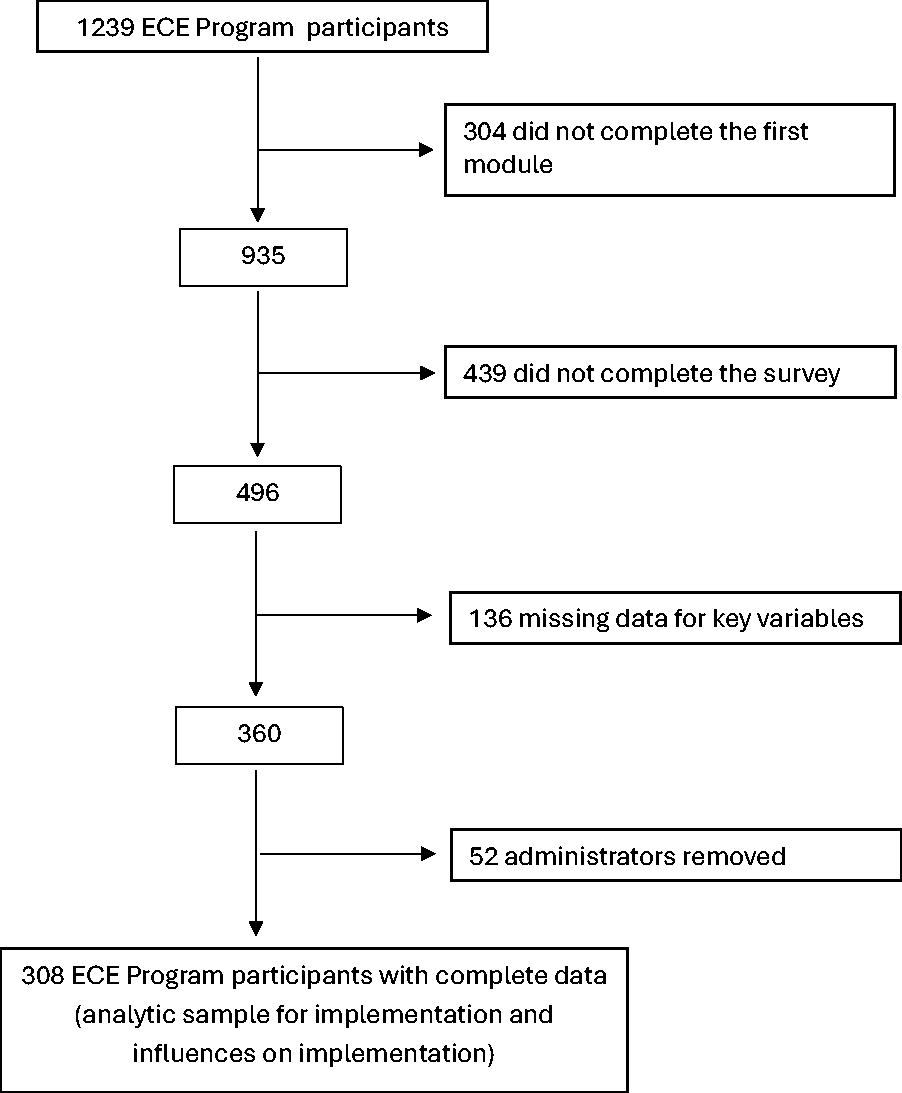
Flowchart for dissemination and implementation in Go SHAPES. SHAPES, Study of Health and Activity in Preschool Environments.
SHAPES Implementation
Teachers reported a weekly average of 88.3 (SD = 62.3) minutes of Move Inside, 57.3 (SD = 46.9) minutes of Move to Learn, and 339.8 (SD = 225.4) minutes of Move Outside, which included an average of 295.9 (SD = 225.4) minutes of teacher-led, structured Move Outside activities. These mean values exceeded the SHAPES weekly goals for each component (50 minutes/week for Move Inside and Move to Learn and 200 minutes of Move Outside, including 50 minutes of teacher-led, structured PA time). Two hundred twelve teachers (78.8%) met the criteria of providing 300 or more minutes of PA opportunities through the three components. Plans to use SHAPES fully in the future were reported by 182 (59.1%) of teachers; 62 (20.1%) and 64 (20.8%) teachers planned to use SHAPES with some changes and to use ideas or materials, respectively.
Influences on Implementation Outcomes
Because implementation levels were high, with reduced variability for analysis, we created a variable using the more stringent criteria of summing minutes for Move Inside, Move to Learn, and structured, teacher-led Move Outside; 159 (51.6%) of teachers met the 80% criteria for the more stringent goal.
Bivariate Associations Between Independent Variables and Implementation Outcomes
Table 4 presents the preliminary, bivariate chi-square associations for Inner Setting, Characteristics of Implementers, and Component-Specific Influences (i.e., influences specific to Move Inside, Move to Learn, and Move Outside). Administrator support (Inner Setting) was associated with intentions to use SHAPES in the future. Training resources (Inner Setting), both those provided by SHAPES and other resources, were associated with meeting weekly goals for providing weekly PA opportunities and intentions to use SHAPES in the future. The belief that SHAPES was very worthwhile for the classroom (Characteristics of Implementers) was associated with meeting weekly goals for PA opportunities and intentions to use SHAPES in the future. For all three SHAPES intervention components, the perceptions that SHAPES was easy to implement (Intervention Characteristics), that children loved it (Inner Setting—child response), and that no barriers to implementation existed (Inner Setting—resources) were positively associated with meeting weekly goals for providing weekly PA opportunities and intention to use SHAPES in the future. For Move Outside, but not Move Inside or Move to Learn, adult participation in PA with the children was associated with meeting weekly goals.
Associations of Inner Setting, Characteristics of Implementers, and Component-Specific Influences with Meeting Weekly Goal for Providing Physical Activity Opportunities and Plans to Implement the Study of Health and Activity in Preschool Environments in the Future
Significant values indicated in boldface.
Dichotomized at mean.
Missing = 80.
Multiple Logistic Regression Models to Examine Factors Associated with Meeting Weekly Goal for Providing PA Opportunities
The eight variables selected through bivariate chi-square tests were included in multiple logistic regression models. Two independent variables, “easy to implement” and “no barriers” (e.g., no lack of time, space, and equipment), were significantly associated with meeting the weekly goal for providing PA opportunities, with moderate effect sizes 51 (odds ratios 2.48, 2.64). “Administrator support” and “program worthwhile” were associated with intentions to use SHAPES in the future, with moderate to large effect sizes (odds ratios 2.64, 5.53). 51 Models were adjusted for highest degree, years of experience, and type of school (Table 5).
Results of Unadjusted and Adjusted Multiple Logistic Regression Models for Factors Associated with Meeting Weekly Goal for Providing Physical Activity Opportunities and Plans to Implement the Study of Health and Activity in Preschool Environments in the Future
OR, odds ratio.
Discussion
Go SHAPES statewide dissemination efforts were effective with high levels of online professional development participation and classroom adoption of the SHAPES intervention. Go SHAPES was disseminated successfully over 3 years to 935 ECE personnel from 434 unique programs, reaching more than a quarter (26.2%) of ECE programs in South Carolina. Furthermore, Go SHAPES is one of the few studies, with the exception of Go NAPSACC,12,13 to report dissemination and adoption in ECE settings. Similar to documented effective disseminated programs, several strategies impacted our study’s successful dissemination of Go SHAPES. Primarily, our state- and local-level partnerships enabled us to attend ECE conferences/meetings to facilitate recruitment and secure free continuing education credit to participants (teachers). ECE partnerships are associated with quality programming 52 and maintenance of effective strategies over time and may increase program reach and effectiveness. 53 Thus, the combined dissemination strategies of state-level partnerships and providing continuing education credit for a no-cost, sanctioned, and readily accessible online course, providing ongoing technical assistance support, recruiting through annual conferences/meetings of ECE professional organizations, and cohort enrollment for easy tracking, were effective in this setting. The majority of teachers (83%) in our study who registered for Go SHAPES online professional development completed all six modules of SHAPES, indicative of high adoption rates in the classroom. Our findings, similar to the literature,26–28 show the high potential of self-paced online learning to spread ECE interventions, achieve wide coverage to intended participants and to promote policy, system, and environment changes that enable children to thrive. In addition, ongoing support 54 from a competent, committed, experienced, and credible professional likely facilitated module completion.
Teacher-reported implementation of PA opportunities in their classrooms in Go SHAPES (i.e., implementation fidelity) was high and comparable with that reported in previous SHAPES studies, 35 supporting the effectiveness of online professional development with support for facilitating implementation. Furthermore, nearly 60% of teachers planned to use SHAPES fully in the future, which suggests a positive impact for future classrooms of young children. We found that constructs in CFIR addressing Intervention Characteristics (easy to implement), Inner Setting characteristics (no barriers and administrative support), and Characteristics of Implementers (belief that SHAPES is worthwhile) were associated with Go SHAPES implementation and/or high future implementation intention. In the earlier phase of developing SHAPES, we took into consideration some of these factors’ design and development. For example, to accommodate the myriad of ECE contexts, we partnered with teachers and directors 55 (Characteristics of Implementers) to design a goal-based approach for integrating PA opportunities into the school day in flexible ways (Intervention Characteristics) that capitalized on local resources (Inner Setting resource). Therefore, our finding that these factors positively informed teacher’s perspectives of adopting SHAPES in the classroom was not surprising. This flexible approach to achieving PA goals may have mitigated the impact of barriers such as time and space that are common to implementing interventions in ECE settings.
These results are consistent with findings from teacher and director interviews about perceived influences on implementation in two ECE studies.24,25 These studies emphasize the importance of intervention feasibility and compatibility with practices, leadership engagement, training and support, implementer attitudes, and benefits for children. Similarly, a CFIR-guided review of influences on implementation in ECE settings identified Inner Setting resources (time staffing, space, and trainings) and Intervention Adaptability and Compatibility 56 as important influences. Go SHAPES did not directly assess teachers’ perceptions of intervention adaptability or compatibility; rather, we designed SHAPES using these principles. Our results also show the importance of administrative support, which is consistent with the literature.24,57
A major strength of Go SHAPES was the successful statewide dissemination, adoption, and implementation of an evidence-based PA intervention in ECE settings, using online professional development in a diverse range of program types, including for-profit providers, Head Start, faith-based, and others. The results of the study were consistent with previous SHAPES studies, and the results related to influences were consistent with the literature. SHAPES implementation in the ECE classrooms was concurrent with teachers participating in the professional development training, which encouraged immediate learning to action and avoided knowledge relapse. The SHAPES intervention can be used in ECE professional development programs to achieve compliance with PA standards in statewide quality rating and improvement systems. A limitation of the study is low survey response and missing data; 53% of the teachers who enrolled in the online professional development completed the survey. The analytic sample used to describe implementation and examine factors influencing implementation was 309 (33% of enrolling teachers). Therefore, due to potential bias, implementation-related results should be interpreted cautiously. Other limitations included a single data source of teacher self-report for assessing implementation; no assessment of child PA; and study location in one southeastern state, which may limit generalizability.
Conclusions
Go SHAPES statewide dissemination efforts were effective, resulting in widespread teacher participation in online professional development and adoption and classroom implementation of SHAPES, providing an effective model for PA promotion in ECE settings. Our results support designing flexible, easy-to-implement interventions that are perceived as worthwhile by teachers and supported by administrators. Recruiting teachers through professional ECE organizations and providing no-cost, readily accessible, and state-sanctioned, online professional development with continuing education credit were effective dissemination strategies. Further research in ECE settings is needed to replicate and expand these findings.
Impact Statement
This study advances the literature on physical activity (PA) promotion in young children by demonstrating that Go SHAPES, an online professional development program, was effectively disseminated, adopted, and implemented in ECE settings. Furthermore, the study identified multiple factors that were associated with implementation of PA opportunities in ECE classrooms.
Footnotes
Acknowledgments
The authors thank the early care and education program administrators, teachers, and families for their participation in and support of the study and evaluation. They also thank Gaye Groover Christmus, MPH, who edited the article. With gratitude, the authors acknowledge the contributions of Dr. Dianne Stanton Ward as an adviser and consultant to SHAPES.
Authors’ Contributions
Conceptualization: R.P.S., M.D., and R.R.P. Data curation: M.D. Formal analysis: M.D. Funding acquisition: R.R.P. Methodology: R.P.S., M.D., and R.R.P. Project administration: R.P.S. Resources: M.D. Software: M.D. Supervision: R.R.P. Validation: R.P.S. and R.R.P. Visualization: M.D. Writing—original draft: R.P.S. Writing—review and editing: R.P.S., M.D., D.M., C.M., and R.R.P. All authors have read and agreed to the published version of the article.
Funding Information
The SHAPES dissemination study was funded by the BlueCross BlueShield Foundation of South Carolina. The National Institutes of Health (
Author Disclosure Statement
The authors declare no competing financial interests.