




Abstract
Background:
Acute diseases are associated with increased stress and immune responses. Both of these responses are associated with disturbances of glucose metabolism, and it is therefore difficult to ascertain whether these disturbances are related to increased stress alone or a result of the systemic inflammatory response. We investigated the effects that acute stress has on glucose metabolism in an acute stress model that is not accompanied by an increased immune response.
Subjects and Methods:
Glucose levels as well as pancreatic β-cell function, insulin resistance, and parameters of stress and immune responses were assessed in healthy bungee jumpers 2 h before, immediately before, and after the jump.
Results:
Glucose levels and stress hormones were increased, right before and after the jump, whereas the immune response was decreased. Pancreatic β-cell function was decreased right before the jump, and insulin resistance was increased right after the jump. Higher levels of cortisol correlated with increased insulin resistance after the jump. Furthermore, larger increments of cortisol before and of epinephrine after the jump were associated with decreased pancreatic β-cell function.
Conclusions:
Acute stress in healthy bungee jumpers induces acute disturbances of glucose metabolism that are independent from a systemic inflammatory response.
Introduction
Research Design and Methods
Subjects
We recruited 20 male nonobese, nonsmoking novice bungee jumpers 18–35 years old without diabetes mellitus. In the original trial subjects were randomized between the use of propranolol (40 mg three times a day for 3 days prior to the jump) or no pretreatment to study the role of catecholamines in the responses observed in immune physiology. The study was reviewed and approved by the medical ethics committee of the Academic Medical Center in Amsterdam, The Netherlands, and all subjects signed informed consent.
Bungee jump protocol
Bungee jumps took place from an altitude of 70 m after an overnight fast. Blood samples were drawn exactly 2 h before the jump (T=baseline), right before the jump (while elevated at jump level; T=platform), and immediately after the jump (T=after jump). Measurements of blood pressure and heart rate were performed at the same time points.
Laboratory measurements
Plasma was immediately separated and stored at −80°C until assays were performed.
Paired fasting glucose and fasting insulin levels were assessed in all samples. Markers of stress were plasma cortisol and epinephrine levels measured as described previously. 4 Markers of the immune response were the release of tumor necrosis factor-α and interleukin-10 after ex vivo stimulation with endotoxin as described elsewhere. 4
Evaluation of insulin resistance and β-cell function
Paired fasting glucose and fasting insulin were used to calculate homeostatic model assessment indices. 5,6 The output of the model is calibrated to give a normal insulin resistance of 1 and a normal pancreatic β-cell function of 100%. 5,6 The model is evaluated in healthy subjects and in patients suffering from various diseases. 7
Statistical analysis and outcome measures
First we assessed differences between volunteers with or without propranolol for the following parameters: mean arterial pressure (MAP) in blood, heart rate, catecholamines, cortisol, or parameters of glucose metabolism. Differences were assessed on each of the time points with an independent t test. We used a general linear model to assess if there was an effect of propranolol on time (i.e., changes between subsequent time points) for any of these parameters. Except for heart rate and baseline MAP, all parameters were similar, and there was no effect of propranolol on time; therefore we subsequently assessed all volunteers as one group.
The primary outcome measure was the change of glucose and homeostatic model assessment indices between baseline versus on the platform and right after the jump. We used a general linear model for repeated measures to assess the effect of time on measures of stress and glucose metabolism; a P value of <0.05 was considered statistically significant. In post hoc analysis two-tailed Spearman's correlation coefficients were used to calculate correlation coefficients between parameters of the stress and immune response on the one hand and glucose, insulin resistance, and pancreatic β-cell function on the other hand. Correlations between these parameters were calculated at the three different time points: baseline, at the platform, and after the jump. In addition, we investigated these correlations between absolute changes from baseline of these parameters.
Results
Physical parameters
Volunteers with propranolol had a lower heart rate on all time ponts and a lower MAP at baseline. 4 For the whole group, MAP increased directly prior to the jump relative to baseline (P<0.05). Directly after the jump, MAP had decreased again. 4
Glucose and homeostatic model assessment indices
Glucose levels increased before the jump and increased further during the jump (both P<0.001) (Fig. 1A). Insulin resistance decreased before the jump (P<0.05) and increased during the jump (P<0.0001) (Fig. 1C). Pancreatic β-cell function decreased before the jump but returned to baseline during the jump (P<0.001) (Fig. 1B). There was no difference in homeostatic model assessment indices between volunteers with or without propranolol at any of the time points, and no interaction was found between propranolol and time.
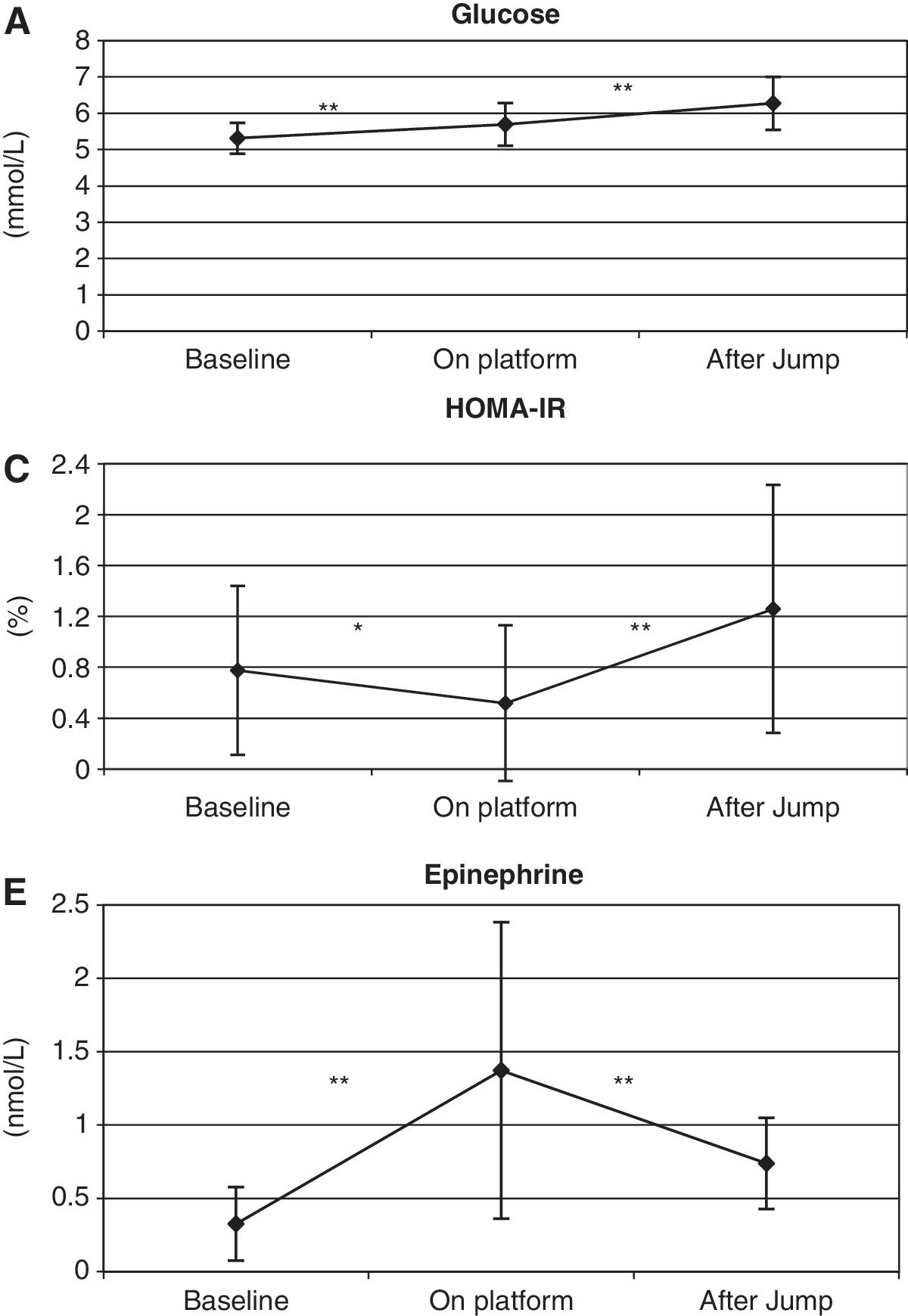
Parameters of (
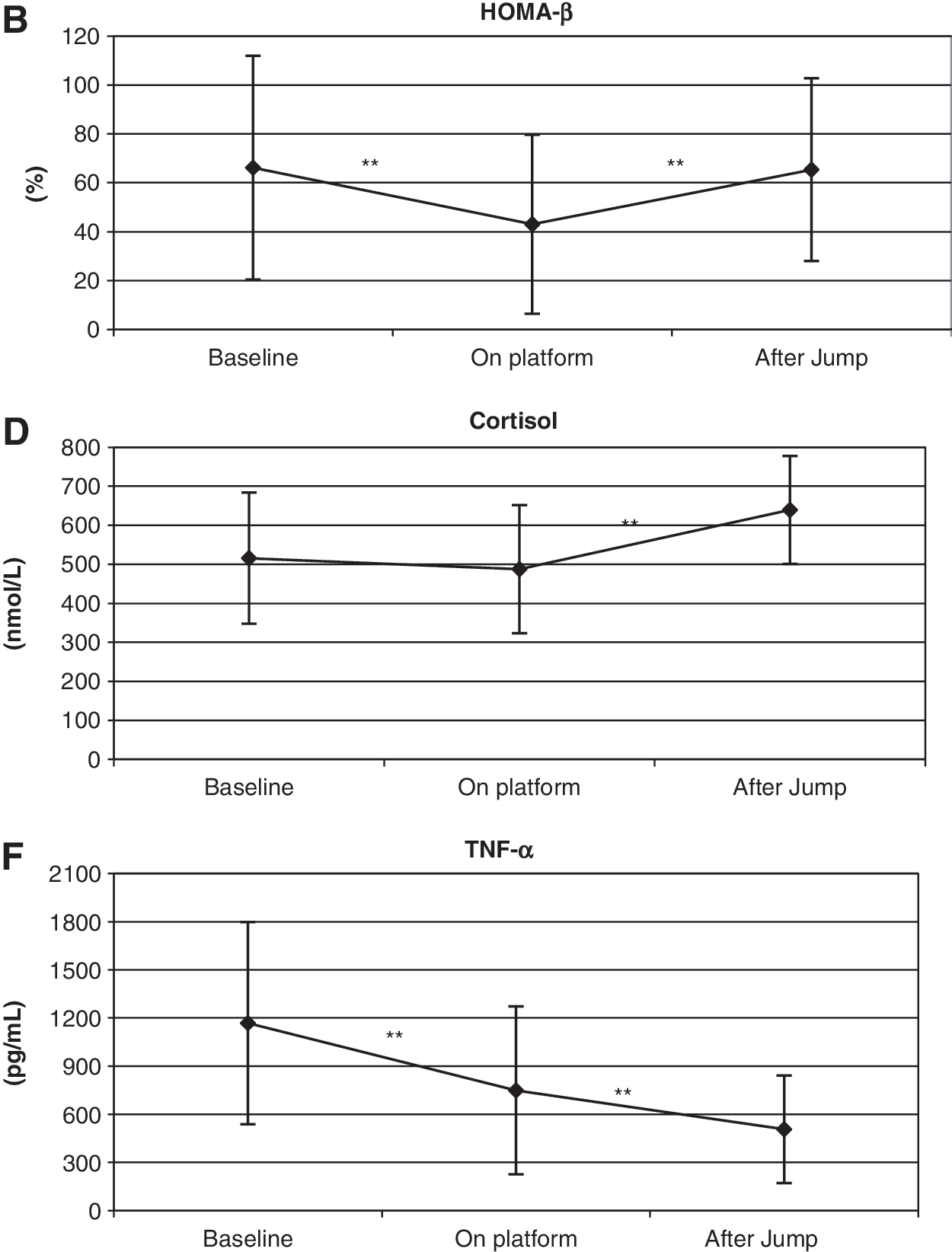
Parameters of stress and immune responses
Cortisol levels did not change before the jump but increased during the jump (P<0.0001) (Fig. 1D). Epinephrine levels increased before the jump but decreased during the jump (P<0.001) (Fig. 1E). Levels of released tumor necrosis factor-α after ex vivo stimulation of whole blood with endotoxin decreased before and further during the jump (P<0.05) (Fig. 1F), whereas interleukin-10 levels did not change significantly. 4
Correlation between glucose metabolism and markers of the stress or immune responses
After the jump, higher levels of cortisol correlated with increased insulin resistance. Between baseline and the platform, an increment in cortisol correlated with a decrease in pancreatic β-cell function (two-tailed Spearman's rho, −0.7; P<0.001). During the jump, an increment of epinephrine correlated with a decrease in β-cell function (rho, −0.6; P<0.005).
No significant correlations were found between glucose metabolism and markers of the immune response.
Discussion
We found stress-induced hyperglycemia after a bungee jump in healthy volunteers without preexistent diabetes mellitus. There was a concomitant immune suppression, indicating that hyperglycemia was not due to an increased systemic inflammatory response. While the subject was on the platform, pancreatic β-cell function had decreased, and during the jump insulin resistance increased, both contributing to hyperglycemia. Larger increments of cortisol before and of epinephrine after the jump correlated with the pancreatic β-cell dysfunction. This observation is in line with experimental studies demonstrating that stress hormones can suppress insulin secretion in pancreatic β-cells. 8,9 In the setting of acute disease, increased insulin resistance is often considered the principal mechanism leading to hyperglycemia. 1 However, recent studies in acute disease showed the importance of pancreatic β-cell dysfunction in relation to stress hyperglycemia. 3,10 In these recent studies the separate contributions of the simultaneously increased stress hormones and immune reaction with an increased release of cytokines could not be disentangled. 11
Glucose-lowering therapy, albeit difficult to accomplish, remains a potential treatment target in several diseases. 12 –14 Recently a study showed that treatment with a glucagon-like peptide-1 receptor agonist could prevent glucocorticoid-induced pancreatic β-cell dysfunction in healthy volunteers, providing new options for further glucose-lowering treatment in the setting of stress hyperglycemia. 15
Although the results of the present study should be interpreted with some caution as the sample size was too small to draw definite conclusions, to our knowledge this is the first study in humans that investigates the association between markers of stress and glucose metabolism in the absence of a systemic inflammatory response.
Footnotes
Acknowledgments
N.D.K. researched data and wrote the manuscript, D.J.vanW. designed the trial and reviewed the manuscript, and J.H.DeV. reviewed and edited the manuscript.
Authors Disclosure Statement
The authors have nothing to disclose.