




Abstract
It has been over 30 years since the beginning of efforts to improve diversity in academia. We can identify four major stages: (1) early and continuing efforts to diversify the pipeline by increasing numbers of women and minorities getting advanced degrees, particularly in science, technology, engineering, and math (STEM); (2) requiring academic institutions to develop their own “affirmative action plans” for hiring and promotion; (3) introducing mentoring programs and coping strategies to help women and minorities deal with faculty practices from an earlier era; (4) asking academic institutions to rethink their practices and policies with an eye toward enabling more faculty diversity, a process known as institutional transformation. The thesis of this article is that research-intensive basic science departments of highly ranked U.S. medical schools are stuck at stage 3, resulting in a less diverse tenured and tenure-track faculty than seen in well-funded science departments of major universities. A review of Web-based records of research-intensive departments in universities with both medical school and nonmedical school departments indicates that the proportion of women and Black faculty in science departments of medical schools is lower than the proportion in similarly research-intensive university science departments. Expectations for faculty productivity in research-intensive medical school departments versus university-based departments may lead to these differences in faculty diversity.
Introduction
According to National Science Foundation data (NSF, 2012), the number of Blacks with Ph.D.s in the sciences is usually a factor of 10 lower than the number of women, and explanations for the paucity of Black faculty usually focus not on choice or reluctance to apply, but on the small pipeline of Blacks earning doctorates. During the past decade, Blacks have been earning 3% of the Ph.D.s awarded in biomedical sciences,** 3% in biological sciences, and 3% in chemistry. The 2007 Nelson report (Nelson, 2007), which analyzed university departments in engineering subdisciplines as well as chemistry, physics, biology, math, and economics, concluded that the proportion of Blacks holding tenured and tenure-track faculty positions in engineering fields was not significantly different from what was expected based on the Ph.D. pool, but most of the nonengineering science departments in the study fell short of that goal. Unfortunately, the Nelson report did not investigate biomedical disciplines.
Methods
To assess medical school progress toward diversity, we compare representation of women and Blacks in medical schools and in comparable science disciplines located in nonmedical settings in universities with both medical school and nonmedical school departments. We focused on basic science departments to avoid the complexities of clinical responsibilities and patient care. The American Association of Medical Colleges (AAMC) recently published detailed analyses of gender and race composition for the aggregate of U.S. medical schools, by department and tenure status (AAMC Data Online, 2010b). A summary of the AAMC 2010 findings for basic science departments is presented in Table 1. These aggregated data yield estimates suggesting that women and Blacks are underrepresented among tenure-track basic science faculty compared with the Ph.D. pool. However, the AAMC analysis is not ideal for a diversity analysis because the dataset includes basic science departments with widely varied requirements for scholarly activity, ranging from departments that expect each full-time faculty member to be principal investigator (PI) on at least one NIH R01 grant to those that are primarily teaching departments. Since the goal of this study is to compare levels of diversity in environments that are research intensive, we stratify medical schools by level of research activity, in a manner similar to that done by NSF in its recent report on minority faculty (Burrelli, 2011). We therefore survey women and Blacks among tenured and tenure-track faculty in basic science versus natural science departments in the top-ranked U.S. departments.
NSF/NIH/USED/NEH/USDA/NASA Survey of Earned Doctorates; U.S. citizens only.
Drops to 0.4% tenured and 0.9% tenure-track if Morehouse, Howard, and Meharry are excluded.
To define very research-intensive departments, we rely on national surveys of research funding or ranking of graduate programs. Departments in each basic science discipline are selected from among those ranked in the top 35 based on 2010 NIH funding (Blue Ridge Institute for Medical Research, 2010). The university natural science departments selected are among those listed in the top 25 in rankings in the most recent National Research Council report (NRC, 2011). We identify female and Black faculties by reviewing departmental Web sites containing a listing of faculty, as described previously (Leboy, 2008). Female faculties were easily identified on those Web sites with both the name and picture of each faculty member. If names were ambiguous, we identify gender using Web-based images along with pronoun usage. Identifying Black faculty relied heavily on pictures, with supporting evidence sought in the individual's CV (schooling, minority fellowships, etc.).
Accuracy and statistical significance
The expected error rate for identifying females is low, because there are several different ways (appearance, gendered name, or pronoun) of confirming gender. However, identifying Blacks by looking at pictures has a much higher expected error rate because some individuals self-identifying as Black/African-American who have light skin and other attributes of mixed race may not be apparent to us. Our calculations of percent Black therefore are likely to be underestimates; however, by focusing on comparisons of Blacks identified the same way but in different disciplines, we have attempted to minimize the impact of these underestimates.
The data included faculty composition in 17 to 18 departments in a given discipline. As is common when examining diversity data, there were large variations in the proportions of women within rank from institution to institution; the percent female full professors ranged from 0% to 50%, even when comparing departments in the same discipline. We therefore used the ratio of the percent female or Black assistant professors in the department divided by the percent female in the appropriate availability pool. The availability pools for assistant professors, calculated from NSF data, were the percentages of females earning Ph.D.s between 1997 and 2006. A high value for this ratio means the department had more women than expected by the availability pool. Statistical significance was analyzed by regression analysis, with the dependent variable being the ratio: department's percent of female assistant professors divided by the relevant availability pool, and the independent variable or controls being whether the department was a medical school basic science department or was university based. Because the availability of Black scientists did not vary by field to the same extent as for women, we use the unadjusted proportions of Black scientists for the racial analyses.
Basic science departments
We concentrated on the five most common science disciplines represented in medical schools: biochemistry/molecular biology, cell/developmental biology, genetics, microbiology, and neurobiology/neuroscience. Some basic science departments do not provide pictures of each faculty member on their Web sites, and some do not provide faculty rank; these departments were excluded. Among the 25 medical schools ranked highest in NIH funding, we found 17 medical schools providing pictures and rank for at least 3 of the expected basic science departments. The dataset for basic science departments therefore represents 70 research-intensive departments with a total of 1359 tenured and tenure-track faculty members. Only faculties with a primary appointment in the department were included. When two departmental affiliations were listed, we assumed the first was primary. All faculties with the rank of associate professor or higher were classified as tenured.
University-based natural science departments
Lists of the chemistry, physics, and biology departments ranked within the top 30 departments by the National Research Council were compiled (NRC, 2011). To facilitate comparisons with basic science departments, the selected biology departments exclude any that were primarily plant biology, ecology, and evolution. A department Web site–based approach similar to that used for basic sciences was used to identify female and Black faculties. Only academic units with authority for primary faculty hires were included; programs that overlapped with departments or spanned more than one department were excluded. As with the medical school departments, every effort was made to exclude secondary appointments and those without tenure significance.
Results
Table 2 compares the proportion of female tenure-track assistant professors in each discipline in 2011 with the proportion of women earning a Ph.D. in that discipline during the period 1998–2007. Based on the Career Progression Model of Ginther et al. (2011), an average of 5 years elapses before a given cohort of Ph.D.s moves from postdoctoral status to tenure-track faculty status. Thus, the cohort of female Ph.D.s earned in 1998–2007 should provide an estimate of the women eligible for tenure-track appointment between 2003 and 2012 (the availability pool). Table 3 shows the results of our regression analyses of the effect of a basic science department being in a medical school on the difference between availability and presence of women as assistant professors among institutions with both basic science departments in their medical schools and comparable science departments outside the medical schools. While the proportion of female assistant professors averaged 110% of the female proportion available (Ph.D.s in field 1997–2007) in nonmedical school department, the ratio was only 72% for medical school departments, a statistically significant difference.
Includes U.S. citizens, permanent residents, and temporary residents.
Significantly different from nonmedical school at p>0.972.
Although the proportion of Blacks earning Ph.D.s and holding tenure-track faculty positions is an order of magnitude lower than for women, the relative pattern is similar to that of women. As noted in the 2009 National Academies report (Comm, Gend, Diff, NAS, 2009) “regardless of field women are underrepresented among candidates for tenure relative to the number of female assistant professors, resulting in a marked drop-off between tenure-track females and tenured females.” The Nelson report (Nelson, 2007) analyzing the top 100 departments in 15 science and math disciplines noted a similar pattern for minority faculty, concluding that “the few minority faculty members present in academia are usually concentrated in the lower ranks, chiefly as assistant professors.” In contrast, our survey of very research-intensive science departments shows no concentration of Black faculty at the assistant professor level except in Biology (Table 4). In research-intensive biomedical (basic science) departments, chemistry departments, and physics departments, most of their Black faculties are at associate professor rank (Fig. 1). This pattern, most prominent in chemistry departments, is what would be expected if these research-intensive departments were reluctant to hire Blacks at the assistant professor level, but were recruiting from among Black scientists who had already developed a track record at a less elite institution.
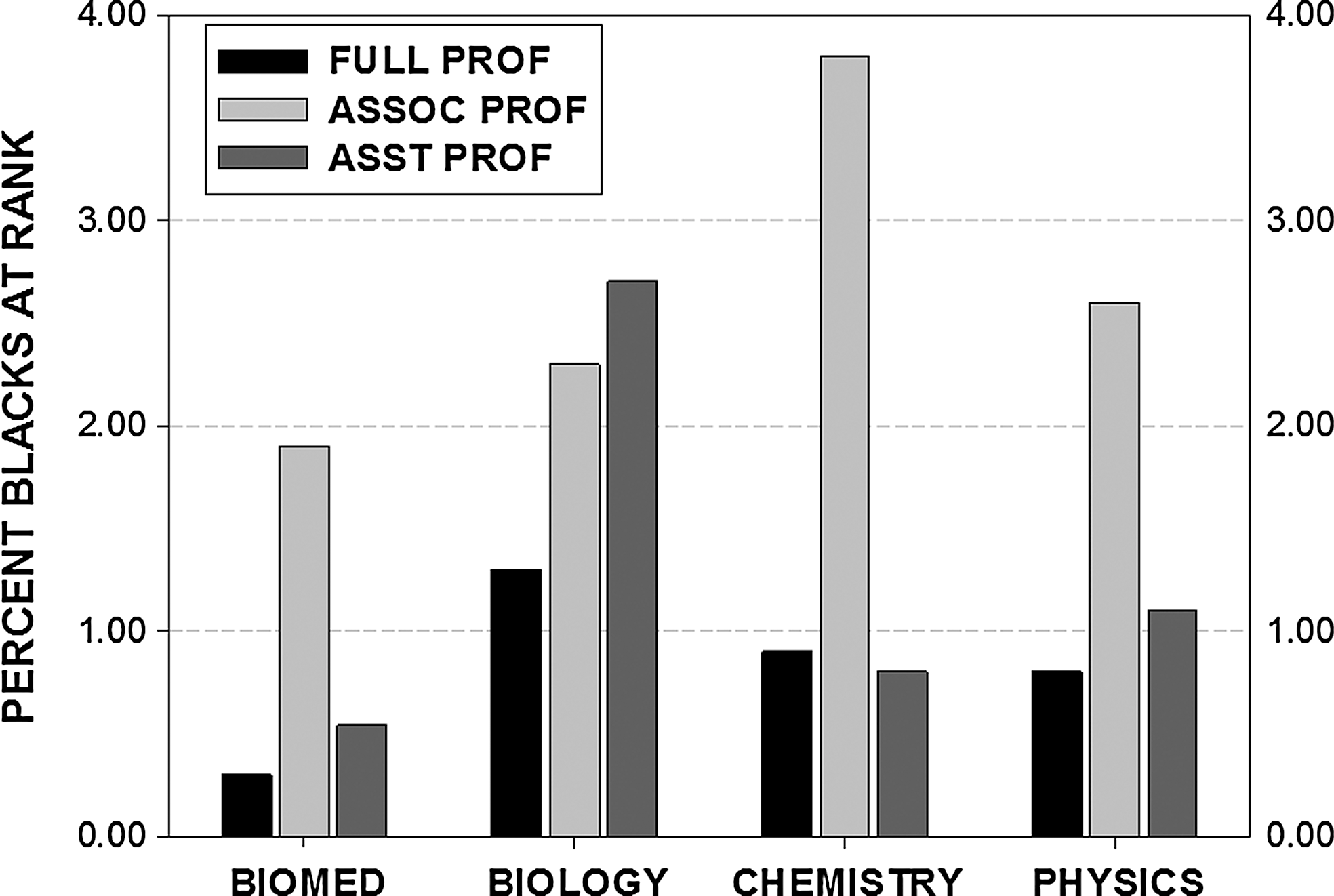
Percent Blacks among faculties at each rank, in research-intensive departments of medical school basic sciences (Biomed) and university-based science. For estimates of availability pools, see Table 4.
Includes only U.S. citizens and permanent residents.
In basic science departments, Blacks were only 0.5% of tenure-track assistant professors at the very research-intensive departments, one-sixth of what would be expected based on the proportion of Blacks among biomedical Ph.D.s earned 5–10 years previously (Table 4). In contrast, the proportion of Black assistant professors in biology and physics was more than half of the expected values. Table 5 indicates that there was a significantly lower representation of Black full professors in medical schools than expected. While there was also lower representation of Blacks among associate professors and assistant professors in medical schools than nonmedical departments, this was not statistically significant. In most cases, a Ph.D. in a biomedical field is a suitable qualification for faculty appointment in either a university biology department or a medical school basic science department. The marked difference in proportion of Black faculty between these two types of departments at all ranks suggests that differences in workplace environment may be a key factor.
Significantly different from nonmedical school at p>0.989.
Not significantly different from nonmedical school, p>0.750.
Not significantly different from nonmedical school, p>0.648.
Among African-Americans, women comprise more than half of recent Ph.D.s in biomedical sciences and biology (Table 6). If hiring was gender neutral, half of the Black assistant professors in these fields would be women. We found 3 Black faculties among the 483 assistant professors in biology departments; only 1 was woman. The disparity is even greater in the research-intensive basic science departments in medical school; among 370 assistant professors only 2 were Black and neither were woman. This indicates that Black women are not only underrepresented by race, but also by gender. The proportion of women is larger if we look at the entire complement of U.S. medical schools; AAMC data show 19 women among 34 Black tenure-track assistant professors in basic science departments (AAMC Data Online, 2010a).
Includes only U.S. citizens and permanent residents.
As shown in Table 6, women are more than half of recent Ph.D.s earned by African-Americans in biomedical sciences and biology (NSF, 2012) but less than 25% of the Black faculties in research-intensive life sciences departments. If entry-level hiring was gender neutral, half of the Black assistant professors in these fields would be women. We found 3 Black assistant professors among the 125 assistant professors in biology departments; only 1 was woman. The disparity is even greater in the research-intensive basic science departments in medical school; among 370 assistant professors only 2 were Black and neither were woman. This indicates that Black women are not only underrepresented by race, but also by gender. The proportion of Black women is larger if we look at the entire complement of U.S. medical schools; AAMC data show 19 women among 34 Black tenure-track assistant professors in basic science departments (AAMC Data Online, 2010b).
Discussion
There has been much greater focus on gender than race in analysis of science, technology, engineering, and math (STEM) departments, and many efforts are taken to analyze why female scientists are underrepresented. The conclusions on the missing women range from gender-based bias (Barre, 2006) to conscious choices that women make (Ceci and William, 2011). Our survey of applicants for biochemistry/molecular biology tenure-track positions (Leboy, 2009) demonstrated that fewer women applied for medical school positions than nonmedical chemistry, biochemistry, and biology departments, suggesting that many women were avoiding certain disciplines and/or working environments rather than being rejected. The 2009 National Academy's study of Research I universities (Committee on Gender Differences in the Careers of Science, Engineering and Mathematics Faculty, 2009) and its summary ignored obvious discipline-specific variation and implied that this avoidance extended throughout the sciences. Because the National Academy's information reached the public as a generalization that typical female scientists are disinclined to apply for faculty positions, it minimizes the role of discipline-specific workplace conditions and focused on femaleness. This focus stimulated subsequent discussions and proposed solutions to target “women's issues”: primarily, that having a family will present too many obstacles when climbing the tenure ladder. The emphasis on women's concerns was reinforced by results from a survey of NIH postdoctoral fellows (Martinez et al., 2007) reporting that factors related to children and family members were more important to female postdocs than men. Expanding on the family-oriented explanations for few women in science, Ceci and William (2011) described it as a “choice” women must make. Like others, they proposed family-related solutions, including maternity leave, parental leave, flexible policies, and child care facilities.
There is no doubt that family-friendly initiatives have eased the way for many faculties with children, both men and women. However, hoping that these changes will solve diversity problems in academia denies the reality that workplace climates and practices play at least a great role. Further, it ignores the many reports that women scientists without children also experience problems achieving tenure. Women have long reported environments saturated with inherent gender bias, sexist attitudes, and a generally “chilly climate.” Twenty years ago, such complaints were widespread throughout academia. One coordinated response to these concerns was initiatives attempting institutional transformation, conceived as efforts to change workplace environments and eliminate biases. Because these institutional transformation programs were supported by NSF's ADVANCE project but not by NIH, institutional transformation efforts spread through university science departments but rarely had an impact on medical schools.
The findings presented here, comparing basic science departments in medical schools with science departments outside of medical schools, were undertaken to inquire whether workplace differences between the two types of academic units may lead to differences in faculty diversity. By limiting our investigation to research-intensive departments, we sought to compare only those academic units that would attract the most highly qualified faculties. By using only universities with high ranking departments in both the medical school and outside the medical school, we control for any institutional effects that might affect cross institutional comparisons of medical school and nonmedical school departments. We report that the underrepresentation of tenure-track women (where underrepresentation is defined as fewer than expected based on the availability pool of doctorates) is primarily a problem at science departments in medical schools. Our analysis also demonstrates that, compared with university departments, there is a marked lack of diversity in medical school basic science departments with respect to African-Americans. There are several possible explanations for these findings, including the unlikely possibility that medical school faculties are more sexist and racist than their nonmedical colleagues. However, before resorting to that conclusion we must consider that there are significant differences between biomedical research culture and the more traditional academic culture in university science departments.
What might be the workplace problems in the basic sciences that lead to less diversity? Some might be overt biases that emerge during hiring or promotion, but it is more likely the unconscious biases that emerge in day-to-day interactions (Nosek et al., 2002). These commonly include stereotypic assumptions about capabilities and intellectual strengths of minorities and women. There are also less subtle issues that characterize faculty jobs in medical schools and act as deterrents, particularly at schools that are highly ranked and research intensive. The most obvious is the requirement to generate income. Entrepreneurship had not been a major occupational requirement for success in academic science—until the recent expansion of modern academic health centers. A generation ago, faculty hiring committees were willing to bet on an applicant's ability to obtain an NIH R01 before the tenure decision. Now, getting on the short list for a tenure-track position at most research-intensive basic science departments requires the demonstrated ability to be a PI on an NIH grant, and multiple R01s that will supply 80%–90% of the faculty member's salary by the time of tenure decision.
How does this emphasis on money relate to gender? Many analyses dwell on how women tend to lack confidence in a competitive environment (Datta Gupta and Poulsen, 2012)—a requirement for raising the necessary grant funding. NIH data show that while the first R01 grant proposal from a woman fares as well in NIH study sections as that from a man, it is usually for less money, is less likely to get funded as a competing renewal, and is less likely to be followed by a second proposal from the same PI (NIH Data Book, 2011).
Does the emphasis on money disproportionately impact Black scientists? NIH recently commissioned a report examining the role of race and ethnicity on success in obtaining an NIH research award (Ginther et al., 2010). The conclusion was as follows: “After controlling for the applicant's educational background, country of origin, training, previous research awards, publication record, and employer characteristics, we find that Black applicants remain 10 percentage points less likely than whites to be awarded NIH research funding.” Given the current expectations for new assistant professors, the potential effect on hiring Blacks for tenure-track positions in basic science departments is obvious. Even in nonmedical departments that are research intensive, the data suggest a reluctance to hire junior Black faculties until they have proven themselves; Table 4 shows that for three of the four disciplines, the proportion of Blacks in tenured ranks is equal to or exceeds the proportion in tenure-track ranks—a most unusual finding for underrepresented groups.
There are other aspects of being a successful entrepreneurial scientist today that deter women, and perhaps also Black scientists. The list is well known to any tenure-track assistant professor at a highly ranked medical school: concentrate on writing grant proposals to agencies that pay high indirect costs, make yourself (inter)nationally known by publishing multiple articles per year, show up at scientific meetings as often as you can, accumulate a long list of speaking invitations, and cover most or all of your salary with grant funds (Kennelly, 2011). Young scholars often gravitate toward biomedical sciences because they perceive that they can contribute something useful. This is particularly true of many young women, who idealistically aspire to continue working in the lab rather than build a research empire characterized by students and postdocs who work in the lab while the PI travels from talk to talk. In short, the model of a faculty scientist that has emerged in medical centers has a set of predominant traits that are usually described as macho. This implies male, but also a confident, assertive male that may be difficult to reconcile with either woman or Black experience.
The basic science faculties surveyed in this study are 1.4% of the ∼10,800 faculties in tenured and tenure-track positions in U.S. medical school basic science departments, selected because of the high level of research funding in their departments. Do highly ranked research-intensive departments show more or less faculty diversity than their less elite counterparts? The AAMC Faculty Roster, including all U.S. medical schools (see Table 1), reports that women are 33.2% of basic science tenure-track faculties, while we find a similar 32.1% average in our research-intensive survey sample. AAMC reports an average of 22.3% women among tenured faculties in basic science departments; we found 22.8% women among tenured faculty in our research-intensive departments. We can therefore conclude that there are not big differences between high-research and the average basic science departments with respect to gender. However, there are large variations from department to department and from school to school; for example, in our survey the percent women among tenured faculties in basic science departments ranged from a low of 16% in a private institution to a high of 33% for a public institution with a well-developed ADVANCE Institutional Transformation program. The American Chemical Society recently compared gender diversity in research-intensive versus less-intensive chemistry departments (Rovner, 2011). In the top 50 chemistry departments, 27% of the assistant professors were women, in agreement with our survey. However, in the 25 departments lower down the ranking list, assistant professors had declined to 21% women. The national average for female assistant professors in physics in 2010 (AIP Statistical Research Center, 2010) was 22%; we found 25% women among assistant professors in research-intensive departments. These data suggest that highly ranked physics and chemistry departments may be recruiting more women as junior faculties than their less elite peer institutions. The clearest evidence of this is in Table 1, which shows the research-intensive physics departments hiring female assistant professors at a level considerably above predicted availability pool. The Nelson report analyzing minorities in science and engineering faculties (Nelson, 2007) compares underrepresented minorities (URMs) among assistant professors in the top 50 departments versus those in the next group of 50. It yields mixed results concerning the effect of department ranking on diversity; in engineering, the top 50 departments had higher percentages of URMs than the subsequent 50 departments, while the top 50 chemistry, math, and computer science departments had lower representation of URMs than the lower-ranked group.
There has traditionally been reluctance to report faculty data on URMs, ostensibly because the small numbers increase the probability of identifying individuals. Fortunately, reports are starting to emerge from AAMC, NSF, and NIH as well as fragmentary information about minority faculties at individual medical schools and natural science departments embedded in university faculty census reports. At Harvard, the 2007 Faculty Development report revealed that there were no Blacks among tenure-track faculties in the nine medical school basic science and social science departments (Medical Quad), while the Natural Sciences tenure-track faculties were 2.9% Black (Hammond, 2007). University of Michigan data (ADVANCE, 2010) also indicate that medical school basic science departments were less diverse than natural sciences; URMs were 3% of basic science tenure-significant faculties but 7% of natural science faculties. However, tallies of minority faculties are based on very small numbers; indeed, the 10 Black faculties we identified in basic science departments were each isolated as the only Black in the department. Further, there is no information on the postdoctoral experience of Black scientists that might provide clues about the transition to faculty positions (Ginther et al., 2011).
An NSF report on Academic Institutions of Minority Faculty with Science, Engineering and Health Doctorates (Burrelli, 2011) recently estimated that there were ∼2000 Black faculties with doctorates working at research universities classified as “very high research activity” (RUVH) and 400 Blacks on the faculty at medical schools, but these numbers apparently include nontenure track faculty as well as faculty in clinical departments. Among AAMC's 2010 faculty roster reports, table 19 provides detailed information on medical school faculty by race, gender, tenure status, and discipline (AAMC Data Online, 2010b). This table indicates that two-thirds of full-time tenure-significant faculties in U.S. medical schools are in clinical departments, and Blacks were ∼2.5% of these clinical faculties as of 2010. Among basic science faculties, there were 55 tenured Blacks and 34 tenure-track Blacks. These totals include faculties in basic sciences at three historically Black medical schools: Howard, Meharry, and Morehouse, which at the time of writing had 32 tenured and 14 tenure-track Blacks in basic science departments. The basic science departments at these schools are not ranked in the upper 25% and would not be included in our survey. Subtracting the 46 Black basic science faculties in historically Black medical schools from the AAMC numbers, we conclude that there are roughly 43 Black faculties distributed among the remaining predominantly White basic science departments. We have located 10 of these in the 17 research-intensive medical schools in our survey. Since we interrogated <2% of the total basic science faculties and found over 20% of the Black basic science faculties, it appears that the less research-intensive basic science departments may have even fewer Black biomedical scientists in tenure-significant ranks than research-intensive departments.
The relatively high proportion of Black faculties who are tenured versus tenure-track suggests that research-intensive departments may be recruiting Black faculties who have a proven track record of scholarly success. However, we know little about the dynamics of hiring URMs in academic health centers. Are young Black biomedical scientists, like many female biomedical scientists, reluctant to apply for tenure-track junior faculty positions in departments that emphasize competition, assertiveness, and self-promotion? Is the 10% difference between NIH grants awarded to Blacks versus other racial groups significantly impacting their ability to compete? Is the level of implicit bias in basic science departments such that established faculty members subconsciously assume Blacks cannot meet their high standards of scholarship and productivity? These are critical questions that must be answered if medical schools are to acknowledge their poor record on diversity and work for institutional change.
The racial and gender differences between basic science departments and main campus science departments suggest that while the university-wide departments may be moving toward institutional changes that promote diversity, such changes are not occurring in medical schools. Academic medical centers are subjected to powerful pressures to resist institutional change. The emphasis on entrepreneurial behavior developed for an obvious reason: pressure to generate income that would fund expansion of medical institutions. If there is to be relief from the pressure on faculty to bring in income, it seems more likely that it will occur via changes in NIH grant policies and not efforts to increase diversity. But, as noted by Beckerle et al. (2011), there are other destructive components of the culture of academic health centers that should be easier to fix. Key among these is creating an infrastructure of inclusion by acknowledging the value of a more diverse faculty in student recruitment and retention, recognizing the importance of role models in insuring diversity among medicine future leaders, and broadening health research initiatives via a more diverse research community. But there are also changes that will benefit the majority of faculties: revaluing team research, relieving faculty stress, developing structured mentoring systems, rewarding mentors, and recognizing the value of service. Improvements in these areas have already been tested in universities with institutional transformation programs (Bilimoria and Liang, 2011), and are ready to be imported into the medical research arena.
Conclusion
U.S. medical schools should be reviewing faculty evaluation practices that are based on large numbers of publications and more income generation to see whether these measures of productivity place a disproportionately heavy burden on women and minorities.
Footnotes
Disclosure Statement
No competing financial interests exist.
**
Includes the following NSF-defined “fine fields”: anatomy, biochemistry, bioinformatics, biomedical sciences, biometrics and biostatistics, cancer biology, cell biology/histology, endocrinology, genetics, immunology, microbiology, neurosciences, nutrition sciences, pharmacology, physiology, and toxicology.