




Abstract
Haplotypes formed by polymorphisms (T-786C, rs2070744; a variable number of tandem repeats in intron 4, and Glu298Asp, rs1799983) of the eNOS gene were associated previously with gestational hypertension (GH) and preeclampsia (PE). However, no study has explored the Tag SNPs rs743506 and rs7830 in these disorders. The aim of the current study was to compare the distribution of the genotypes and haplotypes formed by the five eNOS polymorphisms mentioned among healthy pregnant (HP, n=122), GH (n=138), and PE (n=157). The haplotype formed by “C b G G C” was more frequent in HP compared to GH and PE (p=0.0071), which is supported by previous findings that demonstrated the association of the combination “C b G” with a higher level of nitrite (NO marker). Our results suggest a protective effect of the haplotype “C b G G C” against the development of hypertensive disorders of pregnancy.
Introduction
Given the relevance of endogenous NO in the maintenance of normal endothelial function, polymorphisms in the gene encoding the enzyme that synthesizes NO (endothelial NO synthase [eNOS]) may affect endogenous NO formation (Metzger et al., 2007; Sandrim et al., 2007, 2010). Therefore, eNOS polymorphisms may contribute to the development of preeclampsia (PE) or gestational hypertension (GH), as previously investigated in some populations (Landau et al., 2004; Serrano et al., 2004; Sandrim et al., 2008a).
The polymorphisms in the eNOS gene most widely studied are the single-nucleotide polymorphisms (SNPs) T−786C (rs2070744) in the promoter region, and Glu298Asp (rs1799983) in exon 7, and a 27-bp variable number of tandem repeats (VNTR) in intron 4 (Metzger et al., 2005; Sandrim et al., 2007). Besides those, the Tag SNPs, rs743506 and rs7830, have also been evaluated regarding the endothelial function (Kathiresan et al., 2005; Ingelsson et al., 2008; Kullo et al., 2008). However, no previous study has explored these two variants in hypertensive disorders of pregnancy. Importantly, these two SNPs are located in intron 20 and in the 3′ untranslated region (UTR), respectively, and were selected to capture a broader extension of eNOS common genetic variation (minor allele frequency ≥10%).
The aim of the current study was to compare the distribution of genetic variants of the two eNOS Tag SNPs, rs743506 and rs7830, as well as the three polymorphisms already studied (T−768C, Intron 4, and Glu298Asp), among healthy pregnant (HP), gestational hypertensive, and preeclamptic subjects. In addition, as previous evidence has pointed that haplotype analysis may provide improved genetic information regarding complex diseases susceptibility than testing the effects of genetic markers one by one (Crawford and Nickerson, 2005; Sandrim et al., 2006a, 2006b), eNOS haplotypes formed by the two novel Tag SNPs or by the five polymorphisms mentioned above were estimated in all groups. Finally, to evaluate the modulation of these polymorphisms on NO synthesis, circulating levels of nitrite (Kelm et al., 1999; Kleinbongard et al., 2003), a biomarker of NO formation, were assessed in three groups and correlated with genotypes and haplotypes of the five polymorphisms.
Material and Methods
Subjects
This study was approved by the Institutional Review Board at the Faculty of Medicine of Ribeirao Preto (FMRP), University of Sao Paulo, Brazil. All patients were enrolled at the Department of Obstetrics and Gynecology, University Hospital of the FMRP, and subjects gave informed consent. We studied 417 pregnant women: 122 HP women with uncomplicated pregnancies (HP group), 138 with GH (GH group), and 157 with PE (PE group). We have considered the self-reported classification of the women as whites or nonwhites, as stated at the medical records from the Department of Obstetrics and Gynecology.
Hypertensive disorders were defined in accordance with the guidelines of the NHBPEP (National High Blood Pressure Education Program Working Group on High Blood Pressure in Pregnancy) (Anonymous, 2000). GH was defined as pregnancy-induced hypertension (≥140 mmHg systolic or ≥90 mmHg diastolic on two or more measurements at least 6 h apart) without significant proteinuria (less than 0.3 g/24 h) in a woman after 20 weeks of gestation, and returning to normal by 12 weeks postpartum. PE was defined as GH plus significant proteinuria (≥0.3 g/24 h) in a woman after 20 weeks of gestation. No women with pre-existing hypertension, with or without superimposed PE, were included in the present study. At the time of clinic attendance, maternal venous blood samples were collected and genomic DNA was extracted from the cellular component of 1 mL of whole blood by a salting-out method and stored at −20°C until analyzed.
Genotype determination
The eNOS Tag SNPs, rs743506 and rs7830, were selected based on previous associations regarding the endothelial function (Kathiresan et al., 2005; Ingelsson et al., 2008; Kullo et al., 2008). We have also studied three clinically relevant polymorphisms (T-786C, rs2070744 in the promoter region; the 27-bp VNTR in intron 4; and Glu298Asp, rs1799983 in exon 7). Genotypes for the T–786C, the Glu298Asp, and rs743506 polymorphisms were determined by TaqMan® Allele Discrimination assays and fluorescence signals were measured on the Chromo 4 Detector (Bio-Rad Laboratories) (Sandrim et al., 2010; Goncalves et al., 2011; Luizon et al., 2012). Genotypes for the VNTR polymorphism in intron 4 and rs7830, however, were determined by PCR and fragment separation by electrophoresis in 8% polyacrylamide gels as previously described (Wang et al., 2009; Sandrim et al., 2010).
Measurement of plasma nitrite concentrations
Plasma aliquots were analyzed in triplicate for their nitrite content using an ozone-based chemiluminescence assay as previously described (Metzger et al., 2006). Briefly, 200 μL of plasma samples were injected into a solution of acidified tri-iodide, purging with nitrogen in-line with a gas-phase chemiluminescence NO analyzer (Sievers Model 280 NO Analyzer). Approximately 8 mL of tri-iodide solution (2 g potassium iodide and 1.3 g iodine dissolved in 40 mL water with 140 mL acetic acid) were placed in the purge vessel into which plasma samples were injected. The tri-iodide solution reduces nitrites to NO gas, which is detected by the NO analyzer.
Statistical analysis
The clinical characteristics of the studied groups were compared by one way analysis of variance (ANOVA), followed by the Dunnett multiple comparisons test or chi-square when appropriate. The distribution of genotypes for each polymorphism was assessed for deviation from the Hardy–Weinberg equilibrium, and differences in genotype and allele frequencies between groups were assessed using chi-squared tests. A value of p<0.05 was considered statistically significant.
The PHASE software (
Results
Table 1 summarizes the characteristics of the 417 pregnant women enrolled in the study. We found no differences in age, ethnicity, smoking, frequency of primiparity, BMI, heart rate, fasting glucose, hemoglobin, and hematocrit when GH and PE women were compared to HP (Table 1; all p>0.05). As expected, PE and GH presented higher systolic and diastolic blood pressure compared with the HP group (Table 1; both p<0.05). Lower newborn weights and gestational ages at delivery were found in the PE group compared with the other study groups (Table 1; all p<0.05). Significant proteinuria was found in PE women only (Table 1).
p<0.05 versus HP group.
Values are the mean+S.D.
BMI, body mass index; SBP, systolic blood pressure; DBP, diastolic blood pressure; HR, heart rate; Hb, hemoglobin concentration; Hct, hematocrit; 24-h-Pr, 24-h proteinuria; ND, not determined (however, with negative dipstick test); GAD, gestational age of delivery; HP, healthy pregnant; GH, gestational hypertension; PE, preeclampsia.
The distribution of genotypes for the five polymorphisms studied here showed no deviation from the Hardy–Weinberg equilibrium (all p>0.05). No significant differences were found in genotypes and alleles distributions when the PE or GH groups were compared with the HP group (Supplementary Table S1; Supplementary Data are available online at
Furthermore, we estimated eNOS haplotypes frequencies, including the five polymorphisms for the three studied groups (Table 2). Lack of significant differences in the overall distributions of haplotype frequencies was observed when the GH group was compared to the HP group (Table 2; p>0.05 in all pregnant women and in only white pregnant women). In opposition, the overall haplotypes distribution between HP and PE was significantly different both when considered in all pregnant women and in only white pregnant women (p=0.03 and p=0.04, respectively). Specifically, the haplotype H5 (“C b G G C”) was more frequent in HP compared to GH and PE both considering in all pregnant women (p=0.0071) and in only white pregnant women (p=0.0071).
p values GH compared to HP; b p values PE compared to HP; p<0.05/7=0.00714.
NS, not significant.
In a subset of pregnant women (105 HP, 65 GH, and 83 PE), plasma nitrite levels were measured to verify the modulation of the five polymorphisms on NO bioavailibility (Supplementary Fig. S1). As previously shown (Sandrim et al., 2010), higher levels of nitrite were found in HP with carriers of CC and bb genotypes compared with carriers of TT and ba+aa genotypes for the T-786C and intron 4 polymorphisms, respectively (p=0.001; Supplementary Fig. S1A and p=0.01; Fig. 1B). The Glu298Asp polymorphism had no effects on plasma nitrite concentrations (Supplementary Fig. S1C). Interestingly, these effects of genotypes on plasma nitrite concentrations were not found in GH or PE women (Supplementary Fig. S1; all p>0.05).
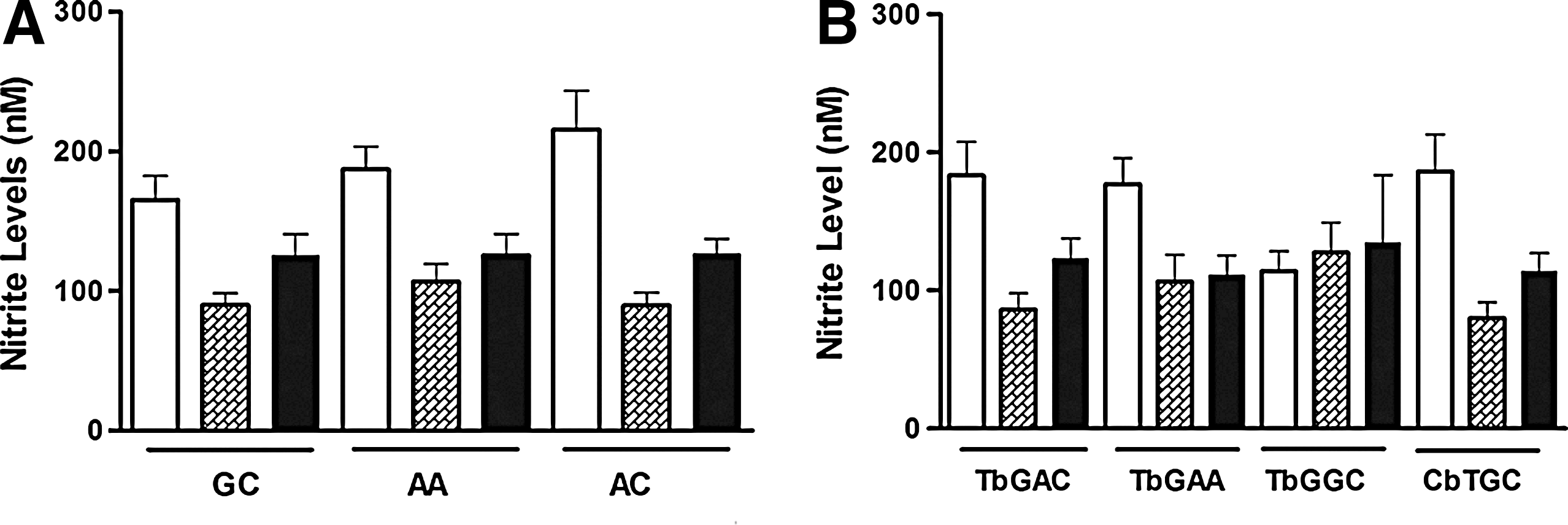
Plasma nitrite concentrations in HP (open bars), GH (scratched bars), and PE (black bars) pregnant women grouped by eNOS haplotypes of rs743506 (A/G) and rs7830 (C/A) polymorphisms
Regarding the two novel Tag SNPs, no significant differences among the different genotypes in three groups were found (Supplementary Fig. S1D, E). Besides that, the haplotype analysis using these two Tag SNPs have shown no effects on plasma nitrite levels in all groups (all p>0.05, Fig. 1A). The inclusion of these Tag SNPs with the other three clinically relevant polymorphisms have also shown negative results (All p>0.05, Fig. 1B).
Discussion
The current study was the first to evaluate the association of the five eNOS Tag polymorphisms with hypertensive disorders of pregnancy (GH and PE). The combinatory analysis of the two novel Tag SNPs, rs743506 and rs7830, along with the three clinically relevant polymorphisms, T-786C, intron 4 VNTR, and Glu298Asp, were estimated and compared among groups. We found that the haplotype H5 (“C b G G C”) was found only in HP, suggesting a protector effect on hypertensive disorders of pregnancy development. Moreover, this study was the first to evaluate the association of the SNPs, rs743506 (A/G) and rs7830 (C/A), located in the eNOS gene with hypertensive disorders of pregnancy. Importantly, while the last three polymorphisms are located in the beginning of the eNOS gene, the SNP rs743506 is located in intron 20 and the SNP rs7830 in the 3′ UTR, respectively, thus covering a more broad extension of the eNOS gene.
A small number of clinical studies have investigated these two eNOS Tag SNPs. It was reported a lack of effect of these polymorphisms on flow-mediated dilation (rs743506 and rs7830) (Kathiresan et al., 2005; Ingelsson et al., 2008). In addition, other studies did not find an association between the tagSNP rs7830 and kidney disease (McKnight et al., 2010) or glaucoma (Liao et al., 2011). Conversely, the haplotype formed by the tagSNPs, rs1808593–rs7830, was associated with an ankle-brachial index, a noninvasive marker of peripheral arterial disease, in hypertensive adults (Kullo et al., 2008).
Several studies in different populations have examined the association among eNOS polymorphisms (T-786C, rs2070744 in the promoter region; the 27 bp-VNTR in intron 4; and Glu298Asp, rs1799983 in exon 7) and PE, and conflicting results were found. For example, the C variant (T-786C polymorphism) was associated with PE in a study (Seremak-Mrozikiewicz et al., 2011), but not in another (Serrano et al., 2004). Conflicting results were also shown for association with the intron 4 polymorphism (Tempfer et al., 2001; Serrano et al., 2004; Chen et al., 2007) and Glu298Asp (Yoshimura et al., 2003; Landau et al., 2004; Serrano et al., 2004; Fatini et al., 2006; Yu et al., 2006; Chen et al., 2007; Sharma et al., 2011). Complementing the several studies published, a recent meta-analysis, including the three polymorphisms (T-786C, intron 4, and Glu298Asp) was performed and demonstrated that homozygosity to 298Asp and Intron 4a are associated with PE (Chen et al., 2012). However, conversely other meta-analysis (Shaik et al., 2011) showed no increased risk to develop PE regarding Glu298Asp (others polymorphisms were not evaluated).
Currently, the evaluation of haplotypic association is considering a more comprehensive genetic analysis than genotypes information only (Balding, 2006; Chappell and Morgan, 2006; Sandrim et al., 2006a, 2006b; Nejatizadeh et al., 2008). Importantly, Serrano et al. (2004) have previously conducted an interesting study showing that carriage of “C Asp b” haplotype increased risk of developing PE in the Colombian population. More recently, eNOS haplotypes were investigated in Maya mestizo preeclamptic women and the authors found the same haplotype combination “C Asp b” associated with PE (Diaz-Olguin et al., 2011). The comparison of these studies with our results that demonstrate a protective role of “C Glu b G C” haplotype is difficult because we evaluated two other polymorphisms in a different population. However, if we consider the three first polymorphism comparison, only the variant Glu298Asp is different (Glu-Protective and Asp-Risk). However, the allele and genotype frequencies of Glu298Asp are similar among groups, indicating the important aspect of haplotype analysis.
Nitrite has been valued as a relevant marker of NO formation (Kelm et al., 1999; Kleinbongard et al., 2003). This is because >70% of plasma nitrite derives from NO synthase activity in the endothelium, and inhibition of NO synthase activity is associated with corresponding decreases in circulation nitrite concentrations (Kelm et al., 1999; Kleinbongard et al., 2003). Indeed, we have recently reported 37% lower plasma nitrite concentrations and 58% lower whole blood nitrite concentrations in PE patients compared with those found in healthy pregnancies (Sandrim et al., 2008b). Although the association between “A C” haplotype and PE has been demonstrated here, a possible modulation of this haplotype on nitrite levels was not observed in all three groups studied, neither in each polymorphism evaluated separately. We observed the effect of T-786C and Intron 4 polymorphism on nitrite levels as previous (Sandrim et al., 2010). The absence of modulation in nitrite levels by haplotypes formed by five polymorphisms in HP may be explained by the lower sample number with nitrite assessment.
Several studies have attempted to demonstrate the functional role of the eNOS polymorphisms evaluated here. The VNTR in eNOS intron 4 modifies the levels of a 27-nt small interference RNA, which inhibits eNOS expression (Zhang et al., 2008). Moreover, the SNP in exon 7 (G894T, rs1799983) leads to a glutamine to aspartate substitution in the 298 position of the protein and probably affects the amounts of eNOS located within the caveolae and eNOS activity (Joshi et al., 2007). On the other hand, there is no functional data related to the eNOS Tag SNPs, rs743506 and rs7830. However, as the rs7830 is located in 3′-UTR, it is possible that it modulates eNOS gene expression, once the region has important physiological and pathological roles in the regulation of the mRNA level (Lai et al., 2003; Ihara et al., 2007). Additional studies are necessary to elucidate molecular mechanisms by which eNOS haplotypes may contribute to the PE development.
Conclusions
Our findings demonstrate a protective effect of the eNOS haplotype H5 (“C b G G C”) against the development of PE that is supported by previous results demonstrating elevated plasma nitrite levels in HP presenting the haplotype “C b G” (Sandrim et al., 2010). This sustains the importance NO in the maintenance of a healthy pregnancy, besides the protective effect of this combination.
Footnotes
Acknowledgments
This study was funded by the Fundação de Amparo a Pesquisa do Estado de Minas Gerais (FAPEMIG-Brazil), the Coordenação de Aperfeiçoamento de Pessoal de Nível Superior (CAPES), the Conselho Nacional de Desenvolvimento Científico e Tecnológico (CNPq), and the Fundação de Amparo a Pesquisa do Estado de São Paulo (FAPESP-Brazil).
Disclosure Statement
All authors declare the absence of conflict.
References
Supplementary Material
Please find the following supplemental material available below.
For Open Access articles published under a Creative Commons License, all supplemental material carries the same license as the article it is associated with.
For non-Open Access articles published, all supplemental material carries a non-exclusive license, and permission requests for re-use of supplemental material or any part of supplemental material shall be sent directly to the copyright owner as specified in the copyright notice associated with the article.
