




Abstract
Mitochondrial aldehyde dehydrogenase-2 (ALDH2) is the principal enzyme involved in alcohol metabolism in humans. Emerging evidence has shown that the common rs671 G>A (Glu504Lys) polymorphism in the ALDH2 gene might play a critical role in increasing the susceptibility to coronary heart disease (CHD), including myocardial infarction (MI); however, individually published studies showed inconclusive results. This meta-analysis aimed to derive a more precise estimation of the relationship between the ALDH2 rs671 polymorphism and its influence on the susceptibility to CHD and MI. Nine case–control studies were included with a total of 7358 subjects, including 1961 CHD patients, 1040 MI patients, and 4357 healthy controls. Our meta-analysis results showed that the A variant of the ALDH2 rs671 polymorphism may be associated with increase risks of CHD (odds ratios [OR]=1.36, 95% confidence interval [CI]=1.06–1.75, p=0.017) and MI (OR=1.64, 95% CI=1.22–2.20, p=0.001). Univariate and multivariate meta-regression analyses showed no potential factors explained heterogeneity. No publication bias was detected in this meta-analysis. In conclusion, the current meta-analysis indicates that the A variant of the ALDH2 rs671 polymorphism may increase the risk of both CHD and MI among Asian populations.
Introduction
Mitochondrial aldehyde dehydrogenase (ALDH) is the principal enzyme involved in alcohol metabolism (Edenberg, 2007). The main pathway of alcohol metabolism is the oxidation of ethanol to acetaldehyde by alcohol dehydrogenase; then, another oxidation of acetaldehyde to acetic acid by ALDH (Hurley and Edenberg, 2012). The human ALDH superfamily consists of 19 genes, among which, ALDH2 is the most widely studied (Vasiliou and Nebert, 2005). The ALDH2 gene is located on chromosome 12q24.2 and consists of approximately 26.2 kbp (Jackson et al., 2011). In exon 12 of the ALDH2 gene, there is a G-to-A missense mutation in which, glutamate at position 504 is replaced by lysine (rs671 G>A; Glu504Lys) (Xu et al., 2010). It was hypothesized that the ALDH2 rs671 polymorphism modulates individual differences in acetaldehyde oxidization capacity and may contribute to CHD susceptibility, including myocardial infarction (MI) (Budas et al., 2009; Chen et al., 2010). Numerous studies have indicated that the ALDH2 rs671 polymorphism might play a critical role in the pathogenesis of CHD and MI among Asian populations (Takagi et al., 2002; Jo et al., 2007; Xue et al., 2007; Bian et al., 2010; Cao and Chen, 2010; Guo et al., 2010; Jiang et al., 2011; Xu et al., 2011); however, there is still no evidence pointing to the possibility of this polymorphism in increasing the risks of CHD and MI among Caucasian populations. However, some studies also suggest that the ALDH2 rs671 polymorphism is not associated with increased risk of CHD and MI (Hashimoto et al., 2002; Nakamura et al., 2002; Xia et al., 2011). In view of these conflicting reports, we performed a meta-analysis of published data to evaluate the associations of the ALDH2 rs671 polymorphism with susceptibility to CHD and MI among Asian populations.
Materials and Methods
Literature search strategy
A comprehensive search for relevant studies was conducted on PubMed, Cochrane Library, Embase, Web of Science, SpringerLink, China BioMedicine (CBM) and China National Knowledge Infrastructure (CNKI) databases from their inception through January 1st, 2013, using the following terms: (“single nucleotide polymorphism” or “SNP” or “genetic polymorphism” or “gene mutation” or “genetic variants”) and (“coronary heart disease” or “CHD” “coronary artery disease” or “CAD” or “myocardial ischemia” or “myocardial infarction” or “MI” or “acute coronary syndrome” or “coronary disease” or “ischemic heart disease”) and (“aldehyde dehydrogenase” or “ALDH” or “aldehyde dehydrogenase-2” or “ALDH2”). There were no language restrictions. The references used in eligible articles or textbooks were also reviewed to find other potential studies. Any disagreements were resolved by discussions and consensus.
Inclusion and exclusion criteria
Studies included in our meta-analysis had to meet the following criteria: (1) cohort studies, nested case–control studies, or case–control studies focused on the association between the ALDH2 rs671 polymorphism and susceptibility to CHD and MI; (2) the minimum number of cases in included studies should be greater than 30; (3) all patients diagnosed with CHD or MI should be confirmed by clinical examinations, such as electrocardiography, echocardiography, and coronary angiography; (4) all subjects in the control group should be healthy controls without a family history of severe cardiovascular disease; (5) the genotype distribution of the controls should conform to the Hardy–Weinberg equilibrium (HWE); (6) published data on the frequencies of alleles or genotypes must be sufficient. Studies were excluded when they were (1) not cohort studies, nested case–control studies, or case–control studies on the association between the ALDH2 rs671 polymorphism and susceptibility to CHD and MI; (2) case–control studies with a small sample size (<30) or without healthy controls; (3) duplicates of previous publications; (4) based on incomplete data; (5) deviation from HWE in the genotype frequencies of the controls; (6) meta-analyses, letters, reviews, or editorial articles. If more than one study by the same author using the same case series was published, either the study with the largest sample size or the most recent publication was included.
Data extraction
Data from the published studies were extracted independently by two authors into a standardized form. For each study, the following characteristics and numbers were collected: the first author, year of publication, country, language, ethnicity of subjects, study design, number of subjects, source of cases and controls, clinical subtype, detecting sample, genotype method, allele and genotype frequencies, and evidence of HWE in controls. In cases of conflicting evaluations, disagreements were resolved through discussions between the authors.
Quality assessment
Two authors independently assessed the quality of the included studies according to the modified STROBE quality score systems (da Costa et al., 2011). Forty assessment items related to quality appraisal were used in this meta-analysis with scores ranging from 0 to 40. Scores of 0–19, 20–29, and 30–40 were defined as low, moderate, and high quality, respectively. Disagreements were resolved through discussions between the authors.
Statistical analysis
Crude odds ratios (ORs) with 95% confidence intervals (CIs) were calculated in a fixed or random effects model. Genotype frequencies of controls were tested for HWE using the χ2 test for each study included in the meta-analysis. The statistical significance of the pooled OR was examined by the Z test. Between-study heterogeneity was estimated using Cochran's Q-statistic, whereas a p h <0.05 was set to identify heterogeneity in the associations (Jackson et al., 2012). We also quantified the effects of heterogeneity using the I 2 test (ranges from 0% to 100%), which represents the proportion of interstudy variability that can be contributed to heterogeneity rather than to chance (Zintzaras and Ioannidis, 2005). The I 2 values of 25%, 50%, and 75% indicate low, moderate, and high degrees of heterogeneity, respectively. When a significant Q-test with p h <0.05 or I 2 >50% indicated existence of heterogeneity among studies existed, a random effects model (DerSimonian-Laird method) was conducted for the meta-analysis; otherwise, a fixed effects model (Mantel-Haenszel method) was used. To explore potential sources of heterogeneity, we performed subgroup analysis by language, country, source of controls or genotype methods. Univariate and multivariable regression analyses were also performed to identify variables explained heterogeneity of the associations (Ioannidis et al., 2008). Sensitivity analysis was performed by omitting each study, in turn, to assess the quality and consistency of the results. Begger's funnel plots and the Egger's linear regression test were used to evaluate publication bias (Peters et al., 2006). Two-sided p<0.05 was considered to be statistically significant. All calculations were performed using the STATA version 12.0 software (STATA Corporation, College Station, TX).
Results
Characteristics of included studies
In total, 138 articles relevant to the searched keywords were identified. Of these articles, 69 were excluded after reviewing their titles and key words; then, the abstract and full text were reviewed, and another 60 articles were excluded. The details of the selection process are presented in a flow chart in Figure 1. Finally, nine case–control studies (Takagi et al., 2002; Jo et al., 2007; Xue et al., 2007; Bian et al., 2010; Cao and Chen, 2010; Guo et al., 2010; Jiang et al., 2011; Xia et al., 2011; Xu et al., 2011) were included with a total of 7358 subjects, including 1961 CHD patients, 1040 MI patients, and 4357 healthy controls. The publication year of the involved studies ranged from 2002 to 2011. All patients diagnosed with CHD or MI were confirmed by coronary angiography. Three of the nine studies used population-based controls, while the other six studies used hospital-based controls. All included studies used blood samples for genotyping. The classical polymerase chain reaction–restriction fragment length polymorphism (PCR-RELP) method was performed in six studies. The other three studies used TaqMan assay. The HWE test was conducted to evaluate the genotype distribution of the controls in all included studies. None of the studies deviated from the HWE (all p>0.05). The characteristics of the included studies are summarized in Table 1.
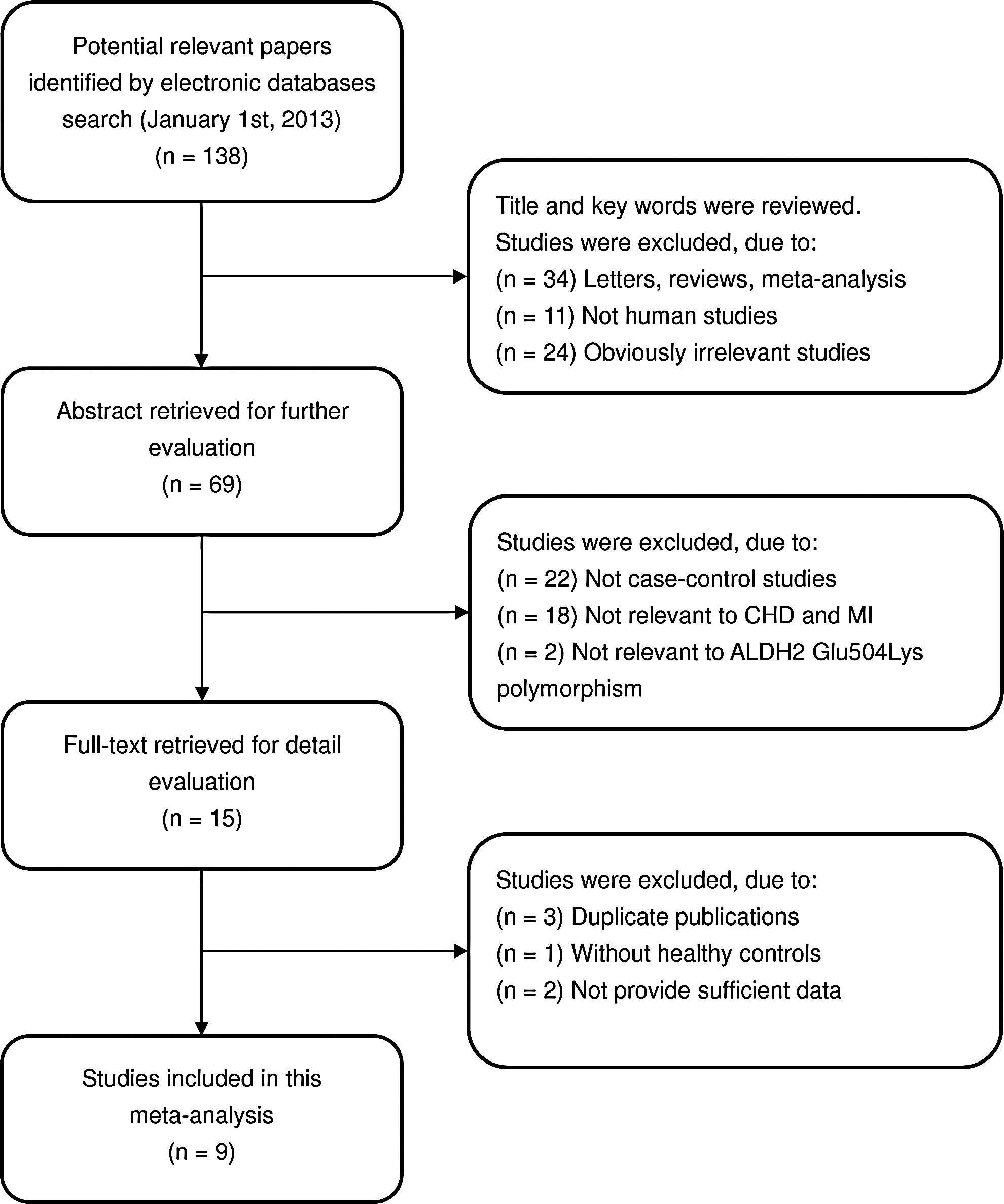
Flowchart shows the study selection procedure.
CHD, coronary heart disease; MI, myocardial infarction; HB, hospital-based; PB, population-based; PCR-RFLP, polymerase chain reaction–restriction fragment length polymorphism; ALDH2, aldehyde dehydrogenase-2; SNP, single-nucleotide polymorphism.
Meta-analysis results
A summary of the meta-analysis findings on the relationship between the ALDH2 rs671 polymorphism and susceptibility to CHD and MI is provided in Table 2. Since there was significant heterogeneity across studies (p h <0.05, I 2=62.5%), the random effects model was used. The meta-analysis results indicated that the ALDH2 rs671 polymorphism was associated with increased risk of both CHD (OR=1.36, 95% CI=1.06–1.75, p=0.017) and MI (OR=1.64, 95% CI=1.22–2.20, p=0.001) (Fig. 2).
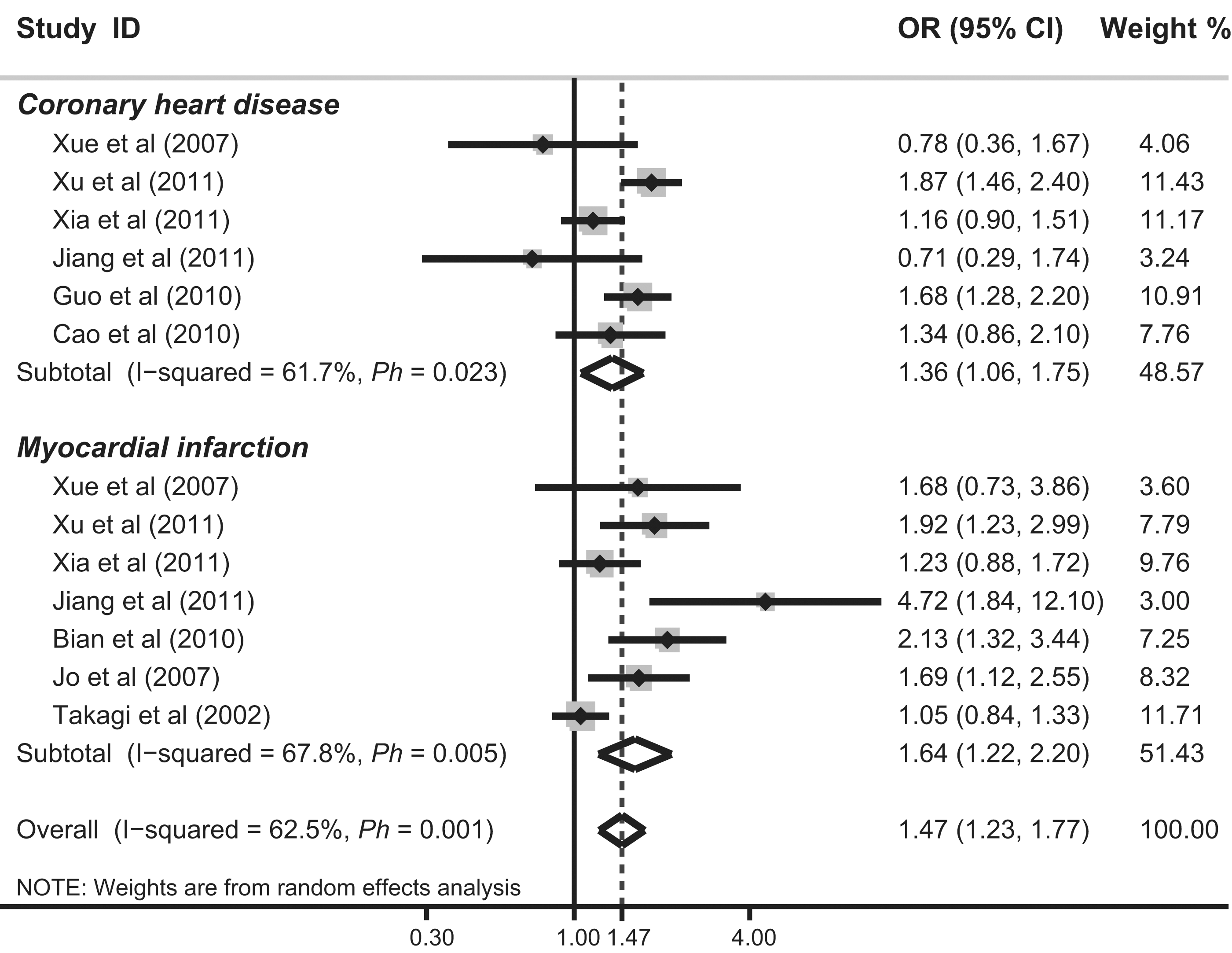
Forest plot of the association between the aldehyde dehydrogenase 2 (ALDH2) rs671 polymorphism and susceptibility to coronary heart disease (CHD) and myocardial infarction (MI).
Estimates for random effects model.
OR, odds ratios; 95% CI, 95% confidence interval; ph ,, p-value of heterogeneity test.
To establish the effect of heterogeneity based on the results from the meta-analyses, we also performed subgroup analyses based on language, country, source of controls or genotype methods. Subgroup analyses showed significant associations between the A variant of ALDH2 rs671 polymorphism and increased risk of CHD in English (OR=1.78, 95% CI=1.48–2.14, p<0.001), Chinese (OR=1.36, 95% CI=1.06–1.75, p=0.017), population-based (OR=1.68, 95% CI=1.28–2.20, p<0.001), and PCR-RFLP (OR=1.43, 95% CI=1.08–1.90, p=0.013) subgroups. The A variant of the ALDH2 rs671 polymorphism displayed significant associations with increased risk of MI in Chinese (OR=1.92, 95% CI=1.17–3.18, p=0.011), China (OR=1.87, 95% CI=1.30–2.71, p=0.001), Korea (OR=1.69, 95% CI=1.12–2.55, p=0.013), hospital-based (OR=1.87, 95% CI=1.30–2.70, p=0.001) subgroups, and both PCR-RFLP (OR=1.80, 95% CI=1.02–3.15, p=0.042) and TaqMan (OR=1.59, 95% CI=1.16–2.17, p=0.004) subgroups. Although no statistically significant associations were found in English, Japanese, and population-based subgroups (all p>0.05), these results might have lacked sufficient reliability due to the estimation error from the effect size.
Meta-regression and sensitivity analyses
Univariate and multivariate meta-regression analyses were used to explore possible sources of heterogeneity among studies (as shown in Table 3). No factors explained heterogeneity: publication year (p=0.789), language (p=0.060), source of controls (p=0.813), and genotype methods (p=0.985). Sensitivity analysis was performed to assess the influence of each individual study on the pooled OR by omitting each individual study. The analysis results suggested that no individual studies significantly affected the pooled OR (Fig. 3), indicating a statistically robust result.
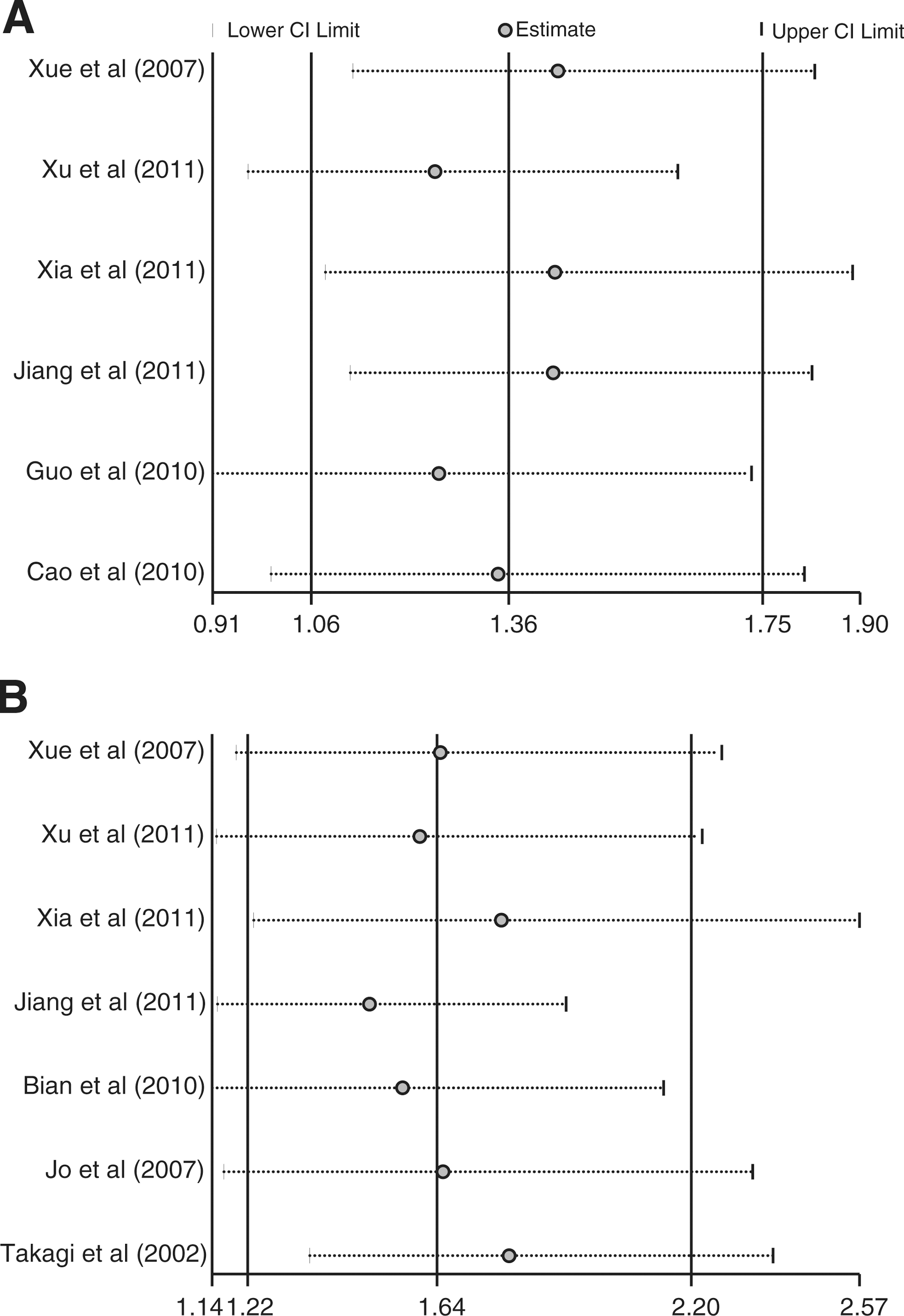
Sensitivity analysis of pooled odds ratio (OR) coefficients on the association between the ALDH2 rs671 polymorphism and susceptibility to CHD
SE, standard error.
Publication bias evaluation
The Begg's funnel plot and Egger's linear regression test were performed to assess the publication biases of the included studies. The shapes of the funnel plots did not reveal any evidence of obvious asymmetry (Fig. 4). The Egger's test also did not display strong statistical evidence of publication bias (CHD: t=−1.80, p=0.145; MI: t=−1.79, p=0.134).
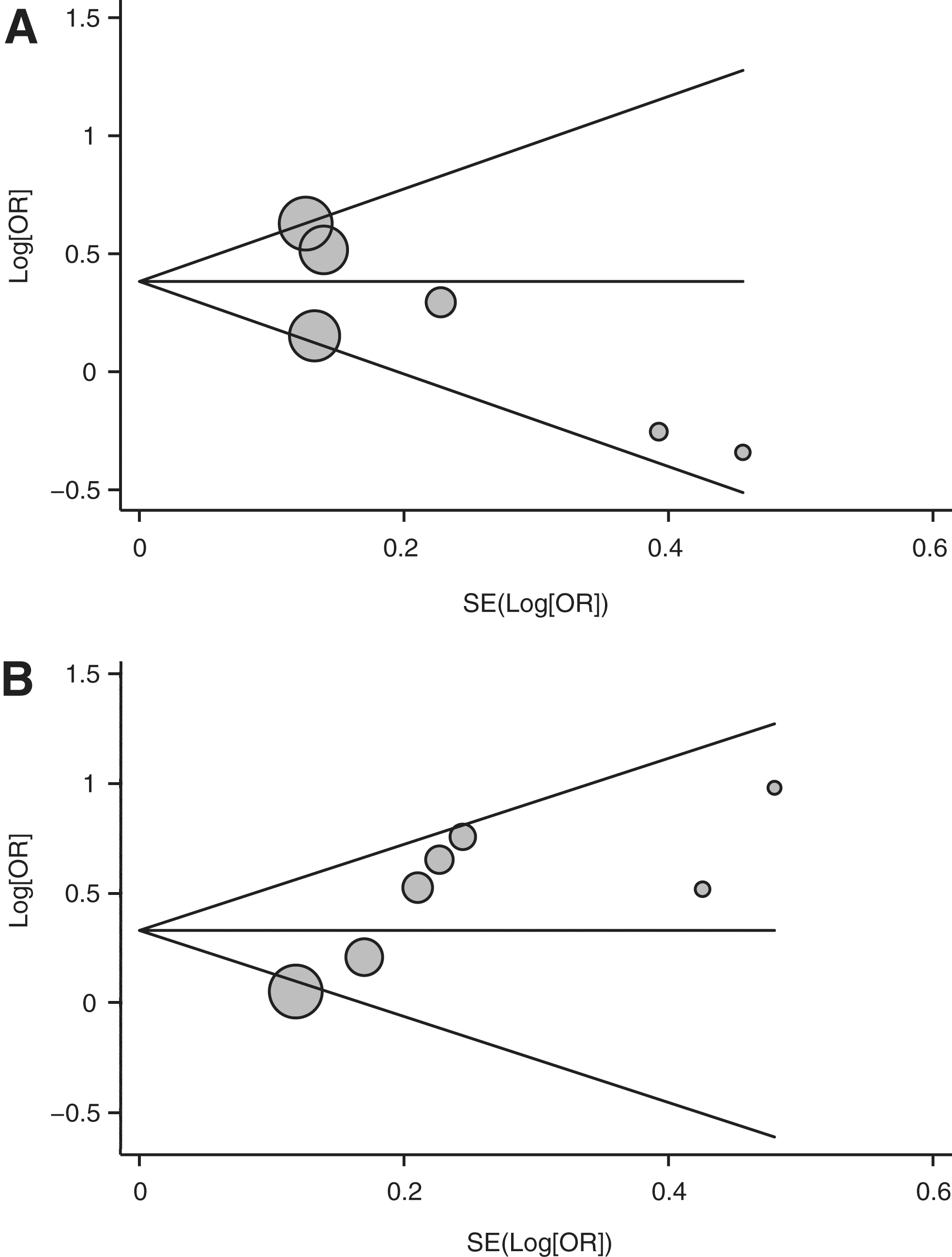
Begg's funnel plot of the association between ALDH2 rs671 polymorphism and susceptibility to CHD
Discussion
Mitochondrial ALDH2 is a tetrameric enzyme responsible for metabolizing toxic aldehydes (Gong et al., 2013). The ALDH2 gene has a common polymorphism rs671 G>A in East Asians (30%–50%), but rare in Caucasians (<5%) (Tan et al., 2012). High prevalence of the ALDH2 rs671 polymorphism in Asians gives some insights into the pathogenesis of CHD and MI in this population. The rs671 G>A polymorphism results in a Gly-to-Lys amino acid substitution in exon 12 of the ALDH2 and may decrease the activity of alcohol-metabolizing enzymes, thereby increasing the risk of cardiovascular diseases associated with alcohol consumption (Hashimoto et al., 2002). Previous studies have reported that the ALDH2 rs671 polymorphism was associated with cardiovascular disease in Asians due to irregular modulation of the ALDH2 enzyme activity (Guo et al., 2010). However, it remains controversial whether rs671 is useful in predicting CHD or MI risk among Asian populations. Many studies revealed that the ALDH2 rs671 polymorphism may play an important role in the development of CHD and MI, while other studies found no convincing evidence of this polymorphism in increasing an individual's susceptibility to CHD and MI (Budas et al., 2009; Chen et al., 2010; Xu et al., 2011). This controversy could be explained with several reasons, such as differences in study designs, geographical backgrounds, sample sizes, and source of controls. Therefore, we conducted this meta-analysis to provide a comprehensive conclusion on the association between the ALDH2 rs671 polymorphism and susceptibility to CHD and MI among Asian populations.
This is the first meta-analysis on the relationship between the ALDH2 genetic polymorphism and an individual's susceptibility to cardiovascular disease. In this meta-analysis, nine independent case–control studies of Asian populations were included with a total of 7358 subjects, including 1961 CHD patients, 1040 MI patients, and 4357 healthy controls. When all the eligible studies were pooled into the meta-analysis, the results showed that the ALDH2 rs671 polymorphism was associated with increased risk of both CHD and MI, suggesting that the ALDH2 rs671 polymorphism may be an important risk factor in developing CHD and MI in Asians. Although the exact role of the ALDH2 polymorphism in the development of CHD and MI is not yet clear, a possible explanation could be that inherited mutations in the ALDH2 gene are associated with changes in the enzyme activity and individual's alcohol metabolism and, thereby, possibly explaining interindividual differences in susceptibility to CHD and MI (Guo and Ren, 2010; Hurley and Edenberg, 2012). Since significant heterogeneity was observed, subgroup and meta-regression analyses were performed to explore sources of heterogeneity. Further subgroup analyses showed that the ALDH2 rs671 polymorphism was associated with increased risk of CHD in English, Chinese, and population-based subgroups, but this polymorphism may increase the risk of MI in Chinese, China and Korea, and hospital-based subgroups, indicating that the language, country, and source of controls may be the potential sources of heterogeneity. However, our meta-regression analysis indicated that none of these factors explained heterogeneity between the studies. These disparate results may be due to the small sample size resulting in substantial errors from estimation. All of these findings are consistent with the previous hypothesis that the ALDH2 rs671 polymorphism may be associated with increased risk of CHD and MI, suggesting that this polymorphism may be a useful biomarker in predicting an individual's susceptibility to CHD and MI.
Some limitations of this meta-analysis should be acknowledged. First, there were only nine articles included in the present meta-analysis, so the sample size was relatively small and may not provide sufficient statistical power to estimate the correlation between polymorphisms in ALDH2 and susceptibility to CHD and MI. Therefore, more studies with a larger sample size are still needed to accurately provide a more representative statistical analysis. Second, as a type of a retrospective study, a meta-analysis may encounter recall or selection bias, possibly influencing the reliability of our study results. Third, our lack of access to the original data from the studies limited further evaluations of the potential interactions between other factors, including alcohol consumption and drinking history and susceptibility to CHD and MI, such as gene–environment and gene–gene interactions.
In conclusion, this meta-analysis provides strong evidence that the A variant of the ALDH2 rs671 polymorphism may increase the risk of both CHD and MI among Asian populations. These relationships have the potential to provide functional profiling of the ALDH2 gene involved in alcohol metabolism and to help us understand the biological processes associated with the development and progression of CHD and MI. Considering the limitations mentioned above, detailed studies are needed to confirm our findings. Further studies investigating the effect of gene–environment interactions on CHD and MI risks are also essential.
Footnotes
Disclosure Statement
No competing financial interests exist.