




Abstract
The shortage of human hepatocytes continues to be a significant limitation for the widespread application of hepatocyte transplantation and bioartificial liver (BAL) support therapy. Recombinant activation gene 2 (Rag2) and fumarylacetoacetate hydrolase (Fah)-deficient mice could be highly repopulated with human hepatocytes. However, Fah/Rag2-deficient mice can only produce up to 1 × 10⁸ human hepatocytes per mouse. We hypothesized that 2–10 × 1010 human hepatocytes can be produced per Fah/Rag2-deficient pig, which is an adequate supply for hepatocyte transplantation and BAL therapy. In a novel approach, we used stably transfected Cas9 cells and single-guide RNA adenoviruses containing fluorescent reporters to enrich porcine cells with Fah/Rag2 dual gene mutations. This resulted in the construction of Fah/Rag2 double knockout porcine iliac artery endothelial cells, which were subsequently used for generating Fah/Rag2-deficient pigs.
Introduction
There is a critical shortage of human hepatocytes for the study of liver disease and for the development of novel diagnostic and therapeutic applications, including hepatocyte transplantation and bioartificial liver (BAL) support (McKenzie et al., 2008; Dhawan et al., 2010). The deletion of the recombinant activation gene 2 (Rag2) can result in the V(D)J rearrangement defect, and it can lead to severe combined immune deficiency (Oettinger et al., 1990). Fumarylacetoacetate hydrolase (Fah) gene mutations can lead to tyrosine metabolic disorders and cause serious liver damage, such as liver cell apoptosis (Kubo et al., 1998; Orejuela et al., 2008; Hickey et al., 2014). In mice, Fah/Rag2 deficiency has been used to produce bioengineered mice with humanized livers (Azuma et al., 2007; He et al., 2010). However, the most obvious limitation of Fah/Rag2-deficient mice is that they produce no more than 1 × 10⁸ human hepatocytes per mouse. We hypothesized that Fah/Rag2-deficient pigs could be expected to produce 2–10 × 1010 human hepatocytes per pig, which is an adequate supply for hepatocyte transplantation and BAL therapy.
Nyberg et al. (Hickey et al., 2014) produced an Fah-deficient pig strain by using recombinant adeno-associated virus DJ serotype (AAV-DJ) and somatic cell nuclear transfer (SCNT), which suffered hereditary tyrosinemia type 1 (HT1) with severe hepatocellular damage as a result of the Fah deficiency. Lai et al. (Huang et al., 2014) produced an Rag2 gene knockout pig model by using transcription activator-like effector nuclease. The pigs were immunodeficient in T and B lymphocytes, and had low activity of NK cells, which could make them ideal xenograft models. Given the research just cited, we expect that an Fah/Rag2-deficient pig could serve as an in vivo incubator for the large-scale production of human hepatocytes.
Clustered regularly interspaced short palindromic repeats (CRISPR)/CRISPR-associated 9 (Cas9) combined with SCNT is an efficient way to generate multiple gene-knockout/knock-in pigs (Niemann and Petersen, 2016; Wang et al., 2017; Yan et al., 2018). However, it is difficult to enrich the gene-edited cells and also to acquire nuclei with highly efficient gene modification for use in SCNT. The aim of this study is to establish a strategy to enrich cells containing multiple gene mutations and quickly generate highly efficient Fah/Rag2 dual-gene knockout cells to establish a foundation for generating Fah/Rag2 double knockout pigs as human hepatocyte bioreactors.
Materials and Methods
Design and construction of Fah/Rag2-targeting CRISPR/Cas9 vector
Single-guide RNAs (sgRNAs) targeting Fah and Rag2 pig genes were designed by using an online CRISPR design tool (
Sequences of Guide RNA Oligomers and Primers Used in This Study
Fah, fumarylacetoacetate hydrolase; Rag2, recombinant activation gene 2.
Construction of Cas9 stable transfection cell lines and double knockout cells
Porcine iliac artery endothelial cells (PIECs) obtained from the Cell Resource Center of Shanghai Institutes for Biological Sciences (GN105, Shanghai, China) were maintained in RPMI 1640 Medium (HyClone) supplemented with 10% (vol/vol) fetal bovine serum (Gibco) in a 24-well plate at 37°C with 5% CO2 (Yang et al., 2017). To construct Cas9 stable transfection cell lines, when the cells reached 50% confluency, they were infected with Cas9 lentivirus (MOI 30, 1 × 10⁸ viral particles/mL) for 4 h; then, they were replenished with fresh medium and cultured for 48 h. Next, 1 μg/mL puromycin was used to select the stably transfected cells and the screening lasted 10 days. Afterward, cells expressing Cas9 were expanded and subjected to sgRNA transfection. When the Cas9 stably transfected cells reached 50% confluency in a 24-well plate, they were successively infected with Fah and Rag2 sgRNA adenovirus (MOI 50, 1 × 10¹⁰ viral particles/mL) for 2 h. After 2 days post-transfection, fluorescence in the cells was examined under a microscope (OBSERVER D1/AX10 cam HRC; Zeiss, Germany).
Enrichment and selection of double knockout cells
To enrich the double transfected cells, cells with strong signals from both red fluorescence protein (RFP) indicating Rag2-sgRNA and green fluorescent protein (GFP) indicating Fah-sgRNA were sorted into a six-well plate by the FACSCalibur system (FACSAria SORP, BD) and the cultures were expanded. To roughly detect modifications of Fah and Rag2, PCR was performed on genomic DNA extracted from cells after flow cytometry by using specific primers (Table 1). The PCR conditions were as follows: 94°C for 5 min; 94°C for 30 s, 58°C for 30 s, and 72°C for 1 min for 35 cycles; 72°C for 5 min; and a hold at 4°C. The PCR was performed with TaKaRaTaq™ Hot Start Version (TaKaRa, Japan). Subsequently, a mixture containing 9 μL PCR product and 1 μL 10 × T7 endonuclease I (T7EI) buffer was incubated at 95°C for 10 min and then incubated at room temperature for 30 min. After the annealing reaction, 1 μL of T7EI (NEB, Ipswich) was added to the sample and the mixture was incubated at 37°C for 30 min. Finally, the digested products were analyzed by electrophoresis in 2% agarose gels.
To select the double knockout cells, the sorted cells were plated at the colonization density in 100-mm dishes. The cultures were maintained for up to 7 days, by which time colonies of the appropriate size were expected to appear. Colonies derived from single cells were separated mechanically.
Detection of double mutation clones generated by the CRISPR/Cas9 system
The target sequences of colonies derived from single cells were sequenced as previously described (Kim et al., 2011). First, PCR products including target sites were cloned into the T-Blunt vector. At least six T-vector clones were sequenced from each colony to identify mutations in all alleles and exclude the possibility of cell contamination between colonies. Then, the cloned vectors were sequenced by using the same primers that were used for PCR amplification.
Meanwhile, the cells derived from single colonies were expanded and used to detect the expression of Fah and Rag2 proteins by immunofluorescence (IF) and immunohistochemistry (IHC). The expanded single-colony cells were cultured in a 24-well plate with a glass cover slip, and wild-type cells were used as a control. After 24 h, the cells adhered and were fixed with 4% paraformaldehyde. Then, IF and IHC were, respectively, performed with primary antibodies against Fah (bs-16194R; Bioss, China) and Rag2 (sc-7623; Santa Cruz Biotechnology, CA). The IF slides were analyzed by a fluorescence microscope (AX10 imager A2/AX10 cam HRC; Zeiss), and the IHC slides were scanned by a digital pathology apparatus (NanoZoomer 2.0T; Hamamatsu, Japan).
Result
Introduction of the CRISPR/Cas9 system
The sgRNA targeting exon 2 of Fah and the sgRNA targeting sites in the open reading frame of Rag2 were selected, and the sequences are shown in Figure 1A. To improve the expression of the CRISPR/Cas9 system, the cell lines stably transfected with Cas9 were enriched through lentivirus and resistance screening. In addition, for improving the efficiency of sgRNA transfection, adenoviruses containing Rag2-sgRNA and Fah-sgRNA were used to transfect the Cas9 transfected cells and the high expression of fluorescent proteins indicated that Rag2-sgRNA (red) and Fah-sgRNA were efficiently infected (Fig. 2A). The quantitative flow cytometry results showed that the efficiency of adenovirus transfection was 95.26%, of which 67.10% included double positive cells (Fig. 2B).

Design of CRISPR/Cas9 vectors.

Generation and isolation of Fah/Rag2 knockout PIECs.
Construction of the double knockout cells
To enrich highly transfected cells, cells infected with Rag2-sgRNA and Fah-sgRNA adenoviruses were sorted by using flow cytometry 48 h post-infection. The results showed that the efficiencies of cells infected with Fah-sgRNA and Rag2-sgRNA adenoviruses were 73.86% and 88.5%, respectively (Fig. 2B). Surprisingly, 67.10% of cells were doubly infected with Fah-sgRNA and Rag2-sgRNA. To obtain cells highly expressing Fah-sgRNA and Rag2-sgRNA, which implied highly efficient mutations, the top 25.00% cells showing the strongest double positive signals were sorted (Fig. 2B). To preliminarily detect the mutations, a T7EI assay was performed, and the result showed that both Fah-sgRNA and Rag2-sgRNA induced mutations at their target sites (Fig. 2C, D).
Identification of Fah/Rag2 double knockout cells
To select the Fah/Rag2 double knockout cells, the sorted double positive cells were trypsinized and plated at a proper density to enable the generation of single-cell colonies in a 100-mm plate. After 10 days of culture, single cell-derived colonies were observed, and one of the colonies is shown in Figure 2E. In our study, four single cell-derived colonies were chosen and their PCR products were screened to detect potential mutations generated by the CRISPR/Cas9 system. One colony only carried a mutation in Fah, one colony only carried a mutation in Rag2, and two colonies were shown to carry mutations on both Fah and Rag2, which suggested that the efficiency of the mutation could be improved to 100% and double gene mutations could reach 50% (2/4) after our enrichment strategy.
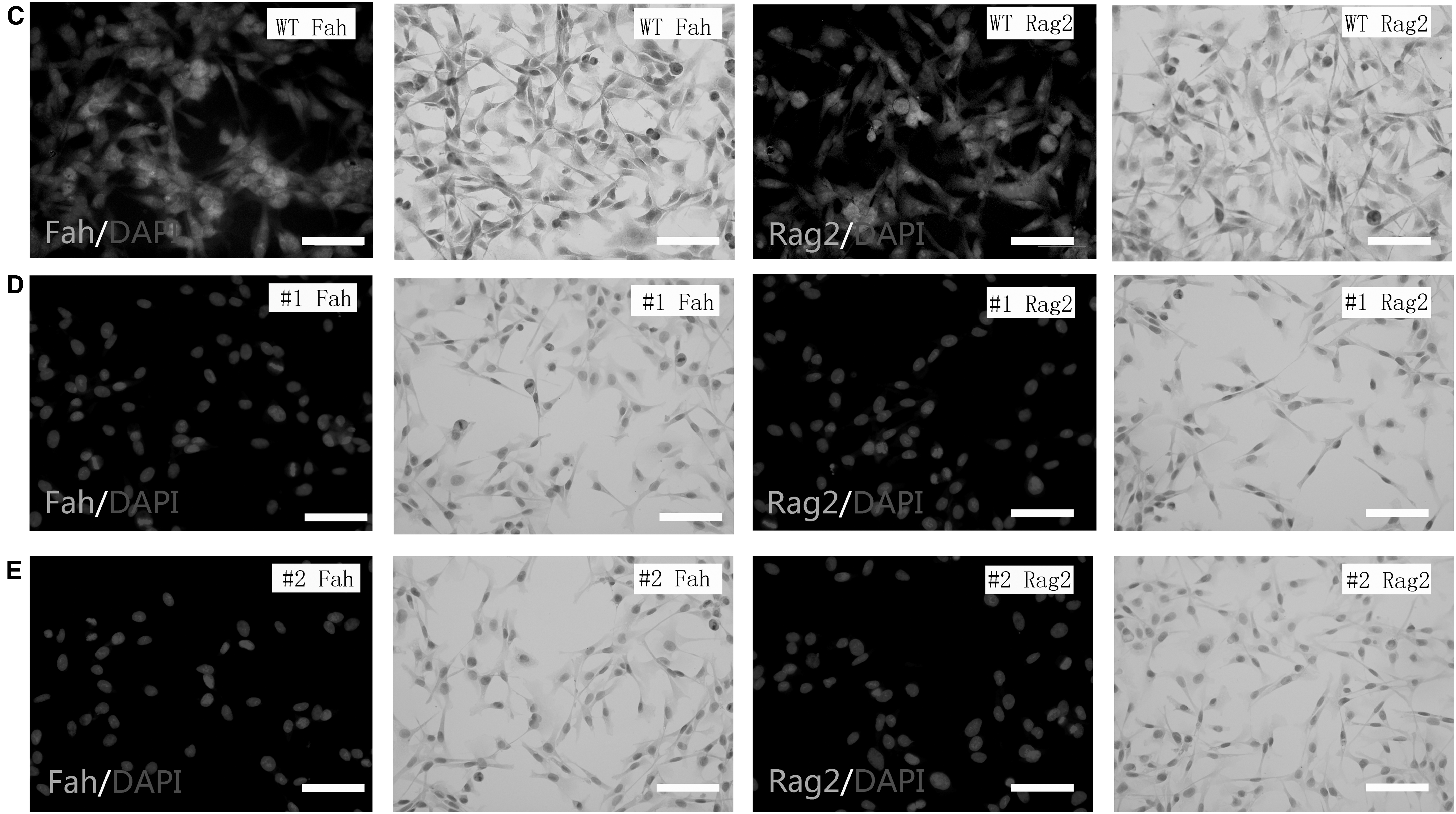
To analyze the two double gene-edited colonies, six T-vector clones for each colony were sequenced and only two types of mutations were found in each colony, which indicated that the colonies were each from a single cell. Sanger sequencing analysis revealed that both the double gene-edited colonies were biallelic mutations and the mutation sites were, respectively, within the region of the protospacer adjacent motif (PAM) in Fah and Rag2, which were adjacent to the gRNA target sequence (Fig. 3A, B). These are characteristic of typical non-homologous end-joining-induced gene-editing outcomes. Meanwhile, the results of IF and IHC also confirmed that there was no expression of Fah or Rag2 protein on the double gene-edited cells. The results just cited demonstrate that CRISPR-mediated targeting is effective in generating mutations in PIECs.

The analysis of double gene-edited colonies generated by the CRISPR/Cas9 system.
Discussion
The CRISPR-Cas9 system is a powerful genome editing technology that can generate double-strand breaks in the genome; it relies on the Cas9 endonuclease and sgRNAs (Cong et al., 2013; Mali et al., 2013; Varshney et al., 2015). Successful genome editing in numerous mammals has been achieved by using CRISPR-Cas9 (Yang et al., 2015; Niu and Wei, 2017; Wang et al., 2017; Cohen, 2018; Yan et al., 2018; Yoon et al., 2018). Genetically modified pigs have many potential applications in the study of disease mechanisms, xenotransplantation, and heterogeneous cell regeneration. As the shortage of human hepatocytes continues to be a significant barrier for the widespread and long-term application of hepatocyte transplantation for treating metabolic liver disease (Soltys et al., 2010), we hypothesized that the use of Fah/Rag2-deficient pigs could provide a feasible approach for the maturation of normal hepatocytes and, thus, enable individualized hepatocyte transplantation for the treatment of human metabolic liver disease.
The current generation of multiple gene-modified animals is mostly based on SCNT combined with CRISPR/Cas9. Therefore, it is essential to generate efficiently gene-edited nuclei. However, due to the large size of the SpCas9 endonuclease gene (∼4.2 kb), it is inefficient at the lentivirus or adenovirus-based production of multiple gene target vectors (Kumar et al., 2001; Wu et al., 2010). In addition, the activity of gene editing was sometimes low and hampered the generation of mutated cells. Methods for cell enrichment with the desired genetic modifications are essential for selecting live cells with a high genome editing efficiency (Kim et al., 2011; Ramakrishna et al., 2014; Li et al., 2015; Ren et al., 2015).
To overcome this problem, we reported an efficient method to enrich cells containing double gene mutations by using Cas9 model porcine cells and adenovirus. In this study, cells stably transfected with Cas9 were established by using lentivirus as the model porcine cells. In the following studies, only the targeting sgRNA had to be transfected into the cells, which reduced its impact on the expression of Cas9 protein in the CRISPR/Cas9 system. And the flow cytometry was used to sort out the strong double sgRNA-adenovirus transfected cells with dual fluorescent reporters. The efficiency of Fah/Rag2 double knockout colonies was found to be 50%. One major advantage offered by the dual-fluorescent sorting system is to enhance the generation of double clonogenic cells with desired genetic modifications (Kim et al., 2011; Ramakrishna et al., 2014). In addition to gene knockout, this strategy could also be used for gene knock-in. Taken together, this method allowed multiple genome edits to be conveniently and efficiently performed in vitro.
Conclusion
Our method enabled the quick and efficient enrichment of Fah/Rag2 double knockout porcine cells to facilitate the selection of multiple gene-edited nuclei for use in SCNT. In future studies, we intend to generate Fah/Rag2 pigs as human hepatocyte “bioreactors” by combining our strategy with SCNT.
Footnotes
Acknowledgments
The research program was supported by the National Key Clinical Project. The research leading to these results has also received funding from National Natural Scientific Foundations of China (81770618) and Sichuan University Student Innovation Training Program (2017502302).
Availability of Data and Materials
The Gene ID of Fah is 100623036 and the Gene ID of Rag2 is 100151744, both of which can be found on
Ethics Approval and Consent to Participate
All experimental procedures involving of cells culture and transfection were complied with the experimental operation manual of West China Hospital of Sichuan University.
Disclosure Statement
No competing financial interests exist.