




Abstract
Genetic variants in several long noncoding RNA genes have been implicated in the occurrence and development of colorectal cancer (CRC). In this study, we explored the association between HAND2-AS1 gene rs2276941 polymorphism and the risk and clinical stage of CRC. A direct sequencing method was used to detect the rs2276941 polymorphism in 576 CRC patients and 864 healthy individuals. Real-time quantitative PCR technology was used to explore the expression of HAND2-AS1 and hsa-miR-1275 in colorectal tissues with different rs2276941 genotypes. Dual-luciferase reporter assay was used to assess the function of the rs2276941 polymorphism. We found that the rs2276941 polymorphism was associated with a decreased risk of CRC (TT vs. CC, OR = 0.38, 95% CI = 0.16–0.89, p = 0.03; TT vs. [CC+CT], OR = 0.40, 95% CI = 0.17–0.94, p = 0.03). Furthermore, a significant negative correlation was observed between the expression of HAND2-AS1 and hsa-miR-1275 in colorectal tissues with rs2276941 TT genotype. Functional experimental results showed that the rs2276941 T allele might promote the binding of HAND2-AS1 to hsa-miR-1275. The current study results suggested that HAND2-AS1 gene rs2276941 polymorphism affecting the binding of hsa-miR-1275 was associated with CRC risk and might serve as a CRC susceptibility biomarker.
Introduction
Colorectal cancer (CRC) is the third most common type of cancer, accounting for roughly 10% of global cancer incidence and causing an estimated 1.93 million new cases in 2020 (Xi and Xu, 2021). In 2040, the global number of new CRC cases is expected to reach 3.2 million (Xi and Xu, 2021). Therefore, it is urgent to reveal CRC risk factors and prevent the occurrence of CRC. Some modifiable environmental risk factors, such as obesity, physical inactivity, poor diet, excessive alcohol intake, and smoking, have been reported to promote the occurrence of CRC (Keum and Giovannucci, 2019).
In addition to modifiable risk factors, genetic risk factors also have a significant impact on the occurrence of CRC (Keum and Giovannucci, 2019; Xi and Xu, 2021). For instance, LOX gene rs1800449 polymorphism, MDM4 gene rs4245739 polymorphism, and CTLA-4 gene rs3087243 polymorphism were associated with CRC risk (Gao et al., 2015; Zhao et al., 2020; Van Nguyen et al., 2021). Thus, identifying these genetic variants related to CRC risk would aid in identifying people who were predisposed to CRC and understanding the pathogenesis of CRC.
Long noncoding RNAs (lncRNAs) are a varied family of noncoding RNA molecules with lengths greater than 200 nt that perform a variety of roles such as gene regulation, dosage compensation, and epigenetic regulation. Recently, dysregulation and genetic variants of several lncRNAs have been implicated in the occurrence and development of several diseases, including CRC (Shang et al., 2020; Chen et al., 2021; Ghafouri-Fard et al., 2021; Huang et al., 2021; Zhu et al., 2021). For example, lncRNA CCAT1 could promote CRC progression by regulating the expression of miR-181a-5p (Shang et al., 2020). Moreover, CCAT1 gene rs7013433 polymorphism was associated with CRC risk and clinical stage (Li et al., 2018). lncRNA MAGI2-AS3 could accelerate CRC progression by regulating the miR-3163/TMEM106B axis (Ren et al., 2020). In addition, the MAGI2-AS3 gene rs7783388 polymorphism could contribute to the risk of CRC by altering the binding affinity of the transcription factor glucocorticoid receptor to the MAGI2-AS3 promoter (Yang et al., 2020). HAND2-AS1 could inhibit cell progression by sponging miR-20a and upregulating PDCD4 in 5-fluorouracil-resistant CRC cells (Jiang et al., 2020b). Furthermore, HAND2-AS1 could suppress CRC progression by serving as a sponge for hsa-miR-1275, which targets KLF14 (Zhou et al., 2018). It is worth noting that the present bioinformatics analysis results showed that the rs2276941 genetic polymorphism (C>T) located in the exonic region of the HAND2-AS1 gene could affect the binding of HAND2-AS1 to hsa-miR-1275. The association of this genetic variant with CRC has not yet been reported.
We speculated that this genetic variant might be linked to the occurrence and development of CRC. To verify the speculation, a case-control study and a functional experiment were carried out in the current study.
Methods
Bioinformatics analysis
The RNAfold web server (
Sample collection
Peripheral blood was obtained from 576 CRC patients and 864 healthy individuals at Shanghai's Xuhui District Central Hospital (Table 1). All individuals were genetically unrelated ethnic Han Chinese. The diagnosis of CRC patients was histopathologically confirmed. Healthy individuals were cancer-free individuals living in the same residential area and seeking routine physical examinations. Clinical characteristics of all individuals were obtained from their medical records. Furthermore, 35 pairs of primary CRC and adjacent noncancerous tissues were obtained from CRC surgery patients who had not received radio- or chemotherapy and medication before surgery. All enrolled subjects provided informed consent. The Ethics Committee at Shanghai Xuhui District Central Hospital accepted the study protocol (No. 047-001).
Clinical Characteristics of Colorectal Cancer Patients and Healthy Controls
SD, standard deviation.
Genotyping
The TIANamp genomic DNA Kit (Tiangen, Beijing, China) was used to isolate genomic DNA from peripheral blood according to the manufacturer's instructions. A NanoDrop spectrophotometer was used to determine the concentration and quality of genomic DNA. The PCR primers used to amplify the sequence containing the rs2276941 polymorphism were designed with Primer Premier 6.0 software and were as follows: Forward: 5′-TGTAAGAGGCTGCCTGCGTAT-3′ and Reverse: 5′-TATCAGTCAGA GGATAATGCAAGTG-3′. Thermocycling conditions of PCR were as follows: initial denaturation at 95°C for 5 min, 34 cycles of PCR consisting of denaturation at 94°C for 30 s, annealing at 60°C for 30 s, extension at 72°C for 30 s, and final extension step of 72°C for 5 min. Synthesis of the suitable size PCR products was confirmed by agarose gel electrophoresis. The genotype of the rs2276941 polymorphic locus for each individual was checked by the direct sequencing method.
Real-time quantitative PCR detection
RNAsimple total RNA kits (Tiangen) were used to isolate total RNA from tissues according to the manufacturer's instructions. ReverTra Ace qPCR RT Kit (Toyobo, Osaka, Japan) was used to synthesize cDNA. Roche FastStart Universal SYBR Green Master (Rox) was used to conduct quantitative real-time PCR. The expression levels of the HAND2-AS1 gene and hsa-miR-1275 were normalized to the internal control GAPDH and U6, respectively. The specific primer pairs for HAND2-AS1 and GAPDH were 5′-ATAAGGTCTTGGATGTGAAGTCTG-3′ (forward), 5′-CTCAGCATCCCATCTCTAGAAGT-3′ (reverse); and 5′-GTCTCCTCT GACTTCAACA-3′ (forward), 5′-TGAGGGTCTCTCTCTTCCT-3′ (reverse), respectively. The specific primer pairs for hsa-miR-1275 and U6 were 5′-ACACT CCAGCTGGGGTGGGGGAGAGGCT-3′ (forward), 5′-CTCAACTGGTGTCGTGG AGTCGGCAATTCAGTTGAGGACAGCC-3′ (reverse); and 5′-CTCGCTTCGGCA GCACA-3′ (forward), 5′-AACGCTTCACGAATTTGCGT-3′ (reverse), respectively.
Dual-luciferase reporter assay
A 200 bp sequence, including the rs2276941 C or T allele, was, respectively, synthesized and inserted into the multiple cloning region of the psiCHECK2 vector, thereby obtaining the wild-type vector carrying the rs2276941 C allele (psiCHECK2-WT) and the mutant-type vector carrying the rs2276941 T allele (psiCHECK2-MT). HEK-293T cells were cultured in a Dulbecco's modified Eagle's medium with 100 IU/mL streptomycin, 100 IU/mL penicillin, and 10% fetal bovine serum (Gibco, Carlsbad, CA) in a 37°C, 5% CO2 incubator. The HEK-293T cells in the logarithmic growth phase were seeded at 1 × 10⁵ cells per well in 24-well plates.
As per established guidelines, 16 h after plating, the dual-luciferase vectors were, respectively, cotransfected with hsa-miR-1275 mimics or miRNA-NC into HEK-293T cells through lipofectamine 2000. After 48 h of transfection, the transfected cells were collected, and the luciferase activity of transfected cells was measured using a dual-luciferase reporter assay system and a luminometer. Each test was conducted in triplicate and repeated at least three times.
Statistical analysis
The chi-square goodness-of-fit test was used to explore whether the genotype distribution of the rs2276941 polymorphic loci was consistent with Hardy-Weinberg equilibrium (HWE) in the control group. p HWE > 0.05 suggested compliance with HWE. Logistic regression analysis was used to assess the association of the rs2276941 polymorphism with the risk and clinical stage of CRC. The correlation between the expression of HAND2-AS1 and hsa-miR-1275 was explored by Pearson correlation analysis. Relative luciferase activity between different alleles was compared by Student's t-test. p < 0.05 was deemed statistically significant. All statistical analyses were conducted using SPSS 22.0 (Chicago, IL).
Results
Bioinformatics analysis results showed that the rs2276941 polymorphism affected the secondary structure of HAND2-AS1 (Fig. 1A, B). The loop structure with rs2276941 T allele contained a sequence fully complementary to the hsa-miR-1275 seed region, which contributed to the binding of hsa-miR-1275 to HAND2-AS1 (Fig. 1B, C). However, the rs2276941 C allele in the HAND2-AS1 gene could interfere with the binding of hsa-miR-1275.
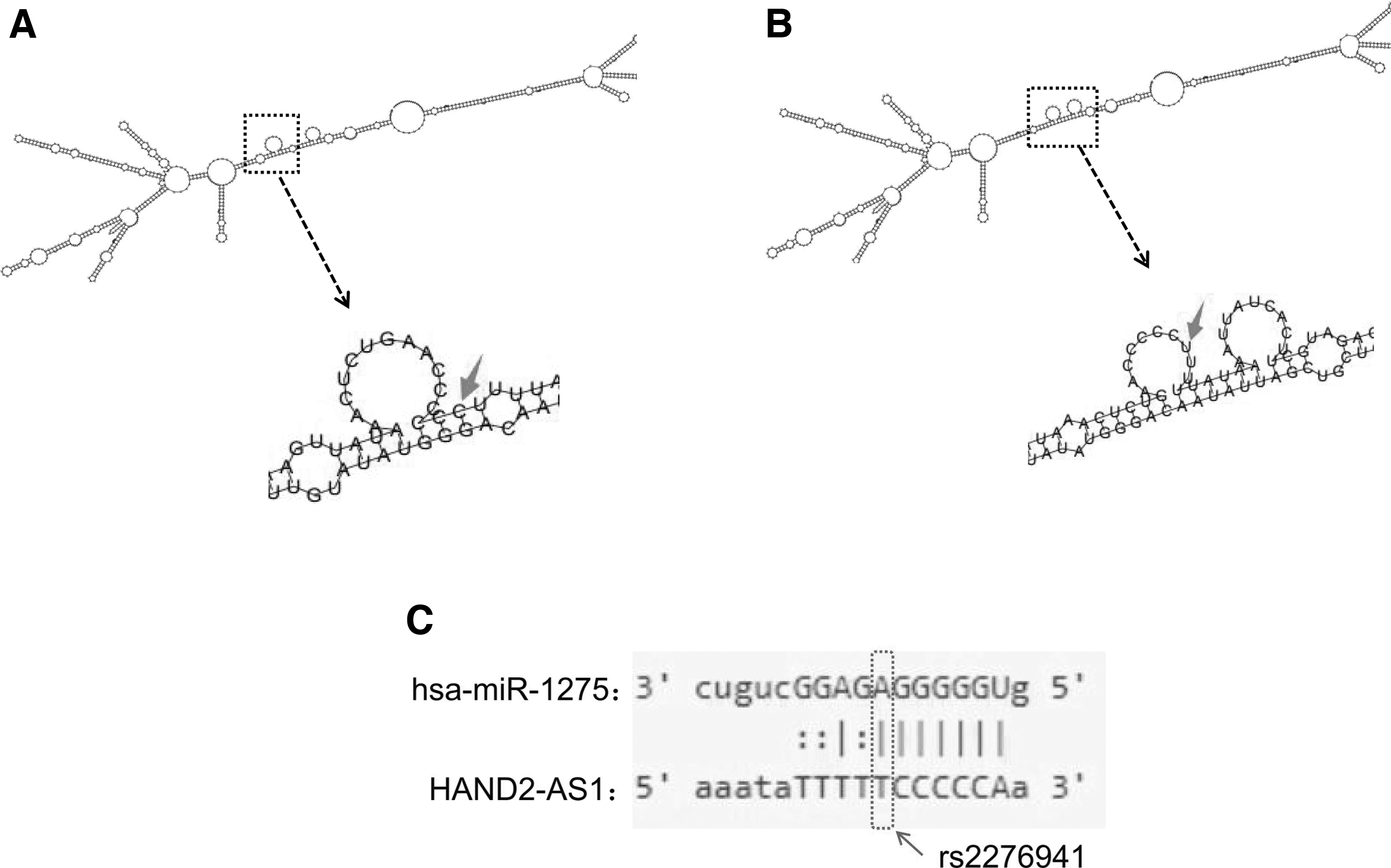
Bioinformatics analysis of the rs2276941 polymorphism in the HAND2-AS1 gene.
The results of case-control study showed that the rs2276941 polymorphism was significantly associated with a decreased risk of CRC (TT vs. CC, OR = 0.38, 95% CI = 0.16–0.89, p = 0.03; TT vs. [CC+CT], OR = 0.40, 95% CI = 0.17–0.94, p = 0.03) (Table 2). The analysis based on clinical stage showed that there was no significant association between the rs2276941 polymorphism and clinical stage (Table 3).
The Association Between HAND2-AS1 Gene rs2276941 Polymorphism and Colorectal Cancer Risk
Adjusted for gender and age.
The Association Between HAND2-AS1 Gene rs2276941 Polymorphism and Clinical Stage of Colorectal Cancer
Adjusted for gender and age when appropriate.
There was a significant negative correlation between the expression of HAND2-AS1 and hsa-miR-1275 in colorectal tissues with rs2276941 TT genotype (Table 4). Dual-luciferase reporter assay indicated that the relative luciferase activity of psiCHECK2-MT but not that of psiCHECK2-WT was significantly downregulated in HEK-293T cells cotransfected with hsa-miR-1275 mimics, suggesting that rs2276941 T allele could contribute to the binding of hsa-miR-1275 (Fig. 2).
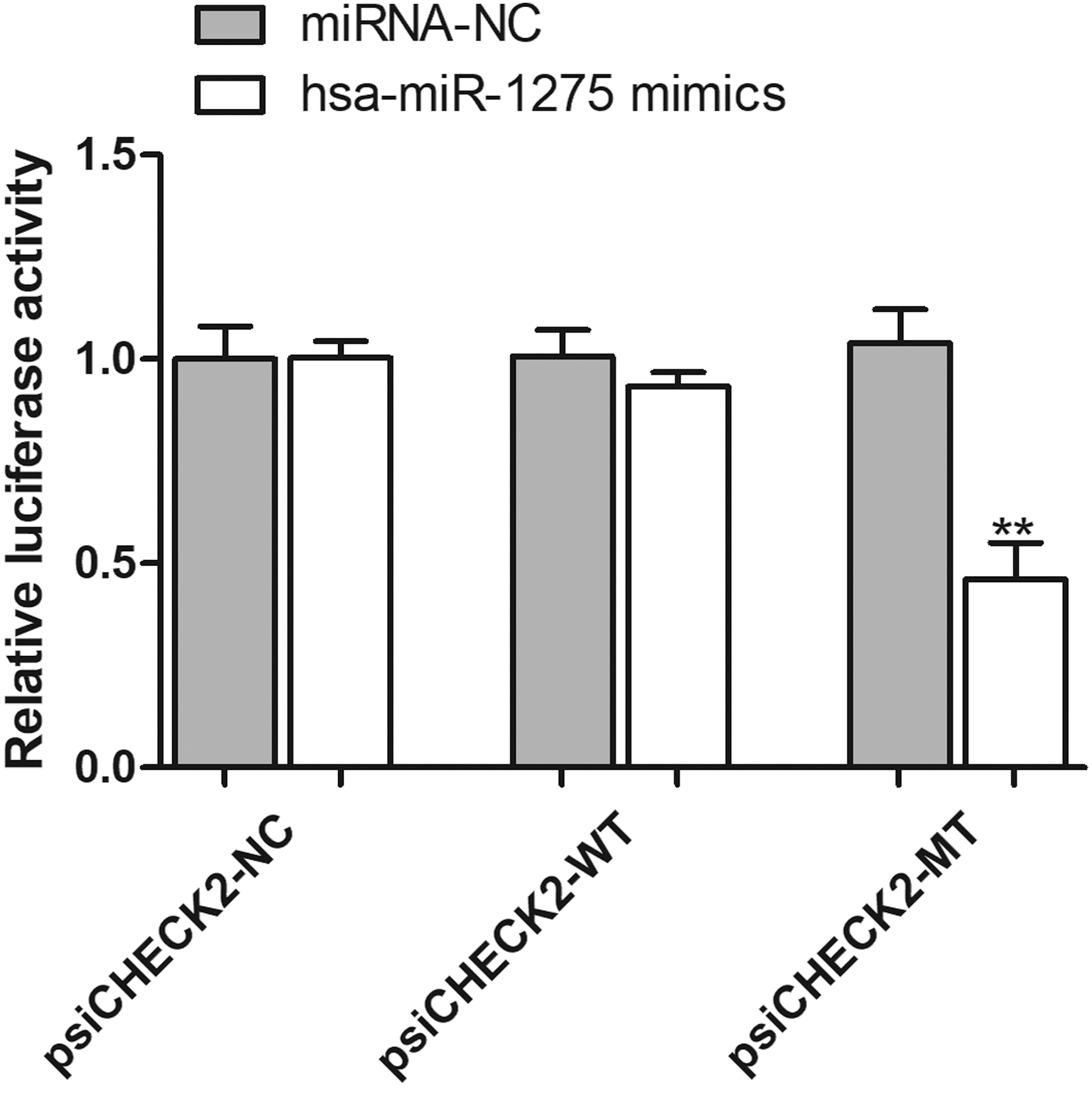
Dual-luciferase reporter assay of the rs2276941 polymorphism in the HAND2-AS1 gene. **p < 0.01.
The Correlation Between the Expression of HAND2-AS1 Gene and hsa-miR-1275 in Colorectal Tissues with Different rs2276941 Genotypes
Discussion
HAND2-AS1 gene located on human chromosome 4 at q34.1 was initially found to be related to hepatocellular carcinoma metastasis (Yang et al., 2017). Accumulating evidence has recently shown that dysregulation of HAND2-AS1 gene expression occurred in a variety of tumors (Gu et al., 2021). Overexpression of HAND2-AS1 could hinder the progression of several tumors, such as triple-negative breast cancer, nonsmall cell lung cancer, cervical cancer, stomach adenocarcinoma, and CRC (Zhou et al., 2018; Gao et al., 2020; Gong et al., 2020; Xing et al., 2020; Xu et al., 2020). Considering that certain genetic variants on tumor-associated lncRNA genes were involved in the tumorigenesis and development, we focused on a potentially functional polymorphism (rs2276941) in the HAND2-AS1 gene, and found that the rs2276941 polymorphism was associated with CRC risk in a Chinese Han population, but not with the clinical stage of CRC.
Individuals with the rs2276941 TT genotype had a significantly lower risk of CRC compared to those with the rs2276941 CC genotype. In addition, a significant association of the rs2276941 polymorphism with CRC risk was also found under the recessive model. To our knowledge, this is the first report to assess the association between genetic polymorphism in the HAND2-AS1 gene and the risk of tumor occurrence.
To further explore the potential functions of the rs2276941 polymorphism, we first performed a bioinformatic analysis and found that the rs2276941 T allele could promote the binding of hsa-miR-1275 to HAND2-AS1. Correlation analysis suggested that the expression of HAND2-AS1 gene was negatively correlated with the expression of hsa-miR-1275 only in colorectal tissues with rs2276941 TT genotype. Dual-luciferase reporter assay showed that rs2276941 T allele could contribute to the binding of hsa-miR-1275. The hsa-miR-1275 could act as a pro-oncogenic molecule regulating the malignant phenotype of tumors and exert its tumorigenic effect (He et al., 2018; Liu et al., 2018; Jiang et al., 2020a).
Furthermore, hsa-miR-1275 could be adsorbed by lncRNA HAND2-AS1 and thus inhibit the progression of various cancers, including CRC (Zhou et al., 2018; Yang et al., 2019; Wang and Cai, 2020). Thus, we speculated that the rs2276941 polymorphism was linked to CRC risk by affecting the binding of lncRNA HAND2-AS1 to hsa-miR-1275, and thus regulating the expression of hsa-miR-1275 target genes.
Conclusion
The current findings indicate that HAND2-AS1 gene rs2276941 polymorphism affecting hsa-miR-1275 binding is associated with a decreased risk in the Chinese Han population, which may serve as a CRC susceptibility biomarker.
Footnotes
Acknowledgments
Thanks to Dr. Zhijun Huang and Dr. Jing Ma from Yancheng First People's Hospital for revising this article.
Disclosure Statement
No competing financial interests exist.
Funding Information
This study was supported by scientific research project of Shanghai Municipal Health Commission (No. 201940389).