






Abstract
Abstract
Sensitive and accurate determination of a small quantity of hydrogen peroxide (H2O2) is of great importance in environmental analysis. In this article, a novel strategy for fabrication of H2O2 sensor was developed by electrodepositing silver nanoparticles (Ag NPs) on a DNA–multiwalled carbon nanotubes (DNA-MWCNTs) composites–modified glassy carbon electrode. Experimental results showed that the constructed electrode had an excellent catalytic ability for the reduction of H2O2, suggesting that it could be used as a sensor to detect H2O2. The good catalytic activity was ascribed to the DNA-MWCNTs composites that resulted in the formation of small Ag NPs and homogenous distribution of these Ag NPs. The sensor showed a high sensitivity, wide linear range, and good stability, and thus it could be used as an ideal tool in environmental engineering.
Introduction
Electrochemical technique based on an enzyme electrode has been extensively employed for accurate determination of H2O2 owing to its intrinsic selectivity and sensitivity of enzymatic reactions (Song et al., 2006; Guo et al., 2007). Lots of materials have been used to immobilize enzyme on an electrode. However, those materials displayed many disadvantages, which resulted in the instability and toxicity of immobilized enzymes (Willner and Katz, 2000; Xiao et al., 2003). Hence, simple and reliable materials with extraordinary electrocatalytic activities to replace enzymes have been a goal for research groups to fabricate sensor for H2O2 detection.
Mediating metal or metal oxide nanoparticles (NPs) on an electrode as a catalyst, which can determine the amount of trace H2O2 exactly, is a hot topic owing to their large specific surface areas, excellent conductivities, and catalytic activities. Many NPs, including Au NPs (Cui et al., 2007; Kumar et al., 2010), Ag NPs (Cui et al., 2008; Riskin et al., 2009; Song et al., 2009; Bui et al., 2010), Pd NPs (Huang et al., 2008), Pt NPs (Niazov et al., 2007; Bahshi et al., 2008; Chakraborty and Retna, 2009), Fe3O4 NPs (Chang et al., 2009), etc., have been widely used to construct sensors for H2O2 detection. Among these sensors, the sensor based on Ag NPs exhibited an extremely fast amperometric response, a low detection limit, and a wide linear range to detect H2O2. A large number of studies showed that the sensor's property depended strongly on the size, distribution, and shape of Ag NPs on electrode. Since the discovery of multiwalled carbon nanotubes (MWCNTs) by Iijima (1991), their remarkable conductivity (regarded as metallic), good electrocatalytic properties, and a large surface for metal NPs deposition have led to an explosion of research activity in electrochemical sensors (Katz and Willner, 2004; Wang, 2005).
In this article, we have exploited Ag NPs electrodeposited on the DNA-MWCNTs composites–modified glassy carbon electrode (GCE) as an electrocatalyst to fabricate an H2O2 sensor. The MWCNTs were decorated by single-stranded DNA (ss-DNA) based on hydrophobic interaction between base of ss-DNA and MWCNTs. DNA can enhance the electron transfer by percolation or physical displacement of associated ions along a negatively charged phosphate backbone when compared with other polymers (Ma et al., 2009). Therefore, the DNA-MWCNTs composites were ideal materials to construct sensors and could provide many sites for Ag NP growth in the electrodepositing. The Ag NPs electrodeposited on the DNA-MWCNTs composites showed very good catalytic ability for the reduction of H2O2 and were investigated in detail.
Experimental
Materials and instruments
λ-DNA and MWCNTs were purchased from Sigma-Aldrich (St. Louis, MO). Other reagents were purchased from Beijing Chemical Reagent Factory (Beijing, China) and were of analytical grade. Phosphate buffer solution (PBS, 0.2 M) was prepared by mixing solutions of 0.2 M Na2HPO4 and 0.2 M NaH2PO4 at various volume ratios. All solutions were prepared with ultrapure water, purified by a Millipore-Q System (18.2 MΩ cm).
All electrochemical experiments were performed by a CHI 660C electrochemical workstation using a conventional three-electrode system with a platinum wire as the auxiliary electrode, a bare or modified GCE as the working electrode, and a saturated calomel electrode as the reference electrode. All experiments were carried out in 10 mL of 0.2 M PBS at room temperature. Electrolyte solutions were purged with high-purity nitrogen prior to experiments and blanketed with nitrogen during electrochemical experiments.
The scanning electron microscopy (SEM) analysis was taken using an XL30 ESEM-FEG SEM, equipped with a Phoenix energy dispersive X-ray analyzer, at an accelerating voltage of 30 kV.
Fabrication of DNA-MWCNTs composites
A vial containing MWCNTs (10 mg) and ultrapure water (20 mL) was sonicated for 30 min at room temperature to obtain black dispersion. Then, a flask containing the black dispersion and DNA (100 ng/μL) at different volume ratios was sonicated at 80°C for 60 min. In this process, the DNA would denature and become ss-DNA. The ss-DNA would adsorb on MWCNTs based on hydrophobic interaction between base of ss-DNA and MWCNTs, which resulted in good dispersion of DNA-MWCNTs composites in water. The resulted dispersion was centrifuged to remove off unmodified MWCNTs. After that, the supernatant was removed into another vial as the DNA-MWCNTs composites.
Preparation of the sensor
Ten microliters of DNA-MWCNTs composites with different volume ratios was directly dropped onto the polished GCE and dried for 4 h at 4°C. Then, the DNA-MWCNTs–modified GCE was immersed in 0.1 M KNO3 solution containing 3.0 mM AgNO3 to electrodeposit for different times, to obtain Ag NPs/DNA-MWCNTs/GCE.
Results and Discussion
Electrodeposition of Ag NPs on DNA-MWCNTs composites
Cyclic voltammetry was utilized to monitor the electrodeposition process of Ag+. As shown in Fig. 1a, a bare GCE showed a cathodic peak at 0.307 V and a sharp anodic peak at 0.496 V in the solution of 3.0 mM AgNO3 and 0.1 M KNO3. The cathodic peak was ascribed to the reduction of Ag+ to form Ag NPs and the anodic peak was attributed to the stripping of the Ag NPs. However, the redox peak currents at DNA-MWCNTs/GCE depressed and the peak potentials shifted slightly in negative direction (Fig. 1b), which might result from the blocking effect of the DNA-MWCNTs composites on the electron transfer. According to the above redox behaviors, the deposition was carried out in 3.0 mM AgNO3 and 0.1 M KNO3 at −0.1 V to obtain Ag NPs.
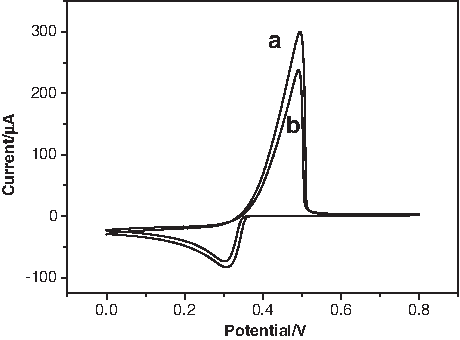
Cyclic voltammograms of GCE
SEM characterization of the sensor construction
As shown in Fig. 2a, DNA-MWCNTs composites are discernible after the suspension was cast on the GCE. The DNA-MWCNTs composites uniformly dispersed on GCE and their surface was quite smoothing. After electrodepositing, many small Ag NPs formed on the DNA-MWCNTs composites and were about 80 nm in diameter (Fig. 2b). In contrast, a few Ag NPs formed on MWCNTs in the absence of DNA (Fig. 2c). The results suggested that DNA-MWCNTs composites provided a medium to produce many Ag NPs on GCE.
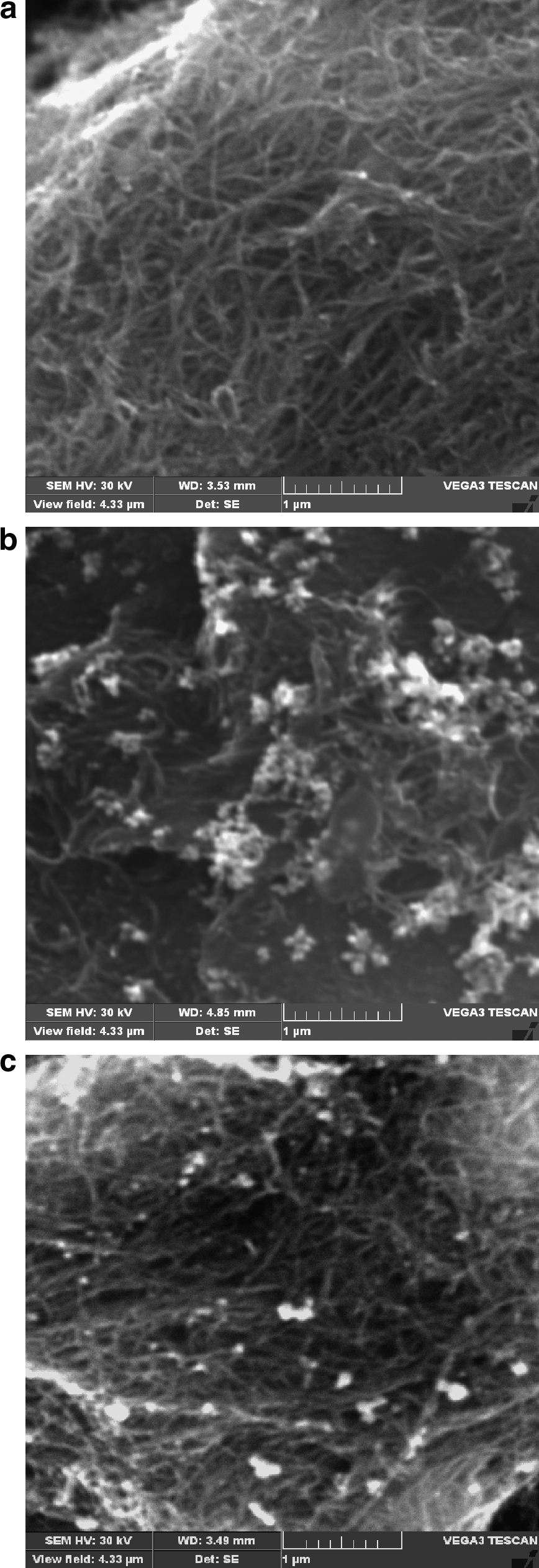
Scanning electron microscopy images of differently modified GCE:
Amperometric response to H2O2
In the presence of 1.0 mM H2O2, an obvious catalytic current appeared for the Ag NPs/DNA-MWCNTs/GCE (Fig. 3e) when compared with that of the absence of H2O2 (Fig. 3a). The peak potentials appeared at −0.47 V and shifted in positive direction compared with that of the Ag NPs/GCE (Fig. 3d). The responses of H2O2 for the bare GCE and DNA-MWCNTs/GCE were obviously weak (Fig. 3b, c). The results showed that the Ag NPs/DNA-MWCNTs/GCE had the remarkable catalytic ability for the reduction of H2O2 and the catalytic current mainly resulted from the Ag NPs electrocatalytic reduction of H2O2.
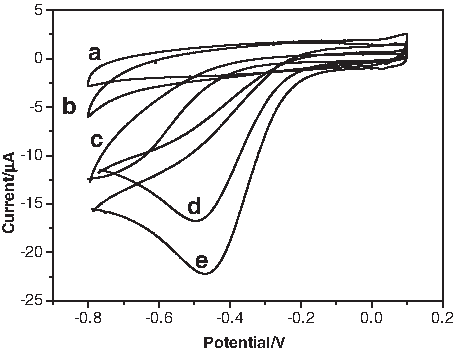
Cyclic voltammograms of different electrodes in 0.2 M PBS (pH 7.0) in the absence
Optimization of experimental variables
The volume ratio of DNA and MWCNTs played a critical role in the formation of Ag NPs and the catalytic ability for the reduction of H2O2. The catalytic current with various volume ratios were achieved as shown in Fig. 4a. There was a remarkable increase in the current response with decreasing the volume ratio and the maximal value occurred at 1:5. After that, the current decreased gradually.
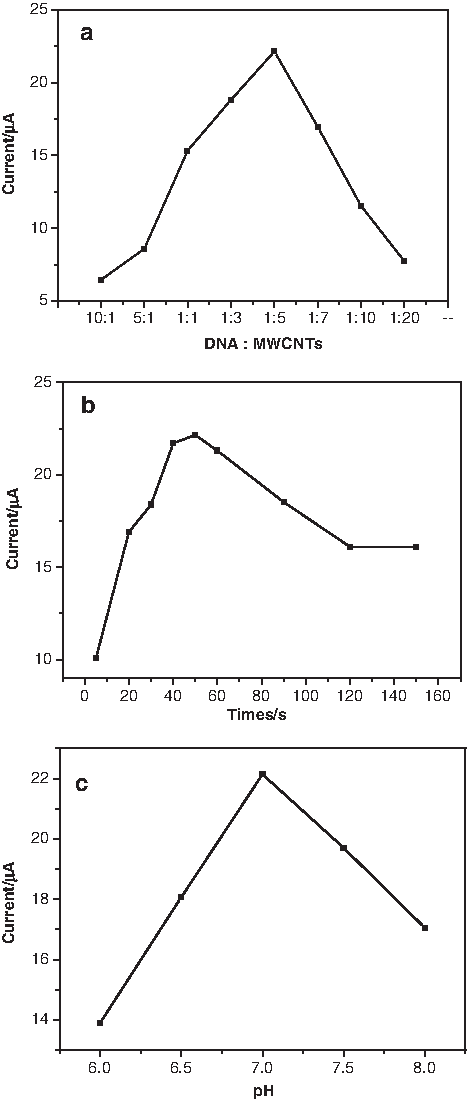
Effects of volume ratio of DNA: MWCNTs
The effect of the electrodeposition time on the electrocatalytic reduction of H2O2 was also studied. Figure 4b showed the electrocatalytic responses of the sensor with different electrodeposition time. The current response increased with electrodeposition time increasing, reaching a maximum value at 50 s. Then, the current response decreased slightly with further increasing the electrodeposition time. This turning point might be due to the fact that Ag NPs would become bigger, which might decrease its electrocatalytic sites.
The effect of pH of PBS on the electrocatalytic response was also investigated. Figure 4c showed the amperometric responses of the sensor in 0.2 M PBS with different pH and 1.0 mM H2O2. The current sharply increased with pH increasing and reached a maximum at 7.0. Then, a decreased value was obtained with increasing pH. Therefore, the PBS with pH 7.0 was selected as the supporting electrolyte.
Chronoamperometric response and calibration curve
The typical current–time curve of the sensor is shown in Fig. 5a. The current rose sharply to reach a maximum value. The linear range of the H2O2 detection was from 5.0 μM to 16.2 mM (r=0.9992; n=17), and the detection limit was estimated to be 3.4 μM based on the criterion of signal-to-noise ratio of 3. The comparison of the parameters of different sensors for H2O2 detection with our results is listed in Table 1, suggesting the resulted sensor exhibited a wide linear range when compared with others.
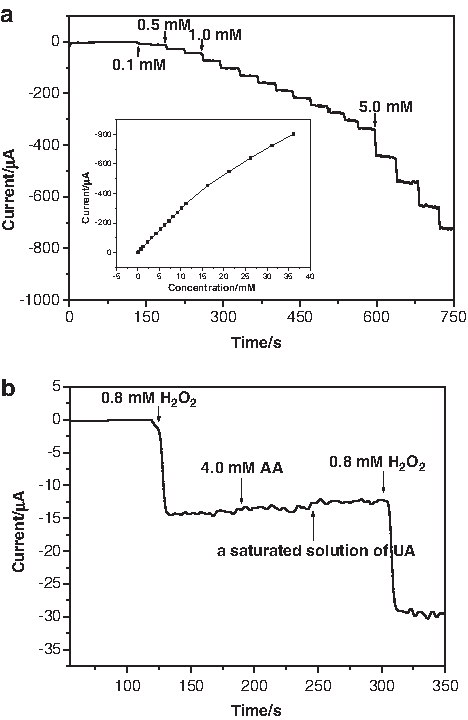
Typical steady-state response of the Ag NPs/DNA-MWCNTs/GCE
Ag NPs, silver nanoparticles; GCE, glassy carbon electrode; DNA-MWCNTs, DNA–multiwalled carbon nanotubes; HRP-DNA-BMIM· BF4/Au, horseradish peroxide-DNA-1-butyl-3-methyl-imidazolium tetrafluoroborate; SWCNT, single-walled carbon nanotubes.
The reproducibility of the current signal for the same electrode and for electrode to electrode was 2.57% and 4.60% (RSD, n=10), respectively. When the electrode was stored in N2-saturated PBS (pH 7.0) for 30 days, there was no obvious change of current in the response to 1.0 mM H2O2.
The selectivity of the sensor was also evaluated (Fig. 5b) and electroactive substances such as ascorbic acid (4.0 mM) and a saturated solution of uric acid had no interference with the detection of 0.8 mM H2O2.
Conclusion
A novel H2O2 sensor based on Ag NPs electrodeposited on DNA-MWCNTs composites–modified GCE was fabricated. Our experiments proved that the Ag NPs electrodeposited on DNA-MWCNTs composites showed good electrocatalytic ability for the reduction of H2O2. When the volume ratio of DNA and MWCNTs was 1:5 and the electrodeposition time was 50 s, the sensor showed the maximal electrocatalytic ability for the reduction of H2O2. The resultant sensor exhibited extremely fast amperometric response, a low detection limit, and a wide linear range to H2O2.
Footnotes
Acknowledgments
This work was financially supported by National Natural Science Foundation of China (20905032, 21065005), Natural Science Foundation of Jiangxi Province (2008GZH0028), Foundation of Jiangxi Educational Committee (GJJ10389), the State Key Laboratory of Electroanalytical Chemistry (2008003), and Scientific Research Foundation for the Returned Overseas Chinese Scholars, State Education Ministry.
Author Disclosure Statement
The authors declare that no conflicting financial interests exist.