




Abstract
Introduction:
Pressurized saline irrigation is commonly used during ureteroscopy, which can cause an increase in intrarenal pressure leading to postoperative pain, sepsis, and renal injury due to pyelovenous and pyelolymphatic backflow. To prevent retrograde stone migration during ureteroscopic lithotripsy, antiretropulsion devices can be deployed, which may or may not protect the kidney against high intrarenal pressures. This study compares the intrarenal pressures generated during the use of two antiretropulsion devices in an ex vivo porcine model.
Materials and Methods:
Using an ex vivo porcine model of the urinary system, flexible ureteroscopy was performed at the proximal, mid, and distal ureter. Intrarenal pressures were measured in the absence and presence of a coil-based antiretropulsion device and a multifold film-based device. Intrarenal pressure measurements were obtained while using saline irrigation at a gravity of 84 cm H2O and pressures of 150 and 300 mm Hg.
Results:
The deployment of a coil device resulted in a significant increase in intrarenal pressures during ureteroscopy with pressurized irrigation when compared with intrarenal pressures without a device. The use of a multifold film device that occluded the ureter during ureteroscopy resulted in a decrease in intrarenal pressures at an irrigation pressure of 300 mm Hg when compared with pressures without a device. In the remaining configurations, the intrarenal pressures were only minimally elevated. When comparing the two devices to each other, the multifold film device had significantly lower intrarenal pressures at each configuration. This has potential implications in preventing renal injury and/or sepsis during ureteroscopy.
Conclusion:
The use of a multifold film antiretropulsion device during ureteroscopy with high-pressure irrigation can potentially protect the kidney from elevated intrarenal pressures.
Introduction
With the use of ureteroscopic lithotripsy, retrograde stone migration and retropulsion can complicate the procedure, resulting in longer operating times and decreased stone-free rates. A variety of devices have been designed to prevent retrograde stone migration during ureteroscopy by occluding the lumen of the ureter proximal to the stone. An additional benefit of these devices may be a decrease in intrarenal pressure from retardation of irrigant flow into the renal pelvis. We sought to compare the intrarenal pressures generated during ureteroscopy with high-pressure irrigation in the absence and presence of various antiretropulsion devices.
Materials and Methods
An intact porcine model of the urinary tract, which included kidneys, ureters, and the urinary bladder, was used for the measurement of intrarenal pressures for this study (Fig. 1). Pressure measurements were obtained using a manometer attached to a 16-gauge angiocatheter placed into the renal pelvis of the porcine kidney. An 8F flexible ureteroscope was advanced retrograde through the ureteral orifices into the ureters and placed at the proximal, mid, or distal ureter. Initially, saline irrigation was provided by gravity drainage from a height of 85 cm, and then pressurized irrigation was used at 150 and 300 mm Hg during this study. At each ureteral location and irrigation pressure, the intrarenal pressure was recorded with and without the presence of an antiretropulsion device. The antiretropulsion devices used in this study included a coil device shown in Figure 2 (Stone Cone®; Boston Scientific, Natick, MA) and a multifold film occlusion device shown in Figure 3 (Accordion®; PercSys, Mountain View, CA). Mean values were calculated and Student's t-test was performed to compare the mean values, using a p-value of <0.05 as significant (Microsoft Excel, Seattle, WA).
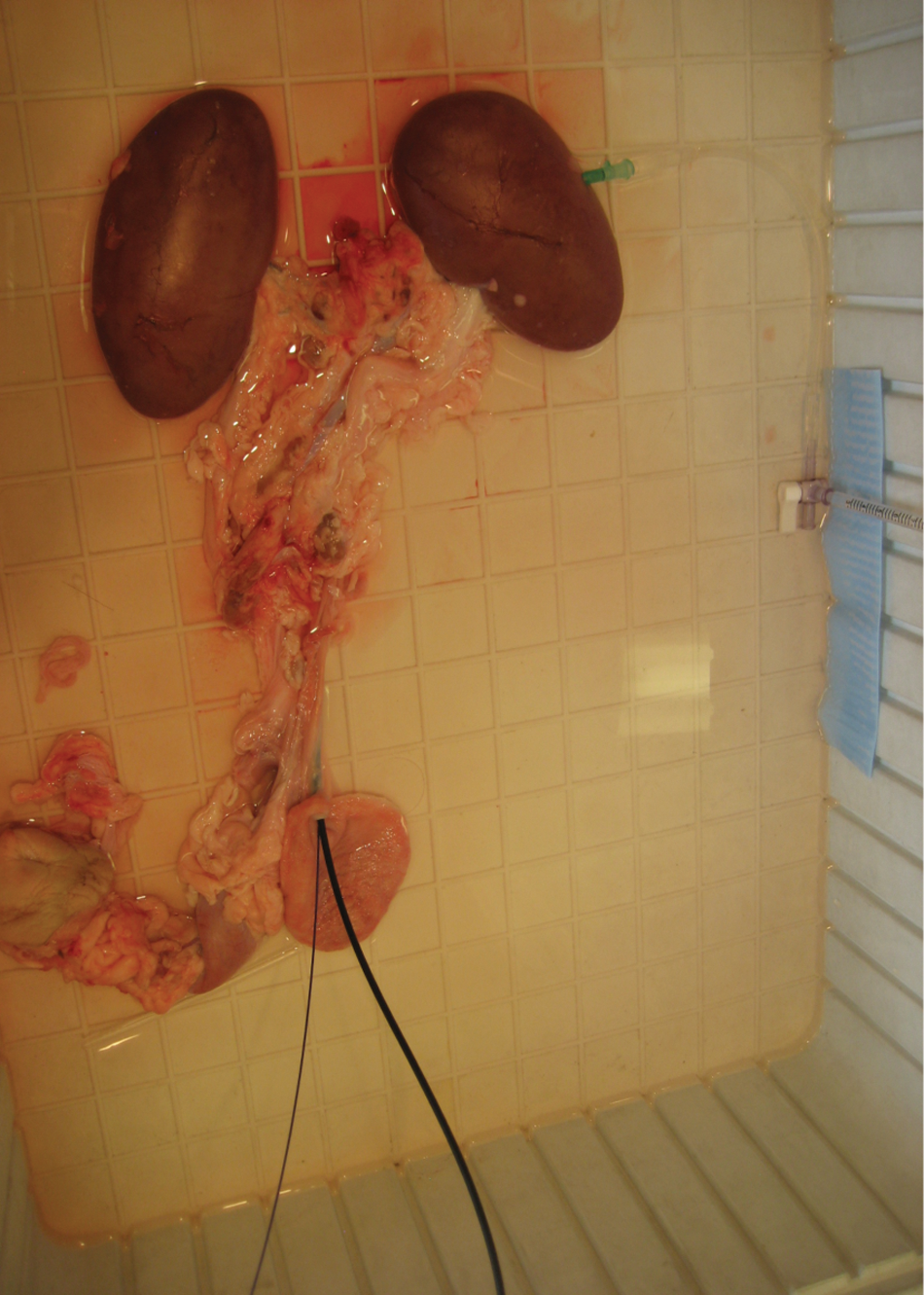
Experimental model with intact porcine urinary tract.

Stone Cone® coil device deployed in the ureter.

Accordion® multi-fold film device (
Results
The mean intrarenal pressures in the absence and presence of two different antiretropulsion devices at each ureteral position and irrigation pressure are shown in Table 1. The deployment of an antiretropulsion device with a coil design resulted in increased mean intrarenal pressures compared with ureteroscopy without a device deployed. This significant increase in intrarenal pressure was seen at each ureteral location and at each irrigation pressure. The use of a multifold film retropulsion device at an irrigation pressure of 300 mm Hg resulted in lower intrarenal pressures when compared with intrarenal pressures without a device (4.70 ± 0.14 vs. 5.48 ± 0.20, p = 0.02 at mid ureter). For the remaining configurations, the deployment of a multifold film device was either not significantly different or only slightly higher when compared with pressures without a device (Table 1).
Compared with mean intrarenal pressures without a device.
Coil device compared with multifold film device.
A comparison of the intrarenal pressures generated during the deployment of a coil device and a multifold film device was performed (Table 1). The deployment of a multifold film device had significantly lower mean intrarenal pressures compared with the coil device at each configuration. At the highest irrigation pressure of 300 mm Hg, the mean intrarenal pressure with the coil device deployed was over two times that observed with the multifold film device deployed (12.95 ± 1.06 vs. 6.07 ± 0.23, p = 0.03 at the proximal ureter location).
Discussion
Although pressurized irrigation during ureteroscopy provides improved visibility during the procedure, it is well established that this benefit comes at the cost of elevated renal pelvic pressures. 4,5 Varying techniques and methods have been used during ureteroscopy in an attempt to reduce intrarenal pressure and the detrimental consequences of elevated pelvic pressures. Studies have shown that the use of a ureteral access sheath during flexible ureteroscopy can reduce intrarenal pelvic pressure. 2,6 A recent randomized, controlled study demonstrated that pharmacologic modulation of the ureter with intraluminal isoproterenol (β-agonist) could reduce pelvic pressure. 7 However, to the best of our knowledge, nobody has investigated intrarenal pressures while using antiretropulsion devices that prevent stone migration.
Our results show that the use of a coil antiretropulsion device resulted in elevated intrarenal pressures in each configuration. The spiral coil design may contribute to the elevated intrarenal pressures by readily allowing irrigation fluid to pass through the coil into the renal pelvis while perhaps impeding the return of fluid. This accumulation of renal pelvic fluid could lead to increased intrarenal pressures seen in this study. In contrast, our study also found that the use of the multifold film device resulted in a reduction in intrarenal pressures at an irrigation pressure of 300 mm Hg and only minimal increases for the remainder of the configurations. This result could be explained by the complete occlusive nature of the multifold film device, which could be preventing the flow of irrigant fluid proximal to the device while it is deployed. Thus, it prevents the accumulation of fluid in the renal pelvis and transmission of the pressure from the working area of the ureter to the renal pelvis.
There are recognized limitations to our study. This study used an ex vivo porcine model of the urinary tract system, such that the ureter is no longer undergoing peristalsis and its compliance may be altered from the in vivo conditions. In addition, this study was performed in a normal caliber ureter in which the devices were able to adequately occlude the ureter proximal to the ureteroscope. Clinically, a hydronephrotic ureter is often encountered, in which the deployment of one of these antiretropulsion devices is not able to adequately occlude the lumen, allowing for irrigant to flow into the renal pelvis and causing potential changes to intrarenal pressure. Also, this study was performed without the use of a ureteral access sheath, which has been shown to reduce intrarenal pressures. The results of this study can only be translated to the use of antiretropulsion devices without a ureteral access sheath and when the calculus is in the ureter.
The results of this study present a novel method to prevent intrarenal pressure increases during ureteroscopy, while having the benefit of preventing retrograde stone migration. The use of a multifold film antiretropulsion device during ureteroscopy, which occludes the ureter, can potentially protect the kidney from elevated intrarenal pressures and its sequelae. This has potential implications in preventing renal injury and/or postoperative sepsis during ureteroscopy, which warrant further studies to be performed under in vivo conditions.
Conclusions
The use of a multifold film antiretropulsion device during ureteroscopy with high-pressure irrigation can potentially protect the kidney from elevated intrarenal pressures.
Footnotes
Disclosure Statement
No competing financial interests exist.