




Abstract
Background and Purpose:
With widespread implementation of posterior rhabdosphincter reconstruction (RSR) followed by urethrovesical anastomosis (UVA), reconstruction has become a significant portion of robot-assisted laparoscopic prostatectomy (RALP). Successful anastomosis can be measured by time for reconstruction and the absence of urinary leak. We prospectively evaluated the experience of a single surgeon (KKB) in using the V-Loc™ wound closure device for the posterior RSR and UVA, and compared it with a standard reconstruction and anastomosis.
Patients and Methods:
A total of 84 patients divided into two groups underwent RALP, undergoing RSR and UVA using a Van Velthoven technique with the V-Loc or with a standard 3-0 monofilament suture. The primary end point was the time to complete RSR, UVA, and the total reconstruction. As a secondary end point, the clinical evidence of an anastomotic leak was also documented.
Results:
The mean RSR, UVA, and total times were 9, 18, and 27 minutes for the control group, and 6, 12 and 18 minutes for the V-Loc group, respectively. The time differences between the two groups for RSR, UVA, and total time were 3 minutes (P<0.01), 6 minutes (P<0.01), and 9 minutes (P<0.001), respectively. There was no clinical evidence of anastomotic leak in either group. Continence recovery was equivalent between the groups at 6 weeks and 6 months. At a 9-month follow-up, no patients in either group had a clinical UVA stricture necessitating intervention.
Conclusions:
The V-Loc suture is associated with a significantly shorter time for the RSR and UVA compared with the traditional suture and is not associated with a higher incidence of clinical urinary leak; however, a larger randomized study with long-term follow-up is necessary to confirm these results.
Introduction
The most common technique used for the RSR has been described previously. 3 Briefly, after prostate extirpation, the free edge of the Denonvillier fascia is approximated to the posterior rhabdosphincter/median raphe using a running suture. The posterior bladder just superior to the bladder neck is then apposed to the Denonvillier fascia-posterior rhabdosphincter/median raphe complex. 3 The UVA is subsequently completed with a suspended running suture technique using the Van Velthoven principle. 4 Both steps need continuous traction by an assistant or repeated tightening of the suture by the surgeon to avoid suture slippage and unraveling. Reconstruction now takes a larger role in this procedure, and steps to make these steps safe and efficient would decrease overall time of the procedure.
Urine leaks have been reported to be as high as 6.8% at high-volume centers. 5 Leaks may result in clinical sequelae, such as postoperative ileus, infection/sepsis, and bladder neck contracture. 6 In addition, persistent urinomas may delay the time of removal of a pelvic drain and extend the patient's hospital stay.
The V-Loc™ Wound Closure Device (Covidien, Mansfield, MA) is a monofilament polyglyconate (copolymer of glycolic acid and trimethylene carbonate), unidirectional barbed self-anchoring suture (Fig. 1). Barbed sutures have been studied extensively in the plastic and reconstructive surgery literature. 7 –10 The initial application of barbed sutures in the field of urology was reported during laparoscopic pyeloplasty. 11 V-Loc sutures are unique among barbed sutures in that the design includes a loop on the free end through which the suture is passed, allowing for knotless security during the initiation of the posterior RSR and UVA. Similarly, knot tying is not needed to secure the anastomosis when stitching is complete. This is a key feature, because the knot is the site at which sutures are most likely to fail as a result of local stress when under tension. 12
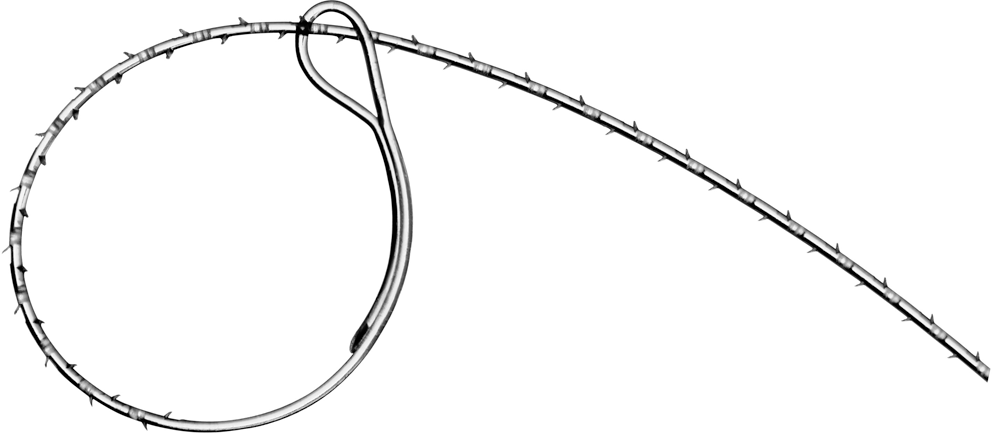
V-Loc™ Wound Closure Device; monofilament polyglyconate unidirectional barbed self-anchoring suture. Copyright© 2010 Covidien. All rights reserved. Used with the permission of Covidien.
Given the apparent advantages of the V-Loc suture, the purpose of this study was to determine the feasibility and efficacy of the V-Loc suture for RSR and the UVA during RALP. We prospectively evaluated the experience of a single fellowship-trained surgeon (KKB), with experience of more than 1000 procedures, in using the V-Loc wound closure device for the posterior RSR and UVA, and compared it with a standard reconstruction and anastomosis. This report is one of few on the use of barbed suture during RALP with follow-up beyond that of the perioperative period.
Patients and Methods
Forty-two patients underwent RALP using the V-Loc wound closure device for the posterior RSR and the UVA. A control group comprised 42 patients—24 consecutive patients just before and 18 patients concurrently with the V-Loc group—who underwent a standard RALP with 3-0 monofilament for the RSR and UVA. Although the patients were not randomized to each arm, the selection of suture was not made based on any clinical factors but on availability of the suture for the pilot group.
Robot-assisted procedures were performed using the da Vinci® S™ Surgical System (Intuitive Surgical, Sunnyvale, CA) using a transperitoneal approach. Prostate extirpation was completed in standard fashion. The UVA and RSR were then performed using either a 3-0 monofilament as previously described or the V-Loc suture. RSR was performed following the technique described by Coelho and associates. 13 In the study group, a single barbed suture was knotlessly initiated and used to approximate the Denonvillier fascia to the posterior rhabdosphincter. The suture was then cut without tying a knot. A knot is used at the outset of the second layer, because the barbed suture remnant from the first layer is reused and the loop on the free end is thereby lost. No knot is used, however, on completion of the second layer.
The UVA was performed using two 6" V-Loc sutures and is completed with a standard Van Velthoven (running) technique. 4 Both sutures were anchored with a knotless initiation and were run separately during the anastomosis. On completion, the sutures were tied together to ensure a durable watertight closure. The RSR and anastomosis in the control group were performed in the same manner using 3-0 monofilament sutures. Both the RSR and UVA need two 6" sutures (one dyed and one undyed) tied together at the distal end.
On completion of the UVA, a Foley catheter was passed into the bladder, and the bladder filled with 120 mL of sterile saline while under direct visualization. Just before robot undocking, a Jackson-Pratt (JP) drain was placed in the pelvis.
The primary outcome measured was time to perform both the RSR and UVA individually and the total time needed to perform the reconstruction. Secondary outcomes measures included clinical urinary leak defined as either the leakage of saline during intraoperative filling or a postoperative increased JP output confirmed by an elevated JP fluid creatinine level. Logistical regression analysis was performed to compare time for the RSR and UVA as well as the total time for the reconstruction.
Results
A total of 42 patients successfully underwent RALP in each group. There was no difference between groups in terms of age, prostate-specific antigen level, or clinical stage. In the control group, the mean time for RSR was 9 minutes (range 6–19 min) while the mean UVA time was 18 minutes (range 11–28 min). Accordingly, total time for completion was 27 minutes. In the V-Loc group, the mean time for RSR was shorter at 6 minutes (range 5–16 min), and the mean time of anastomosis was also shorter at 12 minutes (range 8–18 min), both significantly shorter than the control group. Total time for completion in the study group was 18 minutes. The time difference between the control and study groups needed for the RSR, UVA, and total completion were significant at 3 (P<0.01), 6 (P<0.01), and 9 (P<0.001) minutes, respectively (Table 1).
Copyright© 2010 Covidien. All rights reserved. Used with the permission of Covidien.
RSR=rhabdosphincter reconstruction; UVA=urethrovesical anastomosis.
None of the sutures broke or tore through either the urethra or the bladder neck. The bladder neck was routinely spared in these procedures, and reconstruction was performed in 32% of the control group and 28% of the V-loc suture group. We did not include bladder neck reconstruction because it was the same technique before UVA in both groups and therefore did not influence time. No anastomotic leak was noted intraoperatively or during subsequent follow-up in either group. Mean indwelling Foley catheter duration was 7 days (range 6–12 d).
Continence recovery was equivalent between the two groups, defined as 0 pads usage per day. In the control group, continence recovery was 48% at 6 weeks and 84% at 6 months. In the V-Loc group, 52% had recovered continence by 6 weeks and 88% by 6 months. At a mean follow-up of 9.4 months (range 7–13 mos), no patients in either group had a clinical UVA stricture necessitating intervention. There were no other noted complications, including stone formation, erosion of suture, or disruption of anastomosis.
Discussion
While the barbed suture was first described by Mansberger and colleagues, 14 its introduction into the field of urology is fairly recent. 9 Its initial use in robot-assisted prostatectomy was reported in 2010 by Williams and coworkers 15 who found that compared with traditional sutures, barbed polyglyconate sutures were associated with a shorter mean anastomosis time of 9.8 vs 9.7 minutes (P=0.014). While statistically significant, the clinical significance of the time difference is debatable. In a second study by Kaul and colleagues, 16 however, a 25% reduction in time to complete the UVA with the barbed suture was noted, suggesting that time saved may be surgeon or technique dependent.
Our technique differs from that of Kaul and associates 16 in that our closure with the barbed suture more closely resembles the classic suspended Van Velthoven anastomosis, while they pass each suture through the loop of the neighboring suture, thereby creating a single, bidirectional barbed suture. The technique also differed in that Kaul and coworkers 16 used an assistant to stabilize the monofilament suture in between needle passes and did not use an assistant with the V-Loc group. This difference alone could potentially affect time outcome. Our study did not use an assistant in either group, making a more direct comparison. We achieved a 33% reduction in time for RSR, UVA, and total time, which is comparable to their results.
The presence of clinical urinary leak is the primary outcome that may be used to determine the short-term efficacy of the procedure. Although not a primary end point of our study, urinary leak did not occur during the intraoperative period or during the postoperative period in any of the patients, suggesting equivalency. A report of the use of the V-Loc by Tewari and coworkers 17 does not mention the use of direct visualization, with instillation of sterile saline after the UVA, to look for leaks, which may change intraoperative management. 17 Kaul and colleagues 16 documented no evidence of anastomotic leak using the barbed suture after performing postoperative cystography on postoperative day 7. Williams and associates 15 reported a higher rate of extravasation (27.6%) in the barbed polyglyconate suture cohort on postoperative cystography; however, after modification of technique to avoid overtightening, there was only a single case of documented extravasation. 15
In this study, as is our clinical practice, we did not perform cystography before catheter removal. All patients did have a pelvic drain placed at the end of the procedure, and outputs were measured overnight.
In looking at the results of this study, it is important to recognize that the procedures were completed by a single surgeon with extensive experience with robot-assisted prostatectomy. The difference in time between traditional suturing and barbed polyglyconate suture closure was significantly faster using the V-Loc, suggesting that novice robotic surgeons may derive an even greater benefit from this technology. In our experience at an academic training center, no stitch was placed incorrectly necessitating it to be backed out; however, if this were to be the case, rather than pull back on the stitch, the suture would need to be cut and a new V-Loc suture used. While this would increase the procedure time, it occurs so rarely that over the course of many cases, the V-Loc suture would still likely be faster than monofilament.
Because the use of barbed suture in this setting is relatively new, there has been a paucity of reports on the follow-up beyond that of the perioperative period. The extended dissolve time of the V-Loc suture (120 days) exposes the patient to the potential risk of stone formation or foreign body inflammatory response. In addition, because barbed suture can be tensioned without any degree of expected relaxation, there is a theoretical concern of anastomotic strangulation with subsequent localized ischemia that can result in bladder neck contractures. In the current series, after a mean follow-up of more than 9 months (range 7–13 mos), symptoms of foreign body calcifications associated with the use of barbed or monofilament suture did not develop in any patient in either group. Furthermore, there have been no clinically detected bladder neck contractures in the cohort. While longer follow-up is necessary to confirm these findings, these results are very encouraging.
With regard to continence rates, the current study found equivalence between the study and control groups at 6 weeks (52% and 48%, respectively) and at 6 months (88% and 84%, respectively). Although continence rates in both groups will continue to improve at longer follow-up, it is reasonable to assume the use of barbed suture for the RSR and the UVA does not affect continence.
There are several limitations in the study. The first is the use of a mixed consecutive model rather than a formally randomized model. While ideally a prospective randomized study would provide a higher level of evidence by eliminating selection bias, there were no preset selection criteria beyond suture availability. In addition, both groups demonstrated no preoperative differences in typically compared metrics. Overall, this suggests that both groups were likely equivalent, and the results were not significantly affected by selection bias. A second limitation is the reliance on clinical indicators for the development of bladder neck contractures and foreign body reaction. The use of postoperative cystoscopy at various follow-up intervals would provide absolute evidence of both. Conversely, in the patient with no symptoms, the cystoscopic finding of a tight bladder neck would likely go untreated until the commencement of bothersome symptoms. This suggests that the development of clinical evidence of foreign body reaction and bladder neck contracture is a legitimate end point on which to base a conclusion.
Conclusions
The V-Loc barbed polyglyconate suture was associated with a significantly shorter time for posterior RSR and UVA compared with traditional suture and was not associated with a higher incidence of clinical urinary leak. In addition, in the short term, the use of barbed suture does not appear to cause an increased rate of bladder neck contractures or foreign body reactions after RALP. Continence rates after RALP using barbed suture are equivalent to RALP with traditional monofilament suture at 6 weeks and 6 months. A larger prospective randomized study with long-term follow-up is necessary to confirm these results and determine the true efficacy and safety of this technique.
Footnotes
Disclosure Statement
No competing financial interests exist.