




Abstract

Croes Council
Jean de la Rosette, M.D.
Amsterdam (The Netherlands)
Adrian Joyce, M.S.
Leeds (UK)
Stavros Gravas, M.D.
Larissa (Greece)
Margaret Pearle, M.D.
Dallas, TX (USA)
Dean Assimos, M.D.
Wake Forest, NC (USA)
Ying-Hao Sun, M.D.
Shanghai (China)
Tadashi Matsuda, M.D.
Osaka (Japan)
Treasurer
John Denstedt, M.D.
London (Canada)
Office Manager
Sonja van Rees Vellinga
Amsterdam (The Netherlands)
Mission
Through worldwide collaboration, CROES seeks to assess, using evidence based scientific methodology, the various aspects of clinical endourology.
Vision
By applying rigorous scientific evaluation to the field of clinical endourology, CROES will enable all urologic surgeons to bring to their patients the most effective and efficient care possible.
Projects
Global PCNL study
Global URS study
Global Greenlight Laser study
Global Renal Mass study
Global NBI study
Contact
For more information please contact Sonja van Rees Vellinga (
News from the Publication Office of Croes
Jean de la Rosette and Stavros Gravas
The Clinical Research Office of the Endourological Society aims to promote and support high quality international patient-centered research in a transparent way. At present, 5 studies are in progress or under evaluation and CROES recognizes the importance of the communications derived from the different studies. The Global PCNL observational study was the first one launched and at present data from 5,803 patients treated in 96 centers is being analyzed. The dataset provides significant insight on academic and community practice and covers all spectrums from high- to more restricted volume centers. These data allow us to assess the current indications, perioperative morbidity and stone-free outcomes for percutaneous nephrolithotomy worldwide. Acomplete overview of the different topics for analysis is presented on the CROES website:
The CROES Council recognizes the importance of these communications as well as the active involvement and recognition of the participating centers. Therefore, guidelines for publications have been prepared in order to secure in a transparent way the recognition of participating sites in publications and presentations. 1 The publication guidelines will allow each site to be involved in one or more publications and/or presentations. Therefore, CROES has established a Publication Office including a professional team to support the preparation of manuscripts, posters and powerpoint presentations. This Publication Office coordinates the different projects, communicates with the authors involved in the preparation of a manuscript, prepares figures and graphs, identifies early any delays in papers' preparation in order to secure the unobstructed and timely flow of data publication, communicates with the Editorial Office of the different Journals and guards the guidelines of publications set forth by CROES.
Data sharing is essential for expedited translation of research results into knowledge, products and procedures to improve human health. CROES is aware that data sharing may be complicated in some cases by institutional policies, local Internal Review Board (IRB) rules, and national laws and regulations. Three other projects were launched in early January 2010; they are still open for those centers that are interested in participating, and recruitment is ongoing. 2,3,4 Interestingly, these studies have been very well received and, for example, in the Global URS study nearly 100 sites have included almost 4,000 cases. In Figure 1 the cumulative recruitment is presented. Figure 2 displays the number of patients included per site until now. We aim to share these data with you on the CROES website to keep you updated on the progress of each project.
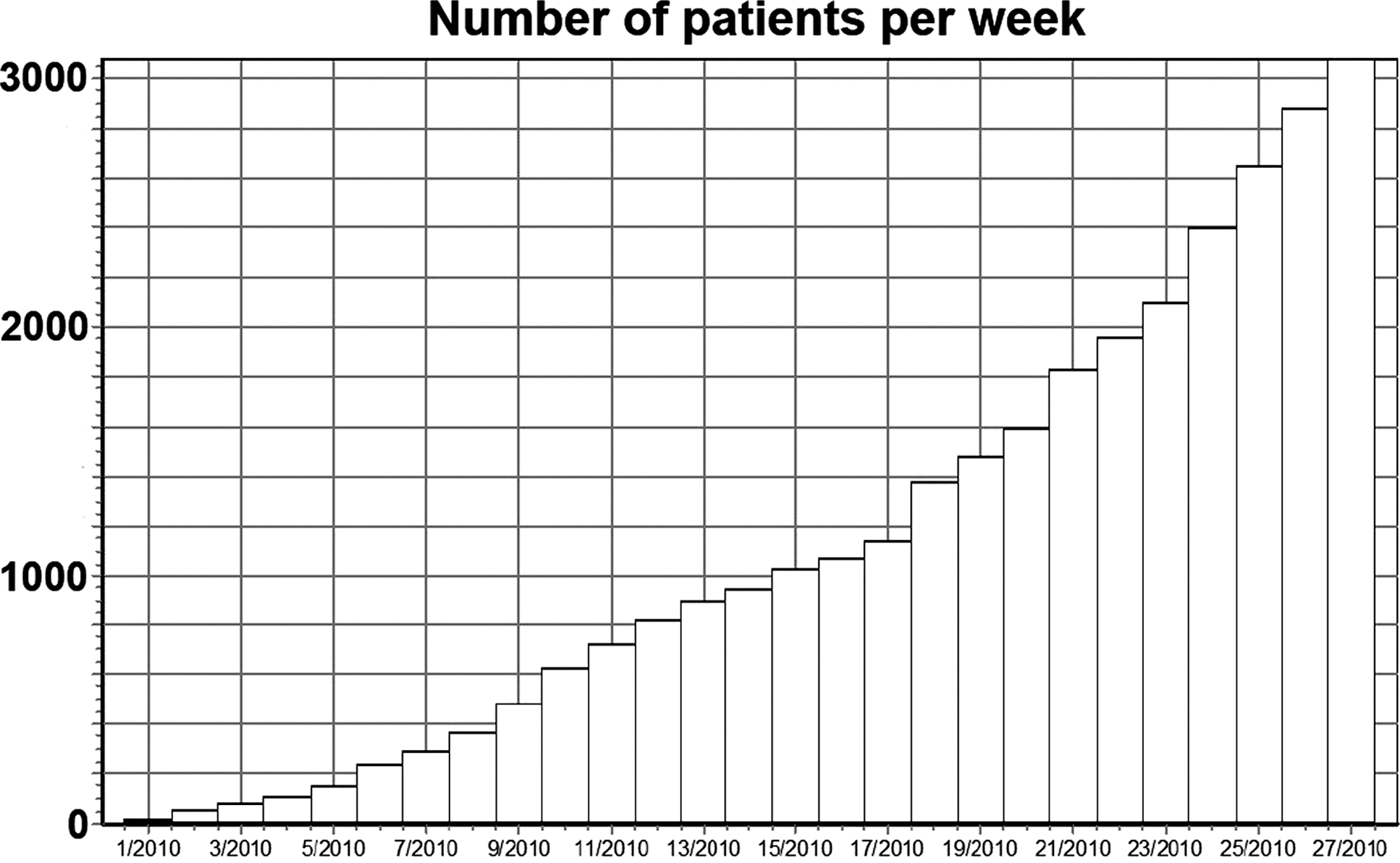
Cumulative number of patients included in the Global Ureteroscopy (URS) study.
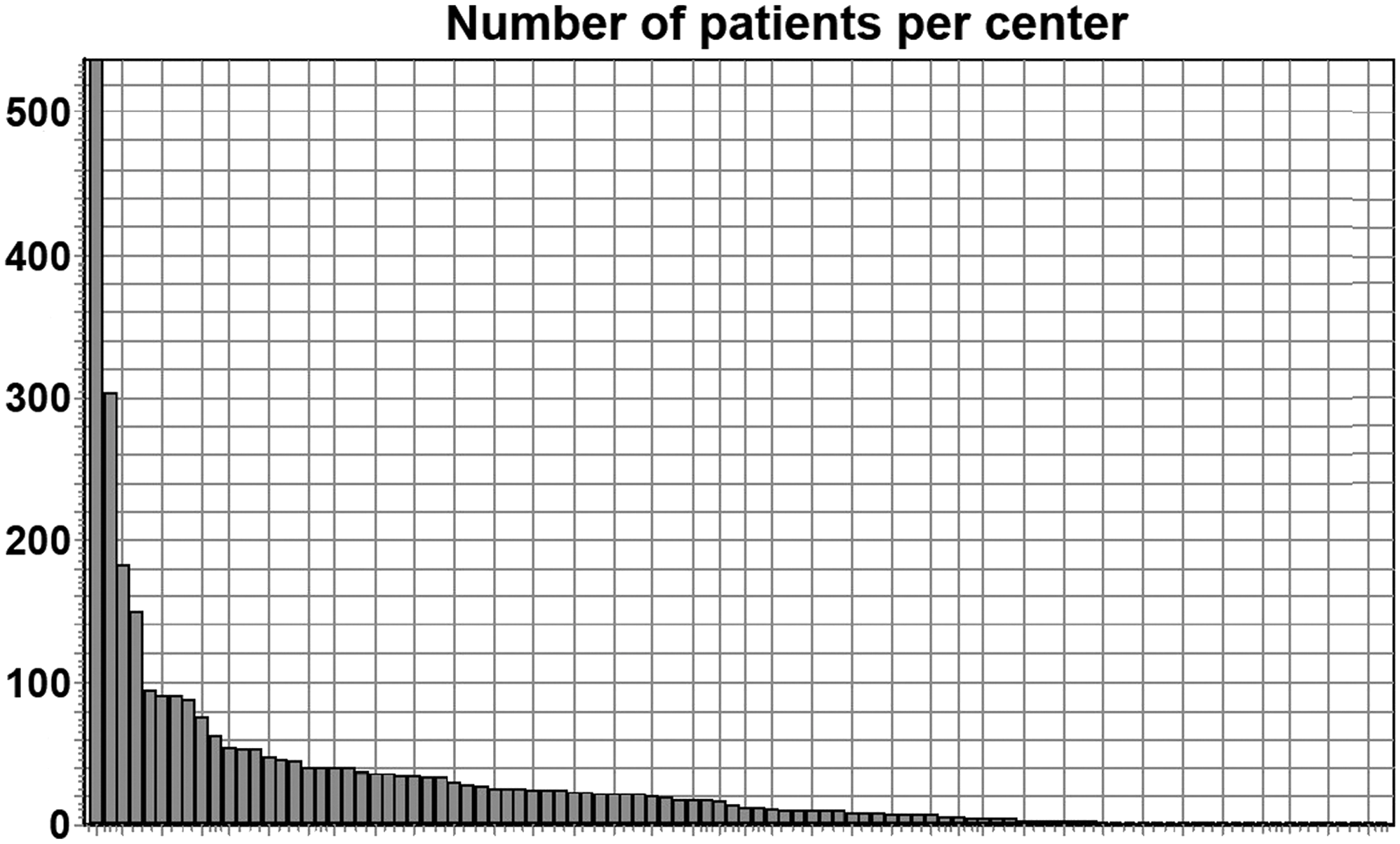
Number of included patients per center.
Finally, we gladly announce the launch of the first randomized study, comparing the use of narrow band imaging (NBI) in addition to white light cystoscopy in the treatment of non-muscle invasive bladder cancer. Nearly 40 centers worldwide have accepted the challenge and will randomize their cases according to a strict inclusion protocol during a one year period. 5 This milestone project is both important for CROES as well as for the supporter: OLYMPUS. It will open new avenues in endourological research. Since CROES projects need long-term cooperation between the different players involved, it is essential to reach a mutual robust commitment that will secure the ethical and scientific integrity of clinical research globally, resulting in the absolute best, least invasive, quality of care for all patients.
We are proud to confirm that the response from many of you participating in the projects is warm and full of enthusiasm. We have been realizing in the past year that becoming a member of the global endourology platform called CROES is highly appreciated. At the end of each study, the participants receive a Certificate of Contribution in recognition of their altruistic contribution to international clinical research in the field of endourology and emerging technologies (Fig. 3). This certificate acknowledges the importance of their work.

Example of Certificate of Contribution in the Global PCNL Study. PCNL=percutaneous nephrolithotomy.
The activities of the CROES Publication Office include providing updates on all activities in a timely manner. Please feel free to let us know your feedback or suggestions to further improve our work. CROES clearly states its philosophy: “The time is now—with CROES, the ability is yours.” 6