




Abstract
Purpose:
To report the feasibility and the safety of a surgeon-controlled robotic endoscope holder in laparoscopic surgery.
Patients and Methods:
From March 2010 to September 2010, 20 patients were enrolled prospectively to undergo a laparoscopic procedure using an innovative robotic endoscope holder. Two surgeons performed six adrenalectomies, four sacrocolpopexies, five pyeloplasties, four radical prostatectomies, and one radical nephrectomy. Demographic data, overall setup time, operative time, number of assistants needed were reviewed. Surgeon satisfaction regarding the ergonomics was assessed using a 10-point scale. Postoperative clinical outcomes were reviewed at day 1 and 1 month postoperatively.
Results:
The per-protocol analysis was performed on 17 patients for whom the robot was effectively used for surgery. Median age was 63 years; 10 (59%) patients were female. Median body mass index was 26.8. Surgical procedures were completed with the robot in 12 (71%) cases. Median number of surgical assistant was 0. Overall setup time with the robot was 19 minutes; operative time was 130 minutes during which the robot was used 71% of the time. Mean hospital stay was 6.94±2.3 days. Median score regarding the easiness of use was 7. Median pain level was 1.5/10 at day 1 and 0 at 1 month postoperatively. Open conversion was needed in one (6%) case, and four minor complications occurred in two (12%) patients.
Conclusion:
This use of this novel robotic laparoscope holder is safe, feasible, and provides good comfort to the surgeon.
Introduction
Our group developed a robotic lightweight endoscope holder that is now marketed by the company Endocontrol™ under the name ViKY.®2 Previous cadaveric studies have shown the feasibility of the robot's use. 3 ViKY obtained European Community marking in 2007 and Food and Drug Administration approval in 2008. 2 The first use of the robot occurred in our institution on July 5, 2007. The first procedure was a bilateral pelvic lymph node dissection in the context of high-grade prostate cancer previous to external beam radiotherapy.
The aim of this pilot study is now to assess the feasibility and the safety of this innovative medical device in different urologic surgical indications. We present the results of the first clinical trial performed with this VIKY robot before a bicenter randomized clinical study.
Patients and Methods
Study design
From March 2010 to September 2010, all the patients scheduled for a laparoscopic procedure in two institutions (Grenoble University Hospital and Saint-Etienne University Hospital) were proposed to enroll in the study. The clinical trial was approved by the French Ethical Committee CPP Sud-Est V. Exclusion criteria were: Age <18 years, pregnancy, and inability to sign the informed consent. Informed consent was obtained from 20 patients. All data were recorded in a case record form that was specifically designed for this study.
Surgery description
Two laparoscopic surgeons (one in Grenoble and one in Saint-Etienne) performed robotic surgeries for different clinical indications: Adrenalectomy, acrocolpopexy, pyeloplasty, radical prostatectomy, and radical nephrectomy. Nevertheless, before the start of this study, the surgeon had to perform three surgeries using the robot, which gave him some experience in manipulating the robot. All the procedures used a transperitoneal approach.
Robot description
The robot used in this trial consists of a compact motorized scope holder placed directly on the patient's abdomen (Figs. 1 –3). Its architecture is based on a rotating circle. It is attached to the rail of the operating table using an articulated arm to improve the steadiness and the stability of the image. The endoscope manipulator is sufficiently small (110 mm in diameter) to be placed directly on the patient without interfering with other handheld instruments during minimally invasive surgery. It is 75 mm high, and its weight is 625 g. The robot motors provide three degrees of freedom: Two rotations that allow exploration of the entire abdominal cavity and translation that allows the endoscope to get closer to or further from the organs. It can be attached to any types of endoscopes and trocars. The robot is submersible and autoclavable. A console, which contains motor controllers and software, analyzes the surgeon's orders and translates them to commands for motors. It contains a touch panel screen for user interface.
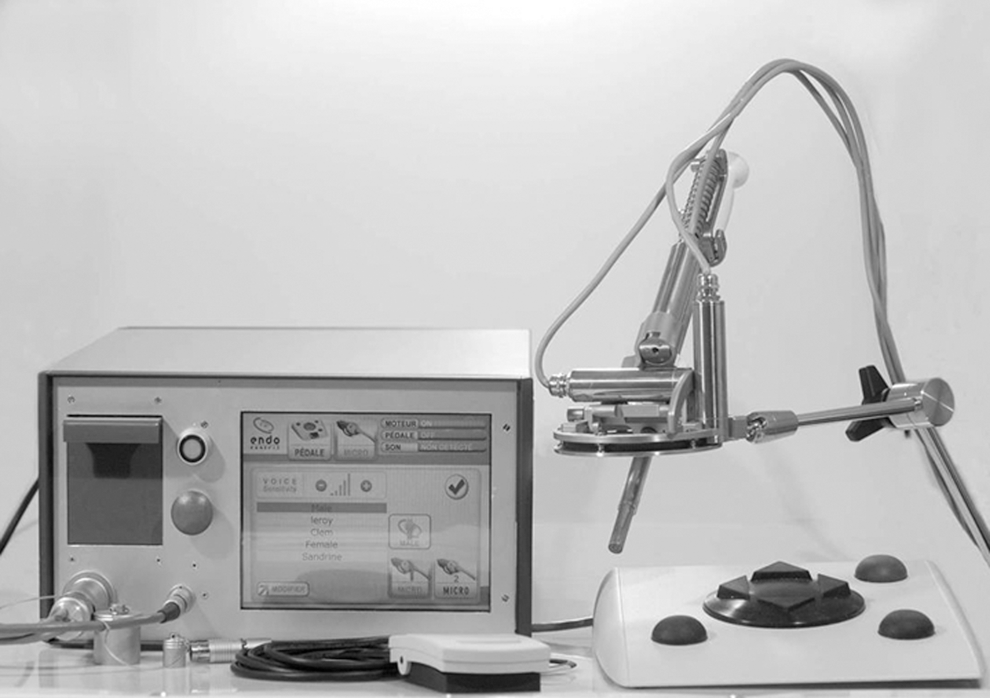
The robotic system, including the console, the robot, and the pedal.
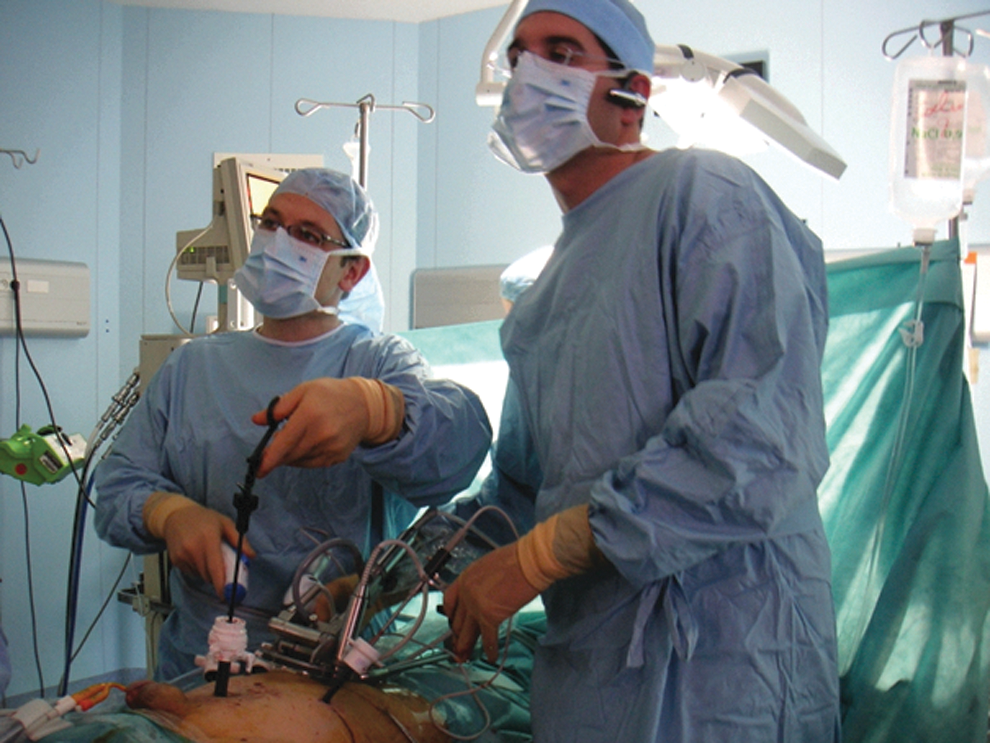
The robotic system in use. Note the headset device that allows voice recognition.

The robot in the operative field.
The system is controlled either by voice (Bluetooth microphone supervised by a single foot switch for security) or foot (six-function foot switch). The motors are back-drivable to allow manual repositioning. Although the robot had been created for use with the patient in the dorsal supine position, it had the ability to extend the potential positions to include the lateral position.
Data assessment
Demographic data were recorded. Setup time, including port placement and all the procedures until robot docking, was reviewed as well as operative time, dismantling time, and length of hospitalization. Any robot technical problems or breakdown, manual completion, or open conversion were recorded. After completion of each procedure, the surgeon's satisfaction was evaluated using a self–10-point scale to assess easiness of use, overall comfort, quality of vision, and steadiness of image. Complications were separated as intraoperative or postoperative. The latter were classified according to the Clavien-Dindo classification. 4 Postoperative pain was evaluated using a 10-point scale the day after surgery and 1 month after. We also used the painkiller records to evaluate the pain. Data were expressed as median and interquartile range (IQR) or mean±standard deviation in case of normal distribution. The descriptive statistical analysis was performed with GNU R software, version 2.13.
Results
Study population
Although 20 patients were enrolled in this clinical study, only 17 were involved in a robot-assisted surgery: One patient changed his mind before the surgery with a withdrawal of his consent (Grenoble); for another patient, a material malfunction of the robot was preoperatively identified during the automatic function check (hands-free headset problem) so that the robot could not be used during the surgery with a combination of the voice and foot, as wanted by the surgeon (Grenoble); last, the robot was not used in one case because of a difficult adhesiolysis necessitating human help (Saint-Etienne). Per-protocol analysis is then performed on 17 patients for whom the surgery was effectively performed with ViKY.
Patient description
Demographic data are summarized in Table 1. Median age was 63 years (IQR 58–70). Ten patients were female (59%). The median preoperative body mass index was 26.8 kg/m2 (IQR 25-–28).
IQR=interquartile range; BMI=body mass index; ASA=American Society of Anesthesiologists.
Surgery description
Two laparoscopic surgeons performed 17 robot-assisted surgeries: 2 sacrocolpopexies, 1 pyeloplasty, 2 radical prostatectomies, and 1 radical nephrectomy were performed in Grenoble. Six adrenalectomies, one sacrocolpopexy, and four pyeloplasties were performed in Saint-Etienne.
Operative data
As summarized in Table 2, the median operative time was 130 minutes (IQR 110; 204) with a median overall setup time (including the robot setup) at 19 minutes (IQR 16; 25); ie, 14.6% of the whole operative time. As illustrated in Figure 4, this setup time seems to be different according to the surgical indication, especially for the radical prostatectomy, which needed a manual step for peritoneal incision and bladder detachment. Furthermore, because the same surgery is performed two times in a consecutive way, we observed a median time gain of 4.5 minutes; ie, a relative gain time of 23%. The median assistant number was 0 per intervention (IQR 0–1).

Setup time, including port insertion and previous dissection to docking.
Data are expressed as median (interquartile range) or mean±standard deviation or frequency (%).
Although the robot has fulfilled its role in 17 surgeries, 5 (29%) were not completed in their totality with the robot: A malfunction of the voice control occurred, necessitating interruption of the robot-assisted surgery, and four were interrupted because the surgical conditions necessitated the help of a human assistant. After a robot-assisted pyeloplasty, one conversion to open surgery was performed to redo a pyeloureteral anastomosis. In 13 (77%) procedures, the robot was voice controlled, whereas it was pedal and voice controlled in 4 surgeries.
Robot dismantling took a median time of 2 minutes (IQR 1–4). The dismantling time seems to be linked to the surgical staff that uses the medical device (Figs. 5A, B, which illustrate different trends between Grenoble and Saint-Etienne). One intraoperative complication occurred that was not because of the robot (pyeloureteral anastomosis leakage).

Dismantling time:
Postoperative outcomes
Four grade II complications 1 occurred in two (12%) patients: A patient had acute prostatitis associated with a hematoma after an adrenalectomy and another one had a bacteremia after a urinary leakage. Patients were discharged from the hospital after a mean of 6.94 days±2.3 days. No skin damage was observed.
Surgeon satisfaction
The score of easiness of use was 7 (IQR 4–9), global comfort was 7 (IQR 5–8), quality of vision was 9 (IQR 7–9), and steadiness was evaluated as 10 (IQR 8–10).
Discussion
Among robots available for laparoscopic surgery, endoscope holders are designed to provide a steady, tremor-free image and better visualization during the entire surgical procedure. 5 Surgeons themselves can direct their optical field, while the robot allows precise voice-activated, hand or foot control of the robotic camera holder.
ViKY robot had been designed by our group. This robot had been successfully validated through preclinical trials that showed the feasibility of the system in terms of work space as well as compatibility of the system with an operating room environment on cadaver experiments. 3,6 The robot was then improved and upgraded on animal models.
This present study was designed to evaluate feasibility and safety of the use of this novel robotic endoscope holder for different urologic surgical indications on humans before a randomized controlled study whose inclusions began in September 2010. 7
In this pilot study, we show that the robot is safe and user-friendly in human patients. Furthermore, the robot was easy and quick to set up and to dismantle in case of emergency. In this study, the learning curve was assessed by the dismantling time because the procedure is similar regardless of the intervention. The data show that in a team involved in the first steps of the robot, there was no improvement with the time, suggesting a reproducible procedure, whereas this time quickly improved in a team not experienced with this robot. Consequently, we can assume that the main advantage of this system is its ease of use.
The advantage of the robot was the surgeon's complete autonomy over camera control. He did not have to rely on the skill of an assistant. Although most of the procedures described need an active assistant during all steps, a couple of procedures, such as nephrectomy and pyeloplasty, could be performed by the surgeon all by himself. This is shown in our study where the assistant's median number was 0.
The only intraoperative complication reported was a urinary leak during a pyeloplasty necessitating an open conversion. It was absolutely independent of the use of the device. Postoperative complications were rare. None of them could be connected to the use of the robot. We reported a bacteremia after a urinary leakage, an acute prostatitis, and a hematoma after an adrenalectomy that were all managed medically.
The reliability of the robot is a crucial issue. During this clinical trial, one robotic surgery was interrupted because of a material issue. Voice recognition was useful to control the endoscope's position. One robotic surgery, however, had to be cancelled because of a failure of the system detected before the surgery, necessitating a setting. This case was excluded in the per-protocol analysis. In a second case, the microphone broke down during surgery. Consequently, the robot was dismantled, although the procedure could have been continued with the foot switch available. These shortcomings were corrected with the current version of the robot, and a different positioning mechanism and actuators were installed to improve the reliability.
In four cases, the robotic procedure had to be interrupted; indeed, some limitations of motions in extreme positions exist with this robot. The robot can hamper the surgeon when wide motions are needed and when moving to an extreme upper position is needed. Best surgeries for the endoscope holder are the ones needing few endoscope motions. This is the case, however, with almost all the robots available, including the da Vinci system. It appears to us that in the urologic field, the best indications seem to be pelvic surgery and adrenalectomy, because the field of view is highly restricted. During a procedure, depending on the anatomic conditions, the range of motion can exceed the possibilities of the robot. As a result, the robot needs to be replaced by a human assistant who is able to anticipate the surgeon's desired view without instruction, especially when unexpected hemorrhage occurs.
In our series, the robot had to be replaced in four cases. This high rate of robot retrieval in our series can also partially be explained by the lack of experience with the robot, given the novelty of the device. Because this robot was designed by our group, one of the two surgeons was involved in the preclinical development of the device, leading to an inherent bias concerning ergonomics evaluation. One surgeon, however, located in an outside hospital, was totally novice in the use of the robot before inclusion in the study. This difference explains why no dismantling time learning curve was observed in the Grenoble group, although a time improvement was shown in the Saint-Etienne group.
A potential drawback of the robot is the circular disk located at its base. This disk measures 10 cm. We showed that port placement had to be modified in 25% of the cases to avoid interferences between laparoscopic instruments and the robot. No consequence was reported because of the difference of port placement.
In comparison with existing robotic camera holders, the light endoscope robot presents two advantages. First, its compactness compared with the other robots available—LapMan® (MedSys, Gembloux, Belgium) and EndoAssist® (Armstrong Healthcare Ltd., High Wycombe, Buck, UK)—has a major influence on the acceptance in the operating room. 8 –10 The robot AESOP that was the first endoscope holder created is no longer available. This robot has been the proof of the concept that using an endoscope holder was feasible. Its diffusion has been restricted by Intuitive Surgical, which purchased the company that sold this robot (Computer Motion). 11 This cumbersome robot had some limitations. Nevertheless, its acceptation by many teams was excellent.
These robotic endoscope holders cannot be compared with full robotic systems such as da Vinci. Because of high definition, three-dimensional optics, and wristed instruments, da Vinci assistance may be particularly well suited for tackling difficult surgeries in a minimally invasive manner. The prohibitive cost, however, is a limitation to their extensive use. The design of robotic endoscope holders aims to provide a low-cost, compact, and lightweight system to help the surgeon during a standard laparoscopic procedure. Consequently, their objective is not to improve the dexterity of the surgeon but to provide to the surgeon a stable image and the capability to perform a solo surgery in selected cases.
Robotic endoscope holders are alternatives to static endoscope positioners such as Endofreeze® (Aesculap, Tuttlingen, Germany) or Endoboy® (Geyser-Endobloc, Coudes, France). 5,12 These static positioners provide a stable image but are inherently slower in use compared with robotic systems, because the operator must release instruments and interrupt the procedure to make operating field adjustments.
As for robotic endoscope holders in general, the question is whether use of such a device is really necessary and if it is useful to provide to the surgeon the possibility to perform solo surgery without any human assistant. 5 Several studies comparing the differences between human and robotic control of the laparoscope have shown that the robotic system could be superior in terms of image steadiness. 13 Very few of these studies, however, were prospective and randomized. 13,14 We believe that each robot has its own indications. Concerning radical prostatectomy, which is the most common laparoscopic procedure in urology, a laparoscope holder cannot compete with a full robot, mostly because of the technical advantages offered by the articulated robotic instruments of a da Vinci system. Such a laparoscope holder represents an available alternative to human help or to allow the assistant to use two hands to grab instruments and provide a real four-hands surgery.
There were several limitations to the present study. This is a pilot study that can only assess the feasibility and the safety of the procedures using the robot. Further studies should investigate the clinical impact. Comparisons between standard laparoscopy and robotic camera assistance were not the aim of this pilot study. These first cases were included in this feasibility evaluation before a larger ongoing multi-institutional randomized and controlled study comparing different procedures performed with or without robotic camera assistance.
Furthermore, the surgeon's assessment of image stability and comfort is subjective, even using a visual analog scale. The good results obtained in terms of image quality (8.5/10), image steadiness (10/10) contrast with a limited global comfort (6.5/10) and the high rate of manual completions (29%). These discrepancies could be explained by a bias induced by one surgeon's involvement in the development of this device.
Conclusion
In this pilot study, this novel robotic endoscope holder was evaluated for the first time in urologic surgery on humans. VIKY use is feasible and safe. The high rate of manual completion and the robot's dismantling, however, need to be evaluated in a further randomized, controlled study to assess its real usefulness.
Footnotes
Disclosure Statement
No competing financial interests exist.