




Abstract

Croes Council
Chairman
Jean de la Rosette, M.D.
Amsterdam (The Netherlands)
Adrian Joyce, M.S.
Leeds (UK)
Stavros Gravas, M.D.
Larissa (Greece)
Margaret Pearle, M.D.
Dallas, TX (USA)
Dean Assimos, M.D.
Wake Forest, NC (USA)
Ying-Hao Sun, M.D.
Shanghai (China)
Tadashi Matsuda, M.D.
Osaka (Japan)
Treasurer
John Denstedt, M.D.
London (Canada)
Executive Director
Sonja van Rees Vellinga
Amsterdam (The Netherlands)
Mission
Through worldwide collaboration, CROES seeks to assess, using evidence based scientific methodology, the various aspects of clinical endourology.
Vision
By applying rigorous scientific evaluation to the field of clinical endourology, CROES will enable all urologic surgeons to bring to their patients the most effective and efficient care possible.
Projects
• Global PCNL study
• Global URS study
• Global GreenLight Laser study
• Global Renal Mass study
• Global NBI study
Contact
For more information please contact Sonja van Rees Vellinga (
Partnership with Industry: Olympus' view on Croes Projects
Susanne Stahlkopf
Under the umbrella of the Endourological Society, the Clinical Research Office of the Endourological Society (CROES) offers a gateway to a global network and provides the necessary infrastructure and support to conduct global multicenter studies. Because of this structure, data acquisition is fast, and the database grows rapidly. This allows us, as supporting industry, to pose scientific questions that can be replied to, based on the evidence coming from the database. In addition, CROES provides a platform for technologic development in partnership with industry.
Before discussing the different CROES projects that Olympus supports, I would like to take this opportunity to first present the Olympus Company. Incorporated in Tokyo, Japan, in 1919, Olympus currently has more than 35,000 employees worldwide with more than 4700 persons working at the 44 European subsidiaries. Starting with their first microscope in 1920 and continuing on to the unveiling of the gastro camera in 1950, Olympus has continuously made technologic innovations that not only support accurate diagnosis but also alleviate the burden on patients. From endoscopes that help save lives to digital cameras that help capture important moments in people's lives, to products that provide security and peace of mind, Olympus drives innovation in a global research and development network structure.
As a high-tech specialist within the Olympus Group, Olympus Surgical Technologies Europe is the development and manufacturing center for endoscopy, bipolar high-frequency surgery, systems integration in the operating theatre, and instrument reprocessing related products for the global market. With a total of 1100 people employed at locations in Hamburg, Berlin, and Tuttlingen in Germany, Prerov in the Czech Republic, and Cardiff in Wales, Olympus Surgical Technologies Europe plays a leading role in the field of minimally invasive surgery.
Headquartered in Hamburg, Germany, Olympus Surgical Technologies Europe provides therapeutic and diagnostic system solutions for applications in urology; gynecology; surgery; ear, nose, and throat; and arthroscopy. The company's rich history began in 1954 as an endoscope repair service. The development of a cystoscope quickly followed in 1960, and in 1975, the alliance with Olympus Optical Co. was established to provide the optical system design with a firm scientific basis and to guarantee the crucial lens supply chain. The establishment of the stainless steel instrument standard, the introduction of the 2- and 5-year unconditional guarantees for autoclavable optics, and the development of the “chip-on-the-tip” videoscopes are some of the important milestones in the company's history. These unique Olympus features are very well received by urologists around the world: “Endoscopes are the doctor's eyes and endotherapy devices are their hands.”
The first study undertaken by CROES focused on percutaneous nephrolithotomy (PCNL) for renal stone removal and was conducted from November 2007 through December 2009. Approximately 100 sites from Asia, Europe, and the Americas participated in the PCNL Global Study, and in the course of 1 year, almost 6000 patients were included. At the moment, almost 20 articles have been published or accepted for publication. Another 10 articles are under way. The study matches Olympus' concept for minimally invasive surgery and the revival of PCNL (Picture 1). Percutaneous stone surgery allows a high success rate for stone treatment in a one-step approach. The indications for the procedure are increasing. Stones that have been managed by open surgery will now be managed with the minimally invasive percutaneous approach. Several questions are still open in regard to efficiency and safety, such as the positioning of the patient during the procedure and the best approach for different stone localizations. Are the findings valid for all patient groups worldwide?

Renaissance of percutaneous nephrolithotomy.
The aim of this study was to show if PCNL is still an effective and safe technique overall for minimally invasive removal of kidney stones. Supporting this study gave us the chance to gain more evidence-based answers, which can be used as input for the next device generation.
The CROES Narrow Band Imaging (NBI) Study is a randomized study that compares the safety (morbidity) and efficacy (recurrence rate) between NBI-assisted transurethral resection of bladder (TURB) cancer (Picture 2) and white light (WL)-assisted TURB. Diagnosis of cancer is one of the challenges in the urologist's daily practice. Olympus, as leader in opto electronics technique seeks solutions to help improve the health of patients, with special emphasis on cancer. Having achieved a certain size, a tumor can be detected with WL. For smaller tumors which cannot be detected easily with white light, photodynamic diagnosis (PDD) can be used. It has to be applied before the investigation into the patient's bladder. NBI does not need such a special preparation and is superior to WL for the detection of tumors. The bladder cancer shows a difference in vascularization in comparison with normal tissue. By using the NBI technology, the capillary structure can be identified without additional preparation of the patient.
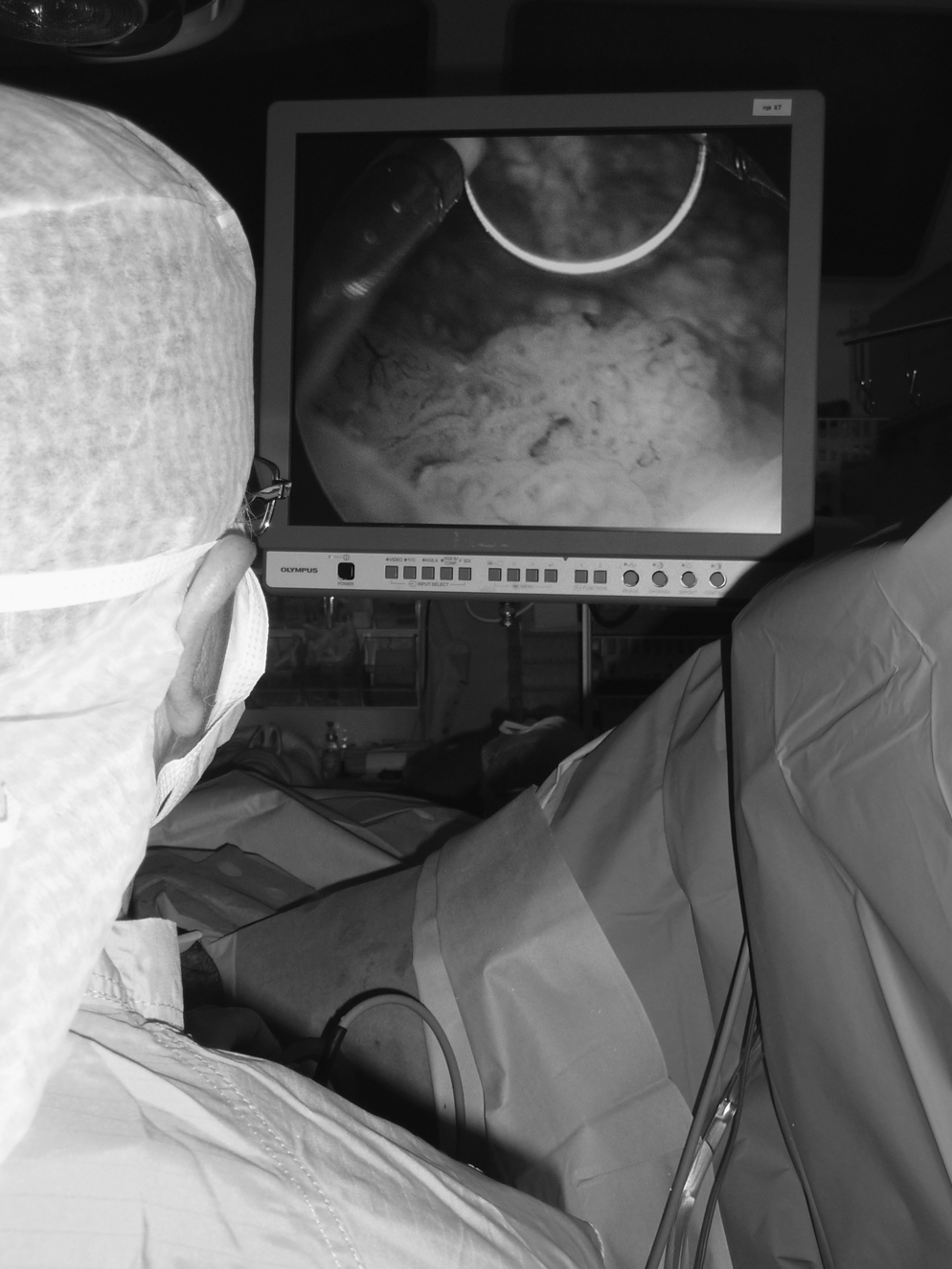
Narrow band imaging-assisted transurethral resection of the bladder.
NBI is an optical image enhancement technology that enhances the visibility of vessels in the surface of the mucosa by using light with the maximum absorption in the same range as hemoglobin. Short wavelengths of 415 nm penetrate only the superficial layers of the mucosa and show the superficial blood vessels. Longer wavelengths of 540 nm penetrate deeper and show the blood vessels, such as veins, in the deeper layers.
Several single-center and multicenter studies have been performed indicating that NBI is useful for the cystoscopic diagnosis of urothelial tumor. The NBI Study is the first randomized study conducted by CROES. At the moment, 25 centers have included more than 400 patients. New centers can still sign up through
The benefits of the CROES NBI Study are evident. Most of the digital equipment that is currently available from Olympus is NBI compatible. By showing a clinical evidence for the use of NBI, this would support the urologist's daily practice. Using NBI could enable the doctors to identify more suspect areas in the bladder during the diagnosis of primary large tumors, identified with white light cystoscopy. NBI could be used as well during the resection and during the control cystoscopies, without additional preparation of the patient. This could impact the subsequent recurrence rate, reduce the number of required cystoscopic procedures during the course of the disease, and ultimately lead to a better quality of life for patients and a reduction in the cost of their care. The outcome of these studies could lead to an enlarged product portfolio.
Olympus believes in and supports long-term partnerships with urologists. These partnerships provide an important basis for gaining trust and enabling a mutual development of medical equipment that contribute to the quality of healthcare that patients receive. A medical development is only achievable if both parties—medical professionals and industry—collaborate closely. The urologists have the insights and the understanding as to how the treatment of patients can be improved. Our engineers develop these ideas into devices. It is the interaction that makes it possible for ideas to become alive. A fair cooperation forms the basis of our relationships. Ethical business conduct and compliance with all applicable antitrust laws are fundamental aspects of Olympus' corporate culture, and this ensures that independence and integrity of the doctors are protected.
The advantage of CROES can be seen in the organization and monitoring by physicians dealing with the same clinical challenge and the knowledge about the best clinical partners to work with on the study. For the future, it will be an advantage to have industry look at the clinical protocol and the expected outcome. Especially for the development of new instruments, it is important to know which data have been collected with which type of equipment and under which conditions. Only with this knowledge can further instrument improvements be made.
• The Global PCNL observational study was closed in December 2009.
• The Global Ureteroscopy Study and the Global Renal Mass Study were closed for initiating new sites in January 2011. The Global Greenlight Laser Study was closed for initiating new sites in April 2011.
• Ongoing project: The randomized study on Narrow Band Imaging vs White Light Imaging.
• For further information please visit: