




Abstract

Croes Council
Chairman
Jean de la Rosette, M.D.
Amsterdam (The Netherlands)
Adrian Joyce, M.S.
Leeds (UK)
Stavros Gravas, M.D.
Larissa (Greece)
Margaret Pearle, M.D.
Dallas, TX (USA)
Dean Assimos, M.D.
Wake Forest, NC (USA)
Ying-Hao Sun, M.D.
Shanghai (China)
Tadashi Matsuda, M.D.
Osaka (Japan)
Treasurer
John Denstedt, M.D.
London (Canada)
Executive Director
Sonja van Rees Vellinga
Amsterdam (The Netherlands)
Mission
Through worldwide collaboration, CROES seeks to assess, using evidence based scientific methodology, the various aspects of clinical endourology.
Vision
By applying rigorous scientific evaluation to the field of clinical endourology, CROES will enable all urologic surgeons to bring to their patients the most effective and efficient care possible.
Projects
• Global PCNL study
• Global URS study
• Global GreenLight Laser study
• Global Renal Mass study
• Global NBI study
Contact
For more information please contact Sonja van Rees Vellinga (
Update on Croes at the American Urological Association Annual Meeting
Jean de la Rosette, Stavros Gravas, and Sonja van Rees Vellinga
The Clinical Research Office of the Endourological Society (CROES) aims at promoting and supporting high quality international patient-centered research in a transparent way.
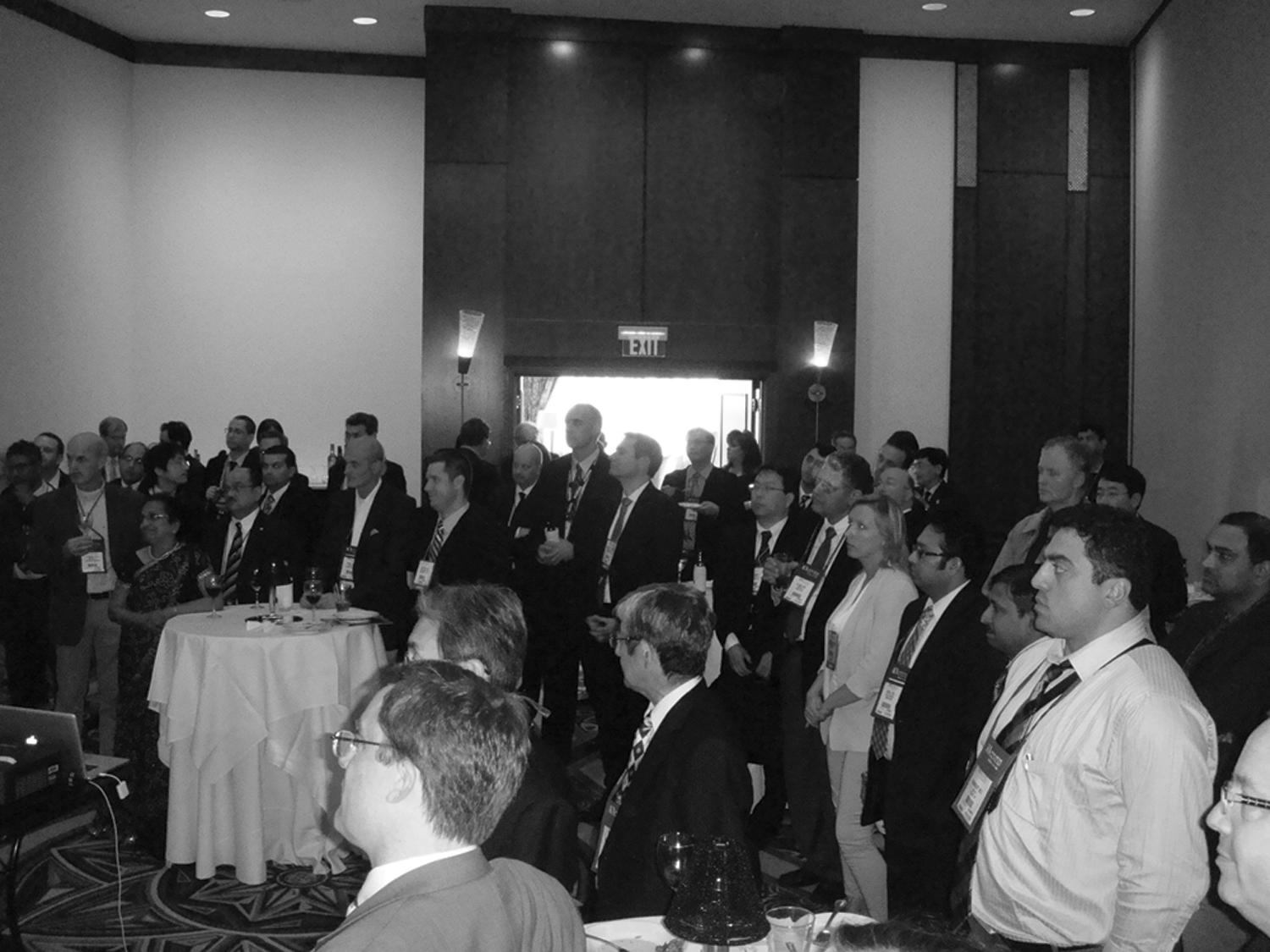
The CROES recognizes the importance of the active involvement and recognition of the participating centers. At the American Urological Association (AUA) Annual Meeting in Atlanta, all investigators who are participating in CROES studies were invited to join the investigators meeting at the Omni Hotel. We discussed the current projects and exchanged ideas on new studies in a friendly and relaxed setting. Almost 100 persons joined the reception regarding the update on all five CROES projects. We would like to thank all participants for joining the meeting, and we would like to present a short summary for those who were not able to attend.
The global percutaneous nephrolithotomy (PCNL) study was the first study launched, and at present, data from 5803 patients who were treated in 96 centers are analyzed. The value of the PCNL study is that it is a real-life study; it demonstrates contemporary global practices in stone management. The dataset provides significant insight on academic and community practice and covers all spectrums from centers with high to more restricted volume. These data allow us to assess the current indications, perioperative morbidity, and stone-free outcomes for PCNL worldwide.
CROES investigators meeting.
Currently, 17 articles have been published or are in press in the Journal of Endourology, Journal of Urology, BJU International, European Urology, and World Journal of Urology. Approximately 13 more articles are currently under review or in preparation. The conclusions of these papers and the new developments in PCNL were discussed at the investigators meeting. We will highlight some of the recent publications that were also presented at the AUA Annual Meeting.
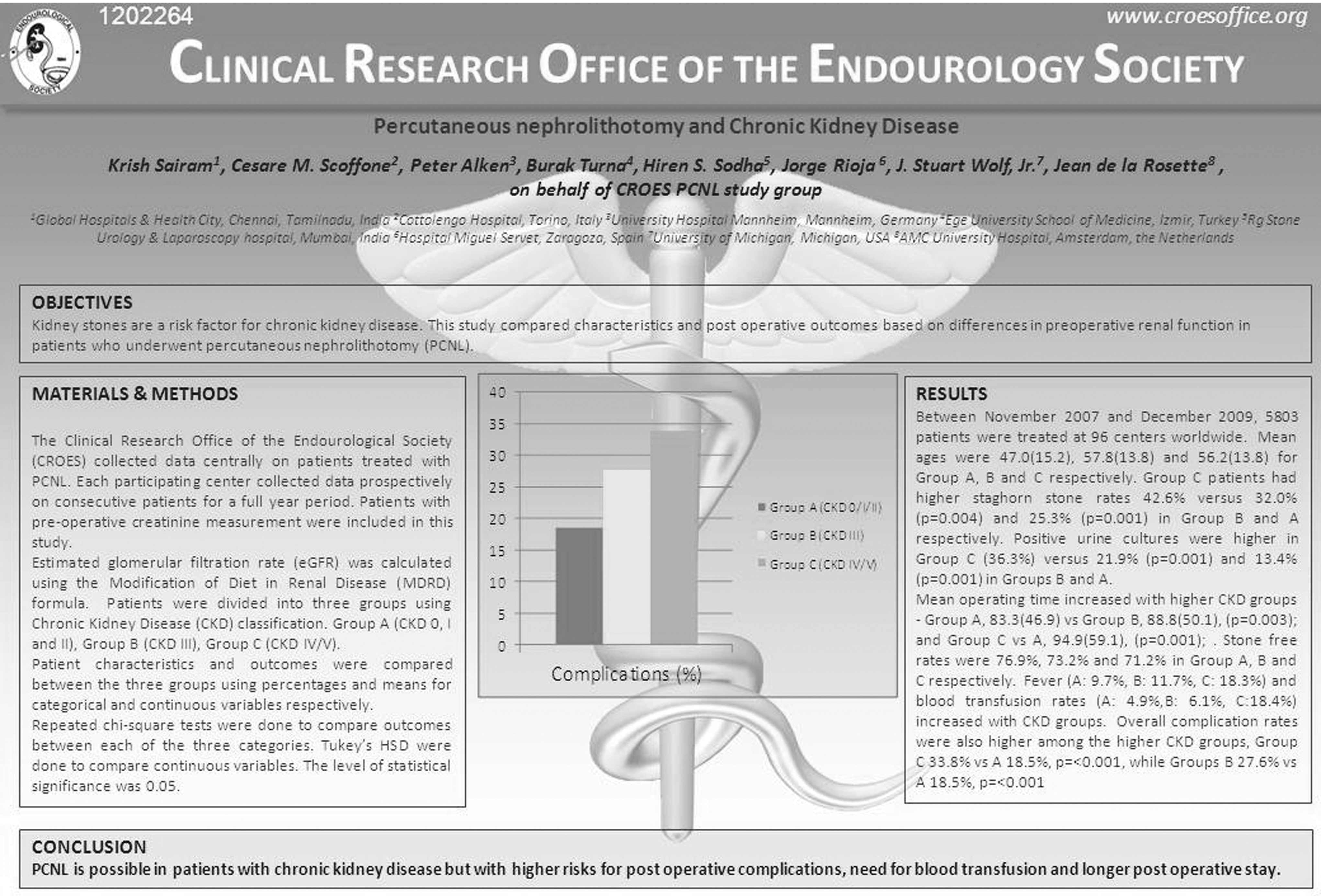
CROES poster: PCNL and chronic kidney disease.
In the first podium presentation, Dr. de la Rosette presented the Clavien score for use in PCNL and standardization of complications. In the manuscript recently accepted in European Urology, 1 data for 528 patients with complications after PCNL were used to create a set of 70 unique complication-management combinations. Clinical case summaries for each complication-management combination were compiled in a survey to 98 urologists who rated each combination using the Clavien classification. The conclusion of this article is that the Clavien score is valid for grading complications in PCNL. The Clavien score has low reliability, however, for minor (more common) PCNL complications. To improve the outcomes of research in PCNL, it would be good if explicit categories for scoring complications were created.
The second podium presentation, by Dr. Fuller, was on PCNL in superobese patients. This article is currently under review and describes the outcomes in the superobese. As the worldwide prevalence of obesity continues to rise, urologic surgeons will increasingly face the challenges associated with providing safe, high-quality care to obese patients. After exclusion criteria were applied, 3709 eligible patients were reviewed, of whom 97 were identified as superobese, with a body mass index in excess of 40 kg/m2. These patients were matched according to stone characteristics with 97 patients of normal weight. A multidimensional match of 97 superobese patients with 97 patients of normal weight was created using propensity score matching (PSM). Two equal groups were created after the matching process. PCNL in superobese patients is associated with longer operative duration, higher rates of reintervention, and an increased risk of minor perioperative complications. With this knowledge, urologists should seek to develop strategies to optimize the perioperative management of such patients.
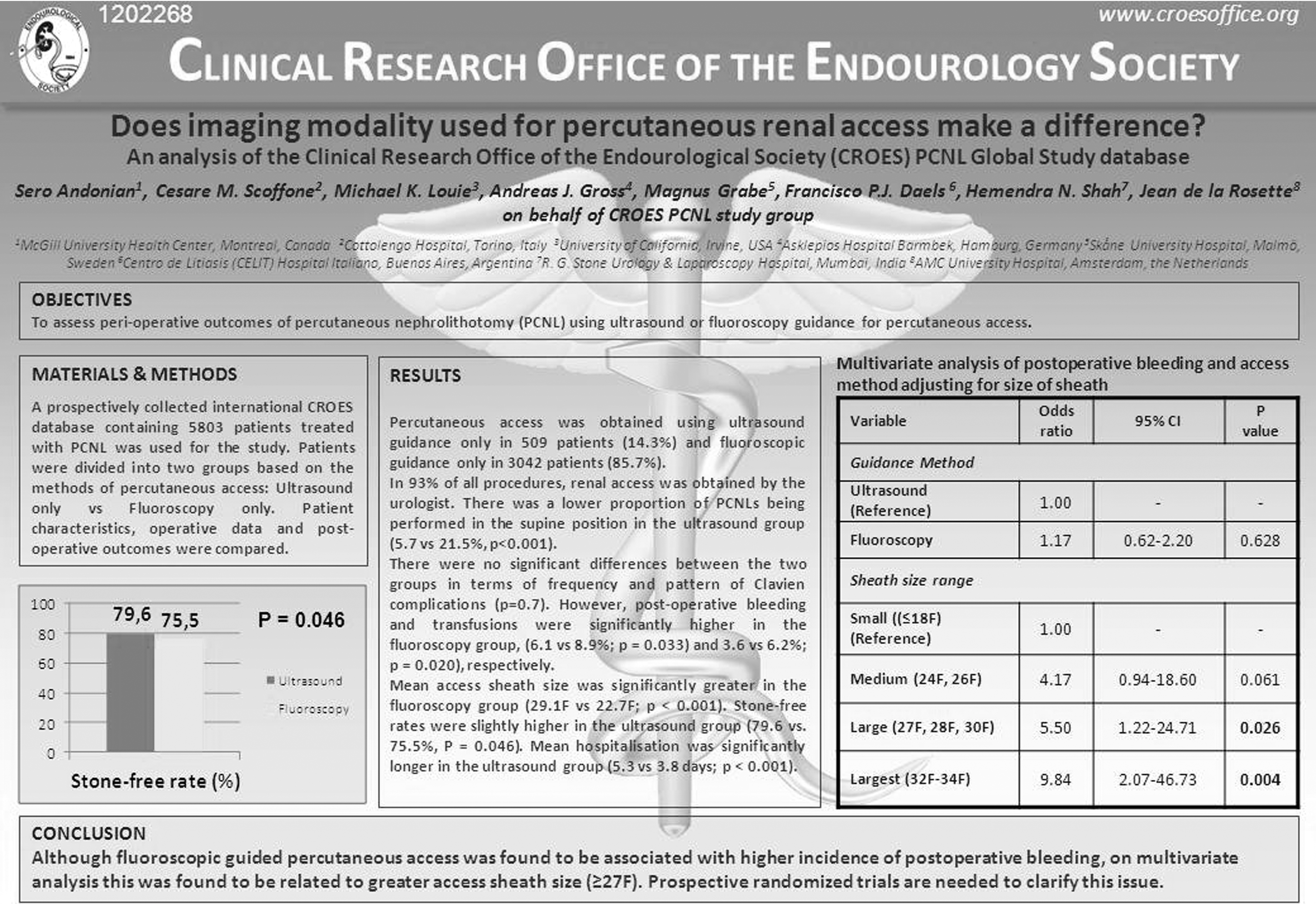
CROES poster: PCNL and imaging modality.
In addition, two posters were presented. Dr. Sodha presented a poster on chronic kidney disease (CKD) and PCNL. In this study it was shown that poor renal function impacts negatively on post-PCNL outcome. Although other factors almost certainly contribute to CKD, by more aggressively removing these stones, particularly staghorn stones, at first presentation and more vigilantly attempting to prevent recurrence through infection control, pharmacologic or other interventions, the progression of CKD from nephrolithiasis may be halted.
Dr. Andonian presented a poster on perioperative outcomes of PCNL using ultrasonographic or fluoroscopy guidance for percutaneous access. The conclusion of these investigators: “Although fluoroscopy-guided percutaneous access was found to be associated with higher incidence of hemorrhage, on multivariate analysis, this was found to be related to greater access sheath size (≥27F). Prospective randomized trials are needed to clarify this issue.”
Three other CROES projects have been closed this year. The Global Ureteroscopy (URS) study 2 is the largest prospective database of patients treated with URS to be reported to date. Approximately 130 sites have included more than 15,000 cases; the results reflect the routine clinical treatment of patients with a variety of indications for URS, and thus represent the use of this technique in a “real-life” scenario. The study is currently being audited, and the data will be ready for analysis October 1, 2012. The data were entered by institutions from 36 countries worldwide. The patients who are included have a mean age of approximately 50 years. Most stones are ureteral stones, and about one quarter of the patients treated have renal stones. The distribution by site is equal. The type of URS most frequently performed is semirigid (around 75%). In about 85% of the cases, it was indicated that the treated area was stone free after URS. A complication was reported in approximately 3% of the cases. The first results are expected in November 2012.
The Renal Mass study 3 was launched in January 2010, and 113 centers have included more than 5000 cases. In this prospective study, we aim to assess on a global basis the indications, treatment modality, and outcomes of instrumental treatment for renal masses including radical or partial nephrectomy and ablative treatments. The study is currently being audited, and the data will be ready for analysis September 1, 2012.
The biggest contributions in number of cases come from countries such as Turkey, France, and the United States. The mean age of the patients included in the database is approximately 60 years, but also a significant portion of younger patients is included. The technique most frequently performed is still radical nephrectomy, but also partial nephrectomy is often performed. In approximately 15% of the cases, an ablative therapy was used. The first results are expected in October 2012.
In the Global Greenlight Laser study, 4 we will study on a global base the indications and outcomes of High Performance System GreenLight laser treatment for benign prostatic hyperplasia. This study has closed in April 2012, and at the moment, 27 centers have included more than 1000 patients. The data were successfully audited with a return rate of 90%. This summer, the first publication on this study will be prepared.
The first randomized study, comparing the use of Narrow Band Imaging in addition to White Light cystoscopy in the treatment of nonmuscle invasive bladder cancer, is still open for new centers. 5 Close to 30 centers worldwide have accepted the challenge and will randomize their cases according to a strict inclusion protocol during a 1-year period. This milestone project will open new avenues in endourologic research.
The CROES studies are open to centers from all over the world, therefore enabling institutions from developing countries to also take part in studies and publications. All participants will be recognized in publications, will receive a certificate, and will have the opportunity to present themselves at national and international meetings. The CROES publication office aims to include all principal investigators in at least one of the publications. In addition, all centers will be acknowledged in each publication resulting from the study in which they participated. This will offer the institutions great exposure and the chance to be recognized as a center of excellence in the field of endourology. All feedback is welcome, and we invite you to contact the CROES office with new ideas and suggestions regarding ongoing studies and future projects. At the upcoming World Congress of Endourology meeting in Istanbul, CROES is looking forward to present you with a new update on the CROES projects.
• The global PCNL observational study was closed in December 2009.
• The Global Ureteroscopy study, the Global Renal Mass study, and the Global Greenlight Laser study are closed January 2012.
• Ongoing project: the randomized study on Narrow Band Imaging vs White Light Imaging.
• For further information please visit: