




Abstract
Objectives:
To develop and to validate the Spanish version of the Ureteral Stent Symptom Questionnaire (USSQ). Describe the prevalence of symptoms associated with the presence of ureteral stent in a Spanish-speaking population.
Methods:
We developed and delivered the Spanish USSQ version to patients who underwent ureteral stent placement after endourological procedures. We determined the internal consistency and the instrument's sensitivity to change. Results of the patients were compared with a control group of healthy individuals. We analyzed the prevalence of symptoms in the six domains of the questionnaire and the overall quality of life. We compared the means of the results by gender to find significant differences in associated symptoms.
Results:
We obtained good internal consistency values of the instrument. Significant differences were obtained after sensitivity to change analysis in the scores of all domains except sexual performance. The correlation between the domains of urinary symptoms, pain, and general health was high. The analysis of specific symptoms showed important affection in all domains, being more significant in urinary symptoms and pain. The ureteral catheter also affected the daily life and work performance. There were no significant differences when comparing the symptoms by gender or age.
Conclusions:
Spanish version of the USSQ is appropriate for assessing the symptoms associated with ureteral stent in the Spanish-speaking population. The ureteral catheter significantly affects the various aspects of life in this population.
Introduction
T
In 2003, Joshi et al. published the Ureteral Stent Symptom Questionnaire (USSQ) 4 that assesses symptoms and their impact on the quality of life of patients with a ureteral catheter. This tool has become the standard for the evaluation of symptoms, and translations to French, 5 Italian, 6 Turkish, 7 and recently Korean 8 have been published. This questionnaire consists of 38 items, divided into six domains: urinary symptoms, pain, general health, work performance, sexual matters, and additional problems; global quality of life is also assessed. 7 Besides reporting the percentage of patients with certain symptoms, this tool allows to score all domains: a higher score indicates more associated symptoms.
Spanish is the second most common spoken language in the world and in the United States. 9 Furthermore, recent transnational migration has modified the proportion of Spanish-speaking patients seen in North America and non-native Spanish-speaking countries. There is no Spanish translation of USSQ, so the initial objective of this study was to validate the Spanish linguistic translation of the original questionnaire in patients undergoing ureteral stent placement. Additionally, the analysis of the questionnaire will allow the description of symptoms related to the presence of ureteral catheter in Spanish-speaking patients. In addition, we analyzed the differences in domain scores according to the age and gender of the studied population.
Materials and Methods
The original USSQ questionnaire was translated to Spanish by a professional translator, whose native language was Spanish, getting the first draft. Subsequently, two urologists (D.O.P., C.M.P.) reviewed and corrected the wording to get a second draft. The questionnaire was then retranslated from Spanish to English and compared with the original version of the USSQ. Discrepancies were discussed and finally, a preliminary version of the questionnaire in Spanish was obtained. After that, the questionnaire was administrated to three subjects to make specific corrections in writing, ambiguity, and syntax. We made the pertinent corrections obtaining the final version of the questionnaire that was used throughout the study.
A 6F ureteral stent was positioned in all the patients, with a variable length according to the manufacturer's instructions. The decision of placing the catheter was taken by the attending urologist according to the complexity and findings at the end of the procedure. The patients who were invited to participate in the study received the relevant indications and signed informed consent.
Patients were given an envelope with two versions of the questionnaire, the first to be answered one week after the placement of the catheter (in situ version) and the second one to be completed a week after its removal (postremoval). The study was conducted prospectively from January 2011 to August 2012.
We included patients who required ureteral stent placement after semi-rigid/flexible ureteroscopy and intracorporeal litotripsy with the Ho:YAG laser. Since various comorbidities, treatments, and complicated endourologic procedures may affect the assessment of the domains of the questionnaire, patients with the following characteristics were excluded: (1) urinary tract infections associated with the procedure, (2) symptoms due to benign prostatic enlargement treated with α-blockers, (3) overactive bladder diagnosis and those treated with anticholinergics, (4) previous diagnosis of bladder cancer, chronic pelvic pain, prostate cancer, urethral strictures or urinary incontinence, (5) chronic use of analgesics for other comorbidities, (6) complicated ureteroscopy with ureteral perforation, (7) bilateral ureteral stent placement, (8) residual stones after the procedure, and (9) those who received alpha-blockers after stent placement.
During the same period, we delivered two copies of each version (in situ/postremoval) to be answered independently in a period of less than 24 hours to analyze the internal consistency of the tool. We compared the results of the in situ and postremoval versions and calculated the Cronbach's alpha in each domain to determine the internal consistency between two moments.
The in situ version was also answered by 50 healthy individuals as the control group. We excluded from the final analysis, incomplete questionnaires. We examined the answers and the sum of the scores in each domain according to the recommendations of the original questionnaire. 4 We analyzed the correlations between the different domains of the questionnaire using the Pearson's coefficient test. We compared the medians obtained from the studied population with a control group with a nonparametric test of medians.
Through the Wilcoxon test, we searched for statistical differences between several domains of the in situ and postremoval version to determine the sensitivity to change. We performed a descriptive analysis of the most common symptoms, including all patients who answered the in situ questionnaire properly. Finally, we compared the median scores for each domain according to gender with the Mann–Whitney test and looked for correlations between the score domains and age. The study was approved by the Bioethics Committee of our institution and informed consent was obtained from every patient.
Results
The initial validation analysis included a total of 20 patients who answered completely two copies of both versions of the questionnaire. Ten males and 10 females with a mean age of 48.75 years. While analyzing the internal consistency of the questionnaire, we obtained acceptable to good values in most domains, Table 1 shows the results. The correlation coefficients between the scores of the domains with the ureteral stent in two different moments are shown in Table 2 being highly significant between the domains of urinary symptoms, pain, and general health.
Acceptable to high values are in bold.
USSQ=Ureteral Stent Symptom Questionnaire.
Correlation indexes>good are in bold.
We analyzed the sensitivity to change comparing the medians in the six domains with and without the catheter by the Wilcoxon test. We found a significant difference in the domain of urinary symptoms (p<0.001), pain (p<0.001), overall health (p=0.002), and work performance (p=0.027). There was a numerical difference in the domain of sexual performance, nevertheless, it did not reach a statistically significant difference (p=0.06). When comparing the scores of quality of life with and without a catheter, we found no difference, which means that the patient's perception about the ureteral stent is similar before and after its removal.
We found significant differences in all domains by comparing the total score of the 44 patients with in situ questionnaire with the control group (n=50); Table 3 shows the results. A total of 44 patients, 25 females and 19 males answered completely the in situ version, with a mean age of 49.9 years (range 20–83 years). The final analysis of stent-related symptoms was performed with data from 44 cases with the complete questionnaire. Eighty-two percent of the population underwent semirigid ureteroscopy, the remaining patients were treated with flexible ureteroscopy. Basic score statistics of each domain are shown in Table 4.
Significant differences.
NP=no patient reported body pain.
Urinary symptoms
About 70.5% of patients reported at least one void every two hours. Only three patients had no alteration on urinary frequency with the presence of the catheter. About 97.7% reported nocturia occasionally. About 77.3% reported urinary urgency at least occasionally and 23.5% of these patients had urgency in all voids. About 47.7% of the patients had urge incontinence associated with the ureteral catheter. About 86.4% reported the feeling of incomplete emptying. About 77.3% described at least occasional dysuria, 20.5% of these patients had dysuria in all voids, and 72.7% reported at least one episode of hematuria. Figure 1 shows the perception of the symptoms.
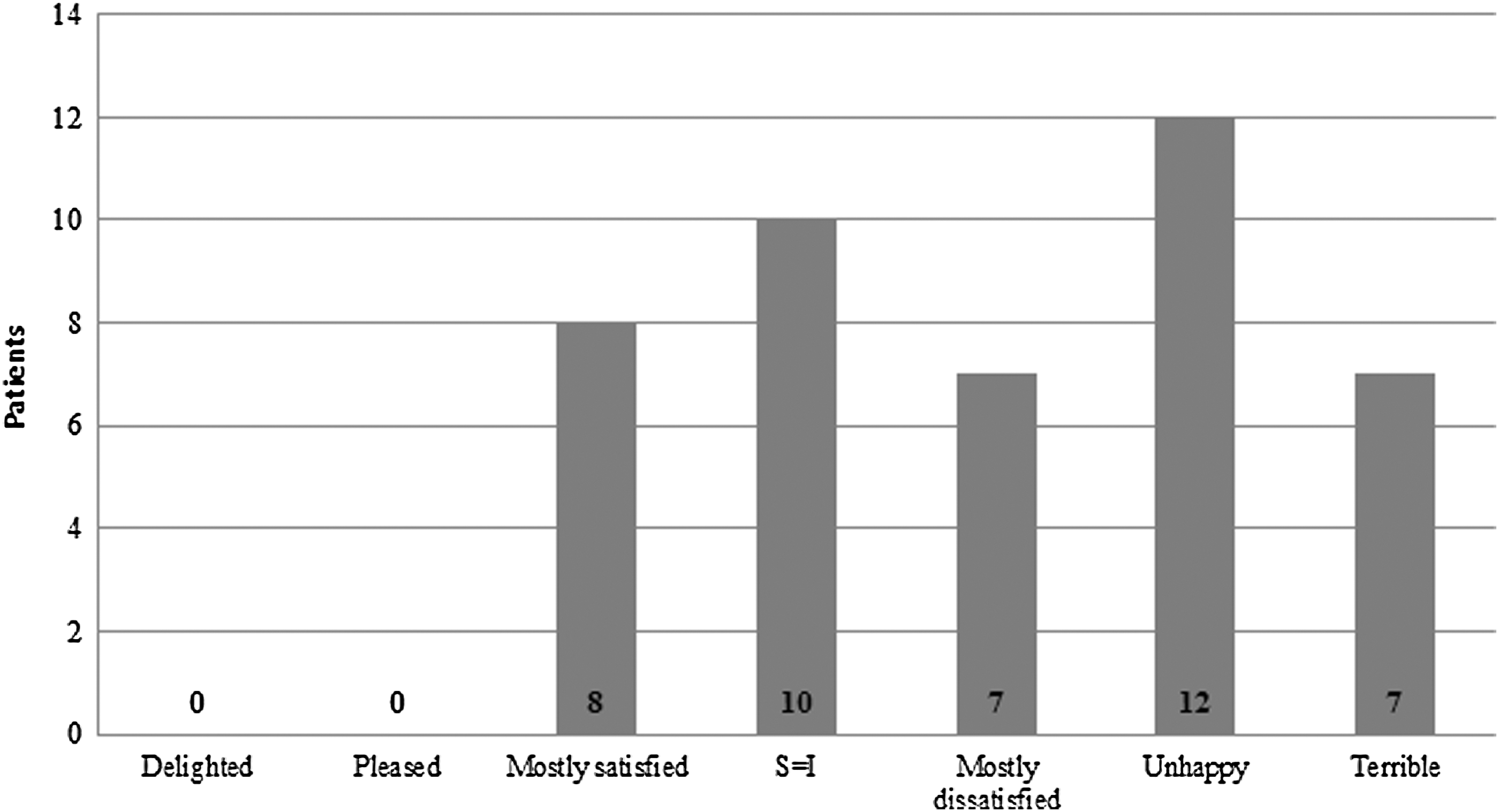
In the future, if you were advised to have another stent inserted, how would you feel about it?
Body pain
Ninety-one percent of the patients reported pain or discomfort associated with the catheter. Fifteen patients (37.5%) reported pain at one anatomical region, 12 (30%) in 2 regions, 6 (15%) in three sites, and 7 (17.5%) in four regions. The most common site was the lumbar region in 65% of cases, followed by the suprapubic region in 57.5% of patients. The 41% of patients reported lumbar pain during micturition. About 55% of the males reported pain in the genital region. The mean pain score according to the visual analogue scale was 4/10. Forty percent of those who reported catheter-associated discomfort also reported sleep disruption at least occasionally. Fifty percent of all patients reported analgesic use after stent placement.
General health
The impact of catheter use in this domain was important. Forty-one percent of the population could perform light activity (walking, driving) without problems; but only 18% achieved heavy activities (sports, heavy lifting) without difficulty. Most patients (68%) felt tired and worn out during the time they were using the catheter, besides, they were unable to regularly enjoy their social life. About 70.5% required assistance from family or friends at least occasionally to perform several activities.
Work performance
Only 18 of the 44 patients were formally employed. The average number of days that the patients had to cut their routine because of the catheter was 1 day. When comparing the score's means of work performance with and without a catheter by T-Student, we found a significant difference (p=0.006), which proves the negative impact of the catheter in the quality of work.
Sexual matters
Of the eight patients who suspended their sexual life after the catheter placement, only three cases were due to complaints associated with the stent. Only 11 patients were sexually active after the catheter placement; when comparing the mean of this score with the control group, we obtained significant differences (p=0.037), showing an impact in this domain.
Additional problems and quality of life
Eighty-six percent of the sample thought that at least occasionally they were suffering from urinary tract infection because of the associated symptoms. Almost one third (27.3%) reported taking antibiotics even without a prescription. However, only 9.1% (four patients) went to hospital for associated problems. In assessing the overall impact in the quality of life, only 30% had positive feelings about a future need of placing another catheter. Forty-three percent found themselves dissatisfied; the rest of them had mixed opinions. No differences were found in this domain when comparing the results with and without a catheter.
We confirmed that the distribution and median scores for each domain were similar regardless of the gender. We found no significant correlations between age and the final scores of each section. After comparing the sample in two groups according to age, with 50 years as the cutoff point, we found similar median scores in all domains.
Discussion
The Spanish version of the USSQ will be used to analyze the impact of ureteral catheters in the second most common spoken language in the world. It could also be applied to the migrant population in countries with another native language. The overall results of our study demonstrates that the Spanish version of the USSQ is reliable and valid for assessing the impact of the ureteral catheters in the Spanish-speaking population. Cronbach's alpha was used to estimate the reliability of the questionnaire, the alpha coefficients of all domains for both versions are indicatives of good internal consistency of the test, a feature required in questionnaires that evaluate symptoms. Unfortunately, sometimes high values of alpha reflect redundancy of the instrument. The Wilcoxon test permits the analysis of sensitivity to change in non-normally distributed samples, and the Mann–Whitney test was used because the gender groups have less than 30 patients. Discriminant validity was analyzed by the nonparametric test of medians, which help us find statistically significant differences between the scores in each domain between cases and controls.
The correlation between the domains at different times of the symptom assessment was acceptable for urinary symptoms, pain, and general health. Probably because few patients were in a paid employment or had an active sex life, domain results were not similar. This is reflected by analyzing the sensitivity to change with and without a catheter in the domain of sexual matters, where no significant differences were found after the removal of the ureteral stent catheter.
The previous result was also observed in the original report of the USSQ 3 ; there were no significant difference in the sexual matter domain. We believe that the cause could be the sum of only two items, which decreases the possible range of results.
When analyzing the symptoms associated with the ureteral stent, we found an important affection in every domain, especially in urinary discomfort and pain. We observed higher prevalence of storage symptoms such as frequency, urge incontinency, feeling of incomplete emptying, and dysuria.
Ninety-one percent of the patients reported pain or discomfort associated with the presence of the catheter, with the lumbar region being the most affected. More than half of the male population reported pain in the genital area, a situation that also could be associated with impairment of sexual performance. The catheter affected everyday life of the patients, perception of fatigue, health status, and decreased work performance. There were differences when comparing the sexual matter domain between the cases and the control group; however, there was no significant difference when comparing the medians with and without catheter, probably due to the small number of sexually active patients.
The results of our study are similar to those published by Giannarini et al., 6 Joshi et al., 4 and Park et al. 8 Table 5 shows the scores for each domain confirming the impact of the stent in various aspects of everyday life regardless of the translation used. We believe this confirms the quality of the original version of the USSQ, its translations, and also demonstrates the overall negative impact of the catheter.
Medians reported.
Means reported.
NR=not reported.
We also proved that the discomfort was similar between males and females, and found no correlation between the magnitude of symptoms and age of the population. There is a study that evaluated the impact of a ketorolac-eluting ureteral catheter and showed less use of oral analgesics in the male population; this is the only study that so far found differences by genre. 10 By obtaining similar results in the quality of life items with and without catheter, we can assume that the overall perception about the catheter would not be modified by its removal.
Multiple studies examining the possible impact of physicochemical characteristics of the catheter have been published, such as thickness, 11 material, 12 and length 13 in relation to the associated symptoms. Studies analyzing the impact of alpha-blockers in symptom improvement have been described. 14,15 Unfortunately, none has included the Spanish-speaking population. We believe this translation will facilitate the evaluation of symptoms associated with ureteral stent catheter in this population. It will be a suitable instrument to study the intrinsic characteristics of the catheter and treatments that reduce their impact on future clinical studies. In a recent study, Maan et al. 12 reported improvements in the domains of pain, urinary symptoms, and general health with a thermoexpandable segmental metallic stent in comparison with the conventional Double-J stent.
One of the main strengths of the study is the exclusion of patients with urological comorbidities, which without any doubt allows a more objective assessment of symptoms. Unfortunately, the previous history of ureteral stent placement, which could influence the answers of the questionnaire, was not investigated. The retrospective bias to describe the symptoms in the questionnaire, such as urinary frequency, could be resolved with prospective evaluation of symptoms, almost an impossible task with this type of questionnaire. The domains of work performance and sexual matters could reveal stronger results if more patients were include in the analysis. Our study has some limitations. The sexual matter domain could not be completely evaluated because a small proportion of patients were sexually active. This aspect could be resolved with the inclusion of more patients.
Moreover, it would be more appropriate to include patients with a history of endourological manipulation without a ureteral stent as the control group, instead of healthy patients. Either way, the primary objectives of the study were fulfilled.
Conclusions
The Spanish version of the USSQ is a reliable instrument, with adequate internal consistency between the different items and sensitivity to change that will allow the analysis of the impact of the ureteral catheters in our patients. The symptoms are significant and affect all the analyzed domains being similar, regardless of the gender and age of the population. Additionally, the medians reported are similar than those obtained in other populations. This questionnaire will assess the impact of the catheter in Spanish-speaking patients in future studies.
Footnotes
Acknowledgments
We extend our sincere thanks to Yelile Guidi and Martha Lee in the preparation and translation of the questionnaire.
Note
The Spanish version of the USSQ can be requested to the corresponding author or accessed in the following URL:
Disclosure Statement
No competing financial interests exist.