




Abstract
Background:
Laparoendoscopic single-site surgery (LESS) was performed for 31 cases of pediatric urologic disease in our department.
Objective:
A retrospective chart review was performed on pediatric patients who underwent LESS.
Design, Setting, and Participants:
Procedures included pyeloplasty (21), nephrectomy (4), varicocele ligation (3), orchiectomy (1), orchiopexy (1), and removal of female genitalia (1). In all 31 cases, an incision of 15 to 20 mm was made in the umbilical region, and a port for LESS was put in place. A 5-mm flexible scope and 5-mm forceps with a bending tip and regular laparoscopic forceps (3, 5 mm) were used.
Outcome Measurements and Statistical Analysis:
Intraoperative and postoperative outcomes were evaluated.
Results and Limitations:
For the 21 patients with pyeloplasty, the mean operation time was 240 minutes. Postoperative renal pelvis dilatation was relieved in all patients. For the 4 patients with nephrectomy, the mean operation time was 128 minutes. Postoperative urinary incontinence disappeared in all patients. The mean operation time of varicocele ligation was 73 minutes. Postoperation, varicocele disappeared and there was no testicular atrophy. The operation times of orchidectomy, bilateral orchidopexy, and removal of female genitalia mutilation were 60, 170, and 189 minutes, respectively. In all cases, there were no intraoperative or postoperative complications.
Conclusions:
The advantages of LESS include superior aesthetics with a smaller scar and less pain. LESS is considered as a less burdensome surgery for pediatric patients.
Introduction
M
However, conventional laparoscopic approaches require 3 to 4 incisions. To improve the limitations of conventional laparoscopy, laparoendoscopic single-site surgery (LESS) for pediatrics has been performed in urologic surgery 1 –3 Although many LESS procedures in adults have been reported, less information is available about LESS in pediatric urology. 4 –6
Our department started performing LESS for pediatric urologic diseases in 2009. We report the results of LESS performed on patients with pediatric urologic diseases in our department.
Patients and Methods
Our current series consists of 31 procedures at our department from 2009 to 2014. Table 1 lists details of subjects. Procedures included pyeloplasty (21), nephrectomy (4), varicocele ligation (3), orchiectomy (1), orchiopexy (1), and one removal of female genitalia. All procedures were performed using the LESS port system. (Tri-Port, SILS Port, or OCTO port) In all cases, an incision of 1.5 to 2.5 cm was made in the umbilical region, and a port for LESS was put in place. A 5-mm flexible scope, 5-mm forceps with a bending tip, and regular laparoscopic forceps were used.
LESS = laparoendoscopic single-site surgery.
Pyeloplasty
The operation method has been described elsewhere. 7,3 Briefly, a SILS port was inserted from the umbilical region. A 2 mm port was added for the left hand. After the pelvi-ureteric junction (PUJ) was exposed, a traction suture of the renal pelvis was placed from the abdominal wall. After dismembering the PUJ, the ureter was spatulated without cutting off the ineffective PUJ, which was used as a handle to make adequate traction of the ureter. The posterior anastomosis was created intermittently using a 5-0 monofilament suture. For this anastomosis, traction of the unresected PUJ by the assistant's curved grasper through the SILS port was useful for the accurate attachment of the anastomosis site (Fig. 1). Then, the PUJ was resected and removed for histologic examination. A stent catheter was placed in an anterior manner through the SILS port. The anterior anastomosis was created in the same manner. The stent catheter was removed 4 weeks after the operation.
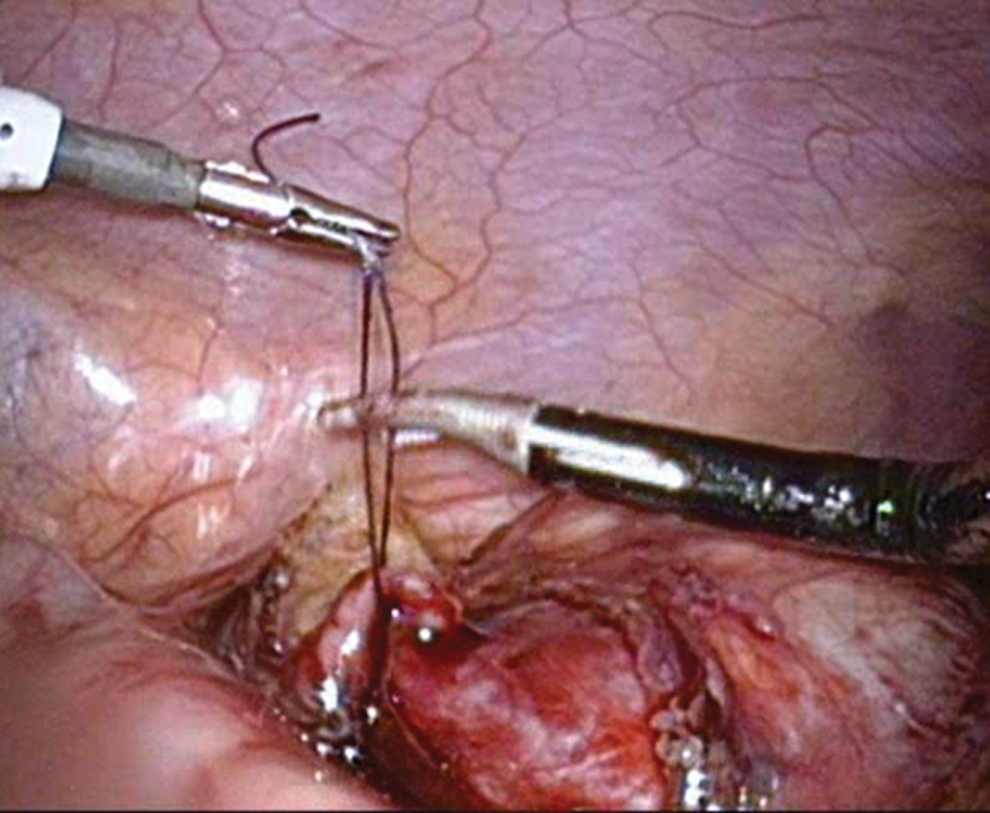
Intraoperative appearance (pyeloplasty).
Nephrectomy
The indication for nephrectomy was continuous urinary incontinence related to a dysplastic kidney with an ectopic ureter. A Tri-port was placed into the peritoneal cavity from the umbilical region. The operative steps were similar to those for conventional laparoscopic nephrectomy. The transperitoneal nephrectomy was performed with conventional and articulating laparoscopic instruments. A 5-mm vessel sealing device was used to dissect the kidney and to control the pedicle. The specimen was retrieved into a laparoscopic bag and removed through the Tri-port. Pathology revealed renal dysplasia in all patients.
Varicocele ligation
The patient was fixed in the supine position under general anesthesia. A Tri-port was placed into the peritoneal cavity. A retroperitoneal incision was made 3 cm superior to the internal inguinal ring along the testicular vessels. The vessels were dissected from the lymphatics, coagulated using a vessel sealing device, and transected. The peritoneum and rectus fascia were closed with 4-0 absorbable sutures.
Orchiopexy and orchiectomy
For cases of nonpalpable testis, a laparoscopic insection is first conducted from the umbilical port (5 mm). In cases of agenesis, the examination ends with a laparoscopic inspection. In one case, intra-abdominal testis was found and LESS orchiopexy was carried out. After diagnostic laparoscopy, the 5 mm port was removed and the umbilical incision was enlarged to 2.0 cm to insert the Tri-port. Primary orchiopexy was performed. The peritoneum over the testicular vessels was incised, and the intra-abdominal testis was mobilized until it reached the internal ring without the spermatic vessels being cut. A dartos pouch was created by the standard method. Under laparoscopic monitoring, the testis was pulled down to the dartos pouch by laparoscopic forceps and fixed with 4-0 absorbable sutures.
In the other case without intra-abdominal complications, the testicular nubbin was removed without incision in the groin or scrotum. In this case, the vas deferens and testicular blood vessels ran toward the internal ring. The 5 mm port was removed, and the umbilical incision was enlarged to 2.0 cm to insert the Tri-port. The peritoneum was incised outside the blood vessels and the vas deferens. Detachment of the vas deferens and blood vessels proceeded, and the nubbin was exposed and severed. The internal inguinal ring was sutured with 5-0 absorbable sutures, and the peritoneum was closed. Finally, the blood vessels and the vas deferens were severed, and the nubbin was removed.
Removal of female genitalia
The patient was a 7-month-old baby with ambiguous genitalia. Bilateral gonads descended into the scrotum, and subsequent gonadal biopsy demonstrated right dysgenetic testis and left ovary. After several meetings about sex assignment, it was decided that the baby would be raised as a male. Stage genitoplasties were planned. First, resection of the ovary and uterus was performed.
An OCTO port was put in place from the umbilical region. Laparoscopic findings showed a small uterus, bilateral gonadal vessels, and ductal structures entering into the patient's internal inguinal ring. After the left gonadal vessels were cut and divided, we removed the descended gonad on the left side, including the ovary from the inguinoscrotal region. The uterus was dissected, using a vessel sealing device, and the vagina was cut and divided at the vaginal portion of the cervix by a Hem-o-lock clip.
Results
There were 31 consecutive procedures between 2009 and 2014. Procedures included 21 pyeloplasty, 4 nephrectomy, 3 varicocele ligation, 1 orchiectomy, 1 orchiopexy, and 1 removal of female genitalia. Table 1 demonstrates the procedure outcomes. In all cases, there were no intraoperative or postoperative complications and blood loss was minimal. None required narcotic administration after surgery.
In patients with pyeloplasty, the mean operation time was 240 minutes. The stent catheter was removed 4 weeks after operation. Postoperative ultrasound was carried out at 1, 6, and 12 months after operation and every year thereafter. Long-term follow-up results were assessed in this study. The mean follow-up period was 35.1 months (range 12–78 months). Postoperative renal pelvis dilatation was relieved in all patients, and the renal function was unchanged or improved in all patients compared with their condition before surgery. The pain face scale, with the maximum score of 5, was recorded in both LESS pyeloplasty and conventional laparoscopic pyeloplasty cases at our institution. Conventional laparoscopic pyeloplasty cases were evaluated as a control. The pain scale reached a peak on day 1 and gradually decreased in both LESS and conventional cases. There was significant difference in the scores on day 4 between the LESS group and control group (Table 2). Postoperative photographs showed excellent cosmetics at 4 weeks and 5 years after LESS pyeloplasty (Fig. 2).

Umbilical incision 1 month
In patients who had continuous urinary incontinence related to a dysplastic kidney with an ectopic ureter, nephrectomy was performed, and the mean operation time was 128 minutes. Postoperative urinary incontinence disappeared in all patients. The mean operation time for varicocele ligation was 73 minutes. Postoperation, the varicocele disappeared, and there was no testicular atrophy in all patients. The operation times for orchidectomy, bilateral orchidopexy, and the removal of female genitalia were 60, 170, and 189 minutes, respectively.
Discussion
LESS in urology has been reported since 2008 and has demonstrated less postoperative pain, a faster recovery, and improved cosmetic outcomes. 1,4,8 However, the advantages offered by this method are still under discussion. Despite some cosmetic advantages of LESS, the overall benefits of LESS concerning intraoperative safety and postoperative recovery remain unclear. In our previous study, we compare the outcomes of laparoscopic single-site pyeloplasty versus conventional pyeloplasty. 3 A total of 26 LESS pyeloplasty cases were compared with a control group of age-matched laparoscopic pyeloplasty cases. The operative times of LESS pyeloplasty and conventional laparoscopic pyeloplasty were 246 ± 68 and 239 ± 51 minutes, respectively. There were no significant differences in operative time. Blood loss was minimal, and no intraoperative and postoperative complications were observed in either method. Postoperative evaluation of pain in patients with pyeloplasty revealed significant differences in the pain face scales on days 3 and 4 between the LESS group and the control group (conventional method). In the present study, there was significant difference in the pain face scales on day 4 between the LESS group and control group. In the LESS group, the pain subsided more quickly after surgery. We indicated the long-term follow-up results of LESS pyeloplasty. The mean follow-up period was 35.1 months. Postoperative renal pelvis dilatation was relieved in all patients. All patients made comments about their satisfaction with the cosmetic appearance. Our long-term follow-up results indicate the efficacy of LESS pyeloplasty in pediatric patients.
A recent study described comparison between LESS orchiopexy and conventional laparoscopic orchiopexy for nonpalpable testes. The mean operative time was slightly longer in the LESS group than in the conventional orchiopexy group (54.2 minutes vs 47.3 minutes), with no intraoperative complications in either group. No significant differences between the two groups were noted in the viable testis rate and testicular atrophy. 9 Lee et al. compared the outcomes of the two surgical techniques: conventional varicocele ligation and LESS varicocele ligation. In this report, 82 male patients with 92 clinical palpable varicoceles were randomized into two groups. The operating time and hospital stay of the two groups were comparable. A visual analogue scale was significantly lower during postoperative day 2 and 3 in patients who had undergone LESS compared with patients who had undergone conventional varicocele ligation. There were no significant differences between the two groups in surgical outcomes in terms of postoperative semen parameters, recurrence, and hydrocele. 10 On review of the literature, Lee et al. reported that LESS nephrectomy for an ectopic ureter with dysplastic kidney was effectively completed in four pediatric patients without conversion to open surgery. The mean operative time was 83 minutes and blood loss was minimal. No intraoperative or postoperative complications were reported. Lee et al. also reported that the LESS nephrectomy for dysplastic kidney is technically easier than nephrectomy for other diseases such as renal tumor. The ectopic dysplastic kidney is usually smaller than the normal kidney, and the feeding vessels are hypoplastic, easing their division. An extension of the umbilical incision to remove the kidney is not required. 11
LESS nephrectomy for dysplastic kidney is considered a safe and feasible method with better cosmesis.
In pediatric patients, surgery scar is expected to expand with growth. No extraumbilical incisions are required in LESS. Therefore, compared with the two or three incisions of 5 to 10 mm in conventional laparoscopic surgery, this method has a significant cosmetic difference. In EAU guidelines, LESS should be favored in cases where cosmesis is of paramount importance. LESS is considered an excellent indication for pediatric patients. 12
LESS is more challenging than conventional laparoscopic surgery because operators have less freedom of movement with all instruments using the same entry point. Designed flexible instruments have been developed and permit the surgeons to perform LESS more readily. In our opinion, LESS has technical advantages in pediatric patients compared with adult patients. In pediatric patients, the organ is small and more readily identified because visceral fat is minimal. When performed by experienced operators, LESS is considered a safe and good indication for pediatric patients.
Conclusions
The advantages of LESS include superior aesthetics with a smaller scar and less pain. In the field of pediatric urology, LESS can be adequately performed by physicians with standard skills in laparoscopic surgery and is considered as a less burdensome surgery for pediatric patients.
Footnotes
Author Disclosure Statement
No competing financial interests exist