




Abstract
Introduction:
The current experimental study aimed at evaluating the temperature raise of the irrigation fluid caused by the use of the thulium (Tm:YAG) and holmium laser (Ho:YAG) in the upper urinary tract (UT) of pigs.
Materials and Methods:
An experimental setting was designed for the investigation of differences in the temperature of the irrigation fluid in the renal pelvis of a porcine model under different flow rates and laser power settings. The experimental configuration included a single-use flexible ureteroscope, a Tm:YAG and a Ho:YAG laser system. A thermocouple was inserted through a 6F ureteral catheter that was placed parallel to the FlexVue in the renal pelvis. An additional thermocouple was placed next to the renal pelvis after open preparation of the kidney. Irrigation was achieved with either the irrigation bags placed 1 m above the level of the pig or with the use of an irrigation pump (30 and 60 compressions per minute).
Results:
Tm:YAG (10, 20, 30, 40 W): The higher flow provided by the pump system minimized the increase of temperature within the renal pelvis regardless of the laser power. The external temperature increase was lower in comparison to the increase inside the renal pelvis. The internal temperature could increase up to 10.5°C from a baseline value of 23°C.
Ho:YAG (10, 20 W): There was no temperature change or an increase of only 2.1°C under the different power and irrigation flow rate settings. There were no differences in the temperature between the inside and outside of the renal pelvis.
Conclusion:
The use of Tm:YAG in continuous mode with power settings up to 40 W and flow rates similar to those used in the clinical practice seemed to result in temperature increases in the irrigation fluid, which do not represent a risk for the renal tissue during the UT endoscopic surgery.
Introduction
T
Materials and Methods
An experimental setting was designed for the investigation of differences in the temperature of the irrigation fluid in the renal pelvis of a porcine model under different flow rates and laser power settings. For that purpose, a domestic female pig weighting 30 kg was included in the experiment. The protocol was approved by the respective State Services.
Anesthesia
Before anesthesia, food was withheld for 12 hours. Xylazine, ketamine, and atropine sulfate were used for the induction of anesthesia. The pig was intubated and ventilated. During the procedure, anesthesia was maintained with intravenous propofol 5%.
Operative setup and equipment
The pig was set in a supine position and rigid cystoscopy was performed. A specially modified ureteral catheter was inserted in the renal pelvis under fluoroscopic guidance (Supplementary Fig. S1; Supplementary Data are available online at
Parallel to the ureteral catheter, a FlexVue (COOK Medical, Limerick, Ireland) single-use flexible ureteroscope was inserted. For the study, a RevoLix 200 (Lisa laser products OHG, Katlenburg-Lindau, Germany) and a Rhapsody H-30 Holmium Laser system (COOK Medical) were used. An OptiLite 273 nm (COOK Medical) and a 271 nm Laser fiber (Lisa laser products OHG) were used for the Rhapsody device and RevoLix devices, respectively.
Irrigation was achieved with either the irrigation bag placed 1 m above the level of the pig or with the use of a manual irrigation pump (Ureteroscopy Irrigation System; COOK Medical).
Measurements
Baseline measurements from the inside and outside of the renal pelvis were obtained (23°C for the fluid inside the renal pelvis and 38.6 for the outside). Each laser fiber was guided through the FlexVue in the renal pelvis and was activated under endoscopic control for 3 minutes continuously. During the activation of the laser, the fiber was not allowed to contact the tissue and the activation took place only in the irrigation fluid. Temperature measurements were obtained with different laser settings, The settings included 10, 20, 30, and 40 W of continuous mode in the case of Tm:YAG. The respective settings for the Ho:YAG were 10 and 20 W with pulsed mode. The irrigation fluid flow settings included normal and pumped flow with 30 and 60 compressions per minute. After each session of measurements, the renal pelvis was irrigated for 3 minutes to allow the drop of the temperature to the baseline values.
Results
Tm:YAG
Normal irrigation flow: During normal flow irrigation, there was a linear increase of the temperature inside the renal pelvis while increasing the power settings. An increase of 0.5°C, 2.9°C, 4.3°C, and 10.5°C was recorded with the power settings of 10, 20, 30, and 40 W, respectively. The temperature outside the renal pelvis did not show any changes in the 10 and 20 W power settings and only a slight increase of 2.5° in the 30 and 40 W power settings (Fig. 1).

Increases in temperature (°C) between the baseline measurements and the last measurements after 3 minutes of laser activation with normal flow under different power setting of the Tm:YAG.
Pumped flow with 30 compressions per minute: The temperature inside the renal pelvis was steady with no change during the power settings of 10 and 20 W. With the power settings of 30 and 40 W, there was an increase in temperature of 3.5°C and 9.2°C, respectively. The temperature outside the renal pelvis showed no changes in the power settings of 10 and 20 W. In contrast, 0.5°C and 1.2°C increases in temperature were seen in the power settings of 30 and 40 W, respectively (Fig. 2).

Increases in temperature (°C) between the baseline measurements and the last measurements after 3 minutes of laser activation with 30 compressions flow under different power setting of the Tm:YAG.
Pumped flow with 60 compressions per minute: Lower temperature differences were recorded with this setting inside and outside the renal pelvis. There were no differences in the temperature inside the renal pelvis in the 10 and 20 W power settings. A 1.9°C increase of temperature was noted with the 30 W power setting and an 8.7°C increase with the power setting of 40 W. The temperature outside the renal pelvis remained unchanged for the 10, 20, and 30 W power settings. There was an increase in temperature by 0.8°C with the 40 W power setting (Fig. 3). Table 1 summarizes the temperature measurements of the Tm:YAG.
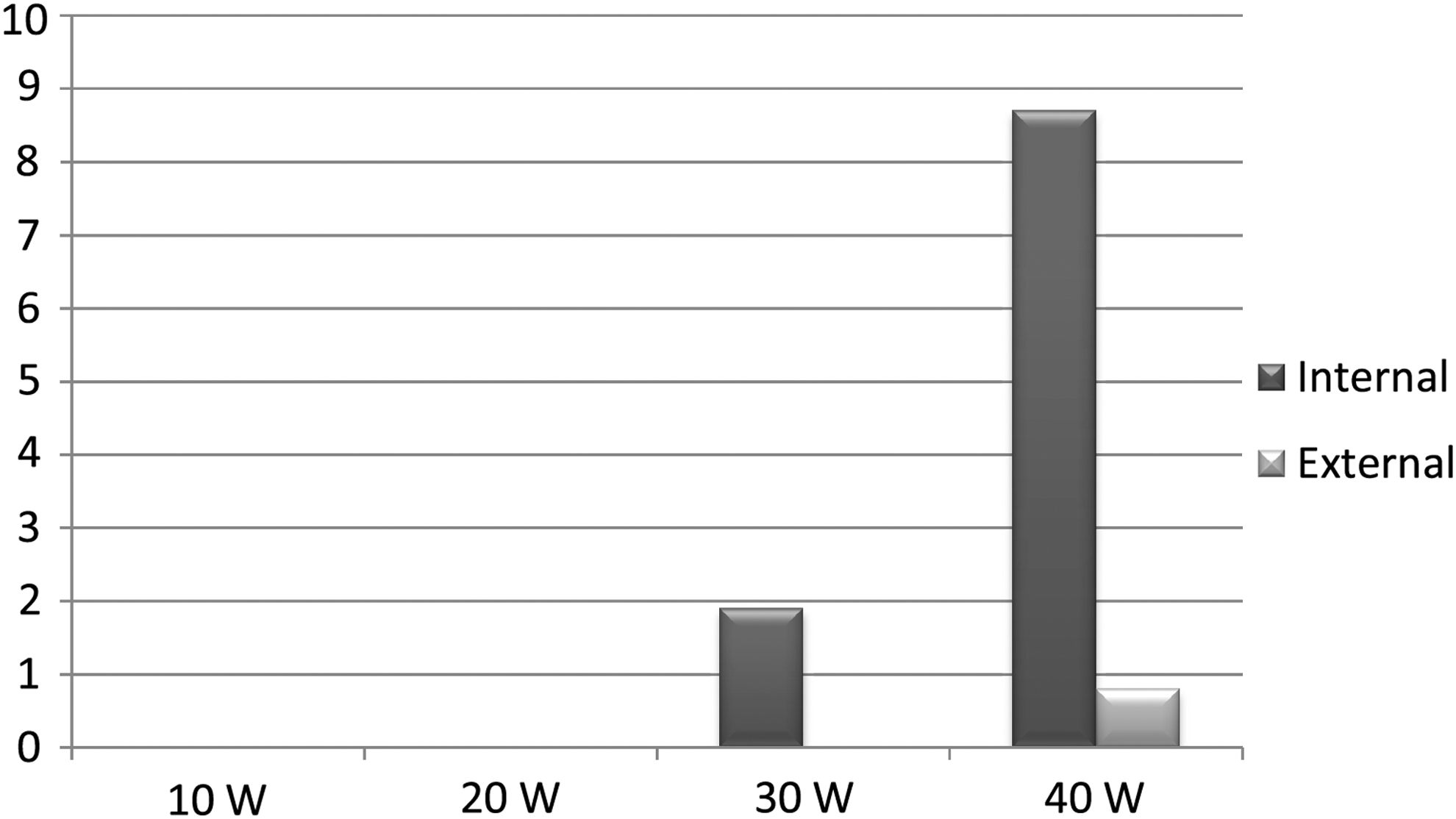
Increases in temperature (°C) between the baseline measurements and the last measurements after 3 minutes of laser activation with 60 compressions flow under different power setting of the Tm:YAG.
Tm:YAG continuous mode.
Ho:YAG
There were no temperature changes with the use of Ho:YAG in the 10 W power setting under the aforementioned irrigation flows. There was only a 2.1°C increase in the temperature of the irrigation fluid at 20 W power setting with normal flow irrigation, while no difference in temperature was noted with the remaining of the investigated irrigation flows. There were no differences in the temperature between the inside and outside of the renal pelvis. Table 2 summarizes the measurements of Tm:YAG.
Ho:YAG pulsed mode.
Discussion
The possible thermal effect and the subsequent increase in temperature of lasers used in the UT have not been adequately investigated. Hardy et al. performed laser lithotripsy in an in vitro setting and investigated the temperature changes of the irrigation fluid during the activation of Ho:YAG and Tm:YAG. 9 They concluded that the Tm:YAG lithotripsy could be performed with safety if the pulse rate was less than 500 Hz or the flow rate of irrigation was increased higher than the rate used in the study (22 mL/min). Nonetheless, all measurements were performed with the same power settings and the same flow rate. Thus, the safety of Tm:YAG under various power settings and flow rates remained unclear. In an attempt to elucidate the earlier issues, we conducted an experimental protocol to investigate different aspects of the Tm:YAG thermal effect in the irrigation fluid and to elaborate the potential use of Tm:YAG in the UT. 11 The study showed that the Tm:YAG with power settings up to 20 W in pulsed and continuous mode could be used in the UT without any risk for thermal injury due to the temperature of the irrigation fluid. These settings could provide a safe approach even under very low flow rates (2 mL/min). The later low flow rate was considered as the worst case scenario for irrigation flow during UT endoscopic surgery 11,12 and higher power settings could be possible in the case of higher flow rates. Nevertheless, there was a standing question if the evidence obtained from the in vitro investigation could be considered as adequate for the in vivo application of the Tm:YAG. Consequently, we conducted the current in vivo experiment to evaluate the temperature changes in UT during the activation of Tm:YAG. The experiment aimed into replicating the conditions for UT endoscopic surgery. Thus, the porcine kidney was used as a model due to its similarities with the human kidney. 13,14 The experiment was designed to provide measurements of the temperature of the irrigation fluid and the renal pelvis to elucidate any significant dissipation of heat to the renal tissue.
The selection of the power settings was based on figures obtained from previous investigations, which showed efficacy of the Tm:YAG in stone fragmentation while maintaining the safety profile proposed from our previous study. 8,9,15 To reveal any differences between Ho:YAG and Tm:YAG, measurements with the same configuration and settings were obtained by the Ho:YAG. The use of Ho:YAG in the UT surgery has a well-established safety profile 16 –18 and the comparative use of this laser could be considered as a control for the Tm:YAG. The fibers of the Ho:YAG and the Tm:YAG, which were used in the current study, could provide up to 20 and 40 W of laser energy, respectively. The previous limitation is related to the use of fibers that are appropriate for insertion through a flexible ureteroscope. As a consequence, the power settings were limited to 20 W for the Ho:YAG and the 40 W for the Tm:YAG. The increased power settings for the Tm:YAG were considered for the experiment to obtain as extensive information as possible for the use of Tm:YAG in UT endoscopic surgery. The comparison of the temperatures obtained by the current investigation showed that the Tm:YAG in continuous mode has a similar increase in temperature with Ho:YAG in power settings up to 20 W. Even the highest power setting for the Tm:YAG (40 W) did not result in an increase of temperature more than 10.5°C. As a result, the appropriate for UT endoscopic surgery fibers could be used in the highest power setting without a harmful increase in the temperature of the irrigation fluid in the renal pelvis at least in the proposed experimental setup.
The flow rate is a significant factor for the increase in the temperature as shown in the previous experimental study. 11 The higher flow provided by the pump system minimized the increase in temperature within the renal pelvis regardless of the power setting of the laser. Practically, the use of the pump eliminated any thermal effect in the irrigation fluid. UT endoscopic surgery is almost exclusively performed with constant irrigation either from an automatic pump or a manual pump and the use of the Tm:YAG could be considered as safe based on the evidence provided by the current in vivo experiment. Nevertheless, it should be made clear that there is a high variation of irrigation flows based on the use of different combinations of access sheaths, fibers, and scopes. 12 The current setting presented a combination of flexible scope with a 14F ureteral access sheath, which could be considered as a common operative setup.
The increase of the external temperature was lower in comparison to the increase inside the renal pelvis. The internal temperature could increase up to 10.5°C from an initial value of 23°C, while the external temperature increased only 2.5°C. The earlier maximal increases in the temperature represent the highest power setting (40 W) and the lowest flow (no use of the pump). The temperature increase with the manual pumping is minimal even in the case of the highest 40 W setting. In ureterorenoscopy, the laser activation is always accompanied by pumping of the irrigation fluid. Thus, the irrigation fluid temperature changes in the highest power setting are likely not related to any clinically significant increase in the temperature of the irrigation fluid. These results could be related to a possible heat sink effect due to the blood flow through the vessels of the renal pelvis and parenchyma. Thermal energy produced by the activation of the laser could probably be absorbed by the tissue and abducted through the blood flow. The increase in the irrigation fluid never achieved temperatures that could be considered to set the renal tissue at risk. A maximal temperature of 35°C could not represent any danger to the renal tissue and this conclusion is further advocated by the fact that the lasers were continuously activated for 3 minutes. Endoscopic surgery frequently requires long laser activation times. Nevertheless, the laser is activated in short intervals and the current investigation protocol provides evidence on the changes of temperature under unusually long activation periods.
The limitation of the study is that the histopathologic evaluation of the thermal effect on the renal tissue was not performed. The laser fiber was not activated on the renal tissue during the measurements. Moreover, only low increases of temperature were observed during the experiment. Thus, we decided not to perform any histopathologic investigation as thermal effects could not be expected. Moreover, the performance of histopathologic assessment would also need the sacrifice of several animals to obtain reliable results. In addition, the use of laser devices with higher variety of power settings when using fibers for UT endoscopic surgery could provide a more extensive documentation of the currently presented results.
Conclusion
The use of Tm:YAG in continuous mode with power settings up to 40 W and flow rates similar to those used in the clinical practice seemed to result in temperature increases in the irrigation fluid, which do not represent a risk for the renal tissue during the UT endoscopic surgery.
Footnotes
Author Disclosure Statement
No competing financial interests exist.
Abbreviations Used
References
Supplementary Material
Please find the following supplemental material available below.
For Open Access articles published under a Creative Commons License, all supplemental material carries the same license as the article it is associated with.
For non-Open Access articles published, all supplemental material carries a non-exclusive license, and permission requests for re-use of supplemental material or any part of supplemental material shall be sent directly to the copyright owner as specified in the copyright notice associated with the article.
