




Abstract
Purpose:
To compare the safety and efficacy of thulium laser enucleation of the prostate (ThuLEP) with plasmakinetic enucleation of the prostate (PKEP).
Methods:
A total of 127 patients with benign prostatic hyperplasia (BPH) were randomized to either ThuLEP (n = 61) or PKEP (n = 66). All patients were assessed preoperatively and followed up at 3, 6, and 12 months postoperatively. Baseline characteristics of the patients, perioperative data, postoperative outcomes, and complications were recorded.
Results:
The decrease in hemoglobin level and the catheter time were statistically significantly lower in the ThuLEP group compared with the PKEP group (0.80 ± 0.49 vs 0.99 ± 0.52, p = 0.037, and 1.85 ± 0.94 vs 2.28 ± 1.34, p = 0.042). There were no statistical differences in complications between the two groups (p > 0.05). There was a significant improvement in 3, 6, and 12 months' parameters compared with preoperative values (p < 0.001). Assessment at the 12-month follow-up showed no difference in urinary parameters between the two groups.
Conclusions:
ThuLEP and PKEP are both safe and efficient procedures for the treatment of patients with BPH. Compared with PKEP, ThuLEP provided less risk of hemorrhage and shorter catheter time, although the differences may be of little clinical relevance. Further well-designed trials with extended follow-up and larger sample size are needed to draw final conclusions about the efficacy of the two procedures.
Introduction
T
Plasmakinetic enucleation of the prostate (PKEP) was introduced to enucleate the prostate adenoma with the electrode loop and resectoscope tip without supernumerary equipment. 3 The procedure enucleating the adenoma is similar to open prostatectomy, which enables anatomic enucleation of the entire lobes of the prostate. 4 Additionally, physiologic saline may be used as the irrigation fluid instead of mannitol solution, which can eliminate the risk of TURS. 2,5 It is considered an effective alternative to TURP and superior to monopolar TURP and bipolar TURP but with lower morbidity and shorter hospital stay. 2,6 PKEP is also a promising surgical approach in patients with large BPH by good surgical efficiency and similar prostatic tissue removal compared with open prostatectomy. 4,7
The thulium laser enucleation of the prostate (ThuLEP) technique is a relatively new approach, which was first introduced in 2010 by Herrmann and colleagues. 8 Thulium (Tm:YAG) laser emits laser energy in a continuous-wave manner at a wavelength of 2013 nm, which is close to the absorption peak of water, and thereby, thulium laser demonstrates a shallow tissue penetration, coagulation zone, and necrotic tissue zone providing high surgical safety. 9 Furthermore, physiologic saline is used as the irrigation fluid during ThuLEP, which can decrease the risk of TURS. 10 Compared with TURP or plasmakinetic TURP, ThuLEP demonstrated a similar efficacy in terms of Qmax, International Prostate Symptom Score (IPSS), postvoid residual (PVR), and quality of life (QoL) during postoperative follow-up and similar safety in terms of local complications but with many benefits, such as lower decreases in serum hemoglobin levels, shorter length of hospital stay, and catheterization time. 5,9,11,12
To the best of our knowledge, few studies have compared ThuLEP with PKEP so far. In the present study, we conducted a randomized trial with a 12-month follow-up to compare the safety and efficacy of ThuLEP with PKEP in the treatment of patients with BPH.
Materials and Methods
Patients
From October 2011 to February 2013, 191 patients were assessed for eligibility, and a total of 127 consecutive patients with symptomatic BPH were enrolled in this study. The patients were randomized to ThuLEP (n = 61) or PKEP (n = 66) before the day of surgery. The inclusion criteria were age ≥50 years but <85 years, IPSS ≥7, Qmax <15 mL/seconds, and medical therapy failure. The exclusion criteria were neurogenic bladder, documented or suspected prostate cancer, a history of prostatic or urethral surgery, and a poor tolerance for surgery. The patients on anticoagulants or those with coagulation defects were also excluded. All patients gave written informed consent. The study protocol was approved by the Institutional Review Board of our hospital and was conducted in compliance with the Declaration of Helsinki.
Assessment
The patients' preoperative evaluations included transrectal ultrasonography with measurement of the total prostate size, serum prostate-specific antigen (PSA) assay, and urine analysis. IPSS, QoL score, Qmax, and PVR volume were recorded before and 3, 6, and 12 months after operation. The catheters were removed once the urine color became clear. The perioperative outcome measures included operation time, changes in serum sodium and hemoglobin levels, resected weight, time to catheter removal, hospital stay, and complications. The complications were classified using the modified Clavien–Dindo classification of surgical complications.
Equipment
All surgical procedures were performed by a single surgeon (J.S.) who was fully trained in ThuLEP and PKEP. The physiologic saline was used as the irrigation fluid for both the procedures. Since the separate commercial morcellator is not widely available in China so far, the difference in the ThuLEP and PKEP procedures in our study from others is that the enucleation adenoma was removed by loop electrode resection but not by the morcellator.
The thulium laser unit (Revolix 70 W surgical laser, Katlenburg, Germany) was used for the ThuLEP procedure with a reusable 550-μm laser fiber (RigiFibTM, Katlenburg, Germany), with an energy setting of 70 W for cutting and 30 W for coagulation. 13 The laser fibers were introduced using a 26F Storz continuous-flow resectoscope (Karl Storz, Tuttlingen, Germany).
The PKEP procedure was performed with a 26F Storz continuous-flow resectoscope (Karl Storz) with the loop of the Gyrus Plasmakinetic SuperPulse System (Gyrus Medical, Cardiff, United Kingdom). The PK system used 160 W for cutting and 80 W for coagulation.
Surgical techniques
Procedure of PKEP
PKEP was performed as previously described by Liu 6 and Rao and colleagues. 14 The incision was started close to the verumontanum from the 5 to the 7 o'clock positions. These grooves were deepened to the level of the surgical capsule. The tip of the resectoscope sheath was then inserted into the groove, which pushed the lobe along the surgical capsule line to create the cleavage plane between the detached lobe and the capsule. The bipolar plasmakinetic loop moved in exactly the same plane as the surgeon's index finger does when performing open prostatectomy. Middle lobe, left lobe, and right lobe were dissected off the surgical capsule in a retrograde manner from the apex toward the bladder using the bipolar plasmakinetic loop with arrest of bleeding. The enucleated lobes were devascularized simultaneously but still attached at the bladder neck by a narrow pedicle (the “mushroom” technique 15 ). The adenoma was resected into smaller prostatic chips by the plasmakinetic loop and extracted by Ellic washer. A 22F triple-lumen catheter was inserted and connected to straight drainage after the operation.
Procedure of ThuLEP
ThuLEP procedure was performed similar to the PKEP. The laser was used to cut off the adhesive fibers between the lobe and the surgical capsule and coagulate denuded supply vessels and hemorrhage spots on the capsule surface. After the enucleation procedure, the devascularized lobes, crowded at the bladder neck and attached to bladder neck by mushroom-like pedicles, were resected into smaller prostatic chips by the plasmakinetic loop and extracted by Ellic washer. A 22F triple-lumen catheter was inserted and connected to straight drainage after the operation.
Statistical analysis
The sample size was calculated to be at least 55 patients in each group, with α = 0.05 and a power of 80% (β = 0.20) based on our previous work. Considering the research expenses and possible loss to follow-up, we plan to enroll at least 60 patients in each group. Statistical analysis was performed using the calculating program SPSS (version 16.0; SPSS, Inc., Chicago, IL) for Windows. Continuous variables are presented as mean ± standard deviation, and differences between two groups' data were analyzed by the independent samples t-test. Differences between preoperative and postoperative improvement in the assessed parameters in each group were analyzed using one-way independent analysis of variance. The categorical data were compared using Pearson's χ 2 test, and Fisher's exact test was used when appropriate. Differences with p < 0.05 were considered significant.
Results
Figure 1 shows a flow diagram of participant progress through trial phases. There were no significant differences between the ThuLEP and PKEP groups with respect to age, prostate size, PSA level, IPSS, QoL score, Qmax, and PVR (p > 0.05). There was no TURS, and no subject was converted to open prostatectomy. The operation time, resected weight, decrease in sodium, and hospital stay in the ThuLEP group were similar to those in the PKEP group (p > 0.05). The hemoglobin drop was significantly lower in the ThuLEP group at 0.80 ± 0.49 g/dL compared with 0.99 ± 0.52 g/dL in the PKEP group (p = 0.037). The catheter time was also significantly lower in the ThuLEP group at 1.85 ± 0.94 days compared with the PKEP group at 2.28 ± 1.34 days (p = 0.042). Data are shown in Table 1.
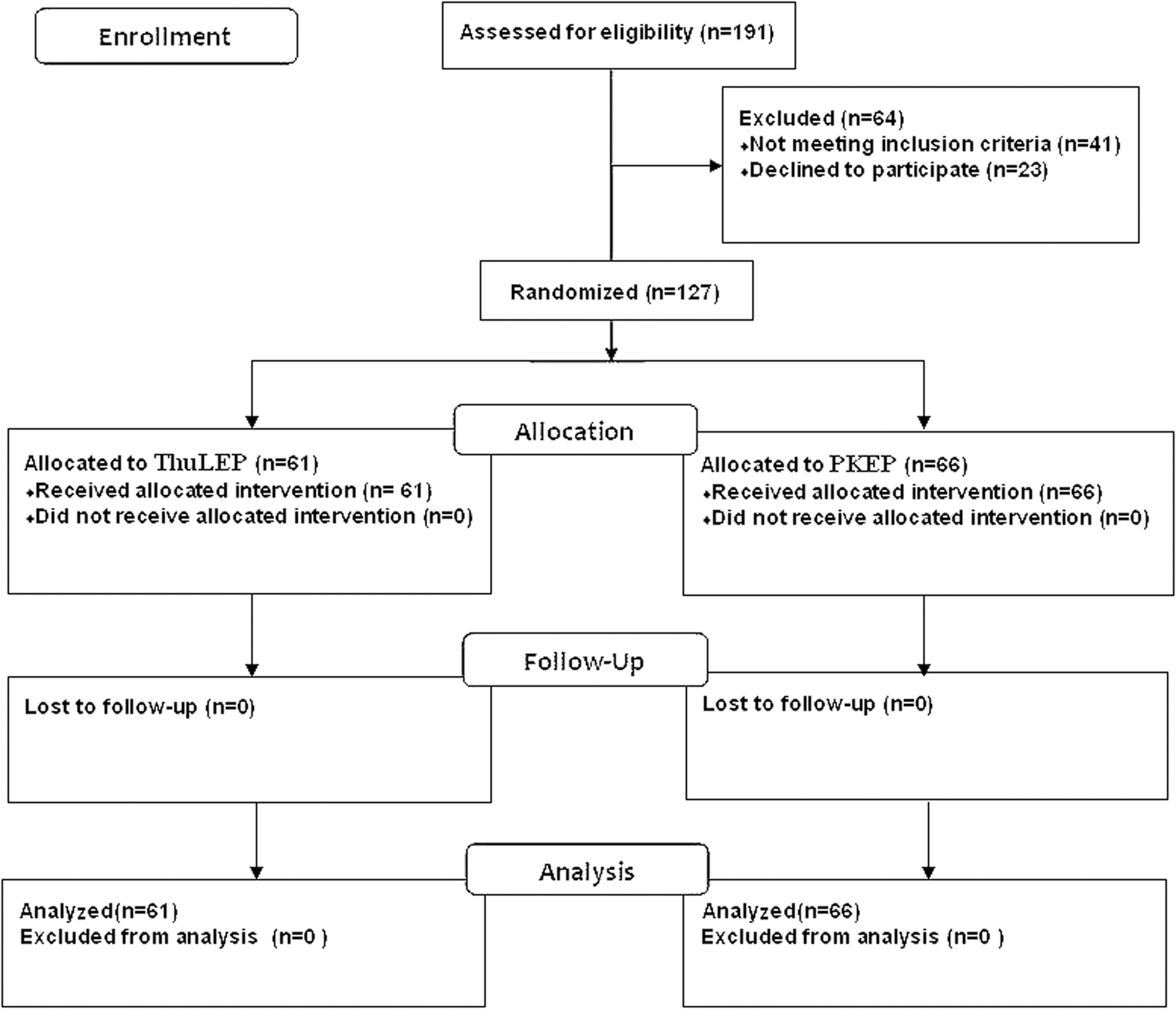
Flow diagram of participant progress through trial phases. ThuLEP = thulium laser enucleation of the prostate; PKEP = plasmakinetic enucleation of the prostate.
Data presented as mean ± standard deviation. * p < 0.05.
IPSS = International Prostate Symptom Score; PKEP = plasmakinetic enucleation of the prostate; PSA = prostate-specific antigen; PVR = postvoid residual; QoL = quality of life; ThuLEP = thulium laser enucleation of the prostate.
All 127 patients in the two groups completed the follow-ups at 3, 6, and 12 months after operation. Table 2 lists the changes in IPSS, QoL score, Qmax, and PVR in the 3, 6, and 12 months after the operation relative to preoperative values. There was a significant improvement in 3, 6, and 12 months' parameters compared with preoperative values in each group (p < 0.001). There were no statistically significant differences between the two groups with respect to preoperative and postoperative values (p > 0.05).
Data presented as mean ± standard deviation. * p < 0.001.
Preop = preoperative.
Intraoperative capsule perforation occurred in 1 (1.5%) patient in the PKEP group. The damage was mild and treated with catheterization for 3–5 days. No bladder mucosal damage occurred in both the groups. Transient urinary incontinence occurred in 3 (4.9%) patients in the ThuLEP group and 3 (4.5%) patients in the PKEP group. The difference was not statistically significant (p = 0.921). No patient developed stress urinary incontinence persistent for more than 3 months. There was 1 (1.5%) patient in the PKEP group who required blood transfusion because anemia existed preoperatively. Urinary tract infection occurred in 1 (1.6%) patient in the ThuLEP group and 2 (3%) patients in the PKEP group, which were treated with antibiotics. There was one patient in each of the two groups who needed recatheterization after surgery, and cystoscopy showed residual tissue at the apex of prostatic fossa. Hematuria requiring reoperation was observed in 1 (1.5%) patient in the PKEP group, which underwent transurethral electric coagulation. The other postoperative complications included urethral stricture that occurred in 1 (1.6%) patient in the ThuLEP group, which required urethrotomy. Bladder neck contracture occurred in 1 (1.5%) patient in the PKEP group, which required transurethral resection of bladder neck. Data are shown in Table 3.
Data presented as n (%).
NA = not applicable.
Discussion
The technique of enucleation of prostate has been widely used, and its adaptation to an endoscopic procedure represents a paradigm shift in the surgical treatment of BPH. Although conceptualized originally for the holmium laser, 16 it has become clear that alternative point sources of energy, delivered in a safe manner, might be equally able to achieve the same end of enucleation. 2 The wavelength of the thulium laser can match the water absorption peak in the tissue. The high density of absorbed energy at the tissue surface leads to instant vaporization and limits the penetration depth from 500 to 2000 μm, a reasonable depth for sufficient homeostasis with minimal thermal injury to surrounding tissue. 17 Moreover, the continuous-wave output of the thulium laser allows incision and vaporization of tissue with much better hemostasis. 18 A few clinical researches had proved ThuLEP to be a safe and effective treatment for BPH, and its effectiveness was similar to that of holmium laser enucleation of the prostate (HoLEP) and TURP. 9,11,13
PKEP is a minimally invasive approach for BPH and can be used in prostates of any size and provide long-term reliable outcomes. 5 It is also as safe and effective as HoLEP, TURP, and open prostatectomy according to the previous report. 2,4,6,7 Although it remains less versatile than the holmium laser, particularly in terms of stone disease, however, the lower capital costs and ease of use of this technique make it a good choice for BPH.
The present study showed that only one patient needed blood transfusion in the PKEP group only because anemia existed before operation. The decrease in hemoglobin in the ThuLEP group was significantly lower than that in the PKEP group. Zhang and colleagues demonstrated that the ThuLEP resulted in lower blood loss statistically compared with the HoLEP. 13 Yang and colleagues also demonstrated that ThuLEP resulted in less hemoglobin decrease than plasmakinetic resection of the prostate. 19 The results were similar to ours, which indicated that the superior hemostasis effectiveness obtained during ThuLEP led to a significantly lower hemoglobin drop. Furthermore, as assessed by the better hemostasis effectiveness, the ThuLEP group also needed shorter catheter time. The hospital stay in the ThuLEP group was also shorter than that in the PKEP group in our study, although the difference had no statistical significance.
The operation time was similar in both the groups. Neill and colleagues had demonstrated that the operation time of PKEP was longer than HoLEP, and the possible reason was that vaporization bubbles often obscured the sight of the tissue planes, and hemostasis was less readily achievable during the PKEP operation. 2 Zhang and colleagues had demonstrated that the operation time of ThuLEP was also longer than HoLEP, and the possible reason was the thulium laser energy induced an “eschar-like” effect on the surface of the incised tissue. The mainly blunt dissection with subsequent laser coagulation of the vessels might have contributed to the longer time spent to dissect in the correct plane. 13 However, the better hemostasis effectiveness of ThuLEP can provide better intraoperative visibility during the operation. Moreover, in the present study, the surgical procedure enucleating the adenoma using the sheath is similar between the two groups. Our result was similar to that of Xu and colleagues, who reported that PKEP had the similar enucleation time compared with diode laser enucleation of the prostate with the same surgical procedure enucleating the adenoma. 20 Furthermore, to minimize the treatment costs and avoid bladder mucosal injury, we used the mushroom technique to resect the enucleation adenoma without a mechanical tissue morcellator in both the groups. Thus, the results in our study indicated that there was no significant difference in the operation time between the two groups. Additionally, the same surgical procedure used in the two groups could also explain that there was no significant difference in resected tissue weight between the two groups. Our results were similar to other studies. 13,20
Accordingly, the curative effect of ThuLEP and PKEP is similar. There was no statistically significant difference between the two groups in IPSS, QoL score, Qmax, and PVR at 3, 6, and 12-month follow-ups postoperatively. The results showed that the curative effect of ThuLEP is equivalent to PKEP in the early postoperative period. However, the follow-up time was short, and long-term follow-up data should be collected to compare ThuLEP with PKEP in the future.
There was only one patient of capsule perforation occurred only in one patient in the PKEP group. The risk of surgical capsule perforation during enucleation and the chance of bladder mucosal damage during morcellation existed in all transurethral enucleation approaches. A literature review of ThuLEP had showed that only one patient in one research reported capsule perforation, 9,13 which is similar to our result. Surgical capsule perforation is generally avoided during ThuLEP as blunt dissection of the adenoma over its capsule not only minimizes such a risk but also ensures proper capsule visualization during enucleation maneuvers. 8
No bladder mucosal damage occurred in both the groups. A literature review of ThuLEP also showed that bladder wall injuries were reported in 1.3%–5.6% of patients in the studies where a mechanical morcellator was used and in none of the studies where the mushroom technique was used. 9,13 With the mushroom technique, the achievement of thorough hemostasis and bladder distention are essential to avoid this complication.
Transient stress urinary incontinence is a common complication of endosurgical prostate enucleation, including laser enucleation and PKEP. 20 In our study, the incidence of urinary incontinence was similar in the two groups. The transient stress urinary incontinence in the present study might be caused by blunt trauma of the external sphincter from large swinging amplitude of the sheath or compressive atrophy of the external sphincter but not the thermal injury of the external sphincter. Therefore, stress urinary incontinence can be obviously relieved after a period of pelvic floor muscle training. 20
There is a higher risk of a harmful effect to the external sphincter while making the 12 o'clock incision because there is no landmark such as the verumontanum. 21 For safety, we usually left some apical tissue to avoid stress urinary incontinence that might occur from the injury to the external sphincter. This might explain that there was one patient in each of the two groups who showed residual tissue at the apex of prostatic fossa. In addition, the two cases occurred only in our early procedures. As experience has accrued, the complication can be avoided by carefully trimming the apex. The other complications in the two groups had no significant difference and were treated in time. The complication results indicated that the ThuLEP and PKEP were both safe and efficient for the treatment of BPH.
There are still some limitations in our study that should be considered. First, the sample size included in this study was small. Even though we obtained statistically significant data, the differences may be difficult to make clinically significant conclusions. Second, the average follow-up was too short not to demonstrate the long-term efficacy. Larger sample trials with longer follow-up are needed to further confirm our results.
Conclusions
ThuLEP and PKEP are both safe and efficient procedures for the treatment of patients with BPH. Compared with PKEP, ThuLEP provided less risk of hemorrhage and shorter catheter time, although the differences may be of little clinical relevance. However, further well-designed trials with extended follow-up and larger sample size are needed to draw final conclusions about the efficacy of the two procedures.
Footnotes
Author Disclosure Statement
No competing financial interests exist.