




Abstract
Introduction:
A novel single-use flexible ureteroscope promises the optical characteristics and maneuverability of a reusable fourth-generation flexible ureteroscope. In this study, the LithoVue Single-Use Digital flexible ureteroscope was directly compared with contemporary reusable flexible ureteroscopes, with regard to optics, deflection, and irrigation flow.
Methods:
Three flexible ureteroscopes such as the LithoVue (Single Use; Boston Scientific), Flex-Xc (Karl Storz, Germany), and Cobra (Richard Wolf, Germany) were assessed in vitro for image resolution, distortion, color representation, grayscale imaging, field of view, and depth of field. Ureteroscope deflection was tested with an empty channel followed by placement of a 200 μm laser fiber and a 1.9F wire basket, a 2.0F nanoelectric pulse lithotripsy (NPL) probe, and a 2.4F NPL probe. Ureteroscope irrigation flow was measured using normal saline at 100 cm, with an empty channel followed by a 200 μm laser fiber, a 1.9F wire basket and a 2.0F NPL probe.
Results:
The LithoVue showed the largest field of view, with excellent resolution, image distortion, and depth of field. No substantial difference was demonstrated in color reproducibility or in the discernment of grayscales between ureteroscopes. The LithoVue maintained full deflection ability with all instruments in the working channel, although the Flex-Xc and Cobra ureteroscopes showed loss of deflection ranging from 2° to 27°, depending on the instrument placed. With an empty channel, the LithoVue showed an absolute flow rate similar to the Flex-Xc ureteroscope (p = 0.003). It maintained better flow with instruments in the channel than the Flex-Xc ureteroscope. The Cobra ureteroscope has a separate 3.3F instrument channel, keeping flow rates the same with instrument insertion.
Conclusion:
The LithoVue Single-Use Digital ureteroscope has comparable optical capabilities, deflection, and flow, making it a viable alternative to standard reusable fourth-generation flexible digital and fiberoptic ureteroscopes.
Introduction
The flexible ureteroscope has changed significantly since its introduction in the late 1980s. Within the past decade, digital flexible ureteroscopes have been introduced and found to result in decreased operative times and improved visibility with similar stone-free rates. 1,2
As the technology of ureteroscopes has advanced, the equipment has become more fragile and requires repair that can be costly for a urology practice and hospital system. Therefore, to address these concerns about current commercially available ureteroscopes and the associated costs with having a ureteroscopy program, single-use ureteroscopes have been introduced, the latest is the LithoVue Single-Use Digital ureteroscope by Boston Scientific. 3
In this study, we compare the optical performance of the LithoVue ureteroscope against contemporary fourth-generation flexible digital and fiberoptic ureteroscopes. We also compare deflection and irrigant flow rates with and without instruments in the working channel of the ureteroscopes.
Materials and Methods
The LithoVue Single-Use Digital ureteroscope was compared with two brand new fourth-generation flexible ureteroscopes: the Flex-Xc Digital ureteroscope by Karl Storz and the Cobra Fiberoptic ureteroscope by Richard Wolf. Comparison criteria included image resolution, distortion, color representation, grayscale imaging, field of view, and depth of field. For each criterion, a single measurement was performed with each ureteroscope and only one ureteroscope of each model was used for data acquisition.
Resolution was determined by viewing a 1951 USAF Test Pattern Card at a distance of 3, 5, 10, and 20 mm with each ureteroscope. Resolution was recorded in line pairs per millimeter (line pairs/mm) and determined using a reference chart attached to the test target. Field of view was determined using a multifrequency grid target. Distortion was determined by imaging a multifrequency grid distortion target and calculating the difference between the actual and the theoretical dot location:
Distortion (%) = (actual distance−theoretical distance)/theoretical distance × 100
Color representation was determined using a Gretag Macbeth Color Checker Target for light flash and red. Grayscale imaging was determined using an ISO-14524 Camera Contrast Chart.
Depth of field was evaluated using Edmund Optics Depth of Field test target.
Ureteroscope deflection was tested with an empty channel followed by placement of a 200 μm laser fiber and a 1.9F wire basket, a 2.0F nanoelectric pulse lithotripsy (NPL) probe and a 2.4F NPL probe. Ureteroscope irrigation flow was measured using normal saline at 100 cm, with an empty channel followed by a 200 μm laser fiber, a 1.9F wire basket, and a 2.0F NPL probe.
Results
In assessment of the optical characteristics, image resolution of the LithoVue Single-Use Digital ureteroscope was found to be comparable with that of the Flex-Xc Digital ureteroscope by Karl Storz and nearly 40% better than that of the Cobra Fiberoptic ureteroscope. Image distortion was reduced compared with that of the Flex-Xc and the Cobra ureteroscopes. The LithoVue ureteroscope showed comparable depth of field and a superior field of view at 15.75 mm (Figs. 1 –3).

Irrigation flow was measured through each ureteroscope at 100 cm of H2O with an empty channel and with the introduction of various instruments. Both the Flex-Xc and LithoVue ureteroscopes have 3.6F working channels. The Cobra ureteroscope has two separate, side-by-side 3.3F working channels.
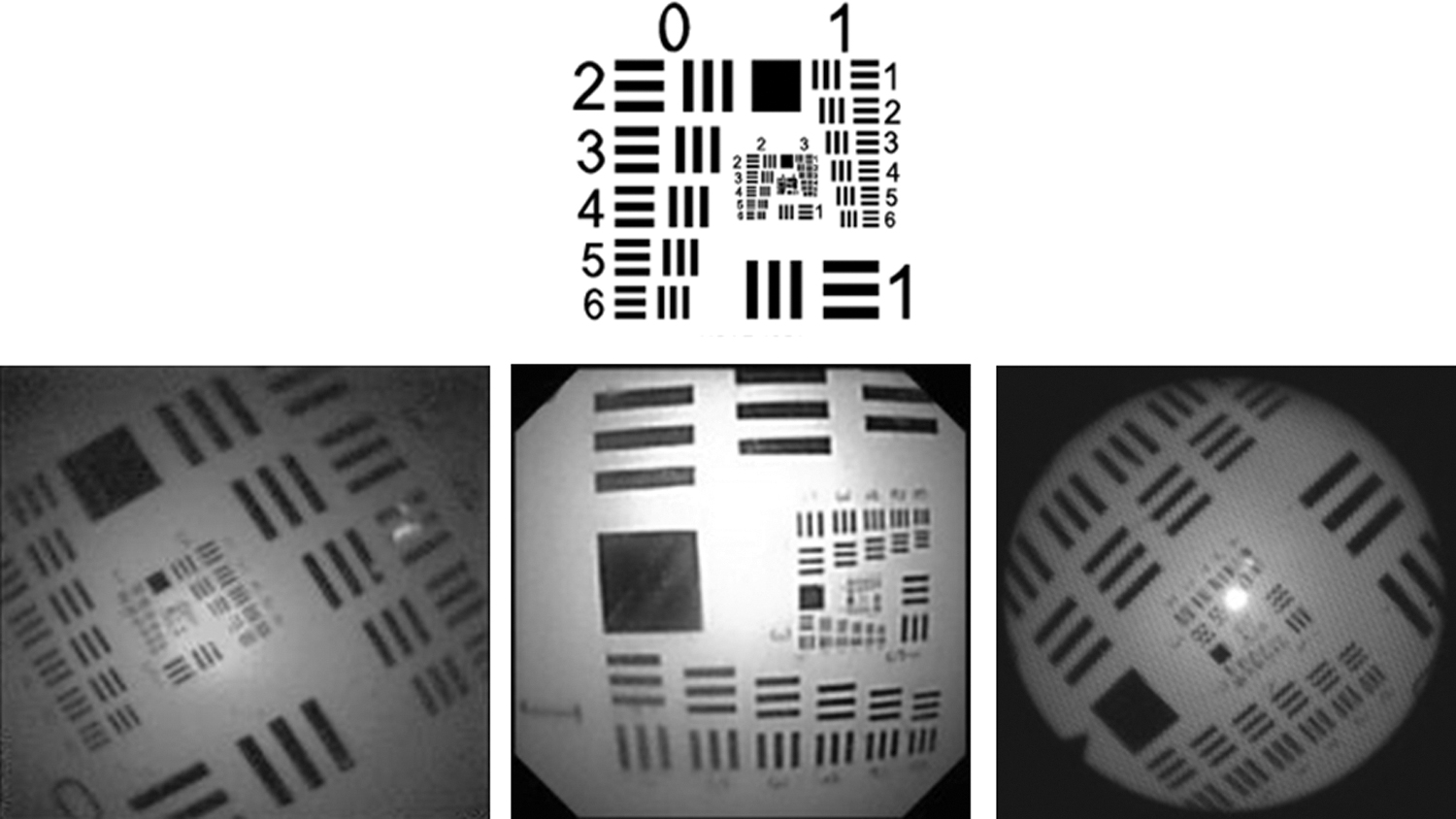
Image resolution. Resolution at 10 mm using 1951 USAF Test Pattern Card. Left: LithoVue Single-Use Digital ureteroscope (7.13 line pairs/mm); Middle: Flex-Xc Digital ureteroscope (8.00 line pairs/mm); Right: Cobra Fiberoptic ureteroscope (4.00 line pairs/mm).
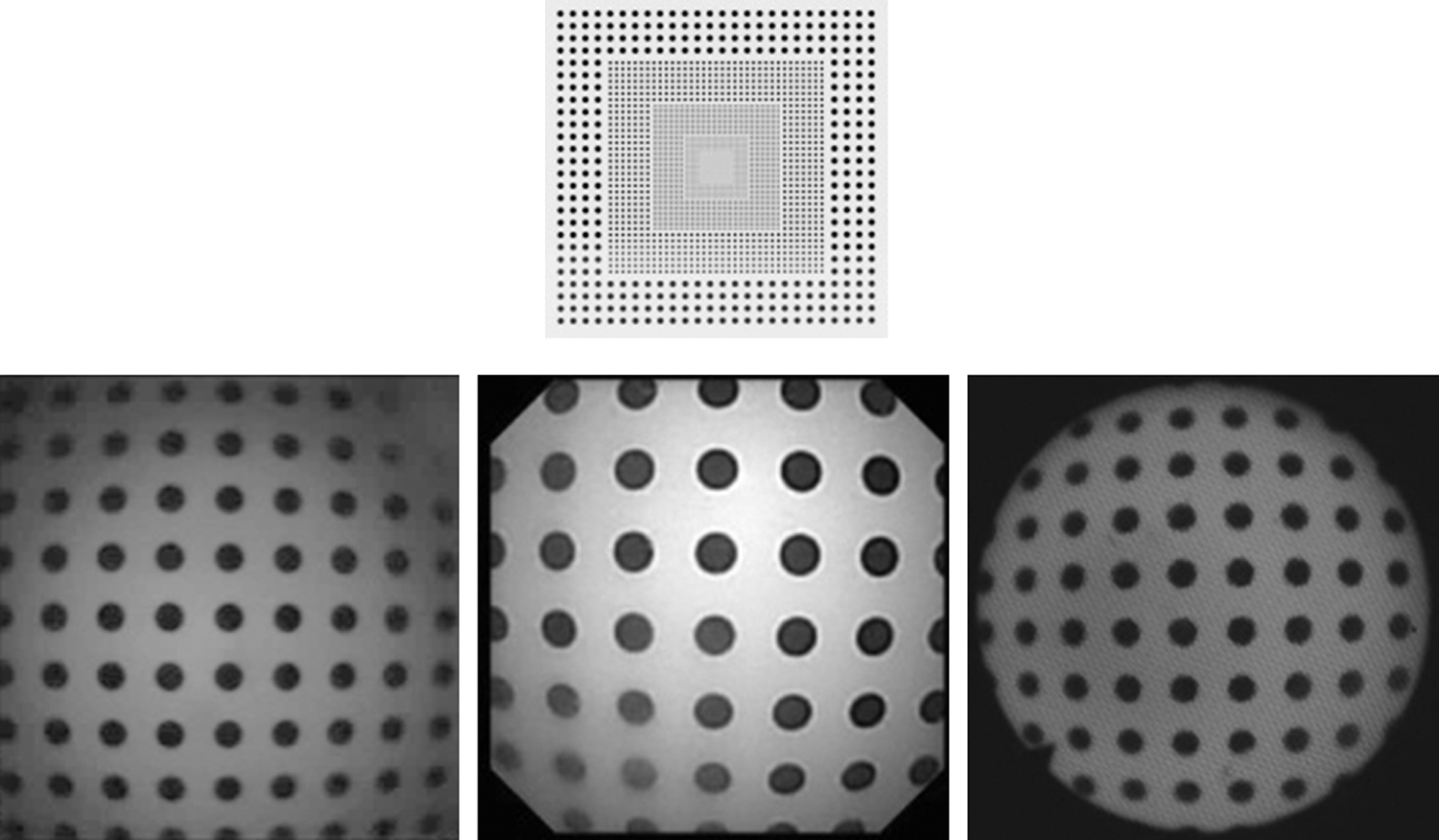
Image distortion. Distortion was checked using multifrequency grid distortion target. Left: LithoVue Single-Use ureteroscope (3.6% distortion); Middle: Flex-Xc ureteroscope (22.6% distortion); Right: Cobra ureteroscope (16.7% distortion).
There was no significant difference seen between color reproducibility or grayscale imaging among the three tested ureteroscopes (Fig. 4).
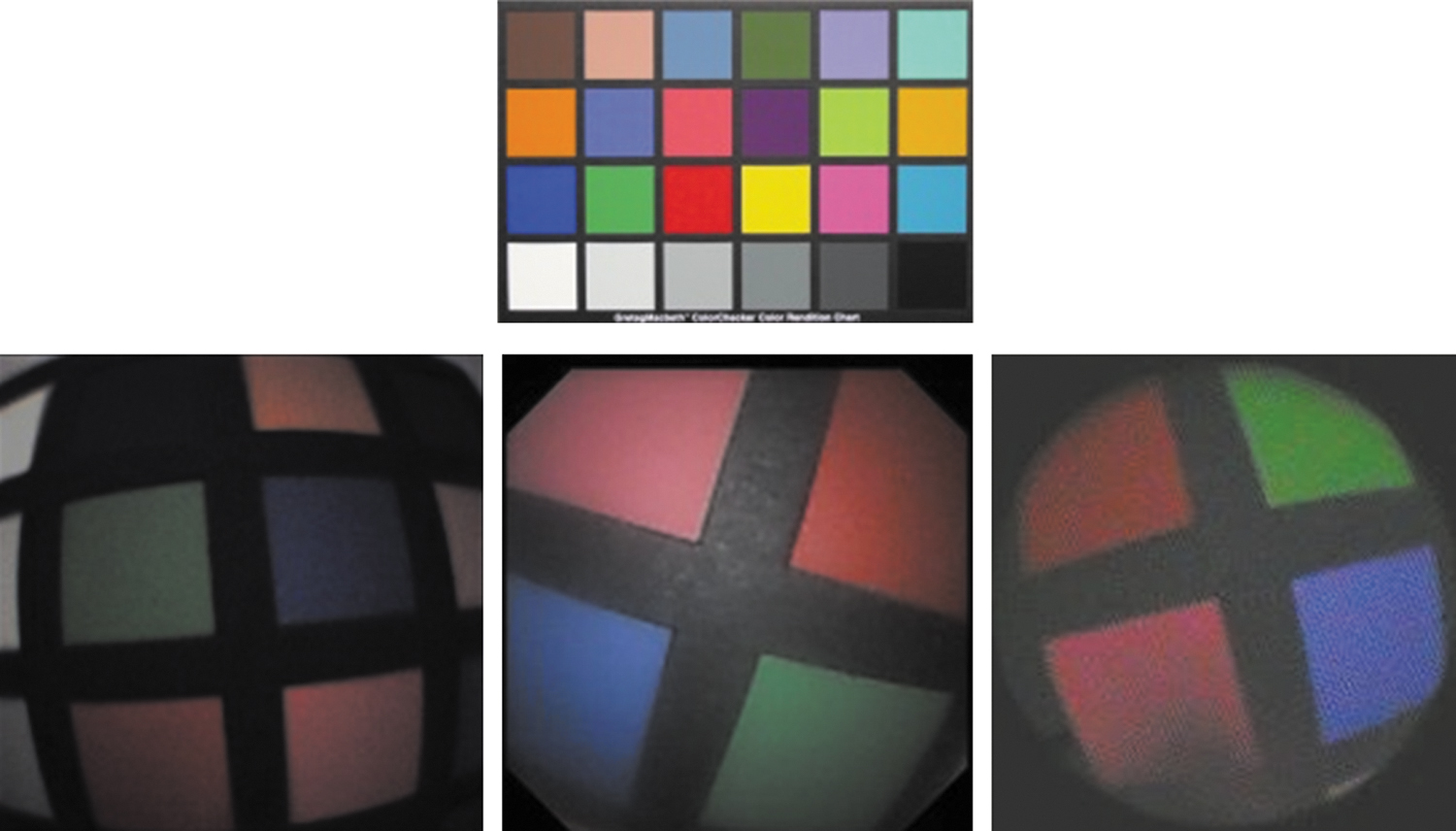
Color reproducibility using Gretag Macbeth color checker target. Left: LithoVue Single-Use ureteroscope; Middle: Flex-Xc ureteroscope; Right: Cobra ureteroscope.
The LithoVue Single-Use Digital ureteroscope had superior bidirectional maximal deflection at 276°. The LithoVue ureteroscope had minimal loss of deflection, between 2 and 5°, with the 200 μm laser fiber, 1.9F nitinol basket, and 2.0 and 2.4 NPL probes, in the working channel. The Flex-Xc ureteroscope lost deflection of 9° with the 200 μm laser fiber and 27° with the 2.4F NPL probe in the working channel. The Cobra lost deflection of 5° with the 1.9F nitinol basket and 19° with the 2.4F NPL probe in the working channel (Table 1).
Optical and Functional Characteristics of the Three Tested Ureteroscopes
With regard to ureteroscope irrigation flow, the LithoVue and Flex-Xc ureteroscopes had similar absolute flow rates at 40 and 38 mL/min, respectively. Irrigation flow was better preserved through the LithoVue working channel, but similar to the Flex-Xc ureteroscope. The Cobra Fiberoptic ureteroscope has two side-by-side working channels, keeping irrigation flow preserved with instruments in a working channel (Fig. 5).

Depth of field determined using Edmonds Optics Depth of Filed test target. Left: LithoVue Single-Use ureteroscope; Middle: Flex-Xc ureteroscope; Right: Cobra ureteroscope.
Results are summarized in Table 2.
Deflection Was Measured with an Empty Channel and Then with Placement of Various Instruments
Boldface indicates unit of measure is degrees.
NPL, nanoelectric pulse lithotripsy.
Discussion
The first ureteroscopy was described at the beginning of the 20th century, but it is not until the late 1980s that the technology advanced and ureteroscopy became more common practice. 4 Over the next decade, design improvements were made to include an active deflection mechanism, better light transmission, and miniaturization of individual optic fibers, allowing for introduction of a working channel for irrigation as well as passage of small caliber instruments. In the subsequent 10 years, digital flexible ureteroscopes were introduced and have been shown to be superior to fiberoptic ureteroscopes with decreased operative times, better vision, and maneuverability with similar stone-free rates. 1,2 Zilberman et al. performed a direct comparison between a digital and a fiberoptic ureteroscope, showing that digital ureteroscopes have improved color reproducibility, 2–3 × better image resolution, and a larger image size. 5 Although current digital ureteroscopes are impressive instruments, there remain problems with cost, fragility, and the need for endoscope processing. With these limitations in mind, there have been a number of single-use ureteroscopes developed over the past few years in an attempt to address some of these issues.
The LithoVue ureteroscope offers a compelling alternative to flexible reusable ureteroscopes, by which, as the technology improved and the caliber of the instrument became smaller, the equipment became more delicate and fragile, requiring continual maintenance. Sterile processing accounts for some of the damage incurred, anywhere from 7% to 22% of the time, as a result of overcurling, closing the storage case on the shaft, improper cleaning or sterilization. 6,7 By far, the most common cause of repairs needed is from surgeon use as a result of laser burns, instrument passage, and/or extreme deflection with indwelling instruments. 7 –9 The average fiberoptic ureteroscope is used 6 to 15 times before needing repair and the average digital ureteroscope is used 21 times before needing repair. 6,10 In addition, once a ureteroscope is refurbished, it needs to be repaired after using it for fewer cases. A brand new ureteroscope may get used 40 to 50 times before needing repair, but after repair, it averages only 11 uses before repairs are required. 11 Reusable ureteroscopes break and they are costly to repair. The cost to provide ureteroscopy includes the capital equipment purchase, service contract, the cost of sterile processing, and the repair cost, which can be greater than $100,000 a year. 12
This is the first rigorous comparison of the LithoVue Single-Use Digital Flexible Ureteroscope to contemporary fourth-generation digital and fiberoptic flexible ureteroscopes. Our benchtop analysis comparing the LithoVue Single-Use Digital ureteroscope with the Flex-Xc Digital ureteroscope by Karl Storz and the Cobra Fiberoptic ureteroscope by Richard Wolf found that the LithoVue ureteroscope has superior deflection characteristics with comparable optics and irrigation flow to the Flex-Xc Digital ureteroscope. The LithoVue ureteroscope has superior deflection and optic characteristics to the Cobra Fiberoptic ureteroscope.
Given the advances in ureteroscope technology and the ubiquitous nature of ureteroscopy training, ureteroscopy has become the first-line treatment for many patients with upper tract stone disease and an invaluable tool in the diagnosis and treatment of other upper tract pathologies. 13 The CROES Ureteroscopy Global Study notes that the use of ureteroscopy globally decreased hospital stays, patients had fewer postoperative complication, and had better outcomes with higher stone-free rates. Most of the ureteroscopies performed globally are semirigid however, further highlighting the expense of reusable flexible technology and need for a more affordable option with comparable optical and performance features, allowing for the diffusion of the surgical standard of care for upper tract pathologies. 14,15
Although our results are impactful, we acknowledge that all the tests were performed on the bench and clinical results could be somewhat different. Yet, our limited clinical experience since the LithoVue was approved for use in Europe and the United States in December, 2015, has been positive, suggesting that this single-use ureteroscope will have a place in managing routine and complex ureteral and renal pathologies. Further evaluations of the LithoVue Single-Use Digital ureteroscope in vivo are needed to validate whether the excellent benchtop parameters seen in this analysis translate into valuable clinical performance.
Conclusions
The LithoVue Single-Use Digital ureteroscope has comparable optical capabilities, deflection, and flow, making it a viable alternative to standard nondisposable fourth-generation flexible digital and fiberoptic ureteroscopes.
Footnotes
Acknowledgments
The abstract of this article was first presented at the 33rd World Congress of Endourology London in October 2015.
Author Disclosure Statement
Dr. G.M.P., Dr. M.E.L., and Dr. W.N.S. are consultants for Boston Scientific.