




Abstract
Introduction:
The decision between partial nephrectomy (PN) and radical nephrectomy (RN) may be influenced by training, practice type, or location. We sought to evaluate current opinions about the optimal management of 4–10 cm renal-cell carcinoma (RCC).
Materials and Methods:
A survey was emailed to ∼2500 Endourologic Society and Society of Urologic Oncology members regarding training, practice setting, and interest in clinical trials in addition to questions about four patient scenarios. We evaluated the associations of demographic variables with specific answers.
Results:
399 physicians completed the survey with 37% and 34% completing urologic oncology and endourology fellowships, respectively. More respondents reported receiving adequate training in complex open PN compared with complex minimally invasive surgery (MIS) PN, 81% vs 37%. Eighty-three percent of respondents would offer a healthy patient a PN for a 7 cm exophytic mass. Receiving adequate training in complex PN is predictive of offering PN for a central RCC (p = 0.001). Academic practitioners were more likely to offer PN in these patients (p = 0.03). Those completing training after 2000 were more likely to offer MIS (p = 0.02), and respondents who completed an oncology fellowship were more likely to offer PN to unhealthy patients (p = 0.03).
Conclusions:
Opinions about the best treatment for 4–10 cm RCC differ significantly, with 70% of respondents willing to enroll patients in a randomized clinical trial. Effective efforts in teaching PN and minimally-invasive surgery result in practices that favor these approaches.
Introduction
W
When considering surgical management for RCC, surgeons have two goals: remove the tumor completely and maximize kidney function. In smaller RCC, aggressive tumors are rare, and nephron sparing surgery is often technically easier. As tumors become larger, the incidence of high grade and high stage tumors increases and surgery may be technically challenging. A phase 3 randomized clinical trial of radical vs PN for localized RCC was performed by the EORTC, but more than half of the tumors were less than 3 cm, so it is not possible to draw conclusions about the best treatment of 4–10 cm RCC from this trial. 3
With no high quality studies to provide evidence for the superiority of either RN or PN in larger but clinically localized RCC, surgeons likely make these decisions based on multiple factors, including training, prior experience, overall renal function, and location of the tumor. The objective of this study was to evaluate current opinions about the optimal management of 4–10 cm RCCs among members of the Endourologic Society and Society of Urologic Oncology (SUO).
Materials and Methods
Members of the Endourologic Society and Society of Urologic Oncology were invited to participate in a web-based 16-question survey on opinions of PN for large renal masses (4–10 cm). Of the ∼2500 emails sent out, 399 physicians (16%) completed the survey.
The survey (Supplementary Data; Supplementary Data are available online at
Fisher's exact test was used to evaluate differences among groups, and univariate and multivariate logistic regression were used to determine the associations between the prognostic variables and choices of treatment. p-Values (two-sided) less than 0.05 were considered significant. SAS version 9.2 (SAS Institute, Inc., Cary, NC) was used to perform all analyses.
Results
Approximately 2500 emails were sent to members of the SUO and Endourologic Society with a link to a web-based survey (Supplementary Data). A total of 399 (16%) surveys were completed and included in the analysis. For emails sent to active members of the SUO, of the 261 members who opened the email, 89 (34.1%) responded to the survey. Similar information is not available from the Endourologic Society. Respondent demographic information and characteristics are shown in Table 1.
AUA = American Urological Association; MIS = minimally invasive surgery.
Characteristics of respondents
Question 1 queried the surgical volume of the respondents. A total of 48%, 25%, and 11% of respondents treated 1–4, 5–10, and greater than 10 kidney tumors per month. Collectively, respondents answered that they surgically treated ∼20,706 patients with kidney tumors annually. The majority (58%) of respondents practice within the United States, distributed widely among the AUA geographical sections. Most respondents were located at academic centers (71.3%), and urologic oncology and endourology fellowships were completed by 37% and 34% of respondents, respectively. The median year that respondents finished training was 2000 (1993–2008). For complex large centrally located kidney tumors, 81% of respondents felt that they received adequate training to perform open PN and 37% of respondents felt that they received adequate training to perform PN using a robotic/laparoscopic approach. When asked about their comfort level for PN for 4–10 cm RCC based on approach, 37% of respondents were equally comfortable with open/MIS PN; while 44% felt more comfortable with an open approach, 12% reported greater comfort with MIS approach, and 6% reported they did not feel comfortable with either approach.
Respondents completing training after 2000 were more likely to report adequate training for both open (OR 1.9 95% CI 1.08–3.34, p = 0.03) and MIS (OR 3.6 95%CI 2.24–5.91, p < 0.0001) approaches for PN. The type of fellowship completed was also associated with respondents answering that they received adequate training. Oncology-trained respondents were 4.0 (1.92–8.52) times more likely to report adequate training in open PN than those with no fellowship (p = 0.0015). Both endourology and oncology trained surgeons were more likely to report that they were adequately trained in minimally invasive PN (OR = 2.9 and 3.5, respectively, p < 0.0001).
Respondent opinions about the best treatment for 4–10 cm renal mass considering only cancer outcomes
The majority (56%) of survey respondents answered that PN offers equal oncologic outcomes to RN, while 38% selected the response: “based on the available studies, we cannot conclude whether a PN or RN is a better treatment with regards to cancer outcomes.” Six percent of respondents answered, “partial nephrectomy has worse oncologic outcomes compared to RN for larger renal masses.”
Patient scenarios
Four theoretical patient scenarios were presented to respondents. For a healthy 50-year-old patient (Fig. 1) with normal renal function without comorbidities and an exophytic 7 cm RCC, 83% of respondents would treat with PN, while 17% of respondents would treat with RN. Respondents who reported that they did receive adequate training in open PN were less likely to offer RN (OR 0.487, p = 0.0239).
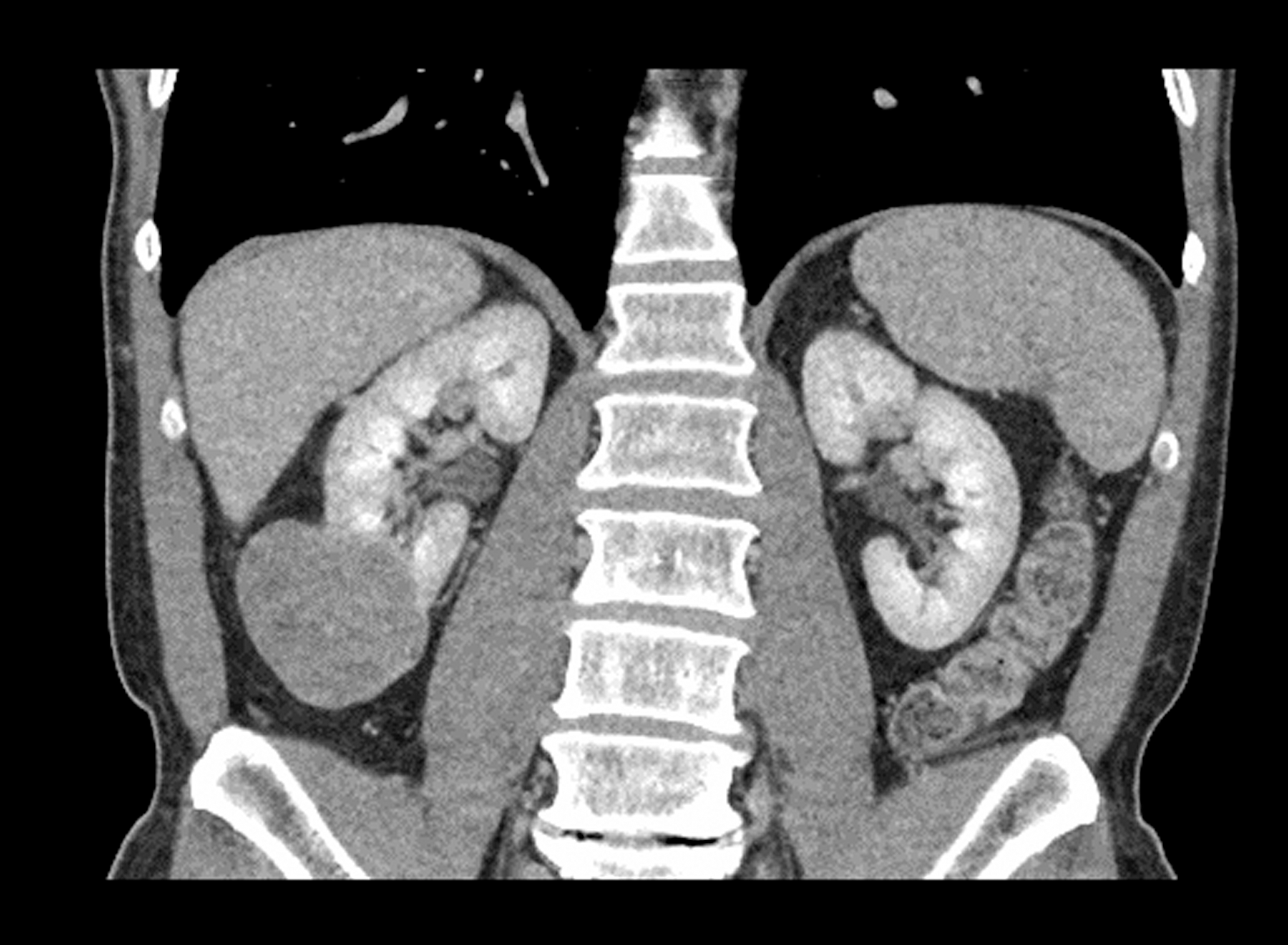
Fifty year old man with exophytic 7 cm RCC.
When the 50-year-old patient with the 7 cm exophytic RCC also has diabetes, hypertension, and mild obesity but normal renal function, 93% of respondents would treat the patient with PN. Again, the only factor found to be associated with offering PN instead of radical was perceived adequacy of training in open PN, with those reporting adequate training again being less likely to recommend RN (OR 0.265. p = 0.0019).
The third patient scenario involved a 70-year-old patient without comorbidities but with normal renal function and a centrally located 7 cm RCC. RN was the treatment of choice for 76% of respondents, while 23% of respondents answered PN. Factors that were associated with answering RN for this question included practicing in a small group private setting (OR 2.3, p = 0.04) and a reported absence of adequate training in minimally invasive PN (OR 1.9, p = 0.008).
In the final patient scenario, a 70-year-old man with diabetes, hypertension, and CrCl of 65 mL/min has a 7 cm central biopsy proven RCC. For this patient, 55% of respondents answered PN, 41% answered RN, and 4% answered observation. Several factors were found to be associated with answering RN for this question. Oncology trained respondents were less likely to offer RN than those without oncology fellowships (OR 0.7, p = 0.04). Reporting adequacy of training in either open or MIS PN was also associated with reduced odds of recommending RN (OR 0.4, p = 0.0005 and OR 0.6, p = 0.01). Respondents in large private practice groups were more likely than academic practitioners to offer RN (OR 2.3, p = 0.02).
Open vs minimally invasive approach for PN
For the two patient scenarios with exophytic 7 cm RCC tumors (Fig. 1), minimally invasive PN was the treatment of choice for 55%–57% of respondents, while open PN was recommended by 28%–36%. Factors associated with recommending MIS rather than open PN included completing training after 2000 (healthy patient: OR 2.5, p = < 0.0001, comorbid patient: OR 1.9, p = 0.004), completing an endourology fellowship (OR 2.9, p < 0.0001 and OR 2.8, p < 0.0001), and, not surprisingly, reported adequacy in training in MIS PN (OR 2.4, p = 0.0001 and OR 3.1, p < 0.0001). Completion of an oncology fellowship was associated with a lower rate of recommending MIS PN in either exophytic renal cancer scenario (OR 0.6, p = 0.02 and OR 0.63, p = 0.03).
In the two patient scenarios with central 7 cm RCC tumors (Fig. 2), minimally invasive PN was the treatment of choice for 11%–16% of respondents, while open PN was recommended by 12%–36%, with a higher number of respondents recommending PN in the comorbid patient. The only factor found to be associated with recommendation of MIS rather than open PN approach was perceived adequacy of training in PN (OR 2.5, p = 0.007). Those who reported adequate training in either open PN or MIS PN were more likely to recommend MIS PN for the comorbid patient with central renal cancer (OR 2.8, p = 0.03 and OR 2.7, p = 0.0006, respectively). Similarly, adequate training in MIS PN was associated with a higher rate of recommending MIS PN for the healthy endophytic renal tumor patient (OR 2.5, p = 0.007).

Seventy year old man with 7 cm central RCC.
Impact of practice setting
Practice type was not associated with any statistically significant variations in management strategy for exophytic case scenarios, but surgeons in academic practices did express some different recommendations than large and small private practice group providers in the management of endophytic cancers. Respondents from small private groups were less likely than academic practitioners to recommend any form of PN for a central mass in a healthy 70-year old (OR 0.4, p = 0.03), while both large and small group private practitioners were less likely to offer a PN to an unhealthy patient with a central renal mass (OR 0.46, p = 0.03 and OR 0.52, p = 0.04).
Academic practitioners were more likely than private or government practitioners to offer a PN for a large central renal mass regardless of patient comorbidities (p = 0.03 and 0.04) and were also more likely to switch their recommendation from RN to PN, once the scenario was changed to add diabetes and hypertension to the patient history (25% recommended PN for healthy patient, 62% for comorbid patient, p = 0.03).
Future randomized trial to evaluate optimal treatment of 4–10 cm RCC
Question 15 asked if respondents would consider enrolling patients in a randomized clinical trial for patients with 4–10 cm RCC and the majority (70%) of respondents answered yes. Graduation year (p = 0.65), practice type (p = 0.78), location (p = 0.57), and self-assessed adequacy of training in PN (p = 0.22 for open PN and p = 0.29 for MIS PN) were not associated with a reported willingness to enroll patients in a clinical trial. Respondents who completed an oncology fellowship were more likely than other respondents to report willingness to enroll patients in an RCT of T1b surgical management (OR 1.742, p = 0.02).
Respondents were queried about “what would be the greatest obstacle to conducting a randomized clinical trial for patients with RCC 4–10 cm?” The most common response (42%) was that the greatest obstacle was that, “patients will not want to be randomized to RN.” Other common answers included, “urologists believe that the trial is not necessary because we already have an answer” (18%), “patients will not want to be randomized because an open approach might be used” (16%), and “urologists will not be interested because of the time necessary to explain the study and consent for randomization” (14%).
Discussion
The often conflicting goals of surgery for RCC are to completely remove the cancerous tumor while preserving as much of patient's future renal function as possible. For small tumors, PN is considered the “treatment of choice” by the AUA 1 and is being increasingly utilized for tumors less than 4 cm. 4 Since the risk of cancer progression is low with T1a RCC, 5 preservation of renal function is relatively more important for patient longevity and PN is associated with improved long-term overall survival. 6 However, in larger RCC tumors, the risk of cancer progression is greater 7 and PN may be technically more challenging. Technical difficulty of the surgery is clearly important for decision-making evidenced by the 83% of respondents answering PN for exophytic tumors compared to 23% for a similar scenario with a technically complex tumor. When only considering cancer outcomes, 38% of respondents acknowledged that it is unknown if PN or RN is a better cancer treatment for larger RCC. Interestingly, 70% of respondents expressed willingness to participate in a randomized clinical trial of partial vs RN for patients with 4–10 cm RCC.
Without a consensus about the optimal surgical treatments for 4–10 cm RCC, surgeons must make decisions with limited evidence. The only randomized controlled trial of PN vs RN, EORTC 30904, closed early due to a failure to accrue even half of its 1300 patient goal, 3 and small renal masses comprised a majority of patients enrolled. This absence of consensus can result in wide variations in treatment recommendations, as evidenced by responses to our survey questions. Even if surgical approach (MIS vs open) is ignored, respondents were divided about the “best operation” for a 70-year-old unhealthy patient with a 7 cm central RCC, with 55% of respondents recommending PN and 41% recommending RN.
Although utilization of PN is increasing for complex tumors, 8 it remains unclear whether PN is the best strategy in elective larger RCC. Among the many factors that influence the selection of surgical approach are characteristics such as tumor size/location, comorbidities, renal function, and prior surgeries, but surgeon experience and preference also impact the treatment decision. Colli and colleagues found that PN rates for T1a renal masses were highest in the East and Midwest of the United States and were also higher in teaching-research hospitals and Veterans Affairs hospitals. 9 To elucidate some of the surgeon-specific characteristics that might be at the heart of such geographic and practice-related variations, we surveyed two urologic societies likely to be involved in treating renal mass patients, the Society of Urologic Oncology and Endourologic Society.
This study has limitations that are similar to other survey based investigations. While the response rate of 16% is low, it is influenced by the inability to define exactly how many of the email addresses for the Endourologic Society were valid and it is not possible to determine how many of these email addresses are correct and “active.” In the SUO cohort, 34% of those who opened the email subsequently participated in the survey. In addition, responses were received from a broad spectrum of the urology community, including similar response rates from all AUA sections and a large number of non-American urologists. Sampling of high volume experts in renal surgery was likely achieved given the approximate figure of 50,000 nephrectomy/PN procedures each year in the United States 10,11 and the respondents in this reporting ∼20,000 annual procedures. Both oncology and endourology fellowships were well represented, as were nonfellowship trained urologists. There is a risk for selection bias as emails were only sent to the members of these societies, but members of the Endourologic Society and SUO are thought to be the surgeons performing many of the RCC cases done each year. Finally, responses represent “theoretical” management opinions and strategies and may not reflect what surgeons actually do in their practices.
A major trend found in our survey is that the patterns of practice appear to be heavily influenced by training. While on the surface this trend seems common sense, the potential variations in care arising from this trend may be significant. The skills we teach our residents and fellows may have long-lasting implications for their surgical practices. Our findings show that there is no clear consensus on the ideal operation or approach for larger renal tumors and that treatment recommendations may depend as much on surgeon background as on patient or tumor characteristics. Since treatment practices appear to be linked to training experiences, effective efforts in teaching PN and minimally-invasive surgery may result in practices that favor these approaches. Finally, most respondents were aware of the absence of evidence for treatment of larger RCC and expressed willingness to participate in a randomized clinical trial to investigate outcomes for surgical treatment of these patients.
Footnotes
Acknowledgments
This material is the result of work supported with resources and the use of facilities at the William S. Memorial Veterans Hospital. The contents do not represent the views of the U. S. Department of Veterans Affairs or the United States Government.
Author Disclosure Statement
No competing financial interests exist.
Abbreviations Used
References
Supplementary Material
Please find the following supplemental material available below.
For Open Access articles published under a Creative Commons License, all supplemental material carries the same license as the article it is associated with.
For non-Open Access articles published, all supplemental material carries a non-exclusive license, and permission requests for re-use of supplemental material or any part of supplemental material shall be sent directly to the copyright owner as specified in the copyright notice associated with the article.
