




Abstract
Purpose:
To investigate the effect of laser fiber stripping on stone fragmentation and laser fiber power output.
Materials and Methods:
In a benchtop simulation of laser lithotripsy, 20 BegoStone phantoms were positioned within a ureteral model and irradiated for 10 minutes at 8 Hz and 0.8 J. A freshly cleaved 365 μm laser fiber was used for all trials, with half of the fibers also undergoing stripping. Power output was measured at 1-minute intervals, beginning with an initial prelithotripsy recording at 0 minutes. Fiber tips were imaged with scanning electron microscopy. In a single-blinded manner, final masses of residual stone fragments were measured and used to quantify stone breakdown. Independent-sample Mann–Whitney U tests were performed with significance set at p < 0.05, comparing stripped and unstripped fiber tips with respect to power output and fraction of stone fragmentation.
Results:
Mean power output after 1 minute of lasing was significantly greater in unstripped laser fibers (p = 0.015), while fibers, whether stripped or not, demonstrated no significant output differences prelithotripsy or at any time from 2 to 10 minutes. However, stripped laser fibers achieved significantly increased stone breakdown compared to unstripped fibers (p = 0.004), fragmenting 63 mg (25%) more of the initial stone mass per trial.
Conclusions:
Although unstripped laser fibers provided superior power output at 1 minute, output at all other time points was similar between stripped and unstripped fibers. However, despite similar optical output, stripped laser fibers achieved greater stone fragmentation, possibly due to improved contact between stone and fiber tip.
Introduction
S
A recently published study suggested that stripping of the laser fibers significantly reduces volume of stone ablation over a 30-second trial. 8 The authors reasoned that fiber stripping may damage the niobium cladding surrounding the silicon dioxide laser fiber core, resulting in reduced lithotripsy efficiency.
However, many stones treated with the holmium laser will require more than just 30 seconds of applied energy. In fact, during complicated ureteroscopy, laser time often exceeds 400 seconds and may extend to 1000 seconds. 9 The purpose of this study is to determine the effect of laser fiber stripping on laser power output and lithotripsy efficiency over a 10-minute lasing duration.
Materials and Methods
A benchtop model was designed to test the efficiency of laser lithotripsy using stripped and unstripped laser fibers (Fig. 1A). The model was constructed of a short segment of clear plastic tubing (I.D. = 3/8″) with a 1 × 1 mm wire mesh attached at one end to allow for clearance of fragmented stone debris (Fig. 1D). 10 Uniform BegoStone (Bego USA, Lincoln, RI) phantoms were used for all trials, submerged in 0.9% saline. After performing initial power output measurements on laser fibers either cleaved and stripped or simply cleaved alone, a single investigator held the fiber tip in contact with the BegoStone phantom (Fig. 1E) for 10 minutes of total lasing time, taking additional power readings after each 1-minute interval. During lithotripsy, phantoms were pinned against the mesh and the inner wall of the tubing, thereby ensuring consistent and continuous contact between fiber tip and stone for the entire duration of all trials. Following each trial, all stone fragments too large to pass through the mesh were collected, dried for 48 hours, and weighed by a second investigator blinded to the status of fiber stripping. The fraction of stone degradation was calculated as the total mass degradation (initial stone mass–mass of residual fragments) divided by the initial stone mass. 11 In total, 20 ten-minute trials were performed.
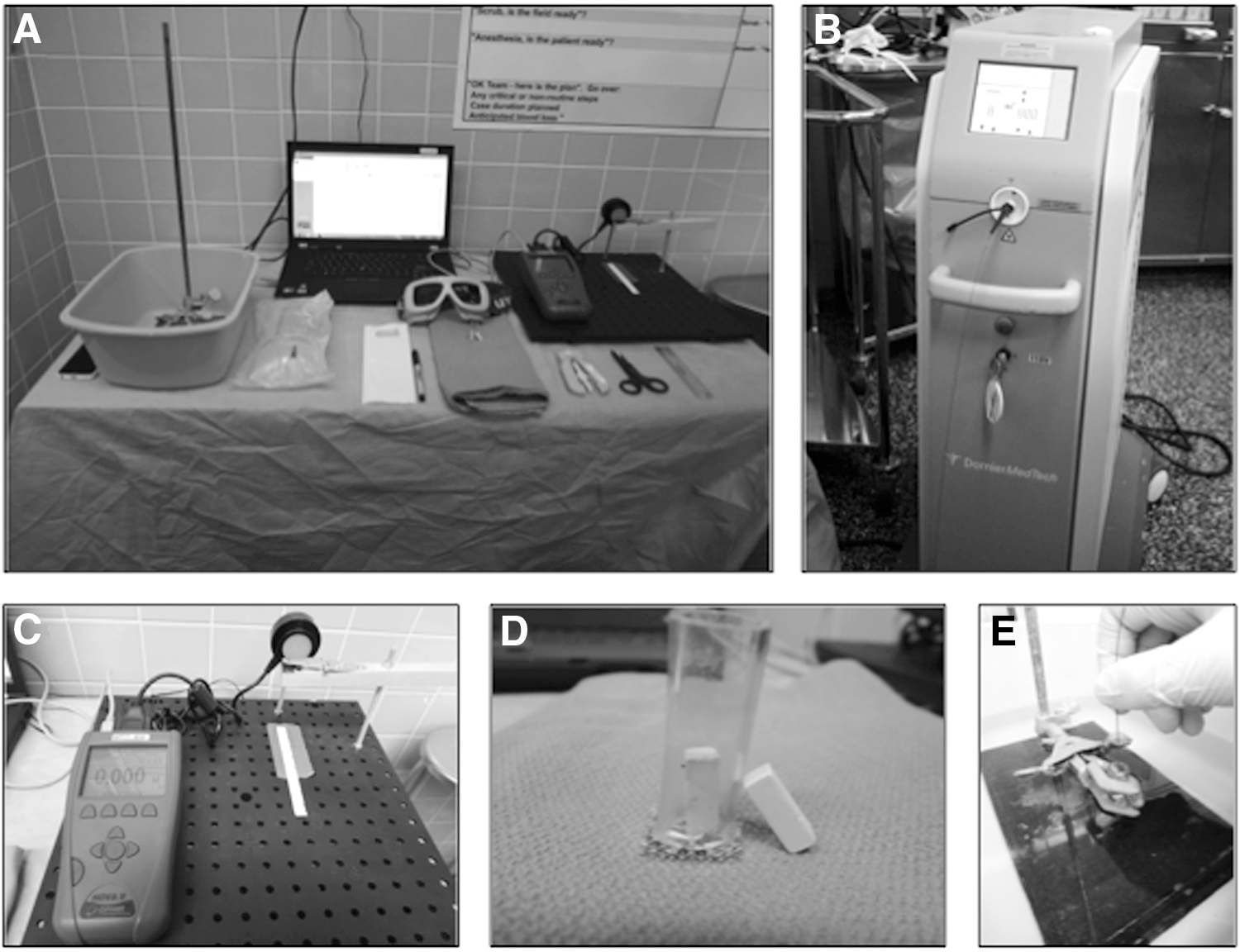
Identical 5 × 5 × 15 mm artificial BegoStone rectangular uroliths were poured in vinyl polysiloxane molds from a BegoStone Plus mixture, consisting of a powder:water ratio of 5:1 by weight, which correlates to a Vickers hardness of 549 MPa. 12 Stones were given 24 hours to cure at room temperature and allowed to air dry for an additional 24 hours to achieve maximum hardness. 13 Initial stone masses were subsequently measured with an electronic balance (American Scientific, Columbus, OH) and recorded.
A new Slimline™ 365 μm laser fiber (Lumenis, Dreieich, Germany) was utilized for all 20 trials. Between trials, the fiber was cleaved with CS-124 ceramic scissors (Kyocera, Kyoto, Japan) (Fig. 2A) 1 cm proximal to any visible defect 14 and either left unstripped, with the blue plastic jacket attached (Fig. 2B), or stripped off the most distal 8 mm of its jacket (Fig. 2C) using a standardized 365 μm fiber stripper (Micro Electronics, Inc., Seekonk, MA) (Fig. 2A). After trials, all fiber tips were saved for scanning electron microscopy (SEM).
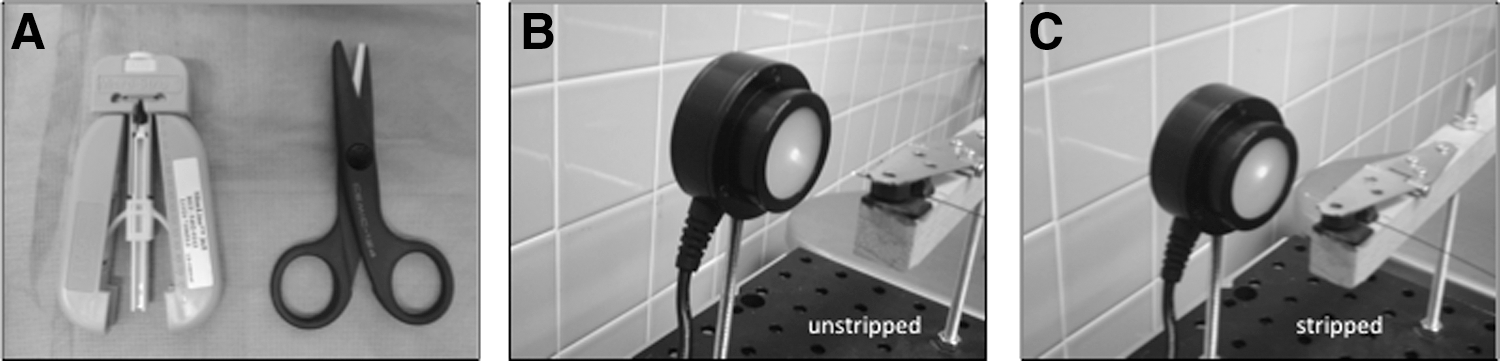
A Dornier Medilas H20 holmium:yttrium aluminum garnet (Ho:YAG)-pulsed laser (Dornier MedTech, Wessling, Germany) (Fig. 1B) was used to deliver a constant power of 6.4 W based on a frequency of 8 Hz and an energy of 0.8 J. 10 These lithotripsy settings are widely used 15 and strike an optimal balance of high urolith fragmentation and low retropulsive effects, thereby ensuring efficient energy transference. 11 With the laser fiber clamped perpendicular 1″ from the 3.5 cm diameter sensor face (Fig. 2B, C), the average power output was measured over 100 pulses, prelithotripsy, and at each 1-minute interval, using a PE50BF-DIF-C pyroelectric energy sensor and recorded with a Nova II power meter (Ophir-Spiricon, North Logan, UT) (Fig. 2C), using the StarLab 3.1.0 software. Previous work by our institution demonstrated that the entire laser beam profile was contained easily within the sensor diameter. 10
Following completion of trials, laser fiber tips were imaged with a VEGA LSH SEM (Tescan USA, Cranberry Township, PA) at an accelerating voltage of 10.0 kV and magnification range of 117–215 × . Images included stripped and unstripped fiber tips at 0 minutes (prelithotripsy) and after 1, 5, and 10 minutes of stone contact. Tip preparation involved upright affixing onto aluminum Pin Stub Mounts with PELCOTabs™ Carbon Conductive Tabs (Ted Pella, Inc., Redding, CA) and plating with a Cressington 108 Auto Sputter Coater (Cressington Scientific Instruments Ltd., Watford, United Kingdom) using gold–palladium.
Data analysis was performed with SPSS software (IBM, version 20) using the independent-sample Mann–Whitney U test, with statistical significance defined at p < 0.05. Stripped and unstripped fiber tips were compared with respect to normalized fraction of stone degradation, as well as power output at 1-minute intervals over 10 minutes of lithotripsy.
Results
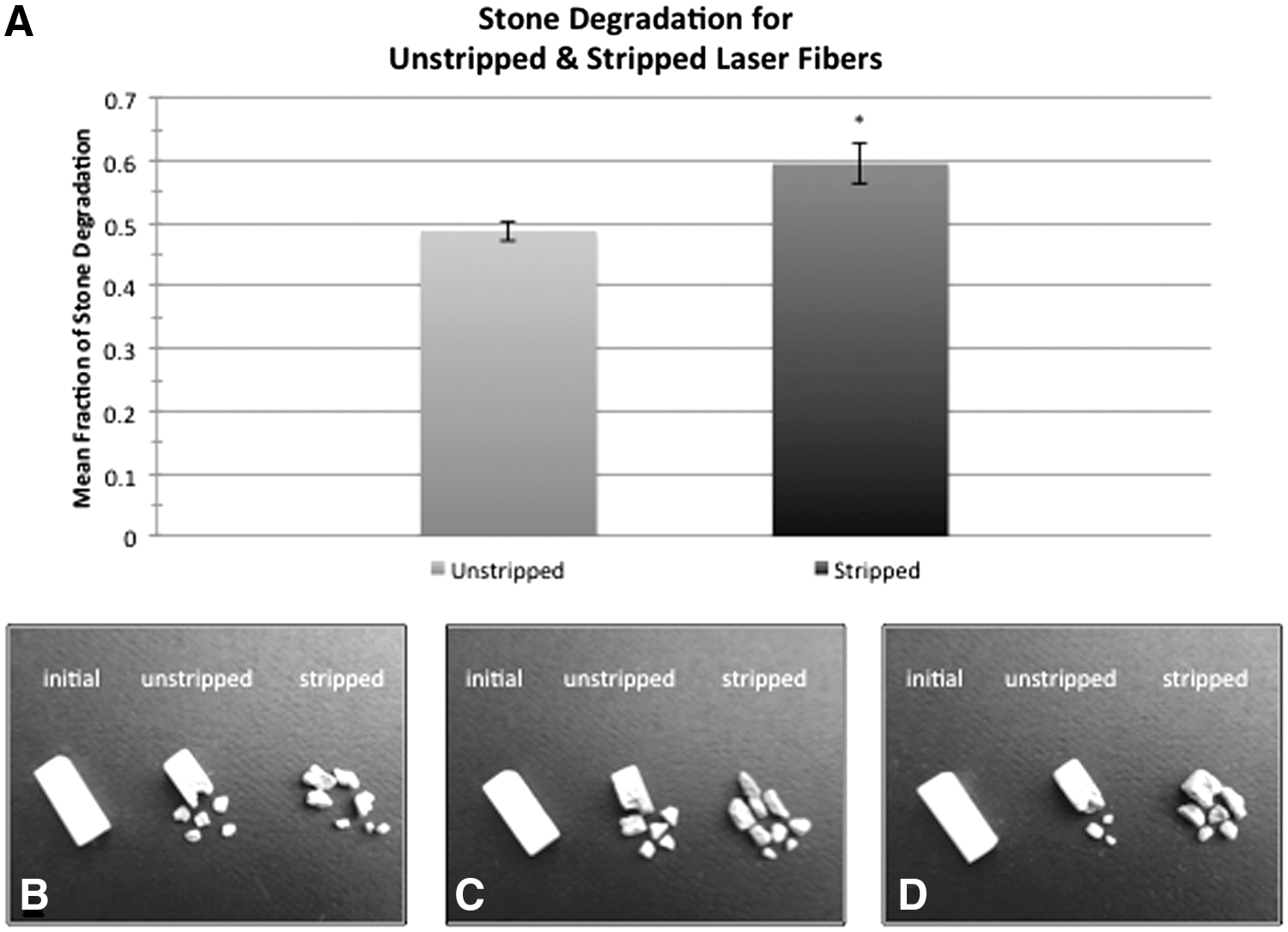
Intact BegoStone phantoms prelithotripsy were statistically similar with respect to initial mass between the two fiber tip conditions, averaging 0.5262 g (unstripped) and 0.5339 g (stripped) (p = 0.63). Figure 3 summarizes stone degradation data. Stripped laser fibers achieved significantly greater stone breakdown (p = 0.004) after 10 minutes, fragmenting 63 mg (25%) more of the initial stone mass relative to unstripped fibers (Fig. 3A). Photographs of residual stone fragments show the improved urolith fragmentation that resulted from lithotripsy with stripped fibers (Fig. 3B–D).
Mean power output was graphed over time for 10 minutes of lithotripsy with 10 unstripped and 10 stripped fibers (Fig. 4). No significant differences were observed between the two fiber tip conditions at 0 minutes before initial stone contact or at any time between 2 and 10 minutes. However, after 1 minute of lithotripsy, unstripped laser fibers achieved 4.18 W of power output, significantly greater than the stripped fiber output of 3.21 W (p = 0.015).
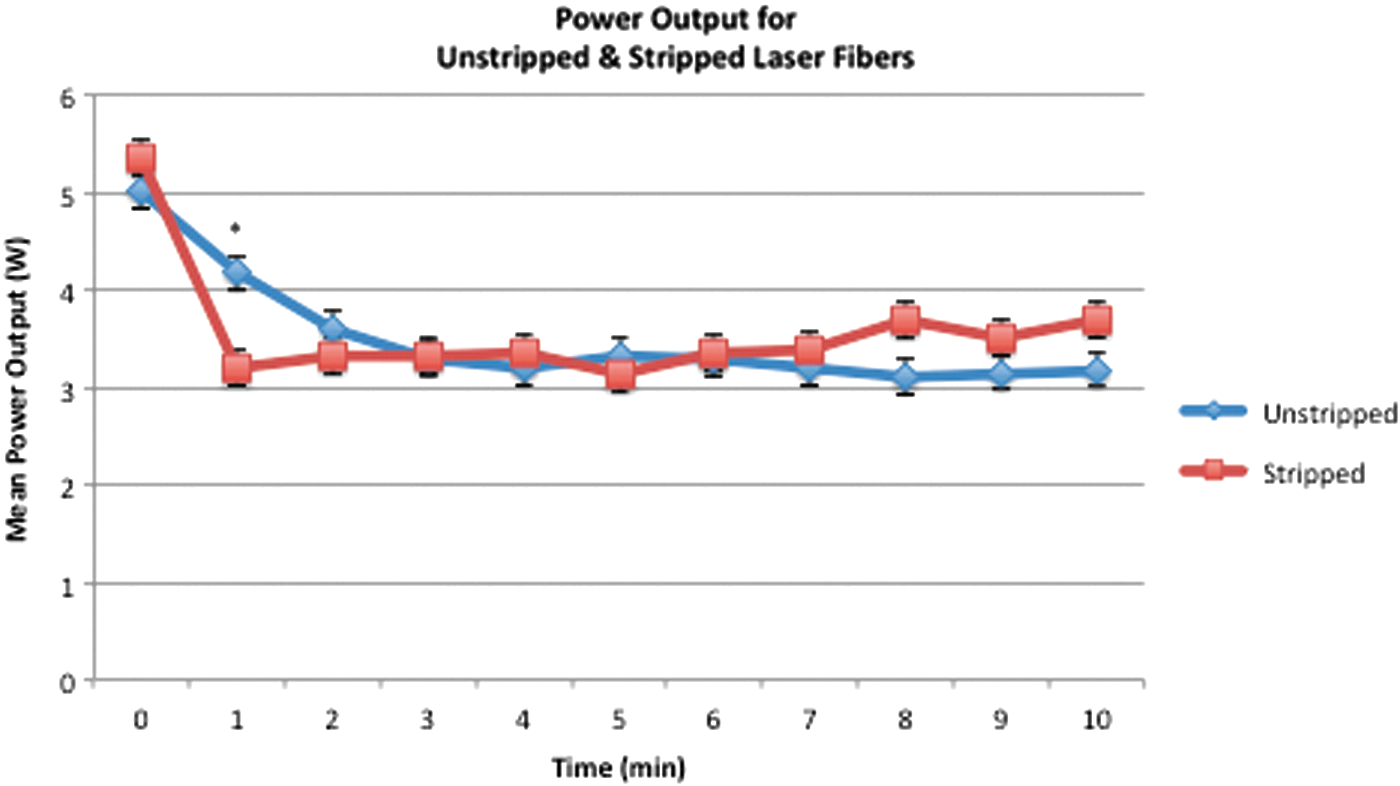
Comparison of unstripped and stripped laser fibers in terms of mean power output at each 1-minute interval over 10 minutes of total lithotripsy time.
SEM images chronicle the effect of stone contact on laser fiber tip morphology throughout 10 minutes of lithotripsy, comparing unstripped and stripped fibers (Fig. 5). Prelithotripsy, the core of the unstripped laser fiber is clearly obscured at its periphery by the outer jacket (Fig. 5B); by contrast, the core of the stripped laser fiber is freely exposed (Fig. 5A). After 1 minute of lasing, the jacket begins to burn back from the tip of the unstripped fiber core, revealing an intact, relatively smooth fiber tip with minimal cratering (Fig. 5E). The stripped fiber exhibits a comparably rougher tip head, characterized by increased surface cratering and significant thermal degradation. At 5 and 10 minutes, the surface morphology of stripped (Fig. 5C, D) and unstripped fibers (Fig. 5G, H) is similar, with both demonstrating an evolving thermal breakdown of the fiber tip.

Scanning electron microscopy images, chronologically displaying unstripped and stripped Lumenis Slimline™ 365 μm laser fiber tips at time points throughout the lithotripsy process.
Discussion
The debate between reusable and disposable surgical instrumentation is a key issue that hinges on considerations of functionality, sustainability, and economy. Seeking to address the almost 50% of operating room costs associated with disposable equipment, a systematic review by Siu and colleagues summarized significant cost reduction from implementation of reusable equipment across multiple surgical specialties. 16 The authors also noted potential environmental benefits of reusable equipment, above and beyond the savings related to decreased disposal of surgical waste. Still, they noted that the latent expense of sterilization, repackaging, and repair remains a relevant concern.
This question is particularly valid to the field of urology. To that end, a recent prospective cost-benefit analysis by Martin and colleagues sought to quantify the difference between reusable and disposable ureteroscopes. Even accounting for reprocessing and repair fees, their model estimated a yearly net savings of $40,340 in favor of reusable instruments. 17 Nevertheless, some authors feel that single-use fibers may be safer during flexible ureteroscopy as reusable fibers can have cracks after the sterilization process, leading to energy leaks, which may damage the ureteroscope. 18 However, in a large multicenter study by Knudsen and colleagues, reusable Ho:YAG laser fibers were superior to their single-use counterparts, resulting in $118 cost savings per case. 6
With this in mind, our institution sought to investigate the processing necessary to promote fiber reuse, in an effort to support financial sustainability without jeopardizing lithotripsy outcomes. Previous work from our institution first highlighted the significance of cleaving tool choice for optimization of initial power output, with the ceramic scissors identified as the superior tool for laser fiber cleavage. 14 Although the ceramic scissors were optimal for prelithotripsy power preservation, this study further indicated that intraprocedural fiber cleaving proved insignificant in the face of the steep decline in optical output that results from sustained thermal degradation. 10,19 –21 In this study, we sought to turn our attention to the stripping of reusable laser fibers, given the relative scarcity of data on this subject.
Although some previous evidence has theoretically supported laser fiber stripping as an integral component of optimal lithotripsy, 6,7,22 recent work by Kronenberg and Traxer has questioned the validity of the currently accepted practice. By comparing the volume of stone fragmentation between stripped and unstripped fibers over 30 seconds of lasing time, they concluded that stripping was not necessary and, in fact, had the potential to reduce stone breakdown. 8 However, as the study focused on initial fragmentation over only 30 seconds of laser use, the effects of foregoing stripping at longer intervals of lasing have yet to be defined.
Consistent with the results of Kronenberg and Traxer, 8 this study has shown that unstripped laser fibers generated a significantly greater power output after the first minute of lasing (Fig. 4). Furthermore, our micrographic analysis of laser fiber tip morphology corroborates our power output measurements (Fig. 5). Substantial damage to the stripped fiber head due to loss of its protective jacket may explain the decreased optical output at this shorter interval (Fig. 5B), while the unstripped fiber head remains relatively smooth and unblemished (Fig. 5F), with its power output preserved. However, with further lasing time, the plastic jacket begins to burn back, resulting in a similar fiber tip morphology between stripped and unstripped fibers at 5 and 10 minutes (Fig. 5C, D, G, H). Vassar and colleagues demonstrated similar consequences to the physical damage of laser fiber tips, attributing reduced energy density to refraction of fiber output and the resulting nonparallel, scattered rays. 23
A unique finding of our study is that stripped laser fibers achieved significantly greater stone fragmentation than unstripped fibers over 10 minutes (Fig. 3). This 10-minute duration closely approximates laser times employed during many complex ureteroscopic lithotripsies. 9 The ultimate goal of lithotripsy is complete and efficient fragmentation of all stones. 24 By facilitating fiber tip contact with the stone, stripping may improve lithotripsy efficiency, thereby reducing dependence upon baskets for stone removal and, ultimately, decreasing costs and complications associated with laser use. 11 SEM tip morphology may shed light on our data (Fig. 5): at time point 0, various sections of the plastic jacket protrude beyond the laser fiber tip (Fig. 5E), potentially impeding stone contact. Likewise, at 1 and 5 minutes, the plastic jacket remains adherent to the unstripped fiber as it burns back and continues to be a source of potential interference (Fig. 5F, G).
The clinical effectiveness of the Ho:YAG laser is enhanced by direct contact between its fiber tip and the stone surface. 25 As such, strategies to maximize lithotripsy efficiency have sought to avoid excessive fiber repositioning, during which time contact is lost, including techniques that immobilize the stone against the urinary tract wall. 22 In this light, we suggest the following: while leaving laser fibers unstripped may initially protect their tips from burn back degradation, thereby preserving optical output, 20 the plastic jacket may in fact impair lithotripsy performance by impeding direct stone contact.
Energy dissipation in the fluid medium offers another potential explanation for our finding that stripped fibers achieved greater stone fragmentation without a corresponding increase in power output. At first glance, laser fibers appeared to have similar outputs, except at 1 minute. However, it is important to remember that laser power output was measured in air, where the laser energy travels much further than it does in saline. 23 It is possible that the plastic jacket prevents direct contact and allows fluid to fill the space between the fiber tip and the stone, thereby dissipating a significant amount of laser energy. 26 This may, in part, account for the significantly greater stone fragmentation rates with stripped fibers compared to unstripped fibers, despite similar power output in air.
Another important consideration not fully explored by this study involves the fate of the plastic fragments left inside the patient, as well as the potential release of toxic residue as the plastic jacket burns back. During our trials, we observed smoke trails emitted from unstripped fibers during lasing that were absent from stripped fibers. Also notable were strips of blue material of varying sizes floating throughout the saline solution, some too small to capture and remove. The potential for jacket residue to serve as a nidus for infection or stone formation may represent a valid concern and subject for future investigation.
There are several limitations of our study. One is the substitution of artificial stone phantoms for true uroliths of organic composition. Furthermore, our study was limited to a single stone type. Stone composition may influence fiber degradation, with uric acid and cystine resulting in less burn back and fiber tip damage. 21 However, BegoStone phantoms have been shown to simulate the mechanical properties of calcium oxalate monohydrate stones in a reproducible manner. 12 In addition, our study employed only one fiber size and cleaving technique. A recent study from our institution concluded that the ceramic scissors are the most effective tool for cleaving laser fibers, and the 365 μm fiber is the most durable with respect to power output preservation. 10 Also, our study utilized only Lumenis brand fibers and a single energy setting. Future work, comparing various fiber types and laser settings, may clarify potential differences in the pattern of burn back degradation observed as a result of these variables. These results guided the choices of the 365 μm fiber and the ceramic scissors for this study. Furthermore, the use of a benchtop model is unable to recreate every physiologic factor at play during lithotripsy in a living patient; on the other hand, the model is ideal for making reproducible comparisons between stripped and unstripped fibers that would prove impossible in vivo. Our findings could be confirmed in randomized clinical trials.
Conclusions
The results of this study suggest that stripping of the outer plastic jacket improves the efficiency of laser lithotripsy over 10 minutes of lasing. To maximize stone fragmentation during intervals longer than 1 minute, we recommend laser fiber stripping.
Footnotes
Author Disclosure Statement
D. Duane Baldwin is a consultant for Bard and Olympus, a medical director for DARRT and StepLite, and owns stock in DARRT and Pfizer. None of the remaining authors have any competing financial interests.