




Abstract
Introduction and Objective:
Nonabsorbable monofilament suture is traditionally used to secure vaginal mesh for robot-assisted sacral colpopexy (RASC) but can become exposed postoperatively requiring invasive vaginal removal. Polydioxanone delayed absorbable suture may avoid this. We sought to determine the objective and subjective impact of suture choice for mesh fixation.
Materials and Methods:
A cohort study was undertaken using a prospective registry and subjects were grouped based on type of suture at the time of RASC. Apical failure was defined as C point descent of >2 cm, anterior compartment failure was defined as pelvic organ prolapse quantification (POP-Q) Ba point of >0, and posterior compartment failure was defined as Bp point of >0. Patient-reported outcomes included urogenital distress inventory (UDI)-6 and QoL. Two-tailed t-test and chi-squared were used for analysis.
Results:
A total of 119 women underwent RASC between 2009 and 2016. Patients had similar preoperative characteristics (Table 1). All POP-Q, UDI-6, and quality of life (QoL) scores improved postoperatively (Tables 1 and 2). Apical failure was noted in 0, anterior failure was noted in 7 (average Ba +1.1 cm in failures), and posterior failure was noted in 4 (mean Bp +1.0 cm) at 16 months' follow-up. Failures in the anterior compartment were much more common in the nonabsorbable monofilament cohort (Table 2). Failures in the apical and posterior compartments were not significantly different between groups. Nine suture erosions were noted in the nonabsorbable monofilament cohort, five requiring excision in the clinic and two in the operating room. Two suture erosions were noted in the delayed absorbable cohort, 0 required excision. Postoperative UDI-6 and QoL scores did not vary significantly between groups (5.3 ± 4.0 vs 5.1 ± 4.0, p = not significant (NS), 2.8 ± 2.0 vs 2.8 ± 2.2, p = NS).
Preoperative Demographics
Prolene®
PDS®
p
Age (years)
62.1 ± 13.4
63.9 ± 10.0
NS
UDI-6
12.1 ± 3.3
10.2 ± 5.1
NS
QoL
7.4 ± 3.0
6.8 ± 3.8
0.01
Body mass index
28.8 ± 6.8
27.7 ± 5.2
NS
Diabetic
1
1
NS
Prior prolapse surgery
11
8
NS
Active tobacco use
3
10
NS
Steroid use
2
0
NS
POP-Q-preoperative
Aa
+0.6
+0.8
NS
Ba
+2.1
+2.4
0.01
C
−3.1
−3.7
NS
TVL
8.4
8.0
NS
Ap
−0.4
−1.1
0.01
Bp
+0.8
−0.2
NS
Outcomes for Sacral Colpopexy by Suture Type
Prolene®
PDS®
p
UDI-6
5.3 ± 4.0
5.1 ± 4.0
NS
QoL
2.8 ± 2.0
2.8 ± 2.2
NS
Follow-up (months)
23.0 ± 18.8
10.4 ± 11.2
<0.01
POP-Q postoperative
Aa
−1.7
−2.1
NS
Ba
−1.4
−1.9
NS
C
−8.1
−8.5
NS
TVL
8.5
8.7
NS
Ap
−2.1
−2.3
NS
Bp
−1.7
−2.0
NS
Conclusion:
Securing mesh with delayed absorbable monofilament did not appear to increase risk of failure in patients undergoing RASC and eliminates the need for suture excision postoperatively.
Introduction
Abdominal sacral colpopexy is the gold standard treatment for women with advanced pelvic organ prolapse (POP). Although highly effective with long-term durability, this open procedure is associated with significant surgical morbidities. 1 Minimally invasive techniques, such as laparoscopic sacral colpopexy, have many advantages over abdominal sacral colpopexy. Laparoscopic sacral colpopexy has been shown to achieve similar outcomes to the open approach, but the procedure is technically demanding with longer operative times. 2 The introduction of the Da Vinci® Surgical System (Intuitive Surgical, Sunnyvale, CA) in recent years has resulted in a paradigm shift for management of POP, and this approach has been increasing nationwide. 3
A recent meta-analysis demonstrated equivalent long-term outcomes for abdominal sacral colpopexy and robot-assisted sacral colpopexy (RASC). Serati and colleagues reviewed >1400 RASC procedures in the literature highlighting the growing popularity of this approach. 4 The complications of RASC are not as well described in the literature as those for the open technique. Mesh extrusion has received significant attention recently and is among the most concerning complications from a patient perspective. Nonabsorbable monofilament polypropylene suture (Prolene®; Johnson & Johnson, New Brunswick, NJ) is typically used to secure the mesh, and suture extrusion can be almost as distressing to the patient and often requires invasive suture trimming in the clinic or operating room. The authors suggest anchoring mesh to the vaginal wall using monofilament delayed absorbable polydioxanone suture (PDS®; Johnson & Johnson) instead of nonabsorbable monofilament to avoid this complication (the use of the trade name is not intended to imply that the branded product is superior, but it was thought that these trade names would be familiar to many of the readers and so are used sparingly). In addition, some time may be saved by placing these sutures in a running manner to secure mesh as opposed to the traditionally described interrupted technique.
The aim of this study is to compare two techniques to secure vaginal mesh in a retrospective manner—interrupted nonabsorbable monofilament sutures vs running delayed absorbable monofilament sutures. Data are taken from a single-institution experience with RASC and is retrospective. The hypothesis is that both techniques will deliver similar outcomes, but the latter will avoid the need to extract sutures that perforate the vaginal wall.
Materials and Methods
After institutional board approval, a systematic retrospective review of the Indiana University Sacral colpopexy database was undertaken to identify women who underwent RASC between August 2009 and December 2016. The results of the last documented clinic follow-up were reported. All patients undergoing simultaneous hysterectomy had gynecologic consultation. Technique for hysterectomy (robotic supracervical hysterectomy vs robotic total hysterectomy) was left to the discretion of the consulting gynecologist (J.R. and J.H.). Demographic variables were collected from the pre-, intra-, and postoperative periods.
Concomitant procedures, such as mid-urethral sling, culdoplasty, or vaginal cystocele repair were performed in some, but not all, patients. The decision to perform concomitant procedures was left to the discretion of the urologist and patient (C.R.P.). All patients were counseled about the possibility of postoperative urinary incontinence, suture extrusion, mesh erosion, and the possible need for a staged continence procedure during preoperative consultations.
RASC was performed using Da Vinci Surgical System (Intuitive Surgical). The technique can be broken into 11 stages: Setup, positioning, and port placement: The patient is positioned on the table as shown in Figure 1, with the arms tucked to the sides and padded generously. Care and attention to this step can save complications down the road, take care to pad between IV catheters, connectors, and the skin. The four-arm robotic port site location is detailed in Figure 2. The robot can be positioned between the legs, or to the side of the left leg to maintain access to the vaginal area. The side-docking technique is more prone to crashing of arm 2 and 3 with the DaVinci SI® system, but careful planning will avoid this. An assistant port is necessary and can be 5 mm, which is not large enough to pass needles, 8 mm (the authors' preference, large enough for needles as big as SH-1 but not CT-1, and not large enough to accommodate rolled porcine dermis graft), or 10 mm (large enough for anything, but closure can result in port site pain postoperatively in the authors' experience). Once ports are in place 27° of Trendelenburg position is used to allow the bowel to fall out of the pelvis. When hysterectomy was indicated, one of the following three techniques was used: (1) robotic total hysterectomy with one-layer vaginal cuff closure using polyglactin suture; (2) robotic total hysterectomy with two-layer vaginal cuff closure using two layers of polyglactin suture; (3) robotic supracervical hysterectomy. Concomitant bilateral salpingo-oophorectomy was performed in indicated postmenopausal patients. Initially, vaginal retraction was performed with a handheld Lucite vaginal retractor or sponge stick. Beginning in 2012, a bed-mounted vaginal manipulator was used for every case in the series (Uterine Positioning System; Cooper Surgical, Trumbull, CT) to facilitate anterior and posterior dissection of the vagina and offered better stabilization of the vaginal wall during suturing. This is shown in Figures 3 and 4. Cystoscopy is routinely performed at the beginning of the case to place ureteral stents for easy identification of the ureters, but some might argue this is unnecessary. Clear adhesions and open peritoneum over vaginal apex: Hysterectomy is also done at this time. Anterior and posterior vaginal wall dissection: The bladder is typically filled with 120 mL of saline to better identify the reflection of the bladder wall and anterior vaginal wall, particularly in patients who have undergone prior hysterectomy as this can exhibit scarring. The anterior dissection is carried down to the level of bladder trigone, whereas the posterior vaginal wall dissection is carried to the rectovaginal space. Usually an anterior dissection ranges from 5 to 10 cm in length. As a helpful measurement tool, the gray insulation on the DaVinci® monopolar scissor device measures 5.5 cm from the tip of the scissor to the proximal end of the gray insulation. Bring needles and mesh into the operative field: This can be done many ways, the authors prefer to bring 4 × 2-0 delayed absorbable monofilament or 4 × 2-0 nonabsorbable monofilament sutures as well as 0-vicryl to close vaginal cuff if a total hysterectomy is performed, as well as mesh, porcine dermis, or fascia lata graft through the assistant port. If the assistant port is only 5 mm, it is possible to use the no. 1 robotic arm port, which is 8 mm, or the camera port (12 mm). The needles are “stored” in the right lower quadrant abdominal wall and once used, the needles are “stored” in the left lower quadrant abdominal wall, until the end of the case. Some surgeons may prefer to remove used needles immediately to reduce the risk of a lost needle. Secure mesh to the posterior vaginal wall: This can be done in interrupted or running manner, with delayed absorbable suture or nonabsorbable suture. The results section will describe our retrospective results with both techniques. The key is to use the no. 3 robotic arm and vaginal retractor to optimize exposure. Secure mesh to the anterior vaginal wall: This can be done before or after posterior fixation, depending on surgeon preference. Pass needles for sacrum: The authors prefer to pass these needles in two stages to minimize suture tails obscuring the view in the pelvis. Traditionally nonabsorbable monofilament or Gore-Tex® sutures have been used to fix mesh to the sacrum, but Pro-tack® laparoscopic titanium tacks have also been used. The authors use 0-nonabsorbable monofilament on SH-1 needles × 3 to secure the mesh to the sacrum, and either 2-0 braided absorbable polyglactin 910 (Vicryl®) or 2-0 barbed delayed absorbable suture (Stratafix® barbed suture) to close the peritoneum. Sacral dissection: A peritoneal tunnel is created to cover the mesh, but many surgeons prefer to open the peritoneum and simply close the retroperitoneum at the end. The mesh is passed through the tunnel before dissecting out the ligamentum flavum that covers the sacral promontory. The sacral promontory is exposed by retracting the sigmoid colon medially and incising the peritoneum over the sacrum. Secure the mesh to the sacrum: Interrupted sutures of 0-nonabsorbable monofilament are used to fix the mesh, it is important to clear the promontory completely so the mesh adheres to the ligamentum flavum (anterior longitudinal ligament). The structures to be aware of include middle sacral vein, often medial and running cranial-caudal, right ureter, left common iliac vein (if one is extremely cephalad), and branches of hypogastric veins and arteries (if one is extremely caudad). Diskitis has been described when sutures are anchored in the intervertebral disk, and osteomyelitis has also been described.
5,6
Close peritoneum: The peritoneum is reapproximated to cover the mesh using a running absorbable suture. The authors prefer barbed suture. Removal of needles: If a hysterectomy is performed this can be removed using the 10 cm endo-catch® bag and either morcellated or removed intact through a small extension of the umbilical port.
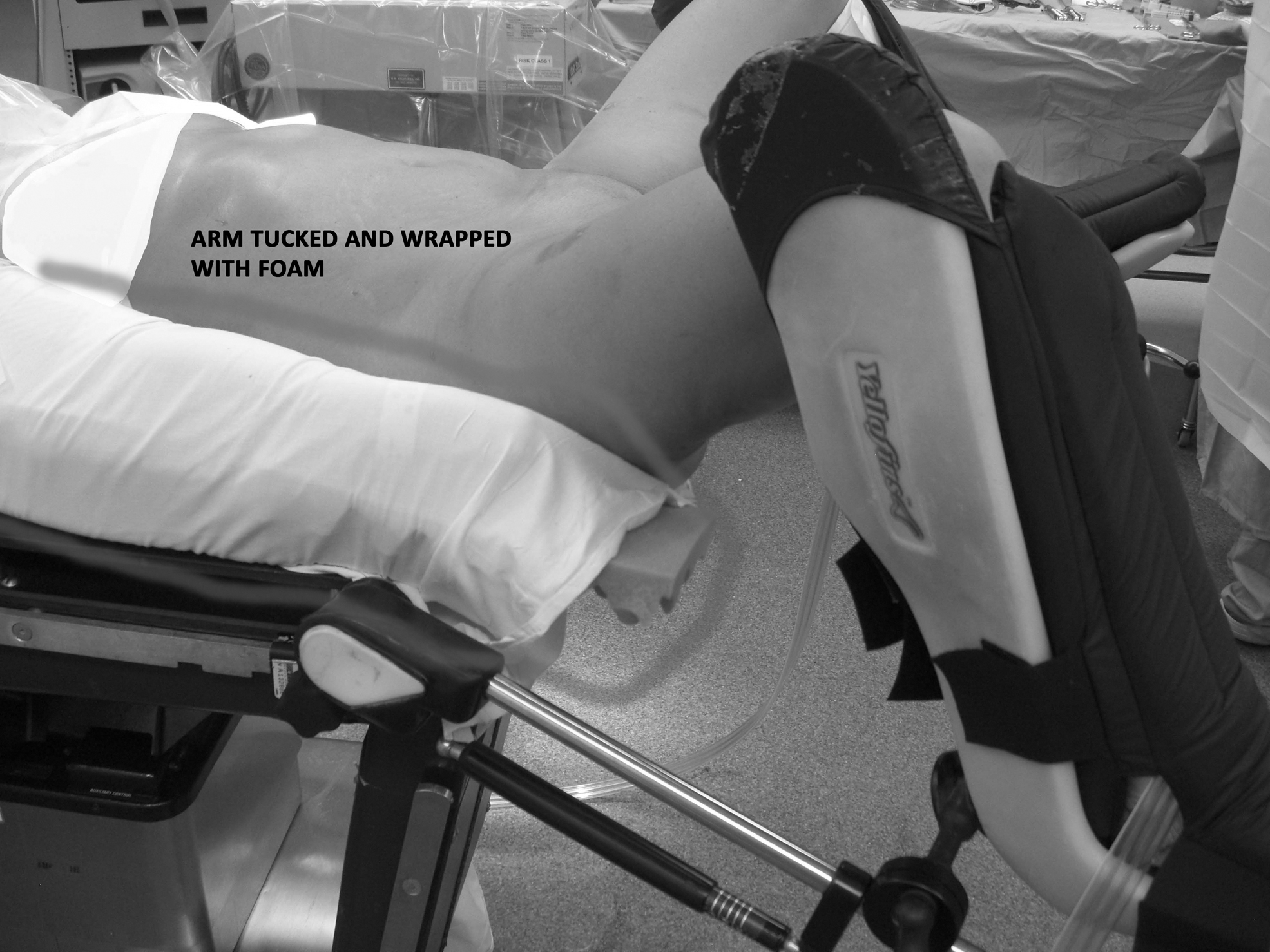
Arm tucked and wrapped with foam, legs in stirrups.

Port site locations on abdomen using four-robotic arm setup.
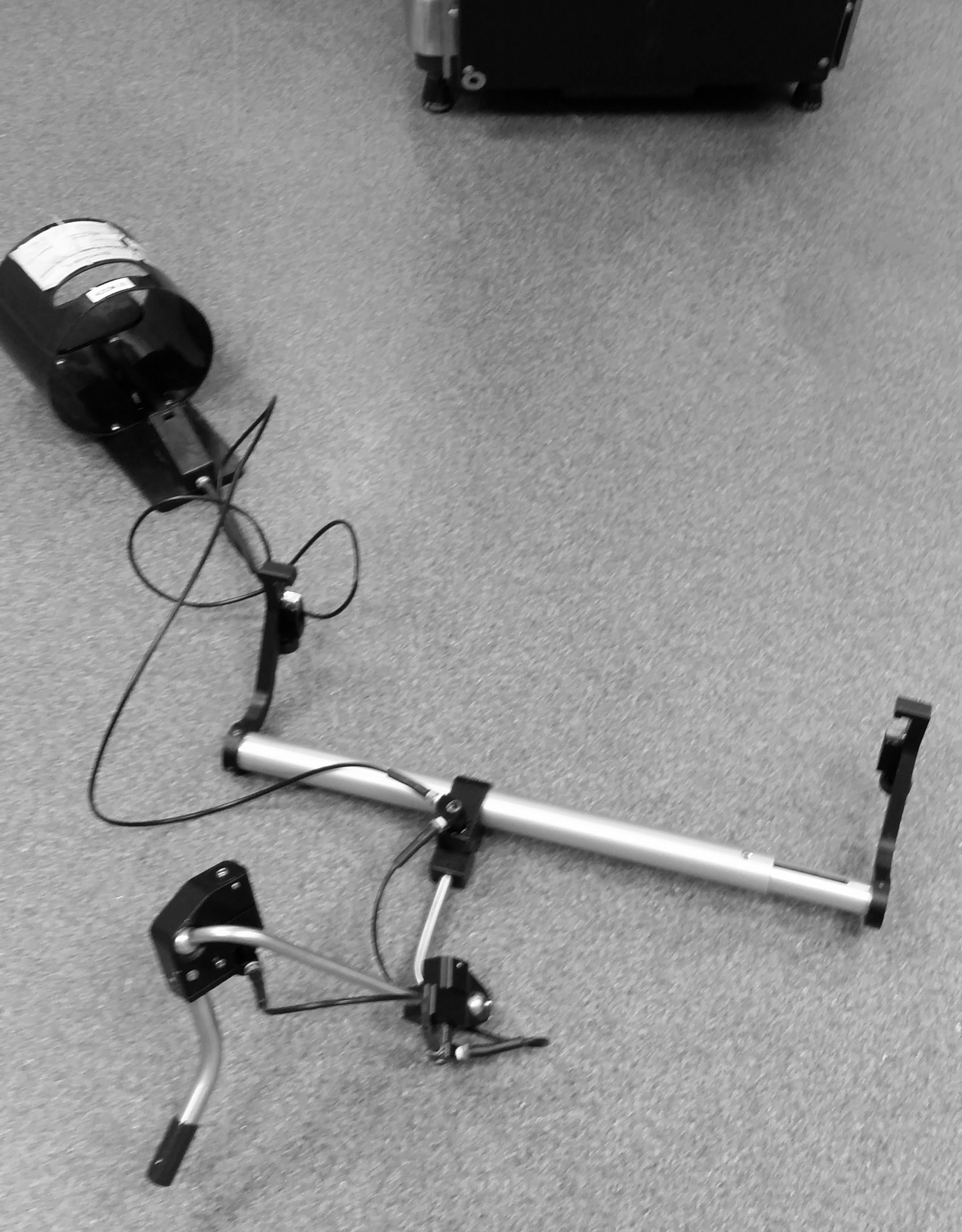
Bed-mounted vaginal retractor before anchoring to bed.
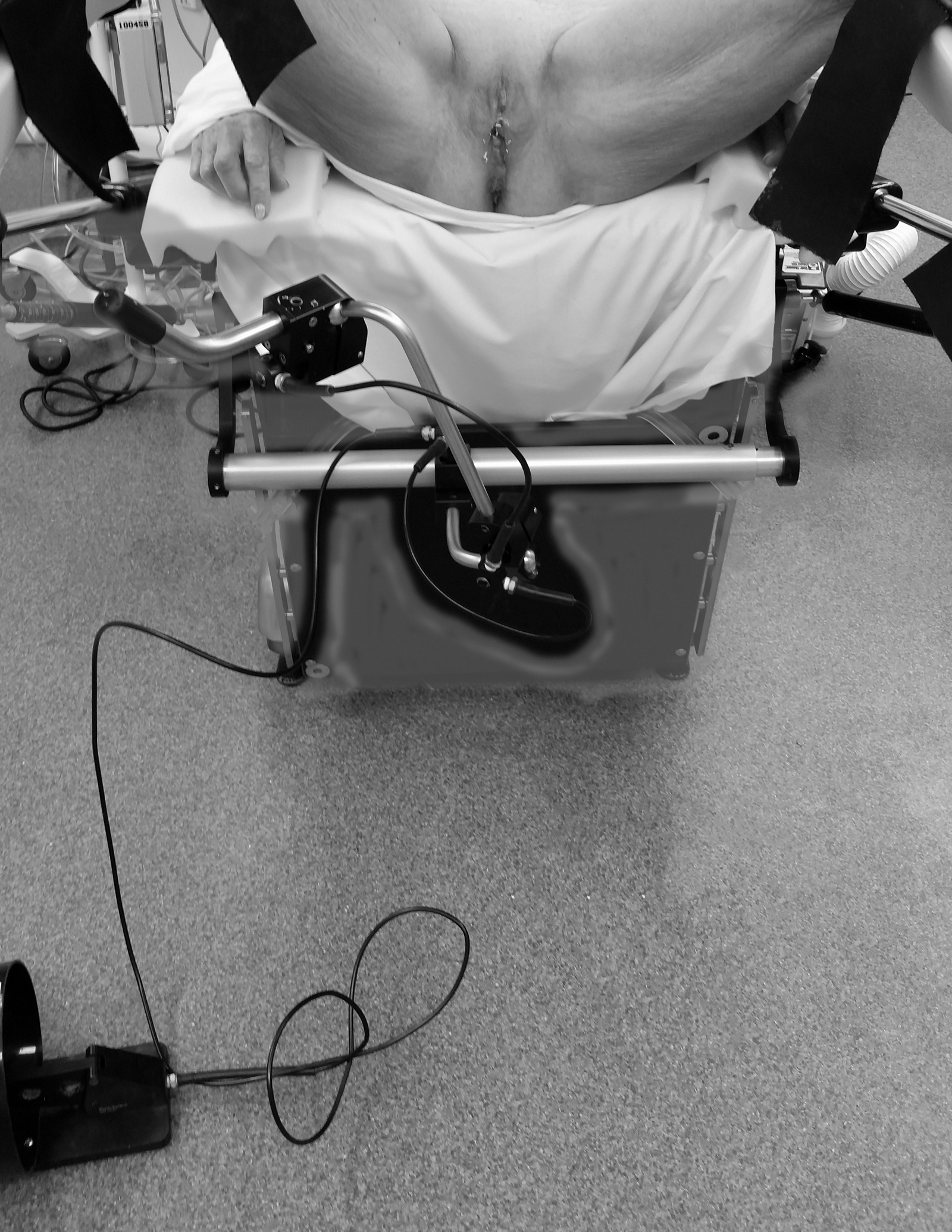
Bed-mounted vaginal retractor after being anchored to bed.
Pelvic organ prolapse quantification (POP-Q) examination was performed and recorded preoperatively and postoperatively on every patient. Treatment failure was defined as recurrent apical prolapse >2 cm or any leading edge beyond the hymen (Ba = 0 or Bp = 0). Surgical characteristics examined included type of sutures used for mesh fixation, prior surgical history, including prolapse and incontinence procedures, POP-Q examination, and validated quality of life instruments such as urogenital distress inventory (UDI)-6 and Incontinence Impact Questionnaire (IIQ)-7. Perioperative complications included vaginal suture extrusion, vaginal mesh extrusion, port site hernia, deep venous thrombus, atrial fibrillation, mesh extrusion, prolonged intubation, and wound infection. The study was approved by the Indiana University School of Medicine Institutional Review Board. Statistical analyses were performed using Microsoft Excel® (Microsoft Corp, Redmond, Washington) and SPSS version 20.0 (IBM, Chicago, IL). Categorical variables were analyzed for significance with chi-squared analysis and continuous variables were analyzed with two-tailed Student's t-test.
Results
A total of 119 consecutive women underwent robotic sacral colpopexy (RSC) between 2009 and 2016. Patients had similar preoperative characteristics (Table 1). Fifty-three had undergone prior hysterectomy, 15 had undergone prior vaginal prolapse repair, and 8 had undergone prior incontinence procedures. Many patients underwent concomitant procedures at the time of colpopexy. Sixty-six underwent robotic supracervical or total hysterectomy, 34 underwent mid-urethral sling at the time of colpopexy, 22 underwent culdoplasty for enterocele, and 5 underwent concomitant anterior vaginal wall suspension. All POP-Q, UDI-6, and quality of life (QoL) scores improved postoperatively (Tables 1 and 2). Apical failure was noted in 0, anterior failure was noted in 7 (average Ba +1.1 cm in failures), and posterior failure was noted in 4 (mean Bp +1.0 cm) at 16 months' mean follow-up. Failures in the anterior compartment were much more common in the nonabsorbable monofilament cohort (Table 3). Failures in the apical and posterior compartments were not significantly different between groups. Nine of 49 suture erosions were noted in the nonabsorbable monofilament cohort, 5 requiring excision in the clinic, 2 in the operating room, and 2 not requiring intervention. Two of 70 suture erosions were noted in the delayed absorbable monofilament cohort, 0 required intervention. Postoperative UDI-6 and QoL scores did not vary significantly between groups (5.3 ± 4.0 vs 5.1 ± 4.0, p = not significant (NS), 2.8 ± 2.0 vs 2.8 ± 2.2, p = NS). Complications included two wound infections managed with antibiotics (Clavien–Dindo classification Grade II 7 ) and two vaginal mesh erosions, as well as one prolonged intubation that was effectively extubated on POD#2 for respiratory compromise thought to be caused by untreated hiatal hernia and advanced age (92 years). One new-onset episode of atrial fibrillation was also noted. Three port site hernias were noted postoperatively, always at the 12 mm port site, one required operative intervention (Clavien–Dindo classification Grade IIIb), and the remaining two were managed nonoperatively. One of the vaginal mesh erosion events occurred after total hysterectomy at the time of colpopexy, managed with operative intervention (Clavien–Dindo classification Grade IIIb). The other patient had undergone prior hysterectomy, had no recognized vaginotomy or opening in the vagina, and was asymptomatic and chose nonoperative management (Clavien I).
Failure of Repair by Compartment and Type of Suture Used to Secure Mesh
Suture extrusion by suture type. Significance is by chi-squared analysis.
Discussion
Compared with other contemporary RASC series, this series is the first to compare failure rates between delayed absorbable monofilament suture (PDS) and permanent monofilament (Prolene). Vaginal suture extrusion is not reported as a complication in many series, but certainly contributes to patient morbidity, and is more common than vaginal mesh exposure. The low rates of suture extrusion made descriptive statistics less meaningful, but the trend in this series is clear. Ploumidis et al. reported intra- and postoperative complication rate of 3.2% in a cohort of 95 women who underwent RASC. 8 In that study, less than half of the patients had prior abdominal surgery and no patients had concomitant hysterectomy. In one large RASC series, Nosti et al. found an overall complication rate of 7% in a group of 262 women of which ∼43% of women had prior abdominal surgeries. 9 Women in the present series were more likely to have previous hysterectomy (44.6%) and concomitant hysterectomy (55.4%).
Our port site hernia rate of 2.5% was higher than the reported rates of 0% to 1.6% in other contemporary series, 9 –11 but not all RASC series report on port site hernia as a complication.
The mesh extrusion rate in this study is comparable with the rates reported by a recent meta-analysis of RASC (1.7% vs 0%–19%). 4 The single patient in the present series who required operative repair of her exposed mesh had undergone concomitant total hysterectomy. Previous studies have shown that concomitant total hysterectomy is associated with a high incidence of mesh extrusion ranging from 16% to 23% after sacrocolpopexy. 12,13
Because of this analysis we now counsel the patients requiring hysterectomy to undergo supracervical hysterectomy if there is no increased risk for cervical cancer, and since that time, no additional mesh exposure events after supracervical hysterectomy were noted in this series. In a recent study of 277 women undergoing abdominal sacral colpopexy (not RASC) with either a concomitant supracervical hysterectomy or no hysterectomy because it had been done previously, the authors found no difference in mesh extrusion in the supracervical group (2/195 = 0.5%, compared with 2/82 = 2.4%) in the total hysterectomy group. 14
Vaginal suture extrusion in our study is higher than another laparoscopic series (9.2% vs 6%). 15 Most patients with suture extrusions presented with no symptoms, only noted by the examining urologist. However, some may present with vaginal discharge or dyspareunia. Vaginal suture extrusion is likely a technical error from placement of nonabsorbable sutures through full thickness of vagina. In an effort to minimize suture extrusions, we switched to delayed absorbable polydioxanone sutures for mesh fixation. A main concern with using absorbable sutures is the durability of mesh fixation. Porcine models demonstrate that majority of the final strength of tissue in-growth into polypropylene mesh is achieved by 12 weeks postoperatively, and that 2 weeks yields significantly lower bond of mesh to fascia. 16 Polydioxanone suture loses only 50% of its tensile strength by 6 weeks, whereas Maxon® loses 50% of its strength by 3 weeks and Vicryl by 2 weeks. 17 The rate of recurrent prolapse was not influenced by the type of mesh fixation suture used in our study. A recent study by Borahay and coworkers also found that delayed absorbable sutures are effective in RASC patients with no apical prolapse at a median follow-up of 17 months. 18 A direct comparative trial with longer follow-up is needed to better address this issue.
There are several limitations in this study, including those common to retrospective reviews. The data came from a single institution, single surgeon, and the sample size is small relative to the number of suture extrusion events. A trial to truly determine the durability of delayed absorbable sutures would need to be randomized and blinded, but this case series suggests results are equivalent.
Conclusions
Securing mesh with delayed absorbable monofilament does not appear to increase risk of failure in patients undergoing RASC and eliminates the need for suture excision postoperatively. The technique for RASC described earlier yields durable outcomes equal to that in the contemporary literature. This work justifies more study into the use of delayed absorbable sutures to secure polypropylene mesh during RASC, but more study is needed before patients can be counseled that absorbable suture can replace permanent suture for this purpose.
Footnotes
Author Disclosure Statement
I serve as a PI for Astellas PLUS trial.
Funding Information
No funding was received for this article.