




Abstract
Introduction:
To investigate the thermal effect on the water by a novel thulium fiber laser (TFL) designed for lithotripsy and evaluate the safety of this laser for clinical use.
Materials and Methods:
An in vitro experimental setup was constructed. A test tube filled with saline was immersed in an electric water bath, and a TFL fiber and a thermal probe were inserted into it. Saline was irrigated into the tube and pumped out synchronously at the same speed by two pumps, respectively, to maintain convection when needed. Then, continuous TFL firing of different power settings was imposed to saline in the tube for 60 seconds, on the conditions of different irrigation rates. The temperature was recorded every 5 seconds during the whole trial, and each trial was repeated five times. Safety threshold of temperature increase (STTI) was determined comparing with the deemed safe temperature of 43°C in vivo.
Results:
On condition of 0 mL/min irrigation rate, STTI was 6.5°C, and water temperature increase (WTI) caused by ≥15 W settings surpassed STTI after 20 seconds of laser firing; on condition of 15 mL/min irrigation rate, only WTI caused by the highest 30 W power setting surpassed STTI after 45 seconds of laser firing. When irrigation rate was added up to 25 and 50 mL/min, WTIs caused by all power settings were below STTIs in a 60-second experiment. High frequency and low pulse energy combinations caused a slightly higher WTI compared with low frequency and high pulse energy, given a constant power and irrigation rate.
Conclusion:
Power setting and irrigation rate collaboratively play a critical role in WTI during TFL lithotripsy, and it is safe to use TFL referring to the thermal effect as long as there is moderate irrigation, while TFL power should be lowered enough when irrigation is ceased.
Introduction
Ureteroscopic lithotripsy is the first-line treatment for ureter and kidney stones <2 cm. For more than two decades, holmium: yttrium aluminum garnet (Ho: YAG) laser has remained the mainstay of lithotripter. 1 However, effectiveness of Ho:YAG laser is offset by the relatively low efficiency for stone ablation, unavoidable stone retropulsion, and small stone size amenable to laser lithotripsy. 2 Thulium fiber laser (TFL) has emerged as a promising new laser technology in the field of stone management in recent years. 1 –3 TFL is composed of silica fiber doped with thulium ions triggered during the laser pumping, and emits 1940 nm laser in wavelength. Its absorption coefficient of energy in water is fourfold higher than the Ho: YAG laser. TFL allows rapid ablation of stone with a high pulse rate, high-power density, and minor stone retropulsion. In vitro and in vivo experiments have found superiority of TFL over Ho:YAG laser in stone fragmentation efficacy. 4 –8 Moreover, a smaller TFL fiber offers better flexibility for flexible ureteroscopy and better irrigation than Ho: YAG. 2,9
While TFL and Ho: YAG laser have good absorption coefficient in water to minimize laser radiation, the dissipation of energy in irrigation fluid can cause heat injury to the surrounding tissues. The thermal effect of Ho: YAG laser has been a concern for a urologist during the surgery and widely studied. Publications have suggested requirements for laser power and irrigation rate to avoid reaching potential tissue-damaging temperature. 10,11 However, there have been sparse data regarding the thermal effect of TFL lithotripsy. The aim of this study is to investigate the impacts of different TFL power settings and irrigation rates on water temperature in an in vitro model.
Materials and Methods
An in vitro experimental setup was constructed to simulate the in vivo use of TFL in the urinary collecting system (Fig. 1). A novel TFL product with 272 μm core diameter fiber was used in this study (Raykeen Laser Technology Limited Corporation, Shanghai, China), with a maximum power output of 55 W in superpulse mode. A model to mimic the collecting system was created with a test tube of 18 mm in diameter filled with 20 mL saline. The model was immersed in an electric water bath (Saidelisi Manufacturer of Experimental Apparatus, Tianjin, China) with a constant temperature of 36.5°C to reflect body temperature. TFL fiber with a thermal probe fixed at the tip was inserted into the tube 10 mm above the bottom.
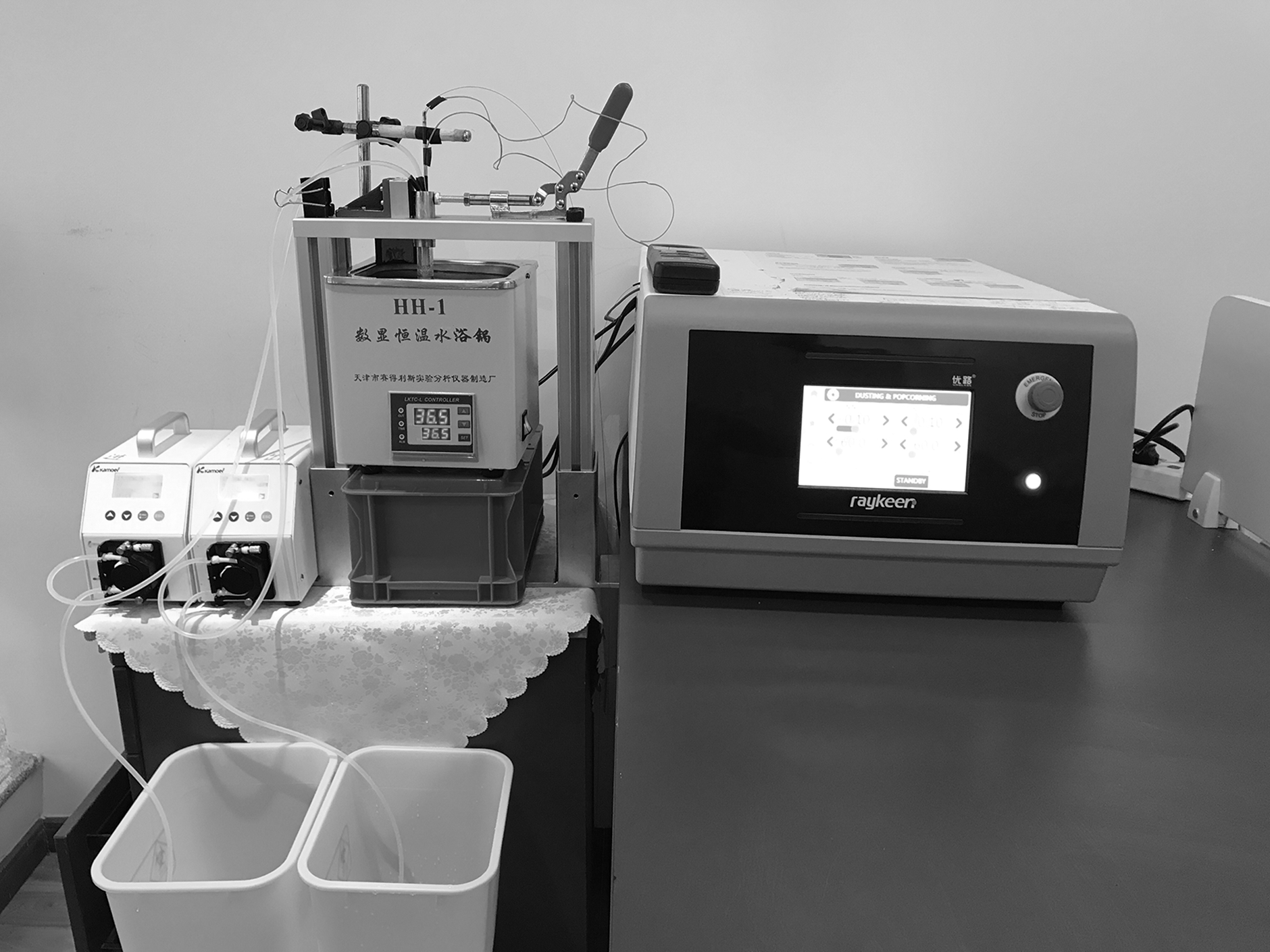
Experimental setup.
Saline in a water tank was irrigated into the test tube by a pump (Kamoer Fluid Technology Limited Corporation, Shanghai, China), and synchronously, saline in the tube was pumped out to another water tank at the same speed to maintain convection when needed during the experiment. As pumped saline of room temperature might be a confounding factor, the initial temperature of water inside the tube was recorded at the beginning of each trial before laser firing. Safety threshold of temperature increase (STTI) in each condition was evaluated and compared with the safety standard temperature of 43°C.
To analyze the influence of power setting and irrigation rate on the thermal effect of TFL, an experiment was conducted with various combinations of laser power and irrigation rates. Laser power was set at five different combinations: 6 W (0.1 J, 60 Hz), 10 W (0.1 J, 100 Hz), 15 W (0.1 J, 150 Hz), 20 W (0.1 J, 200 Hz), and 30 W (0.1 J, 300 Hz). During laser emission, irrigation rates were set at 0, 15, 25, or 50 mL/min. To explore the influence of frequency/pulse energy on the thermal effect of TFL in the setting of a constant power and irrigation, different combinations of frequency and pulse energy were tested: 0.05 J and 400 Hz, 0.1 J and 200 Hz, 0.5 J and 40 Hz, and 0.8 J and 25 Hz. The temperature detected by the thermal probe in the tube was recorded every 5 seconds for a period of 60 seconds during the trial, and each trial was repeated five times.
All the experiments were accomplished in a laboratory room with temperature control of 23.6°C. Water temperature increase (WTI) of each trial was calculated, and the relationship between time points of laser firing and WTI was depicted by curves. Statistical analyses were conducted using SPSS v.21 (IBM Corporation, New York, NY).
Results
On condition of 0 mL/min irrigation, the initial temperature of water within the test tube was 36.5°C and STTI was 6.5°C. After TFL firing, the larger the power setting was, the higher and quicker water temperature increased. From the graphs that demonstrated the relationship between time points of continuous laser firing and WTI, the WTI was noted to surge within 10 seconds of laser emission and then transform into a period of relatively slow increase. From the time point of 20 seconds, WTI increased above STTI in power settings ≥15 W. For low-power settings ≤10 W, WTI was under STTI throughout the 60-second experiment (Fig. 2A).

Water temperature increase and safety threshold of temperature increase in different power settings and irrigation rate:
On condition of 15 mL/min irrigation, the initial temperature of water within the test tube was 29.8°C and STTI became 13.2°C. Only WTI caused by the highest 30 W power surpassed STTI, from the time point of 45 seconds. For power settings ≤20 W implemented in this study, WTI caused by TFL was under STTI throughout the 60-second experiment (Fig. 2B). When the irrigation rate was added up to 25 and 50 mL/min, WTIs caused by all TFL power settings were below their STTIs during the 60-second experiment. As irrigation was started and increased, the initial water temperature within the test tube decreased nearly to a maximum of 10°C at the irrigation rate of 50 mL/min, and STTI became larger accordingly to a maximum of 16.6°C at this irrigation speed (Fig. 2C, D).
Given a constant power setting of 20 W and irrigation rate of 15 mL/min, the TFL thermal effect on water with power combinations of high frequency (≥ 200 Hz) plus low pulse energy, and low frequency plus high pulse energy, was tested and compared. WTI increased quickly by about 5°C in less than 15 seconds in each combination and then gradually reached a plateau by about 8°C within 30 seconds, all below an STTI of 13.2°C during the 60-second experiment. WTI caused by the high frequency plus low pulse energy combination was higher than the low frequency plus high pulse energy, although the discrepancy was only about 2°C at most at the time point of 60 seconds (Fig. 3).
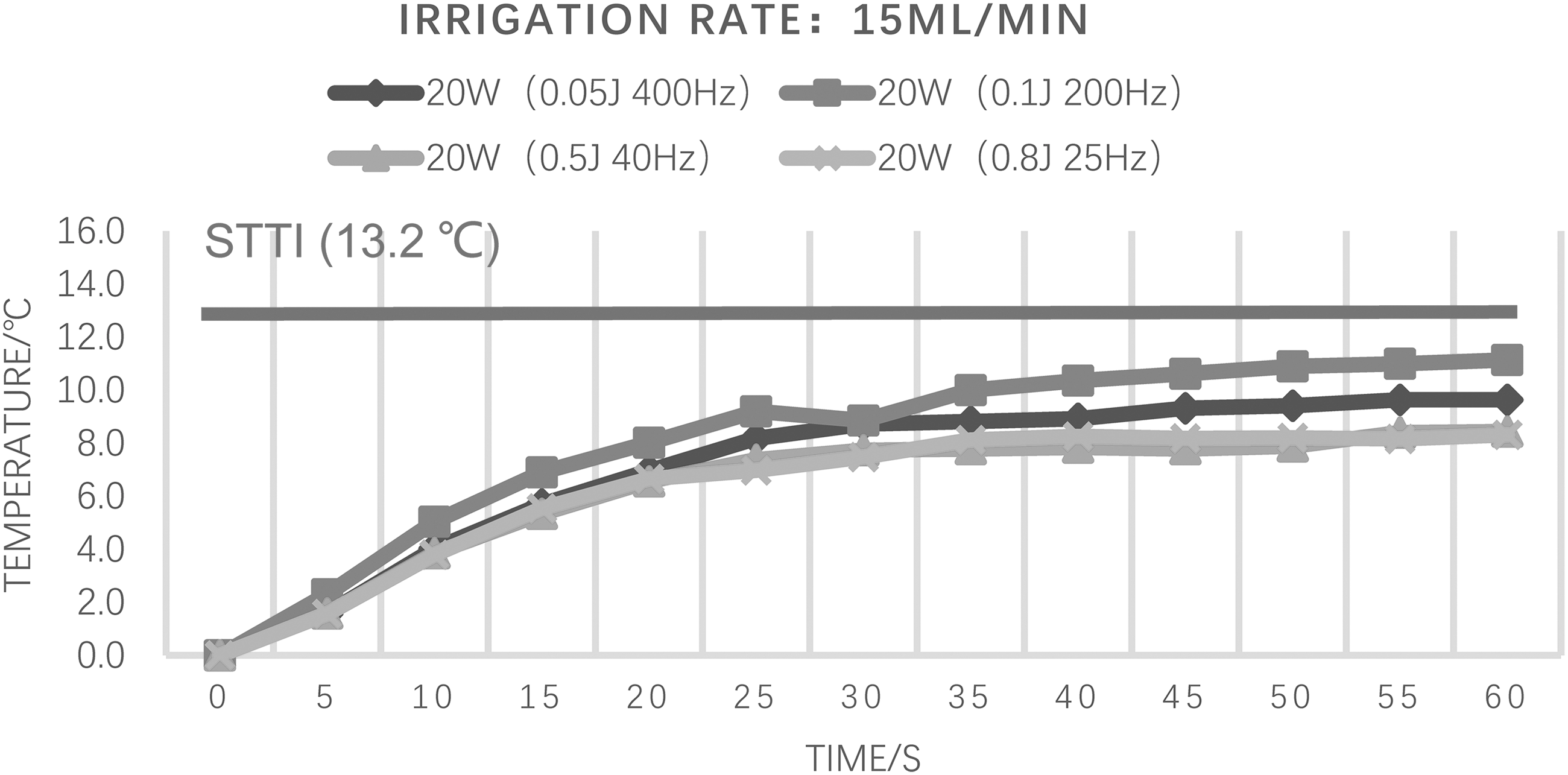
Water temperature increase in the setting of constant power and irrigation with different frequencies and pulse energies.
Discussion
There has been increasing application of TFL in surgical practice, examples being prostate enucleation and vaporization, bladder tumor resection, and so on. 12 –15 It is not until recently that TFL emerges as a more efficient tool than Ho: YAG laser and is increasingly studied in the field of laser lithotripsy. 4 –6,9,16 The mechanism of TFL and Ho: YAG laser in stone fragmentation is similar as they both emit infrared radiation causing water thermal expansion and vaporization. 4,17 Laser around wavelength of 1940 nm has heat production that can potentially be hazardous to tissues, leading to a higher risk of postoperative ureteral stricture. 18
The thermal effect of Ho: YAG laser on surrounding tissues during lithotripsy has been a hot topic since its clinical use. To address this concern, Hein et al. constructed an experimental model, in which laser was emitted at various irrigation rates and power settings to detect the change in water temperature. In the experiment, they concluded that power setting and irrigation rate both played critical roles in WTI during laser lithotripsy. More specifically, high power and low irrigation could lead to potentially tissue-damaging temperatures. 10 Recently, they continued to report this issue using an ex vivo porcine kidney model, and concluded that sufficient irrigation was mandatory to perform Ho:YAG laser lithotripsy safely. 19 At least four other studies had also found that the zero irrigation rate could result in quick and injurious WTI even in low-power setting. 11,20 –22
To our knowledge, there are sparse data regarding the thermal effect of TFL lithotripsy. Hardy and colleagues conducted an experimental model using TFL with a maximum pulse rate of 500 Hz. Peak water temperature in the test tube during lithotripsy experiments was 33°C, 11°C above the baseline temperature of 22°C, and decreasing TFL frequency from 500 to 300 Hz led to a lower WTI. 9 Viktoria and coworkers also found WTI during in vitro TFL lithotripsy as part of comparison with Ho:YAG laser. 7 However, these studies failed to consider the effect of dynamic irrigation and body temperature. Thus, how irrigation rate, power setting, and body temperature influenced the thermal effect of TFL is yet to be fully evaluated.
In the current study, the test tube was placed in a water bath with a constant temperature of 36.5°C and irrigated with saline of room temperature to investigate the effect of different irrigation rates and body temperatures on WTI during TFL lithotripsy. According to previous studies, 43°C was established as a safety threshold of temperature for laser surgery in the human body. 10,11,23 In the setting of zero irrigation, water temperature increased quickly up to injurious temperature within 20 seconds of laser usage in power settings ≥15 W. Meanwhile, WTI remained under STTI throughout the experiment when power setting was lowered to ≤10 W. In a previous study on Ho: YAG laser, there was a 7.5°C increase of temperature with 120 seconds of lasering in the setting of 15 W, 10 lower than the 10°C increase with 60 seconds of lasering in the setting of 15 W in this study. In a study comparing TFL with Ho: YAG laser, experiments showed that WTI was higher in the TFL group than in the Ho: YAG group. 9 These reports echoed the hypothesis that TFL produced a temperature increase at a faster rate than Ho: YAG laser due to its higher absorption coefficient in water. However, another study showed that TFL did not produce higher temperature than Ho: YAG laser. 7
Our study has found that TFL power ≥15 W is prone to cause heat injury of tissues when irrigation is ceased during lithotripsy. This is particularly important as urologists tend to prefer minimal irrigation rate or even suspend irrigation to avoid stone retropulsion or migration. In this circumstance, TFL power should be cautiously lowered in accordance with irrigation rate to avoid irreversible thermal injury of the tissue. Nonetheless, TFL has an advantageous characteristic of less retropulsion force on stones, which helps to justify maintaining a steady irrigation flow during lithotripsy without significant stone migration. Whenever irrigation suspension is needed, TFL power ≤10 W is recommended to prevent thermal injury, which has been proven to remain efficient in stone ablation. 7,8
When irrigation was added up to a moderate rate of 15 mL/min, most power settings resulted in temperature rise within the safety margin. Only the highest power output of 30 W has been demonstrated to cause an injurious WTI after lasering for 45 seconds. When irrigation was pumped at faster rates than 15 mL/min, all power settings were shown to be safe in terms of WTI throughout the experiment. WTI curves of all power settings resembled logarithmic growth type, where temperature increased quickly at the beginning of experiments and there would be a plateau later after some time points. As the irrigation rate increased, WTI of each power setting decreased at all time points, time to reach a plateau was shortened, and the time point for high-power setting to exceed STTI was postponed. Considering that the initial temperature of water in the collecting system correlated negatively with irrigation rate, STTI became larger as irrigation increased, and thus, it became safer to use TFL given a considerably higher irrigation rate during lithotripsy.
However, a higher irrigation rate leads to higher intrapelvic pressure and risk of infectious complications following endoscopic lithotripsy. 24,25 Pressure fluctuation caused by irrigation was not explored in the current study. As this model was unable to simulate anatomy of the collecting system and flexibility of soft tissues, it would be invalid for evaluating the effect on intrapelvic pressure at various irrigation settings. While real-time monitoring of pressure is not a standard of routine practice and unable to guarantee the safety of endoscopic lithotripsy, urologists are advised to adjust irrigation rate as guided by intraoperative factors such as the clearness of vision or stone location. Results from this study showed that laser heat was dissipated efficiently to sustain safety most of the time in the irrigation rate range from 15 to 25 mL/min. In the setting of high power such as 30 W, irrigation ≥25 mL/min or strategy of intermittent laser firing may add to safety redundancy during lithotripsy.
High frequency multiplied by low pulse energy and low frequency multiplied by high pulse energy are common skills to achieve dusting and basketing during laser lithotripsy, and hence, we examined the impact of different frequencies and pulse energies on WTI. Results of this part indicated that frequency and pulse energy were secondary factors influencing WTI in the setting of a constant power and irrigation rate, and high-frequency settings yielded a slightly higher WTI compared with low-frequency settings. This was in accordance with a similar study on Ho: YAG laser, which showed that the higher frequency settings yielded 3.5%–8.8% higher temperatures. 10
There were a few limitations in this study. First, the experimental setup was not able to simulate genuine anatomy of human urinary system, but the relationship between WTI in the collecting system and power setting or irrigation rate during TFL use can be fundamentally revealed. Further study using in vivo models such as porcine kidney may help to address the limitation, where irrigation in combination of ureteral access sheath with pressure monitoring can be achieved. Second, WTI was detected in a single point within the tube, which might not be able to reflect the panorama of WTI during laser use because of the convection. Third, stones were not placed inside the tube, for there was obvious disturbance in WTI found in our preliminary experiment. Nonetheless, we speculated that this study demonstrated more rigorous WTI during laser lithotripsy, as no energy was absorbed for stone ablation. In addition, different fiber sizes were not taken into account in this study. Larger fibers decrease flow rate compared with smaller ones and thus might influence temperature. Although fibers are getting smaller for TFL lithotripsy and fiber size differences are getting smaller too, it should be elucidated in further researches.
Conclusions
The current in vitro study demonstrated that power setting and irrigation rate collaboratively played a critical role in WTI during TFL lithotripsy, and it was safe to use TFL referring to the thermal effect as long as there was moderate irrigation. For future clinical practice, it is noteworthy that TFL power should be lowered enough when irrigation is ceased.
Footnotes
Acknowledgments
Xiaofeng Gao and Yonghan Peng contributed to the study conceptual exploration and revision of the article; Min Liu and Shaoxiong Ming contributed to study design, experiment accomplishment, and composition of the article; Weixing Yu, Ling Li, and Ziyu Fang contributed to proofreading of the article and legend writing; Zeyu Wang, Chaoyue Lu, and Hao Dong contributed to data collection; data analysis and figure editing were accomplished by Rong Shen, Fei Xie, and Xiaomin Gao. Chan Chun Ki revised the language of the article.
Author Disclosure Statement
Thulium fiber laser products used in this study were provided by Raykeen Laser Technology Limited Corporation (Shanghai, China).
Funding Information
This study was supported by projects of Science and Technology Commission of Shanghai Municipality (17441900800) and Ministry of Science and Technology of the People's Republic of China (2017YFB1302800).