




Abstract
Objectives:
We conduct a study to assess the outcome of microultrasonic probe combined with ultrasound (US)-guided minipercutaneous nephrolithotomy (PCNL) for upper ureteral and renal stones.
Patients and Methods:
Data of 119 patients (123 kidney units) who underwent microultrasonic lithotripsy combined with mini-PCNL were retrospectively reviewed. The group included 96 men and 23 women. All procedure of puncture and dilatation were guided by US solely. Data were analyzed by SPSS.
Results:
The mean operation time was 32.6 minutes (range, 10–110 minutes). The mean time of lithotripsy and stone removal was 14.5 minutes (3–100 minutes). The mean postoperative length of stay was 2.7 days (1–7 days). Besides, stone-free rate (SFR) at discharge was 95.9% (118/123). The mean hemoglobin drop was 11.6 mg/dL (range 1–26 mg/dL). Grades I, II, and IIIa complications were observed in four, one, and one patients, respectively. Subgroup analysis was done to compare the outcomes of 20 mm or less vs 21 mm or more calculi. There was a longer operation duration (40 vs 29 minutes) and lower SFR in the 21 mm or more calculi subgroup.
Conclusions:
Microultrasonic probe combined with US-guided mini-PCNL is an effective and safe procedure to treat patients with upper ureteral and renal stones with higher SFR but lower complications.
Introduction
Minipercutaneous nephrolithotomy (PCNL) is commonly performed with a tract size ≤20F. 1 As we all know, the Storz Mini-perc system is equipped with three kinds of sheaths, which has an outer diameter of 18, 19.5, and 24F respectively. 2 The sheath can hold a 12F nephroscope with a 6.7F working channel for instruments up to 5F. Besides, Wolf also deviced a similar system. 2 There are two sheaths available with outer size of 15 and 18F. 2 This system uses a 14F nephroscope with a 6F working channel. Stone can be disintegrated with pneumatic or laser energy in both systems. 3 –5
A significant advantage of this system is that the sheath can accommodate a flexible nephroscope. Miniforceps, graspers, or flexible Nitinol baskets can be used to remove fragment. This technique is commonly used for calculi >1.5 cm in diameter. 2 However, there was no available ultrasonic probes that were small enough to pass through a smaller working channel.
With the development of PCNL, ultramini-PCNL, supermini-PCNL (SMP), and visualized percutaneous nephrolithotherapy, 6,7 the operation channels have become thinner. However, synchronization of stone fragmentation and removal is not well realized in the process of stone fragmentation using laser lithotripsy. 8 –10 Despite the innovative design of vacuum suction sheath for SMP, the larger stone fragments still necessitate repeated retraction and retraction of the nephroscope to remove them.
To achieve higher stone-free rate (SFR) and minimize the occurrence of complications, we developed a new type of microultrasonic lithotripsy probe, which combines the high efficiency of ultrasonic lithotripsy while retaining the smaller percutaneous access. We refer to this technique as microultrasonic probe combined with mini-PCNL. The aim of this report was to assess the outcome of microultrasonic probe combined with ultrasound (US)-guided mini-PCNL in the treatment of upper ureteral and renal stones.
Patients and Methods
This is a retrospective study of 119 patients with upper ureteral and renal stones. All patients performed microultrasonic probe combined with US-guided mini-PCNL between November 2015 and May 2018 in a single center. All patients were informed that the clinical and laboratory data would be used for scientific research and written consent was obtained before the mini-PCNL. The research was approved by the Ethics Committee of Peking University People's Hospital and informed consent was obtained from all participants.
The indications of procedures included cystine stone, extracorporeal shock wave lithotripsy refractory stone, ≥10 mm lower calix stone, or anatomic abnormality of urinary tract. The exclusion criteria were meet the inclusion criteria, but performed procedures other than microultrasonic probe combination with mini-PCNL. For multiple stones of the kidney unit, the stone size was calculated by adding the longest diameter of each stone.
Procedure
All patients were under spinal anesthesia (lumbar anesthesia or combined with spinal anesthesia). A retrograde 5F ureteral catheter (BARD) was inserted into the affected side with 22F cystoscope in the lithotomy position. A 16F ureteral catheter was placed into the bladder for urine drainage. After ureteral catheter insertion, the patients were positioned prone. Renal access was achieved under 3.5 MHz US guidance (Fig. 1) using an 18-gauge puncture needle. Next a J-shaped guidewire was then placed into the collecting system through the needle after observing the urine reflux. The access was dilated by a matched peel-away sheath (Cook, Inc.) through the guidewire. A 16–18F renal access was established. A 12F rigid nephroscope with ultrasonic lithotripsy was used for stone fragmentation and removal.
The procedure of puncture and dilatation was guided by ultrasound.
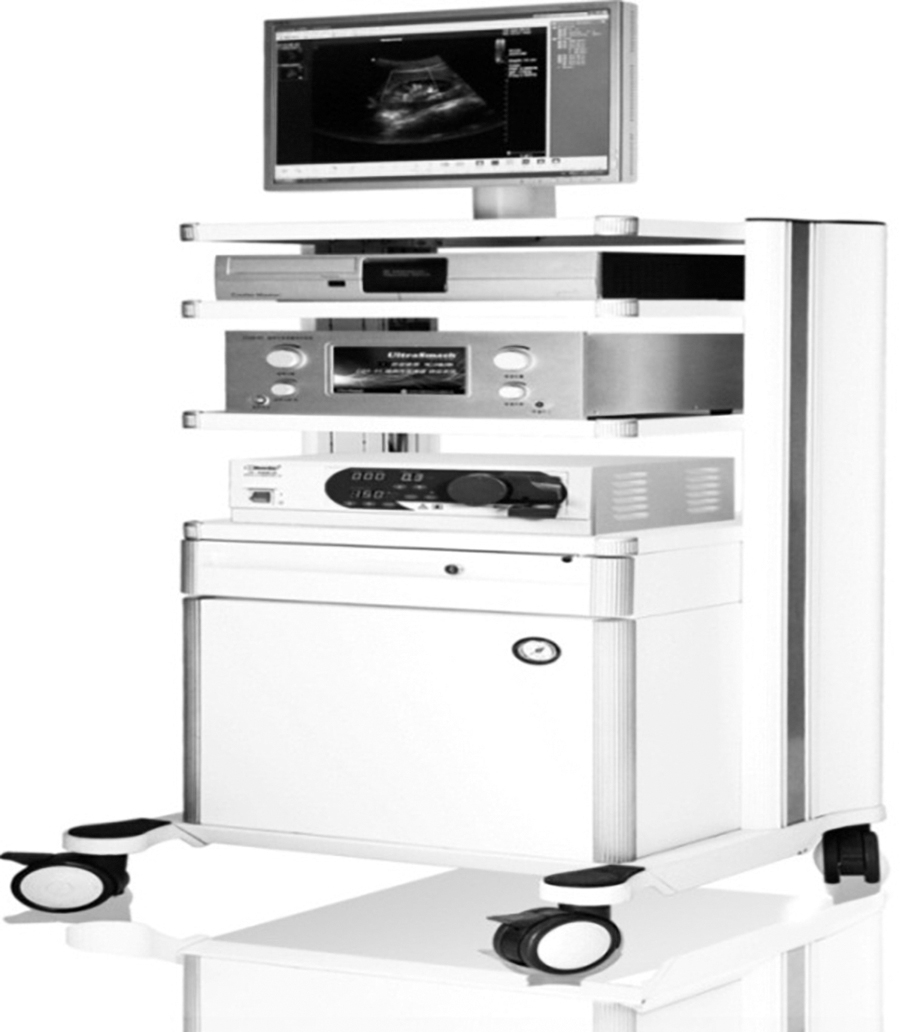
The ultrasonic stone fragmentation and removal system was produced by Huifukang Co., Ltd. (China), the ultrasonic lithotripsy energy is set to 70%, the duty ratio is 70%, the ultrasonic probe inner diameter is 1.6 mm, and the outer diameter is 2 mm (Fig. 2). We set the flushing fluid flow rate to 400 mL/minute, perfusion pressure 200 mmHg, adjusted according to the actual situation, and the vacuum suction pressure is set to 0.04–0.08 MPa.

Comparison of standard ultrasonic probe (3.3 mm, right) and microultrasonic probe (2.0 mm, left).
The operation was complete when no residual fragments could be detected by endoscopic and ultrasonic imaging. We usually placed nephrostomy tubes in patients with bleeding from the nephrolithomy tract. There were no nephrostomy tubes placed in patients with minimal bleeding. We placed a Double-J stent in patients with impacted calculi in the ureter.
The operation duration was defined as the duration between the beginning of the renal puncture and removal of percutaneous system from the kidney. No nephrostomy tube and Double-J stent left were defined as complete tubeless. Patients with only Double-J stent left were defined as incomplete tubeless.
Total tubeless rate was the sum of complete tubeless rate and incomplete tubeless rate. Postoperative serum biochemistry and complete blood count testing were performed immediately. According to the results of urine culture and antibacterial spectrum, prophylactic antibiotics were used. Kidney, ureter, and bladder radiograph (KUB) or CT scan was taken on postoperative day 1 to observe the position of Double-J stent and residual stones. The patients with no nephrostomy tubes after surgery still need to be observed for renal perirenal effusion using US. Patients could get out of bed if the urine color was clear on postoperative day 1. The patients with nephrostomy tube were re-examined with KUB. The nephrostomy tube was extracted when no fever and lumbago occurred within 6 hours, and the urinary tube was removed the next day.
Stone free was defined either as the absence of any residual stone fragment or the presence of residual stones <4 mm in the kidney or upper ureter. Most of the Double-J stent was removed 4 weeks postoperation. The SFR was calculated at hospital discharge, assessed by KUB or CT. A complication was graded by the modified Clavien–Dindo classification system. 11
Statistical analyses
The data (Tables 1 and 2) collected from these patients included demographics, stone data (size, location, and composition), and operation duration. Data were recorded, tabulated, and statistically analyzed and compared using SPSS software version 13. The data are expressed as the mean (standard deviation) and number and percentage according to the type of data. The independent samples t-test and chi-square test were used in the statistical comparison of the two groups and p values were estimated, with a p < 0.05 was considered to indicate statistical significance. Subgroup analysis was performed for stones 20 mm or less, and between 21 mm and more.
Demographics and Stone Characteristics of the Patients Who Underwent Microultrasonic Probe Combined with Ultrasound-Guided Minipercutaneous Nephrolithotomy
SD = standard deviation.
Intraoperative and Postoperative Variables
GFR = glomerular filtration rate; SFR = stone-free rate.
Results
All patients were effectively performed the first-stage operation under US guidance. The stone was disintegrated into 1.0-mm fragments. There was no stone fragment blockage and ultrasonic transducer heating during stone fragmentation. The central region of the pole (98 renal units, 79.0%) was the most commonly accessed (Table 2). Fourteen renal units (11.3%) in the upper pole and 12 (9.7%) renal units in the lower pole were accessed. In all, 124 channels were established in 123 renal units of 119 patients. One hundred and fifteen (96.6%) patients were operated in a single session, whereas 5 (3.5%) patients were operated in two sessions. The mean operation time was 32.6 minutes (10–110 minutes).
Besides, the hemoglobin concentration of 103 cases (86.6%) was decreased after the procedure and the mean hemoglobin drop was 11.6 mg/dL (range, 1–26 mg/dL). The mean postoperative hospital stay time was 2.7 days (range, 1–7 days). The initial SFR was 95.9%. Twenty patients (20 kidney units) underwent CT scan postsurgery in this group. Stone free was demonstrated in 19 patients (19 kidney units) using CT scan. Ninety-nine patients (104 kidney units) used KUB postsurgery and 100 kidney units were defined as stone free.
The tubeless rate was 82.9%, including complete tubeless rate of 22.0%. There was no significant difference between preoperative and postoperative creatinine.
Postoperative complications occurred in six (5.0%) patients, including five patients with minor complications (Grades I and II) and one patient with major complication (Grades III and IV). Four patients with fever (>38.0°C) and one patient with perirenal hematoma were managed with conservative treatment. However, one patient was administered transcutaneous arterial embolization because of severe hemorrhage after the procedure. Dark red hematuria occurred in this patient after removal of the nephrostomy tube on the 4th day after operation. Radiography showed pseudoaneurysm and then microcoil embolization was given. The patient was discharged on the 6th day after the procedure. No patient was administered blood transfusion in our study. No sepsis, kidney loss, and adjacent organ injury was observed.
Subgroup analysis was done to compare the outcomes of 20 mm or less vs 21 mm or more calculi (Table 3). There was a longer operation time (40 vs 29 minutes) and lower SFR in the 21 mm or more calculi subgroup.
Outcome of Calculi Treated with Microultrasonic Probe Combined with Ultrasound-Guided Minipercutaneous Nephrolithotomy
Stone analysis was carried out in 110 patients by infrared spectrophotometry. Results showed calcium oxalate stone in 73 cases, mixed composition stones in 17 cases, struvite stones in 8 cases, uric acid stones in 7 cases, and cystine stones in 5 cases.
Discussion
PCNL is a well-established procedure for patients with large and complex kidney stones. American Urological Association (AUA) recommended that staghorn renal stones should be treated with PCNL. 12 European Association of Urology (EAU) suggested that stone management should be based on kidney stone size and location. 13 PCNL was recommended as a preferred method for calculi >2.0 cm. 13,14
Numerous reports show that PCNL was related to some common complications, such as bleeding that necessitates transfusion. 15 A previous study reported the rate of transfusions after surgery increased from 1.1% to 12.1% in different sizes of tracts. 16 Compare with standard PCNL, mini-PCNL can also achieve acceptable SFR and a lower incidence of severe complications. Compared with the standard PCNL, the less invasiveness of mini-PCNL has not been clearly demonstrated, but it is usually related to less blood loss and shorter hospital stay. 17 –19
Four methods are commonly used for lithotripsy within nephroscope or ureteroscope, such as electrohydraulic, US, pneumatic, and laser lithotripsy. Electrohydraulic lithotripsy has an excellent efficacy in the treatment of most stones. However, it is more likely to cause complications, such as urothelial injury, hemorrhage, and tissue perforation. 2,20 –22 The use of US lithotripsy through a nephroscope or ureteroscope can facilitate removal of small stone fragments by suction through a hollow probe. Neodymium-doped yttrium aluminum garnet laser lithotripsy is effective for most stones and it causes less damage to the surrounding tissues. Lithotripsy can be accomplished using pneumatic or laser energy through both Storz Miniperc and Wolf systems. 1,3
But the available ultrasonic probes are not small enough to fit with the smaller working channel. Nowadays, our center has an ultrasonic probe to fit through the smaller working channel. It can complete stone fragmentation and removal simultaneously. The design of the 2.0 mm microultrasonic probe has the advantage of stone fragmentation and removal simultaneously.
Perfusion of continuous irrigation fluid during PCNL results in high intrarenal pressure, increasing the risk of infection, and is related to the size of the channel. Zhong et al. found that by using 14, 16, and 18F channels for micro-PCNL, the cumulative time of the intrarenal pressure of a 14F channel was significantly higher than that of the 16 and 18F channels, and the incidence of postoperative fever was significantly higher than that of the latter. 23 Microultrasonic lithotripsy combined with mini-PCNL used the12F nephrostomy tube in the 16F renal access. Continuous negative pressure suction maintained the intrarenal pressure at a lower level during the lithotripsy process to avoid retrograde infection caused by high intrarenal pressure.
The efficacy and safety of any stone removal procedure are assessed by three criteria: (1) SFR, (2) complication rate, and (3) auxiliary procedure rate. In our report, the SFR was 95.9%. Subgroup analysis shows that the microultrasonic probe combined with US-guided mini-PCNL seems to be more effective in managing smaller (≤20 mm) rather than larger (>20 mm) kidney calculi (SFR 100% vs 82.6%). The rate of complication is 5.0%. All patients were effectively performed the first-stage operation under US guidance.
Nephrostomy tube is beneficial for drainage and hemostasis, besides, it can help patients to establish renal access in case of performing repeat PCNL. However, complications associated with nephrostomy tube have led urologists to improve the technique to tubeless or completely tubeless. In our series, the total tubeless rate was 82.9% and the complete tubeless rate was 22.0%.
In sum, microultrasonic probe combined with US-guided mini-PCNL has a lower complication rate and a higher SFR with lower auxiliary procedure. Nevertheless, it is optimal for managing stones ≤20 mm. There are some tips of this procedure: (1) maintain coaxial operation as much as possible, that is, the ultrasonic probe is in the same direction as the operation channel, which is especially important for the treatment of upper ureteral stones and (2) the setting of energy is usually 70% of ultrasonic power and 70% of duty ratio. Excessive power and duty ratio easily damages the probe. (3) For treatment of hard stones, micro-US combined with pneumatic can be used to avoid the micro-US probe being overloaded for a long time and (4) when the stone burden is large, the operation time is obviously increased. It is necessary to carefully weigh the pros and cons and avoid the increase of the risk of postoperative infection.
Although the technique of microultrasonic probe combined with US-guided mini-PCNL has the characteristics of higher SFR of standard PCNL, it can also minimize the rate of complications. However, it should be noted that the microultrasonic probe with a diameter of 2 mm is thinner than the standard ultrasonic probe with a diameter of 3.3 mm.
Conclusions
In sum, microultrasonic probe combined with US-guided mini-PCNL is an effective and safe procedure. It may be an alternative method to manage 10–20 mm stone in patients who wish to avoid routine nephrostomy tubes or stents. Besides, randomized controlled reports are warranted.
Footnotes
Author Disclosure Statement
No competing financial interests exist.
Funding Information
No funding was received for this article.