




Abstract
Introduction:
Acquisition costs and prohibitively expensive technical support for endoscope maintenance, repair, and reprocessing have deterred adoption of flexible cystoscopes by many urologists internationally. This study evaluated the performance of a novel single-use digital cystoscope that can directly connect to a laptop or computer monitor for visualization, obviating the need for a tower.
Materials and Methods:
The performance characteristics of flexible single-use cystoscopes (NeoScope) were prospectively evaluated vs a reusable flexible cystoscope (Olympus) in three clinical cases and two independent benchtop testing episodes in Canada. Cystoscope maneuverability, imaging, deflection, irrigation, and ease of use of instrumentation were investigated. Additional investigations were performed during clinical use in Zimbabwe (7 patients), Egypt (10 patients), and Dominica (5 patients).
Results:
Bench testing revealed smaller tip diameter (4.06 vs 6.09 mm) and shorter (35.4 vs 38 cm) single-use cystoscopes vs reusable cystoscopes. Deflection of the single-use scope was superior with an empty working channel (230 up/220 down) vs the reusable (195 up/95 down) but showed a more substantial decrease in deflection on placement of instruments including a grasper. Clinical use revealed satisfactory maneuverability, ease of use of instruments, deflection, and visualization.
Introduction
Since its development, the cystoscope has become an indispensable tool in a urologist's armamentarium. The origin of the cystoscope dates back to the early 1800s when Philipp Bonzi created one of the first endoscopes to observe the bladder, vagina, rectum, and nasopharynx. 1,2 However, the true precursor of the modern day cystoscope was created several decades later by Maximilian Nitze and Joseph Leiter. 3 In the iterations of cystoscopes that followed, the ability for instrumentation was gained. This allowed for the development of the cystoscope into a therapeutic tool used to treat urinary calculi and ureteral stenoses. 2 With the advent of fiber optics, reusable flexible cystoscopy was made possible in 1973 and has since become one of the most commonly performed urologic office-based procedures. 4,5
Despite the adoption of reusable cystoscopes by many urologists, they possess several limitations. One limitation relates to the economic impact of these devices. Reusable endoscopes are associated with a high economic burden because of their high purchasing and maintenance costs. 6,7 The sterilization process also represents a problem with reusable cystoscopes; the current recommended sterilization process for reusable cystoscopes is relatively expensive and time consuming. With many regulations not allowing liquid soaking sterilization (such as glutaraldehyde), sterilization has become very resource intensive as proper sterilization requires specific equipment, facilities, and trained staff. 8 The third limitation relates to the sterility of the cystoscopes themselves. Endoscopes have internal working channels and lumens that can be difficult to clean and are susceptible to bacterial colonization. 9 Upon use in the patient, biofilm can readily form and in turn, contribute to the failure of sterilization. 10 In fact, reusable flexible endoscopes have been noted to possess the highest health care-related infection rates of any other medical device. 9
A potential solution to the problems of reusable cystoscopes is single-use cystoscopes. Disposable cystoscopes circumvent many issues associated with reusable cystoscopes as they require no additional maintenance, sterilization, or repair processes. Given these characteristics, single-use cystoscopes have the ability to be used in areas where proper sterilization infrastructure is not available. 7 Furthermore, as single-use cystoscopes do not require maintenance, sterilization, or repair, they have been demonstrated to be more cost-effective. 11 Some single-use cystoscopes have also been designed to be used in-office thereby further reducing costs associated with operating rooms. 11,12 These reductions in financial burden may render cystoscopy more readily available in low- and middle-income countries (LMICs) where reusable cystoscopy and their repurposing procedures may be cost prohibitive.
One novel single-use cystoscope that has been developed is the NeoFlex – Flexible, Single-Use Cystoscope™ (NeoScope, Inc.). According to the manufacturer, this cystoscope is commercially available in three sizes (9.0F, 12.0F, and 15.0F). 13 The NeoFlex handle is held ventrally with a U-shaped lever controlling the articulating tip (Fig. 1A). Per the manufacturer, this lever is designed to minimize thumb extension for ergonomics and the working channel enters at 0° angle, allowing easy instrument insertion. The articulating tip is capable of bi-directional 270° angle deflection. 13 This cystoscope possesses a resolution of 400 × 400 pixels using a complementary metal-oxide-semiconductor-based imaging sensor. 13 A video tower and control box is also not required as this cystoscope functions through direct Universal Serial Bus (USB) connection to any laptop computer (Fig. 1) providing power, light, and visualization. This sole connection suffices for effective cystoscopy. The clinical use of this cystoscope has not previously been reported in bench-top or clinical testing.
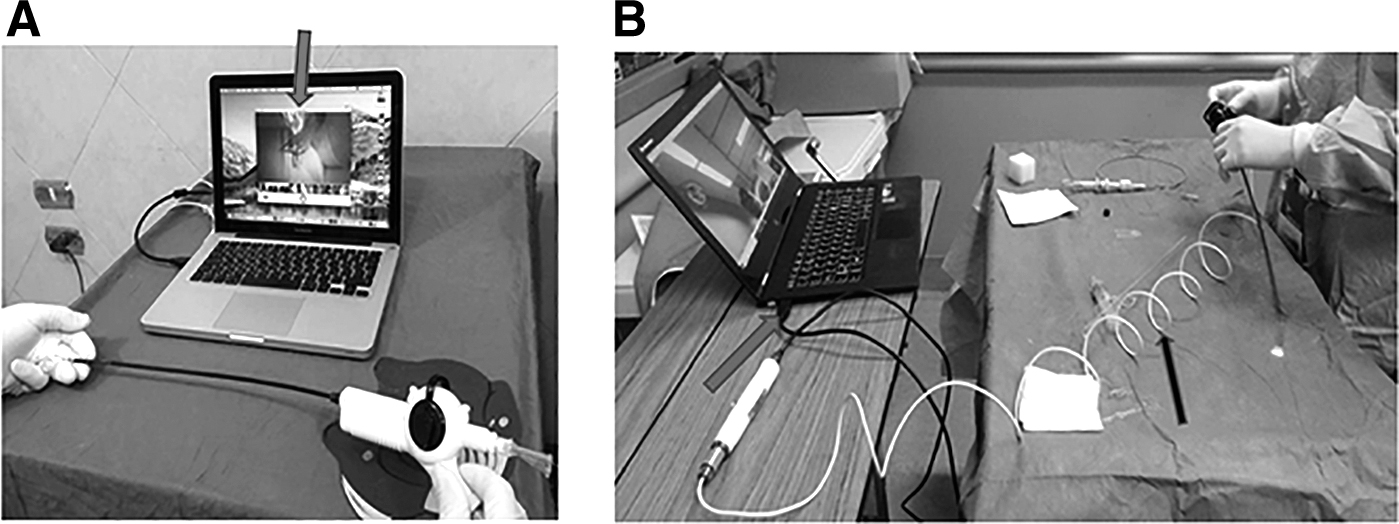
Single-use flexible digital cystoscope showing connection to laptop
The aim of this study was to evaluate and compare the NeoFlex – Flexible, Single-Use Cystoscope to a reusable digital flexible cystoscope (Olympus CYF-VH) in benchtop and clinical settings. We hypothesized that this single-use cystoscope would provide adequate clinical performance including diagnostic procedures or procedures necessitating laser, wire, basket, or forceps in a multinational setting.
Materials and Methods
Two independent benchtop testing episodes and three clinical cases were conducted at the University of British Columbia (UBC) in Canada. Additional clinical use investigations were performed in Zimbabwe (7 patients), Egypt (10 patients), and Dominica (5 patients) by trained urologists who perform flexible cystoscopy regularly.
Benchtop assessments of the 15F NeoFlex – Flexible, Single-Use Cystoscope were performed at a single site (UBC). Two NeoFlex single-use cystoscopes were prospectively compared with two standard-of-care Olympus CYF-VH reusable digital flexible cystoscopes. The 15F disposable cystoscope was chosen as the closest in size to the 16.2F reusable cystoscope. Measurements of tip diameter and overall cystoscope length were taken. Deflection angles of the NeoFlex were investigated with an empty working channel, and with the placement of a standard 365 μm Holmium:YAG laser fiber and a 3F grasper. Benchtop testing was performed by only one investigator to minimize potential differences in surgeons. Optical characteristics evaluated using a U.S. AirForce test pattern card.
Clinical-use assessment of the NeoFlex cystoscope was performed at all sites involved in this study by four urologists in the clinical office and operating room settings. Video imaging during the cystoscopy procedures was achieved through USB connection to commercially available laptop computers for all procedures. Patients during clinical-use assessment underwent standard-of-care diagnostic and therapeutic cystoscopy procedures including stent or catheter placement/removal, urologic surveillance, and treatments for urolithiasis, urinary retention, hematuria, and urinary tract infections. Placement of instruments into the working channel of the NeoFlex cystoscope was dependent on the nature of procedure. During the clinical use assessments, performance in maneuverability, visualization of urological anatomy, scope deflection, image color, illumination, and the presence of bright spots were investigated. Scope characteristics were scored through “success” vs “failure” and procedural data on all patients were collected in a prospectively maintained database. Cystoscope maneuverability was assessed by whether successful passage through urologic anatomy was achieved during procedure. All clinical assessments were performed after the relevant ethics protocols at the individual institutions. Participating patients were informed of the study and elected to proceed.
Results
Benchtop assessments revealed average smaller tip diameter and shorter overall length in the NeoFlex flexible single-use cystoscopes (4.06 mm and 35.35 cm) vs the Olympus flexible reusable cystoscopes (6.09 mm and 38.00 cm). Deflection of the single-use cystoscope was superior with an empty working channel (285° up/270° down) vs the reusable cystoscope (195° up/95° down). The dimensions and deflection of the single-use cystoscope are given in Figure 2. However, the single-use cystoscope had a more significant drop in deflection ability compared with the reusable cystoscope upon placement of instruments including a 365 μm laser fiber (Table 1). It demonstrated similar field of view, distortion, and color representation, but inferior resolution compared with the reusable cystoscope. It was inferior with respect to irrigation flow rate. The flow rate of irrigant in the single-use cystoscope with an empty working channel (5F) was almost half that of the Olympus CYF-VH reusable cystoscopes (6.6F) on bench testing (Table 1). On insertion of a 365 μm laser fiber to the working channel, the flow decreased for both cystoscopes. However, the decrease in flow rate appeared greater in the single-use cystoscope (2.08-fold) vs the reusable cystoscope (1.42-fold), although this difference was not statistically significant.

Benchtop testing of single-use cystoscopes
Benchtop Performance of NeoFlex Single-Use and Olympus Flexible Reusable Cystoscopes
A total of 25 patients underwent a cystoscopy procedure using the NeoFlex cystoscope. Seventeen of these patients were men, whereas eight were women with mean age of 53 years (Table 2). Instrumentation was dependent on the nature of the procedure. Procedures with the NeoFlex single-use cystoscope were successful in all cases except for one, where the device provided inadequate light distribution during stent removal with poor visualization resulting in replacement with the Olympus reusable cystoscope for the continuation of the procedure. Clinical use otherwise revealed satisfactory maneuverability, imaging, illumination, deflection, visualization, and instrumentation through the cystoscope's working channel (Table 3). Of 25 patients treated with the NeoFlex single-use cystoscope, scope passage, scope deflection, and image color were rated as “successful” in all the procedures. However, poor light distribution was described in three cystoscopes tested, and bright spots were observed with one cystoscope particularly on attempting to observe the bladder wall. Finally, visualization was prohibitively poor in one procedure as detailed previously.
Patient Demographics and Procedure Information
UTI, urinary tract infection.
Single-Use Cystoscope Clinical Performance
Discussion
Although research and development in flexible cystoscopy has resulted in increased popularity worldwide in recent years, the adoption is not universal. This is largely because of the costs and risks associated with reusable flexible cystoscopy. Acquisition costs and prohibitively expensive technical support for endoscope maintenance, repair, and reprocessing have deterred adoption of flexible cystoscopes by many urologists internationally, especially in developing countries. The Spaulding classification system classifies cystoscopes as semi-critical devices necessitating high-level disinfection to be used in a reusable manner, adding to associated costs of the standard cystoscopy procedure. 14 Although the cost analyses performed by Donato et al. 11 and Oderda et al. 12 on cystoscopes designed strictly for stent removal will likely prove to differ from those of the multipurpose NeoFlex, they may be informative as to the potential cost savings of an even more versatile instrument. A single-use diagnostic and therapeutic cystoscope may allow for the performance of this procedure in a clinic setting vs the operating room, potentially adding to cost savings.
In addition to high costs, the risk of infection is another area concern associated with reusable cystoscopes, as reusable endoscopes have been associated with the highest health care-related infection rates of any other medical devices. 9 Because disposable cystoscopes are not expected to harbor latent pathogenic bacteria from the manufacturing and package process, their sterile and single-use characteristic may decrease rates of infection associated with cross-contamination or the improper maintenance of reusable cystoscopes.
The introduction of a widely available affordable single-use cystoscope into the urologist's armamentarium may address these drawbacks. Single-use cystoscopes have the potential to be a cost-effective alternative to the standard reusable cystoscopes to help urologists and institutions manage procedural cost and mitigate risks of infection. A successful single-use cystoscope should offer equivalent image quality, maneuverability, and performance comparable with reusable cystoscopes used by urologists routinely in the clinical office setting. Furthermore, before single-use cystoscopes are considered as viable alternatives to their reusable counterparts, comprehensive evaluation regarding their technological design, clinical efficacy, and cost-effectiveness must be conducted.
In addition to the NeoFlex, there are other single-use cystoscopes developed for targeted commercial use. These include the Uroviu Uro-V Cystoscope Platform that is commercially available as of November 2019. 15 Uro-V is a self-contained, single-use diagnostic cystoscope specifically designed for female diagnostic cystoscopy that integrates a portable handheld system containing a liquid crystal display for visualization with a disposable 12F hydrophilic-coated cannula for fluid infusion and guidewire insertion. 15 This device is designed for endoscopic diagnosis and infusion of irrigating fluid within the bladder and urethra. There is also a separate injection cannula. 15 To our knowledge, no laboratory or clinical evaluations have been published on its performance.
Another single-use cystoscope system is the Isiris α from Coloplast® that has an incorporated grasper solely designed to perform Double-J stent removals. In a published study by Talso et al., this cystoscope has been described to possess comparable quality of vision and water flow compared with reusable cystoscopes, although with a narrower field of view. 16 Moreover, in a study conducted by Doizi et al., 94% of stent removal procedures performed in 83 patients were successful, with the scope faltering in the face of stent encrustation or migration. 17 Salvage ureterorenoscopy was required for all failed procedures after unsuccessful attempts of stent removal with conventional flexible reusable cystoscope and grasper. 17 Overall, the Isiris α single-use cystoscope displayed good image quality, active deflection, maneuverability, and grasper functionality. 17
From our benchtop investigations, the NeoScope NeoFlex flexible single-use cystoscope had superior deflection when the channel was empty, but deflection was inferior compared with commercially available reusable digital cystoscopes on the introduction of instruments into its working channel used routinely during diagnostic and interventional cystoscopy procedures. Furthermore, the irrigation flow rate of the NeoFlex cystoscope was inferior to that of the Olympus CYF-VH with both an empty and occupied working channel. An inferior irrigation system may limit its surveillance and procedural capabilities, as effective irrigation is critical for scope maneuverability, organ dilation, and maintaining adequate visualization. 18 Image resolution was superior in the reusable scope; other optical characteristics were comparable.
However, on clinical use, success was achieved in 96% of all (24/25) cystoscopy procedures performed with the NeoFlex flexible single-use cystoscope in this study. Given the success in a variety of cystoscopy procedures, the NeoFlex flexible single-use cystoscope may be suitable for both diagnostic and therapeutic purposes. However, there is a 4% failure rate, representing a single cystoscope. Because of the small nature of this study, further larger investigations will be needed to validate its clinical utility, particularly given the durability of reusable flexible cystoscopes. 19
The NeoFlex flexible single-use cystoscope boasts a direct connection to any computer monitor through USB connectivity. This permits truly portable utilization of the cystoscope, allowing for treatment of patients in a variety of clinical settings without the need for equipment maintenance, or supporting proprietary tower and monitors. Such a degree of portability may be of interest to urologists working in clinical office and hospital settings lacking video cystoscopy tower units or international urologists participating in medical missions or routine care in rural or isolated locations where resources may be limited. Compared with other single-use cystoscopes described, the NeoScope NeoFlex is capable of performing all cystoscopy-related procedures and allows the use of all instruments typically used with cystoscopes (lasers, forceps, baskets, and guidewires) as opposed to specialized functionality. This cystoscope does not currently incorporate enhanced lesion detection capabilities such as blue light cystoscopy or narrow band imaging. 20 However, the general purpose, nature, and ability to use various instruments allows the NeoFlex cystoscope to potentially serve as a valid alternative to commercially available reusable cystoscopes in any cystoscopy procedures in LMICs or other challenging circumstances.
Although the 9F and 12F versions of this cystoscope have not been formally evaluated in this study, we predict that they would increase the ease of maneuverability while decreasing the ability to perform therapeutic procedures such as lithotripsy or stent removal given the expected decrease in working channel diameter. Further studies will need to be carried out to determine the advantages and disadvantages of these cystoscopes.
Our study has several limitations. Although our investigations into the performance and efficacy of the NeoFlex Single-Use Cystoscope are initial, we did not perform a randomized trial comparing this device with a commercially available flexible reusable cystoscope, as the type of standard cystoscope varied between institutions included in this study, whereas in some study sites, no reusable flexible cystoscopes were readily available. Furthermore, the small number of procedures is also a limiting factor. Our evaluation of this device should serve to warrant further investigations. Studies with larger patient cohorts are needed to evaluate the clinical performance compared with control reusable cystoscopes.
Moreover, a study focusing on the financial costs of using the NeoFlex flexible single-use cystoscope will be necessary to evaluate the cost-effectiveness of implementing such a device as standard practice. The manufacturer's stated introductory price in the United States is $299 per cystoscope. This represents some cost savings compared with the initial cost of a reusable Olympus CYF-VH cystoscope (quoted average cost U.S. $12,800). However, given the durability of reusable cystoscopes, the eventual price per procedure may be as low as $35. 21 The practicality of this cystoscope in LMICs will ultimately depend on the price.
In addition to economic costs, the environmental impact of the NeoFlex remains to be determined. To date there have been no studies that have evaluated the environmental burden of single-use cystoscopes. The materials used for these cystoscopes are not biodegradable. Thus, the effect of disposal of increased numbers of these cystoscopes is expected to be increased compared with a reusable cystoscope. Although Davis et al. did demonstrate the carbon footprint of reusable and single-use flexible ureteroscopes to be comparable, 22 further study specifically looking at single-use cystoscopes will be warranted.
Conclusion
The NeoScope NeoFlex Flexible Single-Use Cystoscope offers comparable maneuverability, imaging, and illumination to standard-of-care flexible reusable cystoscopes available in the market without the need for maintenance or repurposing. Direct connection to any laptop or monitor allows for truly portable use, allowing for cystoscopy procedures to be conducted with no additional resources. Future clinical studies are needed to investigate the performance of this device in a larger patient cohort and cost analysis studies.
Footnotes
Acknowledgments
The authors thank Ashvin Desai of Neoscope for providing us with some of the cystoscopes used in this study. Some of the single-use cystoscopes were provided free of charge from the manufacturer (for bench testing and for use in Dominica as part of a medical mission trip), whereas others were purchased at discounted prices for use in Egypt and Zimbabwe.
Author Disclosure Statement
No competing financial interests exist.
Funding Information
No funding was received for this article.