




Abstract
Introduction:
The advent of single-use disposable flexible ureteroscopes allows for rapid prototyping of novel endoscopes. In this regard, we sought to develop a female-specific ureteroscope, with a shorter working length, to account for the female anatomy. We hypothesized that the shorter, female-specific single-use flexible ureteroscope would engender higher irrigation flow at a given pressure than that of the standard-length ureteroscope.
Methods:
An in vitro analysis of a standard 65 cm Dornier Axis™ ureteroscope and a shorter, 45 cm female-specific Dornier Axis ureteroscope was performed. All other aspects of the endoscopes were identical. Each ureteroscope was oriented vertically and connected to a Thermedx® irrigation system to provide uniform pressurized flow. The average flow rate was computed over five, 2-minute periods at pressure settings of 50, 100, 150, and 200 mm Hg. Data were collected with the working channel unoccupied, after placement of a 200 μm (0.6F) holmium laser fiber and after passage of a 1.7F stone basket. The procedure was then repeated with the endoscopes at maximum deflection.
Results:
The female gender ureteroscope had significantly higher irrigation flow rates than the standard-length ureteroscope under all conditions by an average of 11% (p < 0.02). The highest average percent increase, 17% (p < 0.001), was seen with the 1.7F NGage® basket in the working channel with the endoscope straight. The maximum angle of deflection was not significantly different between the female gender and standard ureteroscopes with an open working channel (314° vs 315°, p = 0.86), with the 1.7F NGage basket in place (314° vs 315°, p = 0.15), and with the 200 μm holmium laser in place (316° vs 309°, p = 0.09).
Conclusions:
A 45 cm female gender ureteroscope allows for a higher irrigation flow rate than the standard-length ureteroscope under all test conditions. There is no added benefit with regard to deflection capabilities.
Introduction
Ureteroscopy is a commonly performed procedure for visualizing the upper urinary tract and removing stones through lithotripsy and basketing. In recent years, manufacturers have developed single-use, disposable ureteroscopes, which are cost-effective alternatives that appear to provide comparable quality and performance to reusable ureteroscopes. 1 Accordingly, manufacturers are no longer confined to a “one-size-fits-all” ureteroscope and are free to experiment with more personalized ureteroscope designs. Recently, our laboratory group collaborated with Dornier MedTech to develop a prototype female gender, disposable ureteroscope, which has a shaft length of 45 cm to account for the shorter urethra in females.
During ureteroscopy, adequate irrigation is key to provide a clear visual field. The shorter ureteroscope designed for females could offer theoretical benefits in this regard based on a theoretical increase in irrigation flow rates. According to Poiseuille's solution, a shorter ureteroscope length will result in an increased flow rate when radius, fluid viscosity, and inlet and outlet pressure differences are held constant. In this study, we hypothesized that a 45 cm female gender, Dornier Axis™ single-use flexible ureteroscope would have a higher irrigation flow rate than the standard 65-cm-long Dornier Axis single-use flexible ureteroscope. We also hypothesized that the shorter ureteroscope might benefit the endoscope's deflection.
Materials and Methods
Dornier AXIS Single-Use Digital Ureteroscope description
The 65 cm standard Dornier AXIS single-use digital ureteroscope and the shorter, 45 cm female gender Dornier AXIS single-use digital ureteroscope (Dornier MedTech America, Inc.) are identical in all other respects (i.e., 3.6F working channel, 8.5F shaft, and 275° bidirectional deflection).
Irrigation flow rate measurements
At the start of procedure, both ureteroscopes were secured to a table in a vertical position; the distal tip was situated 30 cm above the floor (Fig. 1). Each ureteroscope was connected to a 3.2 m length of standard Thermedx® tubing via the ureteroscope's side port valve, which in turn was connected to the Thermedx FluidSmart® Fluid Management System (Thermedx LLC., Solon, OH). The Thermedx unit provides for controlled pressurized irrigation. Sterile water at 37°C was used for irrigation. With each ureteroscope in the vertical position, the built-in adjustable seal of the working channel was loosened to allow for passage of instrumentation and thereafter tightened. Data were recorded with the working channel unoccupied, after placement of a 200 μm (0.6F) holmium laser fiber (Cook Medical, Inc., Bloomington, IN), and after passage of a 1.7F nitinol stone basket (NGage®; Cook Medical, Inc.).
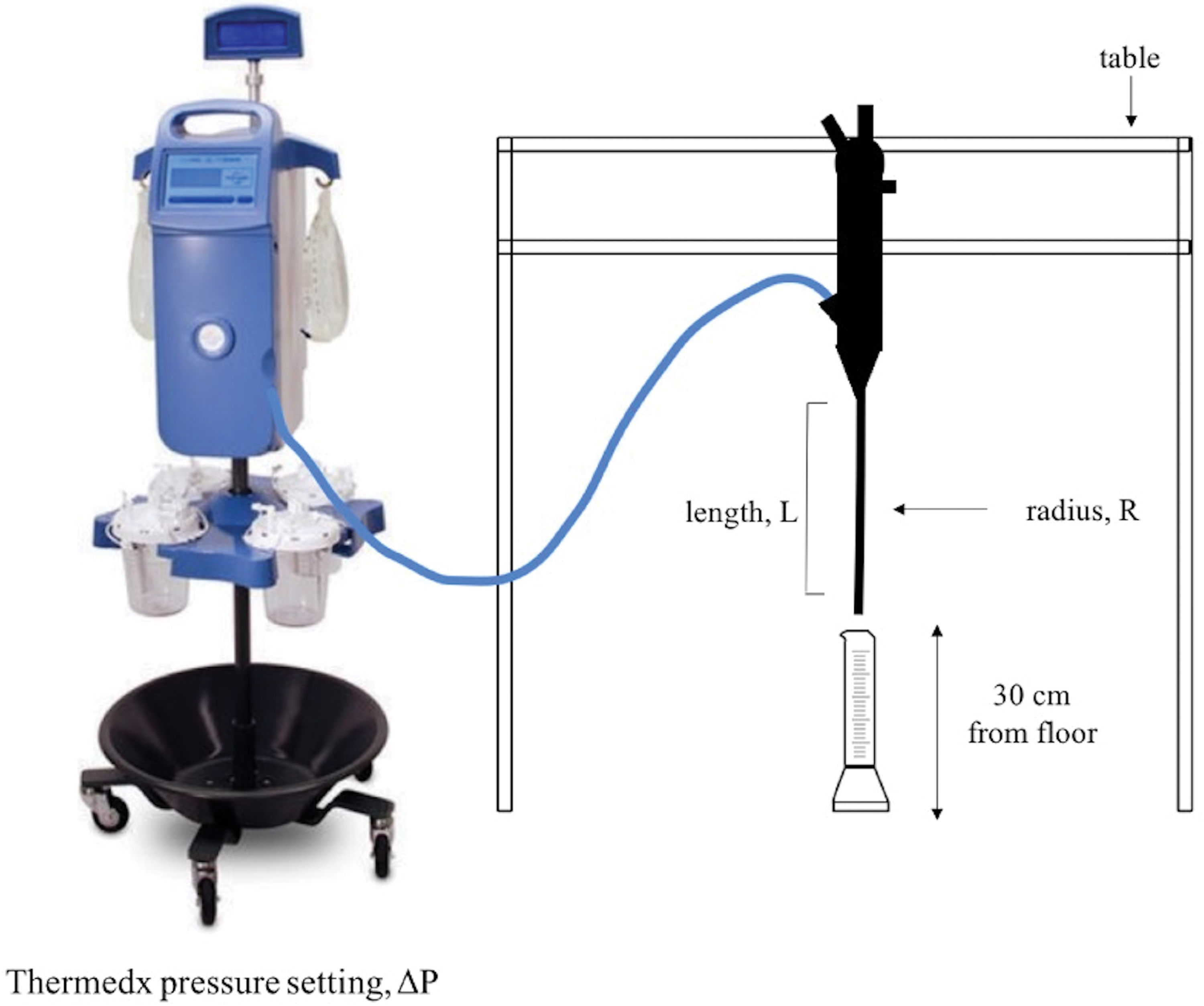
Experimental setup of ureteroscopes oriented vertically and Thermedx®. Color images are available online.
The ureteroscopes were positioned to empty into a graduated cylinder. The average flow rate was calculated from the collected irrigation fluid over a 2-minute interval; five trials were completed with the Thermedx unit for each of the following pressure settings: 50, 100, 150, and 200 mm Hg. Five trials were performed for each scenario, thereby providing 60 measurements for each ureteroscope (total of 120 measurements). The procedure was repeated with both ureteroscopes at maximum tip deflection. Following completion of the trials in the vertical position, the ureteroscopes were oriented horizontally and the procedure was again repeated.
Theoretical calculations using Poiseuille's solution
Theoretical estimates of irrigation flow rate for the ureteroscopes with an open working channel were calculated using Poiseuille's solution

Comparison of experimental irrigation flow rate measurements and theoretical irrigation flow rate calculations for
The theoretical calculations of the irrigation flow rate with the standard-length ureteroscope in the horizontal position yielded 31.31 mL/min at 50 mm Hg, 62.63 mL/min at 100 mm Hg, 93.95 mL/min at 150 mm Hg, and 125.27 mL/min at 200 mm Hg. The theoretical calculations of the irrigation flow rate with the female gender ureteroscope in the horizontal position yielded 45.24 mL/min at 50 mm Hg, 90.47 mL/min at 100 mm Hg, 135.71 mL/min at 150 mm Hg, and 180.94 mL/min at 200 mm Hg.
For theoretical calculations of the irrigation flow rates of the ureteroscopes in the vertical position, a modification of Poiseuille's solution
Maximum deflection measurements
The angle of maximum deflection in the upward and downward direction of both ureteroscopes was measured with a 360° protractor. The distance from the point of deflection to the tip of the ureteroscope and the diameter of the loop formed at maximum deflection were measured on both ureteroscopes. Each measurement was performed three times and the mean calculated.
Durability assessment
New ureteroscopes were used to assess durability. The maximum upward and downward deflection of a 45-cm-long female gender Dornier Axis single-use flexible ureteroscope and a standard 65-cm-long Dornier Axis single-use flexible ureteroscope was measured to provide a baseline. Each ureteroscope was then deflected maximally 60 times in the upward and downward directions. The maximum upward and downward deflection of each ureteroscope was again measured following a set of 60 deflections.
Statistical analysis
Average flow rates in each condition and average angles of maximum deflection were compared using two-sided t-tests. Differences were considered statistically significant with p-values <0.05. Statistical tests were performed using Microsoft Excel 2015 (Microsoft, Redmond, WA).
Results
Flow rate with the ureteroscope in the straight position
With the ureteroscopes oriented both vertically and horizontally, the irrigation flow rate through the 45-cm-long flexible ureteroscope was significantly higher than that of the standard 65-cm-long flexible ureteroscope under nearly all working channel conditions (Table 1). These changes were most pronounced with the 1.7F NGage basket in the working channel, with an average percent increase of 17% when oriented vertically (p < 0.001) and 54% when oriented horizontally (p < 0.001). With an open working channel, the average percent increase in flow rate via the 45-cm-long ureteroscope was 5% in the vertical position (p < 0.001) and 14% in the horizontal position (p < 0.001), compared with the 65-cm-long ureteroscope. Similarly, with the 45-cm-long ureteroscope and with a 200 μm holmium laser in the working channel, the flow rate increased by an average of 13% (p < 0.001) when held vertically and 21% when held horizontally (p < 0.001).
A Comparison of Flow Rate (mL/min) Between Female Gender 45-cm-Long and Standard 65-cm-Long Dornier Axis Single-Use Flexible Ureteroscopes When Oriented Vertically
The only two conditions in which significant increases in flow rate were not observed using the 45 cm ureteroscope were with the ureteroscopes oriented horizontally using 50 mm Hg irrigation fluid pressure with an open working channel and with the laser in the working channel.
Flow rates at maximum deflection
At maximum deflection, the irrigation flow rate through the 45-cm-long flexible ureteroscope was significantly higher than through the standard 65-cm-long flexible ureteroscope in all testing conditions (p < 0.001), with the ureteroscopes oriented vertically and horizontally (Table 2). This difference was most pronounced with the ureteroscopes oriented horizontally and with a 1.7F NGage basket in place, with an average percent increase of 62% (p < 0.001).
A Comparison of Flow Rate (mL/min) Between Female Gender 45-cm-Long and Standard 65-cm-Long Dornier Axis Single-Use Flexible Ureteroscopes When Oriented Horizontally
With an open working channel and oriented both horizontally and vertically, the 45-cm-long ureteroscope had an average percent increase in irrigation flow rate of 15%. Placement of the 200 μm holmium laser yielded an average percent increase in irrigation flow rate of 31% when comparing the two ureteroscopes oriented horizontally. When oriented vertically, there was a 5% increase in irrigation flow rate in the 45-cm-long ureteroscope compared with the 65-cm-long ureteroscope, with the laser occupying the working channel.
Degrees of deflection
The angle of maximum deflection in the upward or downward direction was not significantly different between the two ureteroscopes with an unoccupied working channel (upward: 311° vs 312°, p = 0.20; downward: 311° vs 310°, p = 0.34), with a 1.7F NGage basket in the working channel (upward: 307° vs 308°, p = 0.24; downward: 308° vs 309°, p = 0.40), and with a 200 μm holmium laser in the working channel (upward: 309° vs 308°, p = 0.50; downward: 310° vs 309°, p = 0.51). The distance from the point of deflection to the tip of the ureteroscope was 7.1 cm and the diameter of the loop formed at maximum deflection was 1.9 cm for both ureteroscopes.
Durability
The maximum angle of deflection of the female gender ureteroscope was not significantly impacted by the trial of 60 deflections in the upward direction (before = 310° vs after = 310°, p = 0.73) nor in the downward direction (before = 310° vs after = 310°, p = 1). Similarly, the standard length ureteroscope did not have significantly different maximum angles of deflection before and after 60 deflections in the upward direction (309° vs 309°, p = 0.43) and downward direction (315° vs 314°, p = 0.39).
Discussion
Irrigation is vital to ureteroscopic procedures, as it maintains visibility while simultaneously distending the lumen of the ureter or the calices. 2,3 Irrigation flow rate is dependent on several factors: the driving pressure of irrigant, the radius and length of the working channel, and the viscosity of the fluid used as the irrigant. 4 –7 Ureteral access sheaths are another piece of equipment that have been shown to increase irrigation flow rates by improving irrigation drainage. 8 In this study, we focused on the impact of the length of the ureteroscope on irrigant flow and deflection.
Our study demonstrated consistently higher average flow rates with the female gender (45 cm) ureteroscope compared with the 65 cm standard-length ureteroscope. The differences in flow rates were maintained as the pressure was increased incrementally from 50 to 200 mm Hg; this held true when instruments were passed into the channel (i.e., 200 μm laser fiber or 1.7F stone basket). Furthermore, the increases in flow rates were present in nearly all working conditions regardless of the vertical or horizontal orientation of the ureteroscopes.
The length of a disposable ureteroscope is of importance given its direct relationship with irrigation flow rate. Other single-use ureteroscopes in addition to the Dornier Axis are the Pusen Uscope™ (Zhuhai Pusen Medical Technology Co., Ltd., China), the LithoVue™ (Boston Scientific, Watertown, MA), the NeoFlex™ (NeoScope, Inc., San Jose, CA), and ShaoGang™ (YouCare Technology Co., Ltd., Wuhan, China). The Uscope has similar specifications to the Dornier Axis, such as a 65 cm working length and 3.6F working channel, 9 and theoretically would permit similar irrigation flow rates. The LithoVue and NeoFlex also have a 3.6F working channel, but a 68 cm working length 9 and therefore might have a slightly lower irrigation flow rate. The shortest of the four single-use disposable flexible ureteroscopes is the ShaoGang with a working length of 63 cm; however, this ureteroscope has a shaft size of 9F and also has a larger 4.2F working channel, which would substantially increase the flow. 8 A theoretical calculation of the irrigation flow rates for each of these ureteroscopes oriented horizontally, using Poiseuille's solution, at a set pressure of 100 and 150 mm Hg, is listed in Table 3. We chose this pressure for the theoretical determinations as it most closely matched our benchtop data for the 45 cm ureteroscope (Fig. 2).
Theoretical Irrigation Flow Rates of Several Available Single-Use Flexible Ureteroscopes
The theoretical calculation is not affected by the size of the tip/shaft so a hypothetical number was not assigned for this calculation.
Our results are largely consistent with a study by Marchini and colleagues, which evaluated single-use ureteroscopes and found the shortest ureteroscope to have the highest irrigation flow rate. 10 When occupying the working channel with large instruments, however, their study found the 68-cm-long LithoVue to perform as well as the shorter 65 cm Pusen ureteroscope in terms of irrigation flow rates. In our study, the benefit of the 45 cm female gender disposable flexible ureteroscope was evident at nearly all pressures and all conditions. While shortening the ureteroscope is clearly beneficial for irrigant flow, another approach would be to enlarge the working port. 11,12 The ShaoGang flexible disposable ureteroscope does this with its 4.2F port; however, the size of the endoscope is increased to 9F. We were unable to obtain one of these endoscopes to test and to the best of our knowledge it remains unavailable on the U.S. market.
The negative impact on irrigation flow from having an instrument in the working port of the ureteroscope is significant; however, this is precisely the point in the procedure when the urologist is most in need of a clear field. A study by Bach and colleagues found a direct relationship between the size of an instrument in the working channel and the decrease in irrigation flow rate. 11 Our results are consistent with this finding, as the irrigation flow rates recorded were higher with the placement of the 200 micron (i.e., 0.6F) holmium laser compared with the 1.7F stone basket for each pressure setting. In every instance, aside from when held horizontally and at 50 mm Hg with an open working ch`annel and with the laser in the working channel, the 45-cm-long ureteroscope provided for a higher flow rate than the standard 65-cm-long ureteroscope.
In our study, the relative increase in irrigation flow rates was actually more pronounced when the working channel was occupied, as we observed a 17% and 13% increase in flow with placement of the 1.7F basket and the 200 μm laser fiber, respectively, in the 45 cm female gender ureteroscope when oriented vertically, and 54% and 21% with the basket and the laser, respectively, when oriented horizontally. Of note, the absolute flow rate was always greater with the endoscope in the vertical positions. Also, these increases in flow were maintained at maximum tip deflection.
The maximum angle of deflection in both the upward and downward directions was not statistically significantly different between the two ureteroscopes, under all working channel conditions. The length of the ureteroscope did not impact the deflection capabilities. Of note, the angles of maximum deflection in our study were higher than those in the reported specifications of the ureteroscopes and in most other ureteroscopes in the literature. 11,13 Similar to the study by Bach and colleagues, 11 our study found no consistent alteration in irrigant flow upon maximum deflection compared with the neutral undeflected position. The short-term durability of the short and long disposable ureteroscopes was identical, as the trial of 60 deflections in the upward and downward directions did not significantly impact the maximum angle of deflection in either ureteroscope.
Our experimental values were generally in accordance with Poiseuille's solution for determining the irrigation flow rate. However, it is important to note that Poiseuille's solution applies most closely to a fully developed, horizontal pipe in which the flow is laminar and has a parabolic velocity profile throughout the entire length of the pipe, including the exit. Clearly this is not the case for a flexible pipe as found in the ureteroscope. Another factor could be due to the discrepancy of the pressure settings of the Thermedx unit, which has been shown to overestimate the pressure reading by ∼+16 mm Hg. 14 Nonetheless, based on Poiseuille's solution, a shorter tube (i.e., working channel) length will result in an increased flow rate when radius, fluid viscosity, and inlet and outlet pressure differences are held constant. Removing a portion of the tube results in an increased flow rate due to the decreased overall effect of wall friction on the fluid. Calculations using Poiseuille's solution estimate that reducing the tube length from 65 to 45 cm will increase the flow rate by ∼40%.
This study has several limitations. As an in vitro study, we only measured the changes in irrigation flow rates based on the volume output through two extremes, a vertically positioned ureteroscope and a horizontally positioned ureteroscope. This certainly fails to mimic the in vivo situation, which has the ureteroscope beginning in a vertical position but then conforming to the various curves of the ureter as it travels into the renal collecting system. Another limitation is that we were unable to measure flow velocity during each trial as the flow was too low for our uroflowmetry machine to accurately track. Third, the study was done with only one 45 cm endoscope as this was the only prototype available. Alterations in flow and deflection may have varied had there been at least six endoscopes of both the standard 65 cm and the prototype 45 cm lengths available to test.
Conclusions
A 45-cm-long ureteroscope, specifically designed for female ureteroscopy, facilitates higher flow of irrigant compared with the standard 65-cm-long ureteroscope under nearly all pressure settings and conditions. The shorter ureteroscope, however, confers no benefits with regard to deflection capabilities or durability.
Footnotes
Acknowledgment
We gratefully acknowledge Said Elghobashi, PhD, Distinguished Professor Emeritus of Mechanical and Aerospace Engineering, for his helpful contributions to this work.
Author Disclosure Statement
The Department of Urology at the University of California Irvine is the recipient of a research grant from Dornier MedTech America, Inc.
Funding Information
This work was supported by the Curiosity and Innovation Laboratory Fund at the University of California Irvine.