




Abstract
Introduction:
Kidney stone disease (KSD) is a highly prevalent disease worldwide. As water intake and its mineral content influence stone formation and recurrence, patients and physicians must be aware of the mineral content of drinkable water. We analyzed commercial bottled still water within Europe to assess the variation in its mineral composition across different manufacturers and countries.
Materials and Methods:
Data on the mineral composition of bottled still water regarding bicarbonate, calcium, magnesium, potassium, sodium, and sulfate concentration (mg/L) were collected from ten European countries. To collect the data, the two main supermarket chains in each participating country were either visited to check for the ingredient label on bottles or the online shop was consulted through the website of the supermarket in question. Descriptive statistics such as simple boxplots were used to illustrate the variation in mineral content.
Results:
One hundred eighty-two different commercial water brands were analyzed. Up to a fivefold variation in average concentrations per mineral between countries was observed. For calcium, a wide distribution was found in France and Switzerland compared with other countries with calcium levels ranging from 10.5 to 565 mg/L and 8.4 to 579 mg/L, respectively. By consuming 2 L of water with such high calcium levels, the daily reference intake for calcium is already achieved.
Conclusions:
The mineral content of bottled still water across Europe varies greatly. For patients with KSD it is important to be aware of the mineral content of the water they drink, as it might influence stone recurrence rates and necessitate alterations of their diet.
Introduction
Kidney stone disease (KSD) is a common condition, characterized by the formation of stones within the urinary tract due to urinary supersaturation of crystal-forming substances such as calcium and oxalate. It is a potentially complex and highly prevalent disease worldwide requiring a meaningful approach, as stone recurrence rates are high. In Europe, ∼5%–10% of the general population suffered from KSD in 2011 and both prevalence and incidence have risen significantly over time. 1,2 The lifetime prevalence is now estimated to be 14%. 3 Since KSD is a relapsing disease with stone recurrence rates up to 26 per 100 persons-years without treatment, an adequate metaphylaxis is of great importance. 4 Recent data also suggest that on economic evaluation of KSD on a long-term follow-up, it is a costly disease, comparable to the combined cost of prostate and bladder cancer. 2,5
One of the earliest generally accepted hypotheses suggests a beneficial and preventive effect on KSD formation by drinking sufficient amounts of water. Studies have shown that by increasing the fluid intake to achieve a urinary output of 2 L or more per day, stone recurrence rates in patients with idiopathic calcium stones drop significantly. 6,7 This phenomenon can be explained by the fact that an increased urine production results in dilution of urinary lithogenic factors such as calcium, oxalate, and uric acid, thereby reducing crystallization of calcium salts. In addition, increased diuresis will help prevent stagnation of urine within the urinary tract, a mechanical risk factor for stone formation. 8,9
Historically, patients with idiopathic calcium stones were prescribed a low-calcium diet as a high dietary calcium intake was believed to provoke the formation of calcium-containing kidney stones. However, more recently, studies have demonstrated that a higher calcium intake reduces the risk of KSD by ∼28%–50%. 10 –12 The underlying mechanism is the binding of calcium to dietary oxalate, causing a reduction in oxalate absorption. Consequently, urinary oxalate excretion declines, preventing the formation of calcium oxalate crystals. 13,14 Therefore, nowadays patients are advised to consume the recommended daily dietary intake of calcium of 1000–1200 mg. 15,16 Magnesium might also have a preventive effect on stone formation, as it likewise complexes with oxalate. A study performed in men demonstrated a reduced risk of stone formation with higher dietary magnesium. However, this theory has not been proven in women. 17
A high intake of water and adequate amounts of certain minerals, such as calcium, are essential for patients suffering from KSD. As hydration is the cornerstone in the prevention of urolithiasis, one must realize that the mineral composition of drinking water itself may also affect urinary levels of calcium and oxalate, potentially influencing the risk of stone formation. Studies conducted in Spain and France have already demonstrated an enormous variation in mineral composition of bottled drinking water between different commercial brands. 18,19 Therefore, the aim of this study is to analyze bottled still water within Europe to assess the variation in mineral composition across different manufacturers and countries.
Materials and Methods
This descriptive study was conducted to gain insight into the variation of the mineral composition of bottled drinking water from different commercial water brands within Europe. Data on the mineral composition of bottled drinking water were collected from 10 European countries: Belgium, France, Germany, Greece, Italy, the Netherlands, Poland, Spain, Switzerland, and the United Kingdom. To collect the data, the two main supermarket chains in each participating country were either visited in person to check for the ingredient label on bottles from each water brand or the online shop was consulted through the website of the supermarket in question. Data on “bottled still water” regarding bicarbonate (HCO3−), calcium (Ca), magnesium (Mg), potassium (K), sodium (Na), and sulfate concentration (SO4 2 ) (mg/L) were collected and analyzed. All data presented in this study were collected from October to December 2019.
Statistical analysis
All data were analyzed by using the software Statistical Package for Social Sciences (SPSS) Statistics, version 26 (IBM Corp., Armonk, New York, USA). Given that the data were not normally distributed, the data were treated as nonparametric data. Therefore, for all six minerals analyzed the data are expressed as median with interquartile range (IQR). Simple boxplots were used to provide a visual representation of the data and to examine the distributional features of the mineral composition of still water among the participating countries. The boxplots display the minimum (within the lower fence), the first quartile, the median, the third quartile, and the maximum value (within the upper fence). Outliers (1.5 × IQR) and extreme values (3 × IQR) are included in the boxplots as, respectively, circles and asterisks.
Results
The mineral composition of 182 different commercial water brands for bottled still water across ten European countries was evaluated. On average, 18.2 brands per participating country were analyzed. Fourteen commercial water brands (Acqua Panna, Albert Heijn, Bar le Duc, Chaudfontaine, Contrex, Evian, Hépar, Montecalm, Nestlé Pure Life, San Benedetto, Solan de Cabras, Spa Reine, Vittel, Volvic) were available in up to five different countries.
The mineral composition of still water by country presented as median [IQR] is shown in Table 1. Comparison between countries indicates a great variation in median concentration per mineral. For bicarbonate, for example, the median mineral concentration varies from 106.0 mg/L in Italy to 314.4 mg/L in Poland. The median calcium concentration of still water varies from 32.2 mg/L in Italy to 108.0 mg/L in Switzerland. It is noteworthy that of all 10 participating countries, Italy is the country with the lowest median mineral concentrations regarding bottled still water, except for sulfates.
Mineral Composition (mg/L) of Bottled Still Water by Country (Median [Interquartile Range])
Figure 1 visualizes the distribution of the bicarbonate (Fig. 1A), calcium (Fig. 1B), magnesium (Fig. 1C), potassium (Fig. 1D), sodium (Fig. 1E), and sulfates (Fig. 1F) concentration of still water among the 10 participating countries. The boxplots graphically demonstrate that mineral concentrations vary between the participating countries. Still water brands in France and Switzerland, for example, show a wide variability for calcium concentration compared with the other participating European countries. With a minimum concentration of 10.5 mg/L and a maximum of 565 mg/L, the range for calcium content in France reaches 554.5. Calcium content in Swiss bottled still water varies even more. With a minimum concentration of 8.4mg/L and a maximum of 579 mg/L, the range for calcium content in Switzerland reaches 570.6. The same applies for the sulfate concentration in France with a range score as high as 1524.
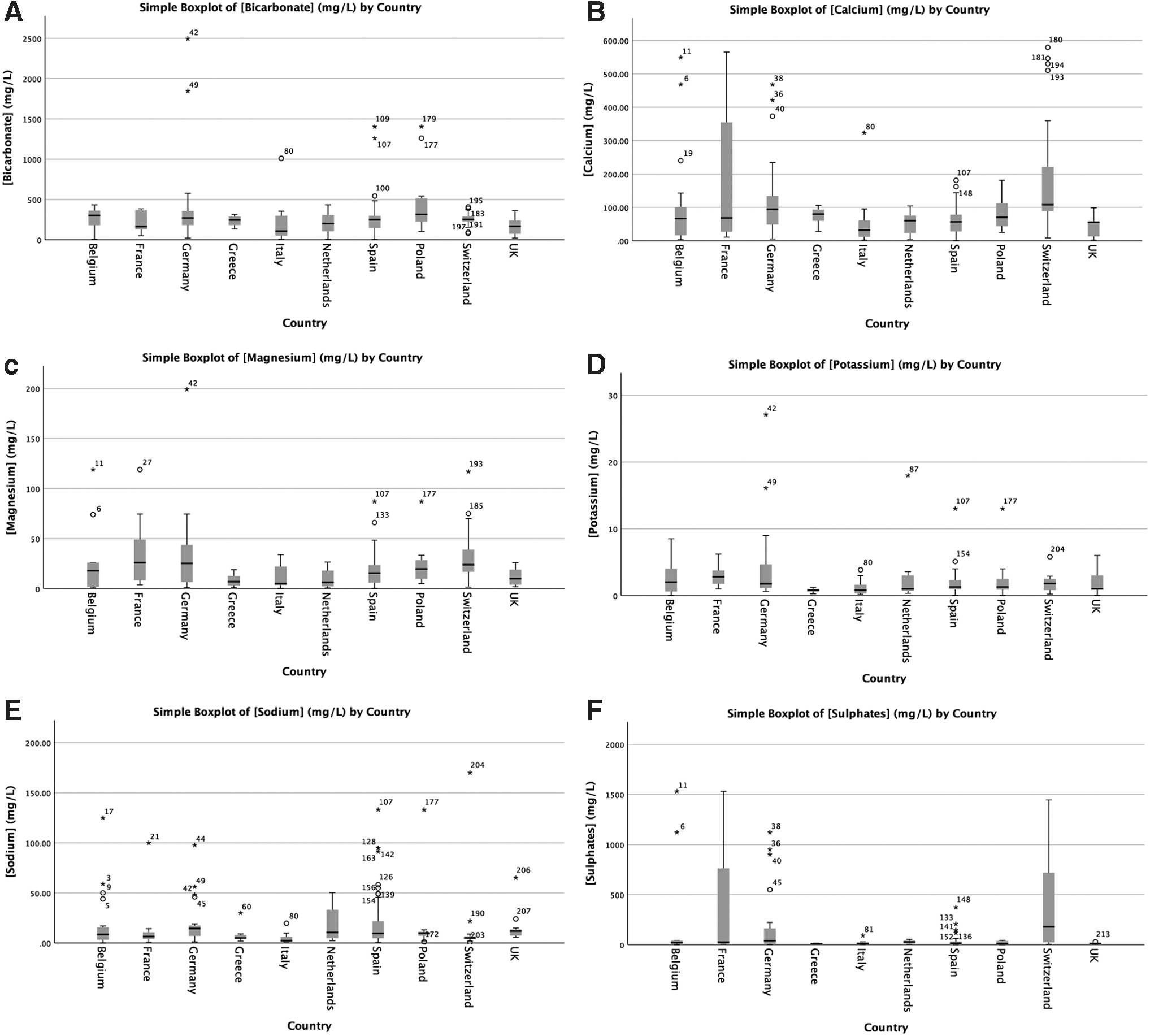
Simple boxplots per mineral (mg/L) by country.
Still water brands sold in Greece show the least variation in mineral concentration for bicarbonate, calcium, magnesium, and potassium. A complete overview of all still water brands included in this study sorted by country can be found in the Appendix Table 1A.
Discussion
This descriptive, multinational study illustrates the variations in the mineral content of 182 commercial brands of bottled still water across ten European countries, including Belgium, France, Germany, Greece, Italy, the Netherlands, Poland, Spain, Switzerland, and the United Kingdom. Our data confirm that the mineral content of bottled still water differs greatly within Europe. For instance, the average content for bicarbonate, calcium, and potassium in one country can be up to three times higher in another country. What is more, the average magnesium, sodium, and sulfates content varies up to fivefold within Europe. On average, apart from sulfates, the lowest mineral content of still water was found in Italy.
Remarkably, calcium levels found in bottled still water sold in France and Switzerland are widely distributed as illustrated by a range of 554.5 and 570.6 respectively. With a calcium concentration as high as 579 mg/L, Adelbodner Cristal from Switzerland contains the highest calcium levels of all still waters included in our study. Other still waters with calcium levels >400 mg/L are Hépar (549 mg/L) sold in Belgium and France, Farmer Mineral Blau (546 mg/L), Adello Mineral (530 mg/L), and Eptinger Still (510 mg/L), all from Switzerland; Contrex Still Water (468 mg/L) available in Belgium, France, and Germany; and Carolinen Naturelle (421 mg/L), which is sold in Germany. These commercial brands are all represented as extreme values in Figure 1B. In contrast, Lauretana Still Water, which is sold in Italy only contains 1.5 mg calcium per liter, which illustrates to what extent calcium levels vary across Europe.
The daily reference intake for calcium is 1000–1200 mg. 15,16 This can be achieved by consuming dairy products such a yoghurt, milk, or cheese, which are all known for their rich calcium content. However, our study shows that some commercial bottled still waters also contain a significant amount of calcium. As a high water intake is essential in the prevention of KSD, patients and physicians must be aware of the great variations in calcium content among different commercial brands for bottled still water across Europe. Although 2 L of Lauretana Still Water does not significantly influence calcium intake, 2 L of Adelbodner Cristal, the water with the highest calcium content in Europe, actually does. By drinking 2 L of the latter, patients would already achieve the daily recommended amount of calcium. Therefore, consumption of other calcium-rich products should be avoided to prevent excess urinary calcium excretion and thus risking the formation of calcium-containing kidney stones. As dairy intake and water consumption preferences differ among patients, physicians should provide individualized and patient-specific recommendations considering their patient's kidney stone diet plan, especially for those kidney stone patients who drink even more than 2 L of water a day. For them, it is even more important to be aware of the mineral content of the water they drink and to realize what effects it could have on their disease.
Besides paying attention to the calcium levels of mineral water, patients and their treating urologists should also consider the content of still water regarding other minerals as they could influence stone formation as well. A study performed by Nouvenne and colleagues demonstrated that patients with idiopathic calcium stone disease and hypercalciuria benefit from a low-sodium diet as excessive sodium intake increases urinary calcium excretion. 20 However, some mineral waters included in this study contain significant amounts of sodium. Staatl. Fachingen, for example, sold in Germany, contains as much as 564 mg/L. Drinking this type of water significantly contributes to the risk of excessive sodium intake, which is already a global health problem.
Contrarily, other minerals may have beneficial effects regarding stone formation. Alkalization of the urine results in an increase of urinary excretion of citrate, an inhibitor of calcium oxalate stone formation. 21 As bicarbonate provides an alkali load, several studies have been conducted to evaluate the effect of bicarbonate-rich mineral water on stone formation. Karagülle and colleagues showed that urinary pH increases significantly to metaphylactic levels by drinking 1.5 L of mineral water with a bicarbonate content of 2673 mg/L. 22 Another study, conducted by Siener and colleagues, demonstrated that besides an increase in urinary pH, the consumption of 1.4 L of bicarbonate-rich mineral water (3388 mg/L) results in an increase in citrate excretion from 3045 to 4554 mmol/24 hours. 23 However, our study did not include mineral waters with such high bicarbonate content, suggesting that they may not be obtained easily. The water with the highest bicarbonate content included in this study is Heppinger Extra Heil Water, which is sold in Germany (2495 mg/L).
To the best of our knowledge, this is the first multinational study analyzing the mineral content of bottled still water across Europe. However, our study is limited by the fact that only 10 European countries were included, which represents only 19.6% of all European countries. Second, only mineral waters available in the two largest supermarket chains were included. Therefore, to provide a complete overview of the mineral content of still water across Europe, further research must be done. An analysis of the mineral content of sparkling water is also suggested, as some patients may prefer sparkling water over still water. Although the consumption of bottled water is increasing across Europe—in some countries to such an extent that it exceeds the consumption of tap water 24 —an analysis of the mineral content of tap water across Europe would be of great interest, especially for those countries where the daily water consumption mainly consists of tap water.
To adequately access the effect of different mineral waters on stone recurrent rates, a long-term study including patients with different types of kidney stones would be recommended. Perhaps health authorities across Europe need to standardize the amount of minerals in all still, sparkling, and tap water.
Conclusions
The mineral content of commercially available bottled still water across Europe varies greatly. For patients with KSD it is important to be aware of the mineral content of the water they drink, especially for promotors of kidney stone formation such as calcium, as it might necessitate alterations of their diet and negatively influence stone recurrence rates. Physicians should facilitate patients in choosing an adequate and individualized kidney stone preventive diet, including the water they drink.
Footnotes
Acknowledgments
The author would like to thank Dr Guido Kamphuis and Professor Bhaskar Somani for their assistance, supervision, and help in writing this article.
Author Disclosure Statement
No competing financial interests exist.
Funding Information
No funding was received.
Abbreviations Used
Appendix
Appendix Table A1. Mineral Composition (mg/L) Per Water Brand Per Country For each country, the minimum and maximum values per mineral are highlighted in bold.
Water brands per country
Mineral composition (mg/L)
Bicarbonate
Calcium
Magnesium
Potassium
Sodium
Sulfates
Belgium
Albert Heijn
10.4
Bar le Duc
170
47
3.4
0.6
10.6
<1
Boni
345
59
59
Bru
180
21
20
2
8
19
Chaudfontaine
305
65
18
2.5
44
40
Contrex
372
468
74
9
1121
Everyday Aurelie
106
3.5
Everyday CristalRoc
200
73
4.5
Everyday Louise
66
50
Evian
360
80
26
1
6
12
Hépar
383.7
4
14.2
Montcalm
0.7
0.6
2.2
10
Nestlé PureLife
70
2
Ordal
317
143
7
5
17
Rocheval
297
96
10.6
Spa reine
15
4
3
4
Val
220
6
1.8
18
Valvert
67.6
1.9
Vittel
240
5.2
Volvic
12
12
France
Abatilles
127
19
9
4
8
Aix Les Bains
337
68
35
1.6
9
61
Celtic
1.9
1.1
Contrex
372
468
74.5
2.8
9.4
1121
Courmayeur
130
56
2.8
1477
Evian
360
80
26
6.5
14
Hépar
383.7
549
4.1
14.2
Ondine
163.5
46.1
4.3
3.5
6.3
9
Vittel
240
42
1.9
5.2
400
Volvic
71
11.5
8
11.6
8.1
Wattwiller
135
35
11
3
24
Germany
Adelholzener Naturell
431
94.7
30.4
4.6
6.9
Aqua Nordic Naturell
195
3.7
19
Bad Pyrmonter Naturell
253
53
24.5
0.9
5.2
9
Black Forest Still
30.5
6.7
2.6
1.7
Carolinen Naturelle
317
421
43
4.3
14.8
950
Christinen Carat Naturelle
282
106
8.4
1.5
11.4
61
Contrex Still
372
74.5
9.4
Evian
360
80
26
1
6.5
14
Extaler Mineralquell Naturell
266
373
62.1
1.6
10.8
900
Gerolsteiner Naturell
577
125
44
5
17
24
Heppinger Extra Heil Water
150
27.1
80
Ja! Mineral water Still 0.5L
189
67.5
12.5
1.1
15.2
59
Ja! Mineral water Still 1.5L
109
9.4
3
1.4
97.7
40.1
Rewe Beste Wahl Sport
296
235
66
3.1
46
548
REWE Beste Wahl Still
353
142
32.4
2.8
15
162
San Benedetto Still
296
51.4
29.7
0.97
6
4.2
Share Still
274
39.7
21.2
1.2
17.6
8.1
Staatl. Fachingen Still
1846
98.7
59.2
16.1
564
39
Vilsa Naturelle
175
47
3.6
2
16.4
10
Vio Still
152
51
5.3
15
19
Vittel
248
94
20
7.7
120
Volvic Naturelle
74
12
8
6
12
9
Vöslauer Ohne
249
114.4
40.9
1.8
14
223
Voss
6
Greece
Ab
236.25
79.65
4.24
0.87
4.35
Arethousa
286
64
7.8
6
Avra
182
60
8.9
14
Dirfys
286
64
19
7.8
6
Erymanthos
308
95.5
8.5
1
30
14.7
Korpi
3.3
0.68
4.7
Marata
236.25
79.65
4.24
0.87
4.35
Samaria
160
31
14
0.5
7
Theoni
149
42
Vikos
270
93.1
1.9
0.7
2.6
12.2
Yas
250
98
7
4.9
11
Zagori
244
83
3.06
1.02
2.85
9.15
Zaros
12.8
0.6
6.7
Italy
Acqua Panna
106
32.2
6.5
0.8
6.6
22
Chiarella
217.8
40.6
22.1
0.2
0.9
8.6
Lauretana
1
Levissima
56.8
19.9
1.7
1.6
2.1
16.9
Norda
50
11.8
3.7
0.82
2.2
6
Pejo
54
19
4.9
1.9
2.2
27.2
Primula
355
91
33.2
0.78
9.8
Rocchetta
185.4
60.36
3.73
0.35
3.87
7.54
Rosalpe
27
5.6
3.9
0.24
San Benedetto
296
51.4
29.7
2.97
6
4.2
San Bernardo
31
10.2
0.48
0.48
Sangemini
16.5
Vitasnella
324
95
1.5
3.7
the Netherlands
Acqua Panna
106
32.2
6.5
0.8
6.4
22
Albert Heijn
360
2.7
5
Albert Heijn Basic
280
3.7
1.8
3.7
Bar le Duc
170
47
3.4
0.6
10.6
Chaudfontaine
305
65
18
2.5
44
40
Cristaline
66
26
50
34
Dalphin
212
71
6.5
3.3
30
37
Evian
360
80
26
1
6.5
14
Jumbo
190
97
10.8
3.4
18.5
Just Water
15
2.35
35
Montcalm
0.6
10
Natural Cool
89.5
3.6
36.2
Solan de Cabra
284
60
1
4.8
Sourcy
180
49
6
1
10
10
Spa
17
5
2
0.5
3
4
Tavina Elegantia
36.5
7.86
2.46
Poland
Aquarel Nestle
482.3
112.2
24.3
4
13
Arctic
260.1
74.15
13.37
1.35
8.12
25.64
Cisowianka
542.6
131.2
22.48
0.78
10.71
2.58
Dobrowinka
276.9
58.12
2
Górska Natura
6.47
1.93
Jurajska
329.9
66.1
32.8
2.2
10
40.5
Kropla Beskidu
186.7
44.09
17.01
1
11.1
Mama I Ja
165.0
43.6
1.06
9.7
13.3
Nałęczowianka
453.7
110.2
23.1
2.8
11
Piwniczanka
1260
87
32
Ustronianka
299
98.1
16.52
1.21
6.44
41.8
Żywiec Zdrój
41.69
5.62
9.65
Spain
Agua de Cuevas
246.9
47
25.4
1.6
13.5
Agua del Rosal
295
65.4
13.7
45.2
Agua del Valle del Cardo
81
35
7
19
Agua Sana
0.7
5.8
Aguas de San Joaquín
165
35.7
16.5
8.3
3.7
Aigua mineral Bonpreu
147.2
47.07
7.27
8.4
29.1
Alzola
188
58.7
6.3
45.5
24.4
AquaBona Fontoira
152
3.4
7.5
11
8.9
AquaBona Fuenmayor
305
77
20.8
1.6
22.8
AquaBona Peña Umbría
298
55
28
5.4
7.3
AquaBona Santolin
274
92.4
2.73
2
6.5
Aquadeus
323
74.2
23.4
0.9
3.3
20.4
Aquarel
14.7
1.9
2.1
4.7
2.9
Auchan
168
28.8
19.7
1.7
8
13.5
Benassal
264
89.9
2.96
2.6
21.3
Bezoya
< 5
2.86
2.04
Cabreiroà
193
10
5
2.1
58.2
Caldes de Boì
34.6
5.4
0.5
21.7
13.2
Carrefour
266
21.5
3.5
11.5
Castrovita
118
39
2
<1
2
3
Fonsana
38
7
7
3
Font Agudes del Montseny
253
58.9
16.8
29.7
41.2
Font de Pla Nova
270
74
36
1.2
11
Font del Pi
317
67
27
207
Font del Regàs
129.2
32.9
4.1
13.5
10.2
Font d'Or
78.8
26.4
3.2
9.2
13.7
Font Jaraba
297
99.6
32
37.1
144
Font Major
173
54.5
7.7
9.5
14.2
Font Natura
205.6
70.9
15.7
8.9
57
Font Selva
249
34
6.8
1
54.9
14.6
Font Vella
167
43.2
11.5
1.3
Fontecabras
295
90.1
37.5
32.6
117
Fontecelta
266
21.5
3.5
11.5
Fuensanta
162
58
4.5
0.9
5.8
17.5
Fuente Bruma
75.9
10.7
8.3
13.1
3.7
Fuente Liviana
268.3
65.4
17
0.8
19.2
Fuente Primavera
297.2
88.7
23.4
18.6
43.9
Fuentedueñas
246
7.4
3
6.7
Insalus
149
20.6
10.7
La Platina
79
16
16
9
18
Lanjaròn
108
28.9
11.4
5.9
Les Creus
119
28
7.3
1
11.7
12.3
Lunares
292
96.3
35.7
2.3
39
142
Marquesado
273.3
75.3
19.3
0.5
1.2
30.1
Mondariz
156
7.7
5.5
49
1.7
Monte Pinos
298
93.8
3.4
1.8
1.6
Na Taconera
275
144
28
49
Ribagorza
331
67
27
24
18
Ribes
146
46.6
7
5.6
San Vicente
109
14.9
9.8
2.6
14.2
9.9
Sant Aniol
349
91.3
17.5
6.4
Sierra Cazorla
78.6
48.5
0.46
1.26
64
Solan de Cabras
284
60
26.7
1
4.8
21.8
Solares
249
75.2
15.6
1.7
91.1
37.2
Sousas
77.7
1.1
1.8
Valtorre
174
22.1
22
32.5
22.3
Veri
140
32.1
9.2
3.3
Viladrau
113
27.7
4.5
11.9
11.2
Switzerland
Adelbodner Cristal
284
39
1.4
6.5
1268
Adello Mineral
291
530
36.5
1.7
5.8
1127
Allegra
344.2
100.4
23.7
0.7
2.6
59.3
Appenzell Mineral Leise
108
17
0.7
3
Aproz Cristal
250
360
70
2.5
6
930
Aquella Cristal
245
300
75
2.5
4
840
Valais Naturelle
225
90
22
2.5
7
110
Aquina Rot
246
174
33.5
2.8
4.4
362
Arkina Blau
355
85
25.7
0.8
8.9
40.8
Cristallo Still
254
221
65.4
2.7
4.3
597
Cristalp without CO2
227.6
115.3
40.7
1.9
21.9
240.7
Eden
91.8
33.5
3.1
2.9
4.3
29.5
Elmer Mineral without CO2
242
118
6.6
0.6
2.5
117
Eptinger Still
278
510
2.5
4.2
Farmer Mineral Blau
287
546
35
6
1256
Henniez Blau
389
104
20
1
7
12
Knutwiler Grün
375
89
24
1.2
5
20
M-Budget without CO2
100
20
0.5
5
280
OK.- Mineralwasser Blau
194
37.3
15.2
0.98
4.42
8.7
Saguaro Nature
277
136
42
1.8
268
San Clemente Naturale
1.8
7.8
Swiss Alpina Rot
239
208
37
1.9
5.2
480
Valser Silence
155
53.7
10
Zurzacher Naturelle
278
53.3
7.8
170
the United Kingdom
Aqua Pura
14
3.5
2.5
12
14
Aquavia
74.25
Buxton
248
55
19
1
24
13
Evian
80
1
6.5
14
Harrogate
215
57
19
8
13
Highland
150
40.5
10.1
0.7
Hildon
7.03
6.6
Nestlé Pure Life
184.6
59
10
1.2
11.9
9.7
Sainsbury's Caledonian
240
55
16
2
15
Tesco Ashbeck
25
11
3.5
2.5
10
11
Volvic
74
12
8
12
9