




Abstract
Background:
Holmium:yttrium aluminum garnet laser (Ho:YAG) is still considered the gold standard in laser lithotripsy. There is a large body of literature comparing the capabilities of Ho:YAG and thulium fiber lasers (TFLs). The novel, pulsed thulium:yttrium aluminum garnet laser (p-Tm:YAG) evaluation model has only been compared with Ho:YAG in terms of its dusting performance to date. It was this study's aim to compare the p-Tm:YAG's dusting efficiency with that of a chopped TFL.
Materials and Methods:
During the laser ablation procedure, while the laser device was emitting light, the laser fiber was spiraled across the surface of a uniform kidney stone model via software. We relied on the stone model's difference in weight before and after the dusting procedure to assess the dusting efficiency and assessed each laser device's dusting efficiency at various preset laser configurations and laser fiber-motion speeds. We compared both laser devices' laser configurations, which were identical in pulse energy and frequency, while keeping in mind that the pulse duration differed significantly. In addition, we tested each laser device's capability.
Results:
The average ablated weight across all laser configurations was 0.61 g (standard deviation [SD] = 0.44 g) for p-Tm:YAG and 0.76 g (SD = 0.51 g) for TFL. After statistical analysis, we found no significant difference in ablated weight between the laser devices (U = 1715.5, p-value = 0.11). The maximum permissible frequency configuration for TFL was 1600 Hz, which resulted in the worst overall dusting output.
Conclusions:
We observed that the p-Tm:YAG's dusting efficiency resembled that of TFL in the identical pulse energy and frequency laser configurations. The ablation efficiency did not seem to be affected by the laser devices' differences in pulse duration. Slower laser fiber-motion speeds resulted in more efficient ablation. When using the maximum preset frequency and power configuration, TFL's dusting efficiency appeared to be inefficient.
Introduction
First-
The holmium:yttrium aluminum garnet laser (Ho:YAG) is the most popular laser type for lithotripsy, in use for over 20 years, and is considered the gold standard. 8 However, with novel developments in laser technology, different laser types for lithotripsy are now attracting attention. Enucleation and vaporization of the prostate and enucleation of bladder tumors have been done using the continuous-wave thulium:yttrium aluminum garnet laser (CW-Tm:YAG). However, its application in lithotripsy is not yet well established. 9 –11 The thulium fiber laser (TFL) has shown promise in lithotripsy and is a viable alternative to Ho:YAG. 12,13 The TFL offers a wider range of pulse energies, frequencies, and lengths than the Ho:YAG, as well as electronically modulated pulse shapes and smaller suitable fiber core diameters. 14 The TFL is known to produce three to four times the amount of dust generated by a holmium laser. 15
A novel pulsed thulium:yttrium aluminum garnet laser (p-Tm:YAG) has recently emerged, which, unlike the CW-Tm:YAG's and TFL's technology, enables efficient fine-dusting at low retropulsion that is impossible to achieve with the Ho:YAG. 3 The p-Tm:YAG's dusting performance has proven comparable with the Ho:YAG's at similar laser configurations. 3
The aim of this study was to compare the dusting efficiency of the p-Tm:YAG and TFL at identical preset laser configurations in terms of single-pulse energy and frequency. In addition, the dusting efficiency at the one preset laser configuration, enabling the maximum permissible power and frequency simultaneously, was tested for both laser devices. Our research was based on Petzold and colleagues dusting experiments comparing the dusting efficiency of the Ho:YAG and p-Tm:YAG. 3
Materials and Methods
An evaluation model of a p-Tm:YAG and a commercially available TFL was used in our experiments described below. Table 1 summarizes the basic characteristics of both laser devices based on the manufacturer's specifications. Compared with the p-Tm:YAG, TFL's shorter wavelength results in an nearly doubled water absorption coefficient. The TFL offers a greater variety of pulse energies, frequencies, and durations. Unlike the TFL, the p-Tm:YAG allows the pulse lengths to be modified.
Comparison of the Basic Characteristics of the Laser Devices, Utilized in the Following Experiments
E
Both laser devices used the same laser fiber (“SingleFlex® 400 μm”; Dornier MedTech Laser GmbH, Wessling, Germany).
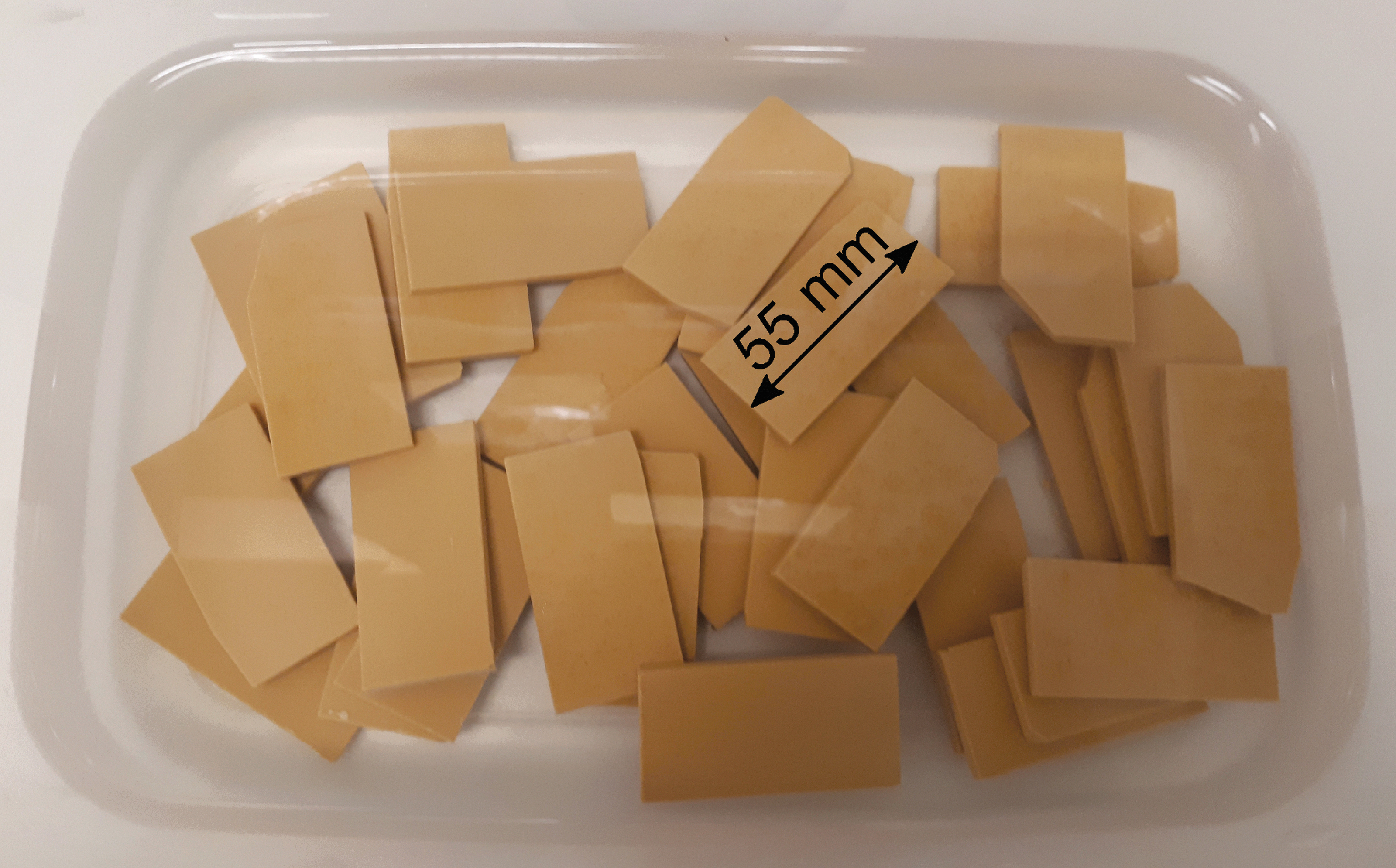
The stone models were made relying on the research of Petzold and colleagues as a reference. 3 Water was combined with super-hard plaster (BegoStone plus; BEGO Bremer Goldschlägerei GmbH & Co., Bremen, Germany) at a 1:5 ratio to produce the stone models. The mixture was poured into a flat mold right away. Using a vibration system (Dental Vibrator SL-JT51B; Guangzhou Sunlight Electronic Technology Co., Ltd., Guangzhou, China), air bubbles were eliminated, and the mixture uniformly dispersed in the mold. The dried plate was sawed into smaller pieces having a width, length, and thickness of 30, 55, and 4 mm, respectively. The stone models were submerged in room temperature water for at least 24 hours before the experiments began (Fig. 1).
Produced stone models submerged in room temperature water.
We replicated the experimental setup as described by Petzold and colleagues (Fig. 2). 3 Water was poured into both the glass and blue-colored tanks. A heating rod (Thermo control 100 W; EHEIM, Deizisau, Germany) was used to maintain the water at a constant 37°C temperature. A precision pump (Cole Parmer, Chicago, IL) ensured irrigation from the glass tank to the blue tank, which was placed close to the laser fiber tip. The flow rate of the irrigation was set to 50 mL/min. To prevent the water in the blue tank from overflowing, we used a hose pump (Samed GmbH, Dresden, Germany). With both pumps in use, the flow of water was constant between the glass tank and blue tank.

Experimental setup:
To ensure homogeneous ablation of the stone models, a single stone plate was connected to the tilt table, allowing adjustments within three axes. The laser fiber was moved spirally across the stone model's surface using the XY-plotter (EleksDraw Drawing Machine of EleksMaker®). The laser fiber was thus connected to the XY-plotter through the three-dimensional (3D)-printed component.
The tilt table was first aligned in general to ensure uniform ablation across the entire stone plate's surface. Before each experimental run, the stone plate was dabbed, weighed, and attached to the tilt table. In addition, the laser fiber was cleaved and its single-pulse energy E SP was measured. We deemed a variance of under 50 mJ permissible. Otherwise, the fiber was recut or a new one used. After that, the laser fiber was directed through a hole in the 3D-printed component until it approximated the stone plate's surface. The initial distance between the laser fiber tip and stone plate's surface was 1 mm.
The software (EleksMaker Evolution Desktop CAM V3.1) that controls the XY-plotter's spiral motion and speed was then started. While the XY-plotter began moving, we manually pressed the laser device's foot pedal. The laser fiber tip then spiraled across the stone plate's surface. The stone plate was removed from the tilt table after the ablation procedure to be weighed again. Using a precision weighing device (EMB 200-3; KERN & SOHN GmbH, Balingen-Frommern, Germany), we measured the weight difference before and after each dusting procedure.
We applied 250, 500, and 1500 mm/min laser fiber-motion speeds (ν), as the latter two were used in a previous study by Petzold and colleagues. 3 Furthermore, we chose ν = 250 mm/min because slower laser-motion speeds are often used in clinical practice. The dusting efficiency of six laser configurations, all similar in single-pulse energy and frequency, was determined for each laser device and laser fiber-motion speed. We were unable to select identical pulse durations for all laser devices due to the fundamental differences in their laser technology and pulse generation. We calculated dusting efficiency as the average ablated weight in grams of three consecutively performed dusting procedures.
To assess each laser device's capability, the dusting efficiency of three additional laser configurations was determined at all three-laser fiber-motion speeds. A direct analogy is impossible since both laser systems' individual pulse energies and frequencies are dissimilar. Both laser devices were used alternately to reduce systematic errors such as exact positioning and composition of the stone plates, as well as other environmental influences.
Python (Python Software Foundation License) was used to perform statistical analysis. Each laser device's ablated weight is stated as a mean value (M) and standard deviation (SD) for each laser fiber-motion speed. To summarize all our results, descriptive statistics were used. To compare medians, we relied on the first and third quartiles, interquartile range (IQR), minimum and maximum ablated weights, as well as the whiskers of a boxplot. Skewness was calculated and post hoc analysis was done: the Shapiro–Wilk test was used to determine if the data were normally distributed. Levene's test was used to determine homogeneity of variance. The Mann–Whitney U test was used to compare differences in dusting efficiency between laser devices. The significance level for all the analyses was 0.05.
Results
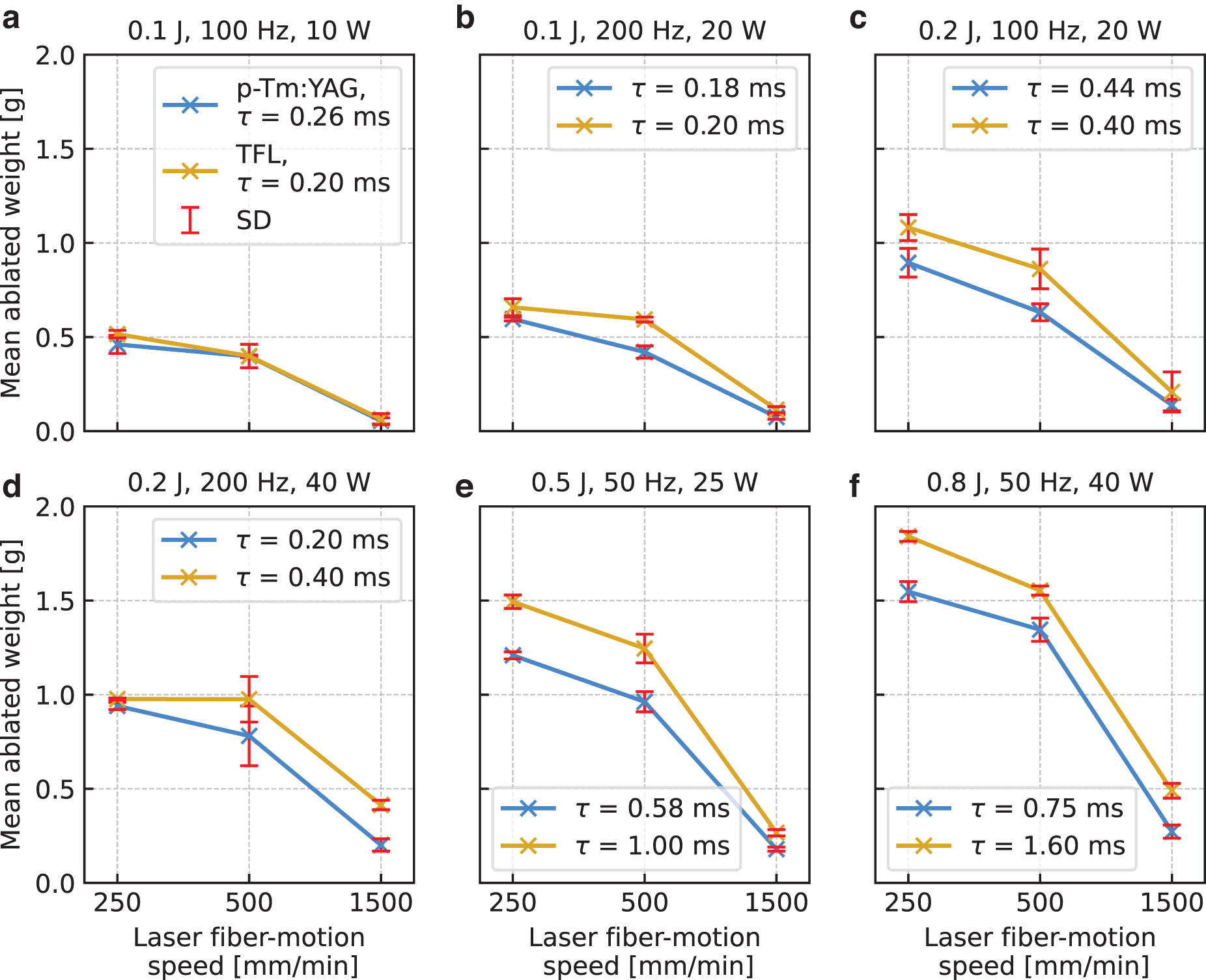
Each diagram in Figure 3 illustrates the relationship between mean ablated weight and laser fiber-motion speed for both laser devices at a specific preset laser configuration. We tended to observe that a slower laser fiber-motion speed leads to greater ablation efficiency from both laser devices. The only exception is the TFL's configuration with 0.2 J, 200 Hz, 40 W at a 250 mm/min laser fiber-motion speed, where the ablated weight is nearly identical to that at 500 mm/min. Unlike the frequency, both laser devices' ablation efficiency increases when the single-pulse energy increases.
Each diagram represents the relationship between the mean ablated weight and the laser fiber-motion speed at a specific preset laser configuration (single-pulse energy [J], frequency [Hz], power [W]) for p-Tm:YAG (blue) and TFL (orange), including the respective pulse duration (τ) and SD. p-Tm:YAG = pulsed thulium:yttrium aluminum garnet laser; SD = standard deviation; TFL = thulium fiber laser.
Figure 3a shows similar dusting efficiency for both laser devices. The TFL's dusting efficiency is higher than the p-Tm:YAG's at all laser fiber-motion speeds, as shown in Figure 3b–f, starting at a power of 20 W. TFL reveals slightly greater ablation efficiency when both laser devices have similar pulse length configurations (Fig. 3b, c) and TFL has roughly twice the pulse lengths (Fig. 3d–f). Average ablated weights across all laser configurations in Figure 3 are 0.61 g (SD = 0.44 g) for p-Tm:YAG and 0.76 g (SD = 0.51 g) for TFL.
The boxplot in Figure 4 represents the ablated weight across all the laser configurations illustrated in Figure 3, for both the laser devices. The mean of both laser devices (p-Tm:YAG: 0.61, TFL: 0.76) is greater than the median (p-Tm:YAG: 0.51, TFL: 0.6). For both the laser devices, the upper whisker is longer than the left whisker. The Shapiro–Wilk test was used to validate the variance from normally distributed values for the p-Tm:YAG (W = 0.93, p-value = 0.003) and TFL (W = 0.94, p-value = 0.009). The skewness of p-Tm:YAG and TFL was determined to be 0.58 and 0.53, respectively, considering statistical bias correction. According to an IQR of 0.71 g for p-Tm:YAG and 0.73 g for TFL, the values of both laser devices are equally distributed. TFL's range (length of the whiskers) is 1.85 g, which is higher than the p-Tm:YAG's range of 1.15 g.

Median (green line within the box) and distribution of the data from Figure 3, for each laser device, represented as boxplot.
When comparing the median lines within each box, note that the left box's median line lies within the right box and vice versa, indicating that there is likely no difference between the two laser devices. To test this hypothesis, we used the two-sided Mann–Whitney U test, which revealed no significant differences in ablated weight between the laser devices (U = 1715.5, p-value = 0.11). Second, we used the one-sided Mann–Whitney U test to assess that the TFL did not perform significantly differently from the p-Tm:YAG (U = 1715.5, p-value = 0.06). Equal variances were assumed (W = 0.86, p-value = 0.36).
Furthermore, for each laser, we chose the one preset laser configuration enabling the maximum permissible power and frequency at the same time. Figure 5 shows those results. The p-Tm:YAG outperforms the TFL in terms of dusting efficiency, despite the fact that the TFL's frequency configuration is 16-fold higher than the p-Tm:YAG's. More efficient ablation does not always imply a higher frequency laser configuration. It is also worth noting that the TFL's ablation efficiency in Figure 3a is higher than that in Figure 5, which has a higher average power.

The diagram represents the relationship between the mean ablated weight and the laser fiber-motion speed at primarily the highest power configuration and secondarily at the highest selectable frequency (single-pulse energy [J], frequency [Hz], power [W], pulse duration τ [ms]) for p-Tm:YAG (blue) and TFL (yellow) including SD.
Discussion
In our experiments, we observed that the TFL's ablation performance resembled or exceeded that of p-Tm:YAG's. However, the two laser devices revealed no statistically significant difference across all laser configurations when identical in pulse energy and frequency. The difference in pulse duration between laser devices did not appear to affect ablation performance. The TFL's pulse duration was either the same as the p-Tm:YAG's or about twice as long. According to our findings, the p-Tm:YAG is a potential alternative to the TFL for dusting urinary stones, as both their ablation performances are similar.
Petzold and colleagues found out that the p-Tm:YAG outperformed the Ho:YAG in dusting efficiency when the former's pulse duration was more than twofold higher than the Ho:YAG's at rapid (1500 mm/min) and slow (500 mm/min) laser fiber-motion speed. 3 On the contrary, several studies concluded that the TFL outperforms the Ho:YAG in ablation performance and is a potential alternative to the Ho:YAG. 2,18 –20 Ventimiglia and colleagues reported that the TFL delivers lower peak power and a rectangular pulse shape, which resulted in a substantially better ablation performance, smaller fragments, and lower retropulsion, in contrast to the Ho:YAG. 20,21
Both observations contribute to the conclusion that peak power and pulse duration are not the only aspects that can affect ablation; the pulse shape must also be considered. The wavelength and its related absorption coefficient must not be overlooked since they have a theoretical impact on ablation. The TFL has a water absorption coefficient roughly twice that of the p-Tm:YAG and four times that of the Ho:YAG. 14,22,23 This technical constraint appears to be benefit the TFL in terms of dusting performance.
However, there have been few to no studies indicating that the TFL is more fragmentation-efficient than the other laser systems such as the Ho:YAG or p-Tm:YAG used in laser lithotripsy. During surgery, both techniques, or a combination such as pop-corning or pop-dusting, are frequently used in clinical application. 4,24,25 Since the surgeon does not strictly carry out fragmentation or dusting due to the individual stone's composition and size, the p-Tm:YAG tends to be suitable for the combined application of both lithotripsy techniques.
For each laser, we evaluated the one preset laser configuration that enables the maximum permissible power and frequency at the same time. The TFL's preset laser configuration (0.025 J, 1600 Hz, 40 W) revealed the overall worst dusting efficiency, resembling the dusting efficiency of both lasers at 0.1 J, 100 Hz, 10 W. Because of the low ablated weight, extremely high frequencies such as 1600 Hz appear to be ineffective for dusting. High frequencies are accompanied by low energies, which may not suffice to surpass certain ablation thresholds such as the light-energy-per-stone surface.
Furthermore, Aldoukhi and colleagues found that exceeding a certain frequency threshold resulted in a minimal increase in ablation volume. 26 We conclude that an extremely high frequency, as configurable by the TFL (1600 Hz), does not automatically lead to a better dusting efficiency. For the TFL so far, an extremely high frequency setting (1600 Hz) is accompanied by an extremely low-energy setting (0.025 J). We observed that the p-Tm:YAG's dusting efficiency at 0.8 J, 50 Hz, 40 W is comparable with that at 0.5 J, 100 Hz, 50 W, having a lower energy and higher frequency configuration.
However, we noted comparable dusting efficiencies when comparing both lasers' results at laser configurations of 0.2 J, 100 Hz, 20 W and 0.2 J, 200 Hz, 40 W. Therefore, we recommend a maximum frequency setting of 100 Hz for both laser devices. It is more important to find the ideal setting between energy and frequency configuration. To stone-dust effectively, a combination of moderate frequency and sufficient energy appears to be crucial and needs to be determined for each laser device individually.
According to our findings, the laser fiber-motion speed is another determining ablation-efficiency parameter. Slower laser fiber-motion speeds heightened the dusting efficiency across all experiments. Petzold and colleagues compared the dusting efficiency of the Ho:YAG and TFL at two laser fiber-motion speeds (500 and 1500 mm/min) and found that the slower laser fiber-motion speed led to superior dusting efficiency across all experiments. 3 Aldoukhi and colleagues evaluated the fragmentation rate at two laser fiber-motion speeds (1 and 3 mm/s) and found that low laser fiber-motion speeds resulted in lower lithotripsy efficiency. 26 Their highest fiber-motion speed, on the contrary, was approximately three times slower than our lowest fiber-motion speed.
Further investigations should aim to find out whether lower laser fiber-motion speeds (<250 mm/min) will result in still better removal efficiency, reach a limit in removal efficiency, or, in the worst case, detract from ablation efficiency.
We are aware that our research may have several limitations influencing the results obtained. We used an automatic laser fiber guide to show the potential of each laser device's dusting efficiency. We intentionally distanced ourselves from a manually guided laser fiber to compare the ablation output of different lasers at different laser fiber-motion speeds. We understand it is the surgeon who guides the laser fiber and influences its speed in the clinical setting.
The laser fiber in our experiment was only directed in the x-y direction; feeding in the z direction was not possible. That is why we chose to have the laser fiber move in a spiral motion. Consequently, we could not determine the optimum distance between the laser fiber and stone surface, and we are aware that the wavelength, or rather the absorption coefficient, as well as the gas/cavitation bubble length, may have influenced our outcomes. This source of error was overlooked because it existed across all experiments. At slower laser fiber motion speeds, we cannot rule out the possibility that the area ablated by two successive pulses overlapped. The impact of retropulsive effects was ignored due to the fixed position of both the laser fiber and stone plate. It is plausible that our slowest fiber-motion speed might be faster than in actual clinical practice. Since this was an experimental study, our findings' clinical validity may be limited and will need to be confirmed, especially through clinical investigations.
Conclusions
The p-Tm:YAG's dusting efficiency was equivalent to that of the TFL. According to our findings, pulse duration had no impact. The TFL's worst ablation performance was at a maximum possible frequency configuration of 1600 Hz and a corresponding low energy of 25 mJ. It is not essential to have a broader range of available frequencies and energies (as the TFL provides) to dust efficiently. A moderate frequency configuration seemed to yield satisfactory dusting efficiency from both laser devices, since it goes hand in hand with a sufficient energy configuration. The dusting efficiency was enhanced by slower laser fiber-motion speeds.
Footnotes
Authors' Contributions
A.M. and R.P. conceived the study concept and design. R.P. and L.K. prepared the material and setup. L.K. carried out the experiment, analyzed the data, and wrote the article. M.Y., R.P., C.G., R.S.-I., and A.M. provided critical feedback and helped shape the research, analysis, and article. A.M. and C.G. supervised the project. All authors discussed the results and commented on the article. A.M. had full access to all the data in the study and takes responsibility for the integrity of the data and the accuracy of the data analysis.
Availability of Data and Material
The raw data are with the corresponding author and can be provided on request.
Ethical Statement
The article contains no clinical studies or patient data, nor does it contain any studies with human or animal subjects performed by any of the authors.
Author Disclosure Statement
A.M. receives research funds from the German Federal Ministry of Education and Research, Berlin (D). He receives support for his travel activities from the European Society of Urology, Arnhem (NL), and the German Society of Urology, Düsseldorf (D). Furthermore, A.M. is consulting for the following: KLS Martin, Tuttlingen (D), avateramedical, Jena (D), LISA Laser Products GmbH, Katlenburg-Lindau (D), Schoelly fiberoptic GmbH, Denzlingen (D), Dornier MedTech Laser GmbH (D), Medi-Tate Ltd. (IL), and B.Braun New ventures GmbH, Freiburg (D). A.M. is speaker for the companies Richard Wolf GmbH (D) and Boston Scientific (USA). In addition, he performed expert activities for the Ludwig Boltzmann Gesellschaft, Wien (A). A.M. is involved in numerous patents and inventions in the field of medical technology.
C.G. is advisor for Astellas Pharma GmbH, Munich (D), Ipsen Pharma GmbH, Munich (D), Steba Biotech S.A., Luxembourg (LUX), Bayer Pharma, Leverkusen (D), Olympus Winter & Ibe GmbH, Hamburg (D), Medi-Tate Ltd., Or Akiva (IL), MSD, Haar (D), Astra-Zeneca, Cambridge (United Kingdom), and Roche, Basel (CH). C.G. receives speaker fees from Amgen, CA, Astellas Pharma GmbH, Munich (D), Ipsen Pharma GmbH, Munich (D), Janssen-Cilag GmbH, Neuss (D), Bayer Pharma, Leverkusen (D), Takeda Pharmaceuticals, Tokyo (JPN), and medac GmbH, Wedel (D). R.P. and L.K. provided consulting services for Dornier MedTech Laser GmbH, Weßling (D).
M.Y. and R.S.-I. have no conflicts of interest.
Funding Information
The study was conducted as a collaborative research project with the medical technology company Dornier MedTech Laser GmbH, Wessling, Germany.