




Abstract
Objectives:
To quantify the environmental impact and costs associated with flexible cystoscopy procedures from an institutional perspective, with particular attention for the comparison between disposable and reusable cystoscopes.
Materials and Methods:
This is a single-center retrospective study, including all flexible cystoscopies performed between 2020 and 2021 using reusable or single-use devices. The Ambu aS4C single-use cystoscope (Ballerup, Denmark) gradually replaced the reusable device in our center, with exclusive use from October 2021. Reprocessing costs for reusable cystoscopes were evaluated using a micro-costing approach. The environmental impact of reusable and disposable cystoscopes was assessed by the amount of waste and water consumed for each procedure.
Results:
A total of 1578 flexible cystoscopies using reusable cystoscopes were performed in 2020, and 550 cystoscopies were performed using the Ambu aS4C cystoscope from October 2021 to February 2022. The cost of flexible cystoscopy with a reusable and a disposable endoscope was €196 and €192, respectively. The amount of waste generated by reprocessing reusable and disposable cystoscopes was 800 and 200 g per procedure, respectively. Water consumption for sterilization of the reusable cystoscope was 60 L per procedure, whereas no water consumption was required with the Ambu aS4C cystoscope. A 100% Ambu aS4C cystoscope use would reduce waste generation and water consumption by 946.8 kg and 94.68 m3 per year.
Conclusion:
In this study, implementing a strategy of using 100% disposable cystoscopes was associated with similar costs and reduced waste generation and water consumption compared to reusable devices. Future studies are needed to compare the carbon footprint of these devices, through a comprehensive and rigorous life cycle assessment from manufacturing to recycling.
Introduction
Since the development of flexible cystoscopy in 1964 and the subsequent custom-built reusable flexible cystoscope in 1984, cystoscopy has become a crucial and essential diagnostic tool in the urologist's office. 1,2 Flexible cystoscopy is widely used for various diagnostic and therapeutic applications in urology patients. 3 Over the past few decades, reusable cystoscopes have undergone significant technological advances such as active deflection, working channels, endoscope miniaturization, and digital imaging technology, which have significantly improved the versatility of flexible cystoscopy. However, several drawbacks have been reported with reusable devices, including sterilization failures, 4 high purchase and repair costs, 5 exposure of health care professionals to toxic agents during sterilization procedures, and release of hospital waste into the environment. 6
To overcome some of these disadvantages, the adoption of disposable flexible cystoscope has been proposed. Ambu® (Ballerup, Denmark) has recently developed a single-use flexible cystoscope (aScope™, aS4C), designed to perform all tasks of reusable flexible cystoscopes. In a previous report, the Ambu aS4C cystoscope demonstrated technical characteristics comparable to commercially available reusable flexible cystoscopes. 7
The global spread of disposable devices for cystoscopy procedures needs to be evaluated and monitored. Two main issues remain unresolved. First, no direct comparison of costs associated with reusable and disposable cystoscopes has been reported during their use in routine practice. Second, the amount of waste generated by cystoscope reprocessing has not been formally quantified, and the environmental footprint of cystoscopy procedures is unclear. The aim of this study was therefore to quantify the waste and costs associated with flexible cystoscopy procedures from an institutional perspective, with particular attention for the comparison between disposable and reusable cystoscopes.
Methods
This is a single-center, retrospective study that included consecutive flexible cystoscopies performed in our department. Procedures were conducted by nine urologists for various diagnostic and therapeutic applications. Flexible cystoscopies were mainly performed in the office as an outpatient procedure, but flexible cystoscopes were also sometimes used in the operating room, as is required for certain surgical procedures. From January 2020 to December 2020, all flexible cystoscopies were performed with a reusable cystoscope. Our arsenal included eight reusable cystoscopes and two video endoscopy columns. Figure 1 shows the reprocessing scheme for reusable endoscopes in our center. A high-level disinfection with peracetic acid was performed after each use of the cystoscopes. The Ambu aS4C single-use flexible cystoscope was introduced at our center during 2021. The disposable device has gradually replaced the reusable device, with exclusive use of the Ambu aS4C cystoscope from October 2021.
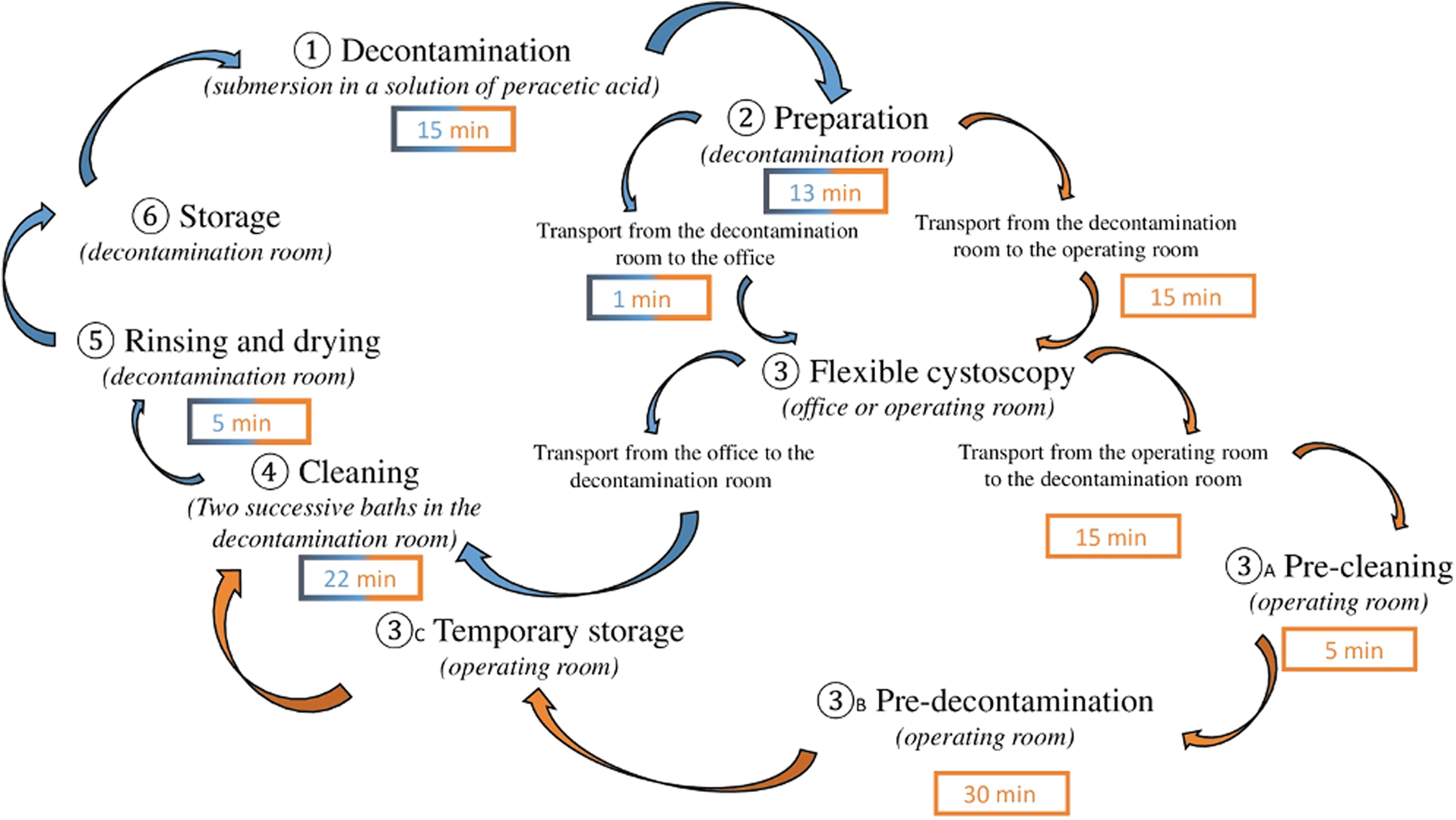
Reprocessing scheme for reusable endoscopes. Color images are available online.
Costs of reprocessing reusable flexible cystoscopes were assessed using a micro-costing approach. The variables included in the micro-costing analysis were as follows: purchasing cost of cystoscopes (5-year amortization) and the towers (two towers were used during the study period), annual maintenance contracts per endoscope for repairs, reprocessing costs (including all materials to properly decontaminate and repackage the endoscopes and associated equipment and maintenance of reprocessing station), transport of the endoscopes, costs for the sterilization equipment and consumables, microbiological tests (usually done twice a year for each endoscope), professional charges, and administrative and structural costs (taxes, insurance, rent, heating, electricity, water, cleaning, and maintenance of premises).
For the disposable cystoscope, the costs incorporated the purchase of the cystoscopes according to the contract established with industry. The portable monitor was provided by industry, the cost of which was incorporated into the purchase price of disposable cystoscopes. We calculated per-procedure costs by summing the cost component inputs and dividing by the total number of procedures performed in 2020. The final cost per procedure using a reusable and a disposable cystoscope was then compared. Expense reports were provided in Euros (€).
To assess the environmental impact of the procedures, we evaluated the amount of waste generated by reusable and disposable cystoscopes. All pre- and post-procedure waste was collected and evaluated by mass. Average water consumption for reprocessing reusable cystoscopes was also assessed and reported by volume. Based on our number of cystoscopies performed in 2020, we calculated the annual volume of water consumed and the annual amount of waste generated by disposable and reusable cystoscopes.
Descriptive statistics were delineated for the available variables. Quantitative variables were reported as median and interquartile range (IQR), and categorical variables were described as numbers and percentages. Local institutional review board approval was not required because the study did not include patient data.
Results
A total of 1578 flexible cystoscopies using reusable cystoscopes were performed in 2020, of which 1467 (93%) and 111 (7%) procedures were performed in the office and operating room, respectively. In addition, from October 2021 to February 2022, 550 cystoscopies were performed using the Ambu aS4C cystoscope.
The results of the micro-cost analysis for reusable cystoscopes are summarized in Table 1. In 2020, five breakages of reusable cystoscopes were recorded, resulting in a median (IQR) repair cost of €2911.47 (2427–3199) per cystoscope. The estimated cost for one procedure using a reusable flexible cystoscope was €196. The cost of use for one procedure using an Ambu aS4C was €192, corresponding to its purchase cost. Indeed, there was no reprocessing cost for this disposable device. Based on the number of procedures performed in 2020, exclusive use of the Ambu aS4C cystoscope would result in a saving of €6312 per year.
Micro-Cost Analysis of Reusable and Disposable Flexible Cystoscopes
Figure 2 shows the amount of waste generated by reprocessing reusable and disposable cystoscopes. Each endoscopy procedure using a reusable cystoscope produced 800 g of waste mass. For Ambu aS4C cystoscopes, in the absence of reprocessing, the amount of waste for each procedure corresponded to the weight of the device and its packaging and was four times less (200 g). Based on the number of procedures performed in 2020, exclusive use of the Ambu aS4C cystoscope would reduce waste generation by 946.8 kg per year.

Waste generated by reusable (
In terms of water consumption, reprocessing the reusable cystoscope required 60 L per procedure, whereas no water consumption was required with the disposable cystoscopes. Based on the number of procedures performed in 2020, exclusive use of the Ambu aS4C cystoscope would reduce water consumption by 94.68 m3 per year.
Discussion
The use of disposable medical devices has become the standard of care over the past decades in developed countries. One of the main reasons is the risk of outbreaks of health care-acquired infections that can occur owing to insufficient or incomplete sterilization of reusable devices. After cases of nosocomial epidemics linked to the use of reusable devices, 8 –13 there has been a sharp increase in the consumption of disposable medical devices. This change in practice has been encouraged by health authorities and the industry has obviously followed the trend. 14 However, the potential benefit of disposable medical devices must be evaluated in its entirety. When using a disposable device, the minimum requirement is that the procedure remains as effective and safe for the patient as when using reusable devices.
Assuming that reusable and disposable devices have the same clinical efficacy from the patient's perspective, the choice of device should be based on the least expensive solution with the least impact on the environment in terms of carbon footprint, water consumption, and amount of waste generated. Indeed, in France, it has been estimated that health care facilities produced as much as 700,000 tons of waste per year. 15 Urology has always been a playground for health care innovations. As a result, urologists have seen a plethora of new disposable surgical devices, leading to a growing list of endoscopes and disposable surgical devices available.
One of the most promising disposable devices developed is the Ambu aS4C cystoscope, which recently entered the market. This single-use flexible cystoscope is expected to provide consistent quality, with no need for reprocessing or repair, and no risk of cross-contamination since the cystoscope is discarded after use. To best inform decision makers of the benefits associated with this disposable device, this study is the first to provide a direct comparison of reusable and disposable flexible cystoscopes in routine clinical practice in terms of cost and environmental impact from an institutional perspective.
When considering the economics of disposable flexible cystoscopes, the cost of the device must be weighed against the savings associated with no reprocessing. Indeed, the savings from not reprocessing endoscopes can help offset some of the cost of purchasing disposable cystoscopes. In this study, we reported that a flexible cystoscopy procedure using reusable device costs €196 in our center. In line, a previous report showed that the cost associated with reusable flexible cystoscopes ranged from $105 to $224 per procedure, depending on hospital volume. 16
In addition, the exclusive use of reusable cystoscopes, implemented at our center since October 2021, has not been associated with any additional expense to our institution compared to reusable devices (difference: €4 per procedure). Our results can be used to guide cost considerations for urological practices. However, these results are not generalizable to all centers because they must be weighted by the hospital's case volume and the cost of purchasing disposable cystoscopes may also vary depending on the contract between the institution and the industry.
Environmental impact should be considered when implementing new devices. A recent systematic review suggested that reducing the number of devices that need sterilization could be an efficient way to reduce environmental impact. 17 In this scenario, to our knowledge, we report the first evaluation of the environmental impact of disposable compared to reusable flexible cystoscopes. Compared to reusable devices, exclusive use of the Ambu aS4C cystoscope is associated with a significant reduction in waste generation and water consumption, of 946.8 kg and 94.68 m3 per year, respectively. Although reuse is supposed to reduce medical waste, our study shows that the sterilization process counterbalances this benefit. These results have also been described in previous reports, which have shown the high environmental impact of sterilization of reusable instruments in operation and anesthesia. 18,19
Conversely, only a few studies have investigated the environmental impact associated with disposable endoscopes. 20,21 Davis et al. showed that the carbon footprint between reusable and disposable ureteroscopes was similar. 20 The main CO2 emissions for reusable ureteroscopes were generated by sterilization, whereas they were mainly caused by the manufacture of disposable equipment. 20 In our study, we assessed the environmental impact of reusable and disposable cystoscopes from an institutional perspective. Future studies are needed to assess the carbon footprint of these devices, which includes all stages of device manufacturing, transportation, and recycling.
Peracetic acid is produced by an equilibrium reaction of acetic acid and hydrogen peroxide. Peracetic acid is one of the strongest oxidizers and is used extensively to control microbial activity in many applications. However, data on the effects of peracetic acid on humans and environment are scarce. The National Institute for Occupational Safety and Health (NIOSH) Registry of Toxic Effects of Chemical Substances recently published a study that evaluated the health problems of hospital employees because of exposure to peracetic acid. Peracetic acid was detected in all air samples collected by full-time employees. Some employees exposed to vapors of the sporicidal product reported work-related symptoms in the upper respiratory tract, eyes, lower respiratory tract, and skin. 22
Similarly, Hawley et al. found that exposure to a product containing peracetic acid contributed to eye and respiratory symptoms, even at low measured exposure levels. 23 Although considered environmentally friendly, peracetic acid may have toxic effects on aquatic organisms. 24 However, we do not know if the amounts released from hospitals into wastewater are sufficient to produce secondary effects, and future studies are needed to assess this possibility.
Our study has some limitations that have already been mentioned above. First, our economical evaluation is not generalizable to all centers because they must be weighted by the hospital's case volume. As previously reported for ureteroscopes, 25 future studies are needed to create an economic model that estimates the threshold value of cystoscopy procedures needed to support the cost-effectiveness of a 100% disposable cystoscope use strategy. Second, although waste contributes to climate change and air pollution, it can also be a resource when incinerated or recycled. Waste-to-energy plants use garbage as a fuel to produce energy (electricity, heat, and transportation fuels), similar to other power plants. Similarly, recycled materials reduce the need to extract and synthesize new materials.
Thus, we should recognize that comparing the environmental impact between disposable and reusable devices based solely on the amount of waste generated is limited. Future studies are needed to compare the carbon footprint of these devices, through a comprehensive and rigorous life cycle assessment of medical devices, including raw material extraction, manufacturing, transportation, use, and end of life. These data were not available at the time of writing the article. However, we are currently performing a full life cycle assessment of reusable and disposable cystoscopies in collaboration with the industry, and these results will be presented in an upcoming publication.
Conclusion
In this study, reprocessing a reusable flexible cystoscope cost €196 and had a significant environmental impact from an institutional perspective. Implementing a strategy of 100% disposable cystoscope use in our center resulted in similar costs and a reduction in waste generation and water consumption of 946.8 kg and 94.68 m3 per year, respectively. In this era of climate emergency, future studies are needed to provide a comprehensive and rigorous life cycle assessment of these devices, from manufacturing to recycling.
Footnotes
Authors' Contributions
Conception and design of study: T.B., N.M., and E.L. Acquisition of data: T.B. and F.M. Analysis and/or interpretation of data: T.B., N.M., and E.L. Drafting the article: T.B. Revising the article critically for important intellectual content: C.B. and E.L. Statistical analysis: N.M. and B.G.-T. Supervision: T.B.
Author Disclosure Statement
No competing financial interests exist.
Funding Information
No funding was received for this article.